Call CA Tally HelpDesk
+91 9205471661,
7428779101
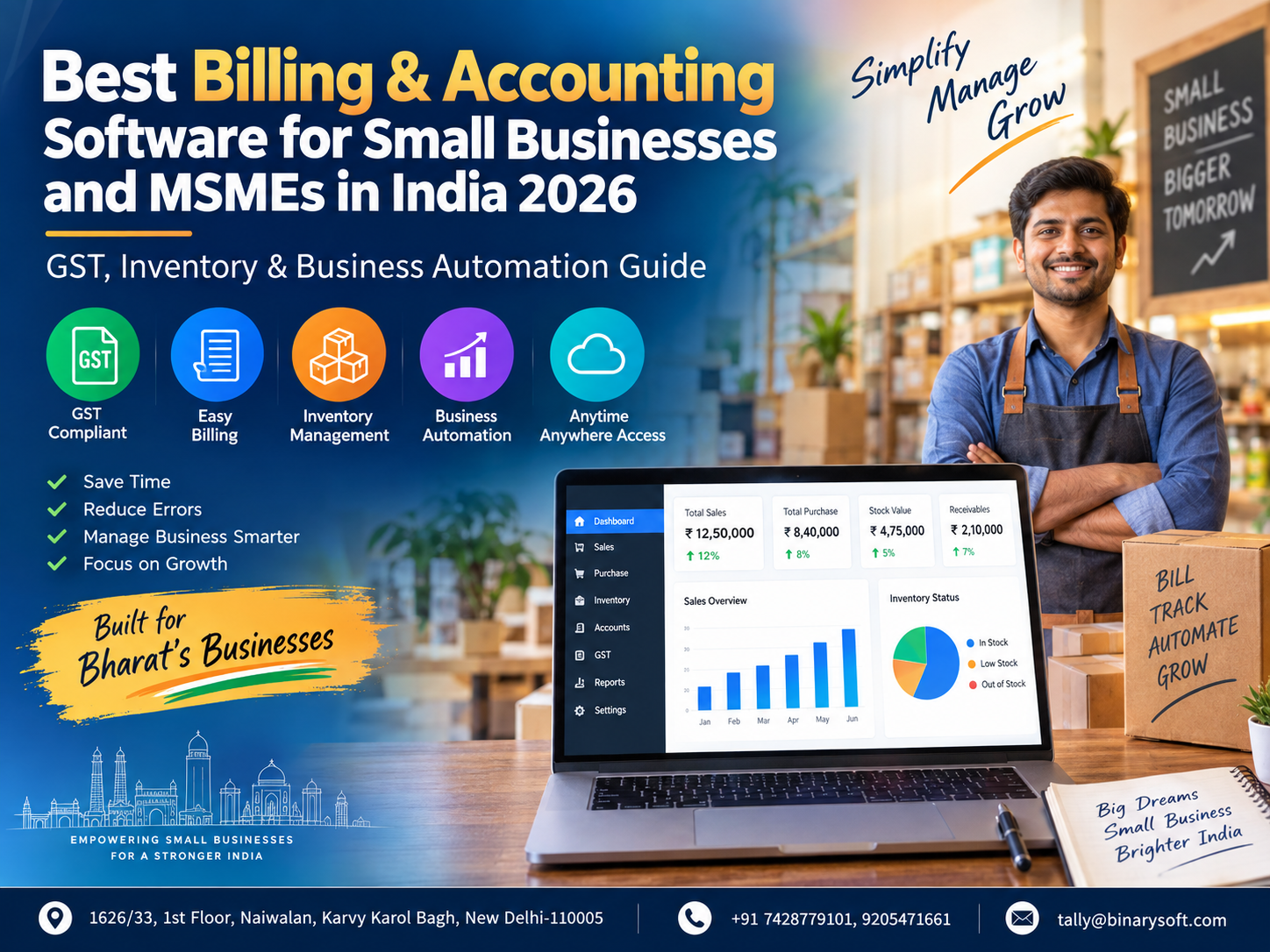
Running a small business in India in 2026 is no longer just about selling more products or finding new customers. Billing speed, GST compliance, inventory accuracy, payment tracking and access to reliable financial information have become equally important. As businesses handle more digital payments, GST invoices, e-invoices, e-way bills and growing product inventories, depending entirely on handwritten bills or disconnected spreadsheets can create unnecessary pressure. A modern billing and accounting system can bring these activities together and help owners understand what is happening in their business without waiting until month-end. For MSMEs, retailers, wholesalers, distributors, manufacturers and service businesses, the benefit is practical: faster invoicing, better stock visibility, fewer repetitive entries and more organized accounts. Choosing the right billing software in 2026 can therefore become an important step toward building a business that is easier to manage, scale and control.
Why Small Businesses Need More Than Basic Billing Software
For many small businesses, the first requirement from software is simple: create an invoice and print or share it with the customer.
But business operations rarely remain that simple.
As transaction volumes increase, an owner may need to manage customer outstanding balances, supplier payments, purchase bills, inventory, GST, bank transactions and financial reports. If every activity is maintained separately, the owner or accounting team spends significant time reconciling information.
This is why businesses increasingly look for an integrated billing and accounting solution rather than a standalone invoice generator.
Good business software should help connect:
- Sales and purchase invoicing
- GST accounting
- Inventory and stock management
- Receivables and payables
- Banking and reconciliation
- E-invoicing and e-way bill processes
- Financial accounting
- Business reports
- Customer and supplier ledgers
- Order and delivery management
The objective is not simply to generate bills faster. It is to create a more organized flow of financial and operational information.
What Is Billing Software?
Billing software is a digital system used to create invoices and maintain records of business transactions.
Modern billing solutions can go significantly beyond invoice creation. Depending on the software and configuration, businesses may be able to record purchases, maintain stock, calculate applicable taxes, track customer balances and generate accounting reports.
For an Indian MSME, billing is closely connected with accounting and GST compliance.
For example, when a sales transaction is recorded correctly, the same information may affect the customer's ledger, sales account, tax calculations, inventory quantities and financial reports.
An integrated system reduces the need to enter the same transaction repeatedly in different applications.
Why Billing and Accounting Automation Matters in 2026
Small businesses often operate with limited teams. One employee may handle sales, billing and customer collections, while another manages purchases, stock and accounting.
Manual processes can therefore consume a significant amount of productive time.
Suppose a wholesaler processes hundreds of invoices every month. If invoice information is manually transferred into spreadsheets and later entered again into accounting software, the business is effectively processing the same information multiple times.
Every repeated entry also introduces another opportunity for mistakes.
Automation can help businesses reduce these repetitive activities and maintain more consistent records.
A Small Business Owner's Story: When Growth Created a New Problem
Consider a fictional example of Rajesh, who runs a growing electrical goods distribution business.
When the business was small, Rajesh managed invoices and stock with spreadsheets. He knew most customers personally, remembered outstanding payments and could roughly estimate which products were available in the warehouse.
Then sales started growing.
More customers meant more invoices. More invoices meant more GST records, outstanding balances and stock movements.
One afternoon, an important customer placed an urgent bulk order. Rajesh's spreadsheet showed sufficient stock, so he confirmed delivery.
When his warehouse employee started packing the order, several items were unavailable.
The spreadsheet had not been updated after recent sales.
The customer was disappointed, the delivery had to be rescheduled and Rajesh realized that the system that had helped him start the business was no longer sufficient for managing its growth.
He introduced an integrated billing, accounting and inventory system.
Over time, invoicing, stock records and customer balances became connected. Instead of depending on memory and multiple spreadsheets, he could review reports before making commitments.
The important change was not simply faster billing.
It was confidence in the information he was using to make decisions.
Important Features to Look for in Billing Software
1. Fast and Professional Invoicing
Billing should be straightforward.
Businesses should be able to create invoices containing relevant customer, product, quantity, rate, discount and tax information without unnecessary complexity.
A professional invoice also improves communication with customers and makes transaction records easier to understand.
2. GST-Ready Accounting
GST is an important consideration when selecting business software in India.
Depending on the business and applicable requirements, software should help maintain GST-related transaction information such as GSTIN, HSN/SAC, tax rates, taxable values and CGST, SGST or IGST calculations.
Proper configuration and accurate source data remain essential. Software can support compliance processes, but businesses should still verify applicable tax rules with their tax professionals where required.
3. Inventory Management
For traders, retailers, distributors and manufacturers, billing and inventory are closely related.
When goods are purchased, stock increases. When goods are sold, stock decreases.
A good inventory system can help businesses monitor stock quantities, movement and availability.
Depending on requirements, businesses may also need:
- Multiple units of measurement
- Batch tracking
- Godown or warehouse management
- Reorder information
- Stock ageing
- Expiry-date management
- Item-wise profitability
- Multiple locations
Better inventory visibility can help prevent both excessive purchasing and unexpected stock shortages.
4. Receivables and Payables Management
Making a sale does not always mean receiving payment immediately.
Credit sales are common in many Indian industries, particularly wholesale and distribution.
Businesses therefore need visibility into who owes money and when payments are due.
Similarly, supplier liabilities need to be tracked carefully.
An integrated accounting system can provide customer and supplier ledgers along with outstanding reports, helping owners follow up on collections and plan payments.
5. E-Invoice and E-Way Bill Support
Businesses subject to applicable e-invoicing or e-way bill requirements should consider whether their accounting workflow can support these processes efficiently.
Integration can reduce duplicate entry and make compliance-related workflows more manageable.
Businesses should always check the latest applicability thresholds and statutory requirements because GST rules can change.
6. Financial Reports
Business owners need more than sales numbers.
They need to understand whether the business is actually making money and where funds are being used.
Useful accounting reports can include:
Balance Sheet
Profit & Loss Account
Cash Flow information
Trial Balance
Day Book
Stock Summary
Sales Register
Purchase Register
Receivables
Payables
Customer Ledger
Supplier Ledger
These reports turn everyday transactions into information that management can use.
7. Bank Reconciliation
Matching accounting records with bank transactions can become time-consuming as transaction volumes increase.
Efficient bank reconciliation helps identify differences between books and bank records and can make accounting records easier to maintain.
For businesses receiving payments through multiple banking channels, organized reconciliation becomes increasingly valuable.
8. Multiple User Access
As a business expands, a single person may no longer manage everything.
The owner, accountant, billing operator, inventory manager and other employees may need access to business information.
Software that supports multiple users and appropriate access controls can help divide responsibilities while protecting sensitive financial information.
9. Data Security and Backup
Business accounting data is extremely valuable.
Invoices, customer balances, supplier information, inventory records and years of accounting transactions should be protected through appropriate backups and security practices.
Businesses should evaluate:
- Backup procedures
- User access controls
- Password policies
- Data recovery processes
- Remote-access security
- Software updates
A backup should not be treated as optional.
Billing Software for Retail Businesses
Retail businesses need fast billing because customers expect short checkout times.
Depending on the business, useful features may include barcode billing, inventory management, multiple payment modes, discount management and item-wise reporting.
The objective should be to make the billing counter faster without compromising accounting accuracy.
Billing Software for Wholesalers
Wholesalers often manage large numbers of products and credit customers.
Their requirements may include:
- Bulk invoicing
- Customer-specific pricing
- Outstanding tracking
- Inventory control
- Order processing
- GST invoices
- Sales analysis
- Supplier management
For wholesale businesses, receivable management can be as important as invoice generation.
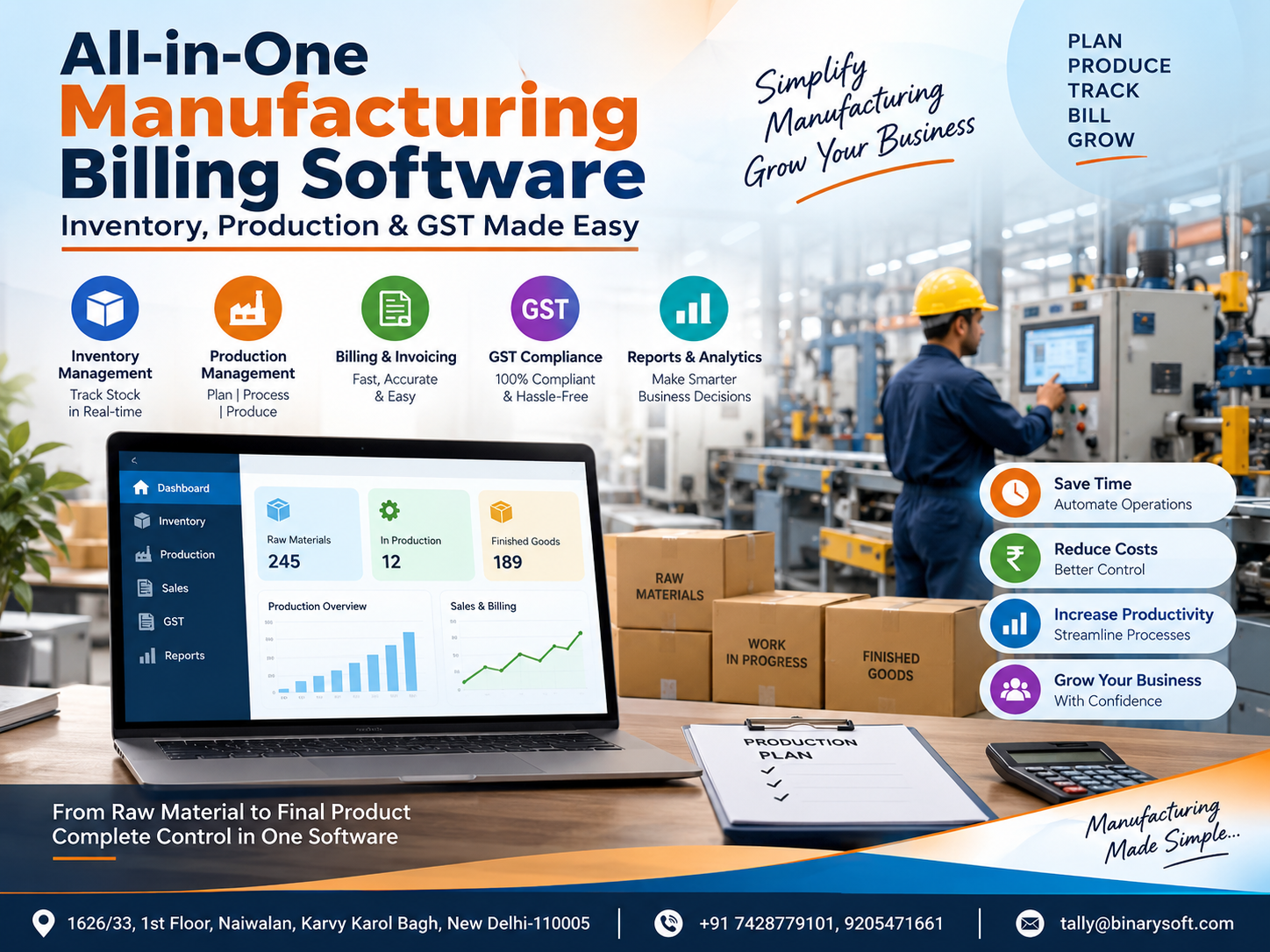
Billing and Accounting for Manufacturers
Manufacturing businesses have more complex requirements because they must track the movement from raw materials to finished goods.
Depending on their operations, manufacturers may need:
Raw material inventory
Bill of Materials (BOM)
Production entries
Finished goods
Job work
Wastage
Batch information
Cost analysis
GST invoicing
Inventory valuation
Connecting production and accounting information can give management better visibility into manufacturing operations.
Billing Software for Service Businesses
Consultants, agencies, professionals, repair businesses and other service providers may not require complex inventory management, but they still need efficient invoicing and accounting.
Useful functions can include service invoices, customer ledgers, outstanding tracking, expense recording and GST-related accounting where applicable.
Why TallyPrime Is Commonly Considered by Indian Businesses
Tally Solutions provides TallyPrime, an accounting and business-management product used by businesses for accounting, invoicing, inventory and related workflows.
For businesses evaluating TallyPrime, important considerations include the organization's transaction volume, number of users, inventory complexity, reporting requirements, deployment setup and integration needs.
The right configuration can differ significantly between a small retailer and a multi-location manufacturer.
TallyPrime for Billing and Accounting
Businesses can use TallyPrime for core accounting activities such as recording sales, purchases, receipts, payments and other transactions.
The advantage of maintaining billing and accounting within the same environment is that businesses can reduce disconnected records.
Instead of creating a bill in one application and subsequently entering it into accounting records, an integrated workflow can keep financial information connected from the beginning.
TallyPrime and Inventory Management
Businesses dealing with physical products can maintain stock-related information alongside accounting records.
This can help management review inventory positions while also understanding the financial impact of transactions.
For businesses with more advanced requirements, the implementation should be planned according to product structure, warehouses, units, manufacturing processes and reporting requirements.
Moving from Excel-Based Billing to Integrated Accounting
Excel remains extremely useful for analysis, calculations and many business processes.
The problem begins when businesses depend on multiple disconnected spreadsheets as their primary accounting system.
One spreadsheet may contain sales.
Another contains purchases.
Another maintains customer outstanding amounts.
Another tracks inventory.
When information changes, every relevant file must be updated correctly.
An integrated accounting system can create a more centralized transaction record.
Businesses migrating from spreadsheets should first clean and organize their existing master and transaction data rather than importing everything without verification.
Cloud Access for Growing Businesses
Some organizations also require remote access to accounting information.
A properly configured remote or cloud environment can allow authorized users to work from different locations.
This can be useful for owners, accountants and distributed teams, but security, licensing, backups, internet reliability and access controls should be evaluated before implementation.
How to Choose the Best Billing Software for Your Business
There is no single configuration that is appropriate for every MSME.
Before selecting software, ask:
How many invoices do we generate each month?
How many users need access?
Do we maintain inventory?
Do we manufacture products?
Do we sell on credit?
Do we need multiple warehouses?
Do we require GST-related features?
Do we need e-invoicing or e-way bill workflows?
Do we sell through marketplaces or e-commerce platforms?
Do we require remote access?
Do we need customized reports or integrations?
Do we need to import information from Excel or other applications?
Answers to these questions make software selection much easier.
Avoid Choosing Software Only on Price
Low-cost software may initially appear attractive, but price should not be the only factor.
Businesses should consider the total value of the solution, including:
Ease of use
Accounting capabilities
Inventory requirements
Compliance features
Data security
Implementation support
Training
Upgrade options
Scalability
Integration possibilities
Support availability
The cheapest application can become expensive if employees spend hours manually correcting information or moving data between systems.
Benefits of Integrated Billing and Accounting
A properly implemented system can help businesses achieve several practical improvements.
Billing can become faster.
Inventory information can become easier to review.
Outstanding customer balances can become more visible.
GST-related records can become more organized.
Accounting reports can be generated from transaction data.
Duplicate data entry can be reduced.
Management can access better information for everyday decision-making.
For an MSME, these small operational improvements can accumulate into significant time savings.
From Billing Software to Business Management
The biggest change businesses should consider in 2026 is moving beyond the idea that accounting software belongs only to the accountant.
Financial and operational information affects almost every important business decision.
Should you purchase more inventory?
Which customers have large outstanding balances?
Which products are moving slowly?
How much has the business sold this month?
What payments are due?
What does the current stock position look like?
Accurate accounting and inventory records make these questions easier to answer.
Implementation Is Just as Important as Software Selection
Buying software does not automatically improve business processes.
The implementation needs to be planned correctly.
Product masters should be organized.
Customer and supplier information should be verified.
Opening balances need to be checked.
Tax settings need to be configured appropriately.
Inventory units and groups should be structured according to actual business operations.
Users also need training.
A carefully planned implementation can prevent many problems later.
Why MSMEs Should Think About Scalability
A business may currently generate only a few invoices each day, but that could change quickly.
New branches, more employees, additional warehouses, online sales and manufacturing operations can create new requirements.
Software should therefore be evaluated not only for today's workload but also for expected growth.
Changing an accounting system after years of transactions can be more complicated than selecting a scalable solution early.
Conclusion
The best billing software for a small business or MSME in India is not simply the application that creates the fastest invoice. It should support the broader financial and operational requirements of the business.
In 2026, businesses increasingly need connected billing, accounting, GST-related workflows, inventory control, receivable tracking and meaningful financial reporting.
Solutions such as TallyPrime can be considered by businesses that want billing and accounting capabilities within an integrated business-management environment. The appropriate setup, however, depends on the organization's size, industry, users, transaction volume and operational requirements.
For small businesses, the goal should be straightforward: reduce repetitive work, maintain accurate records and make important business information easier to access.
A well-planned billing and accounting system can help achieve exactly that.
Frequently Asked Questions
Which billing software is suitable for small businesses in India?
The appropriate software depends on the business's requirements, including GST, inventory, number of users, transaction volume, reporting and accounting needs. Businesses should compare these requirements before selecting a solution.
Can billing software also manage accounting?
Many business-management solutions combine billing with accounting. This allows sales, purchases, receipts, payments and other transactions to contribute to the accounting records without maintaining completely separate systems.
CA. Vivaan Deshmukh focuses on financial reporting, audit procedures, and taxation. He shares practical insights on accounting software, business process optimization, and compliance management for SMEs and growing enterprises.