Call CA Tally HelpDesk
+91 9205471661,
7428779101
What Changed in 2026? Manufacturing Businesses Need More Than Basic Billing
In 2026, manufacturing businesses are dealing with a much bigger challenge than simply creating invoices. Rising raw-material costs, tighter margins, GST compliance, production planning, stock accuracy, e-invoicing and faster customer deliveries are putting constant pressure on manufacturers. When purchasing, production, inventory, accounting and billing are maintained separately, even a small data-entry mistake can affect stock valuation, production costs and profitability. This is why manufacturers are increasingly looking for an all-in-one manufacturing billing software solution that connects the entire workflow. From purchasing raw materials and recording production to tracking finished goods, generating GST invoices and reviewing business reports, an integrated system can reduce repetitive work and provide better control over operations. The biggest benefit is visibility: owners can understand what is being produced, what is available in stock, what has been sold and where money is being spent without depending on multiple disconnected records.
Manufacturing Has Changed: Your Billing System Should Change Too
Manufacturing is no longer only about producing goods efficiently. Modern manufacturers must simultaneously manage inventory, taxation, accounting, customers, suppliers, production schedules and regulatory requirements.
A business may purchase hundreds of raw materials, transform them through multiple production stages and finally sell dozens or even thousands of finished products.
Every stage generates financial and inventory information.
If these records are maintained manually or across separate Excel sheets and software applications, the business can face problems such as inaccurate stock balances, duplicate data entry, incorrect production costs, delayed invoicing and difficulties during GST reconciliation.
An all-in-one manufacturing billing and accounting system brings these activities together.
Instead of treating billing as the final isolated activity, businesses can connect the complete journey:
Raw Material Purchase → Inventory → Production → Finished Goods → Sales → GST Invoice → Accounting → Reporting
This integrated approach can make everyday manufacturing operations easier to control.
What Is All-in-One Manufacturing Billing Software?
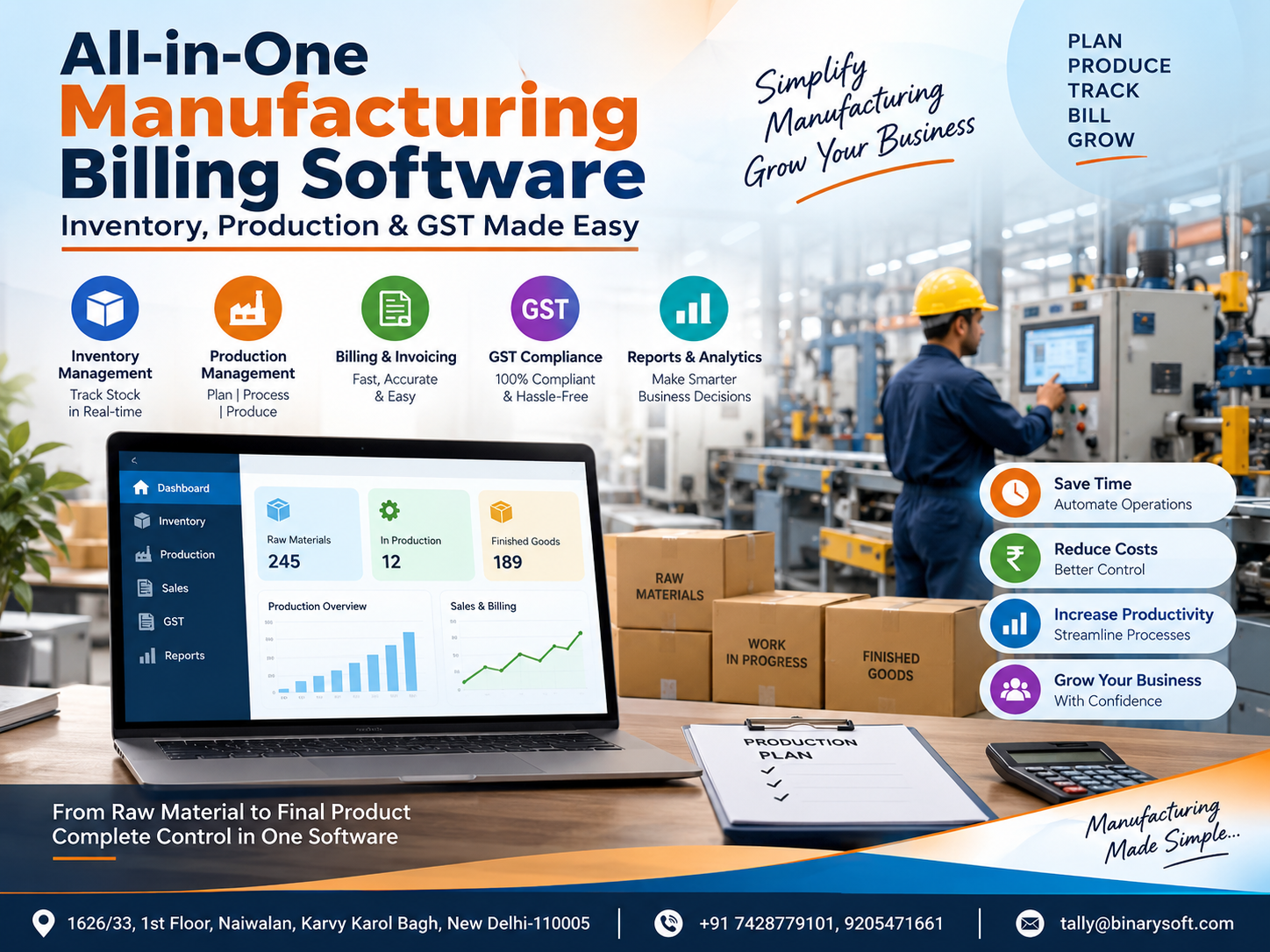
All-in-one manufacturing billing software is a business management solution designed to handle billing together with inventory, production and accounting processes.
Unlike a simple invoice-generation application, manufacturing-focused software should help businesses track the movement of materials from purchase through production and finally to sale.
For example, suppose a manufacturer purchases aluminium sheets, screws, electrical components and packaging material.
These materials enter raw-material inventory.
When production begins, quantities are consumed according to the manufacturing process or Bill of Materials. Finished products are then added to inventory.
When those products are sold, the appropriate finished-goods stock is reduced and the sales transaction is recorded.
With a properly configured integrated accounting environment, businesses can maintain significantly better control over this entire cycle.
Why Manufacturers Need Integrated Billing in 2026
A manufacturing company typically handles three important operational areas simultaneously: materials, production and money.
If these areas are disconnected, management may not have a reliable picture of business performance.
Imagine that your accounting system shows strong sales, but the production department has excessive material wastage.
Alternatively, your warehouse may show sufficient inventory in a spreadsheet while actual stock is significantly lower.
The result can be delayed production, urgent purchasing and reduced margins.
An integrated manufacturing billing system can help create a single operational workflow where purchases, material consumption, production, stock and sales transactions are recorded systematically.
That can help business owners make decisions based on better-organized information instead of estimates.
From Raw Material to Final Invoice: Understanding the Complete Workflow
Step 1: Raw Material Purchasing
Manufacturing begins with procurement.
Businesses purchase raw materials from different suppliers and need to maintain details including:
Supplier information
Purchase quantity
Purchase rate
GST details
Batch or material information where applicable
Outstanding supplier balances
Purchase history
Accurate purchasing records provide the foundation for inventory and production management.
If raw-material purchases are incorrectly entered, stock balances and subsequent reporting can also become inaccurate.
Step 2: Raw Material Inventory Management
After purchasing, businesses need to know exactly what materials are available.
This sounds straightforward, but it becomes complicated when hundreds or thousands of stock items are involved.
Manufacturers may need visibility into opening stock, purchases, consumption, closing stock, warehouse location, units of measurement and reorder requirements.
Proper inventory management helps answer practical questions:
How much material is currently available?
Which materials are running low?
Which products are consuming the most material?
What should be purchased before the next production cycle?
How much money is tied up in inventory?
These questions become particularly important when raw-material prices fluctuate.
Step 3: Bill of Materials Management
A Bill of Materials, commonly called BOM, defines the materials required to manufacture a finished product.
For example, suppose a company manufactures office chairs.
A simplified BOM might include:
Metal frame
Seat cushion
Backrest
Armrests
Wheels
Fasteners
Packaging material
When 100 chairs are manufactured, the system should help account for the corresponding consumption of these components.
A structured BOM reduces dependency on manual calculations and provides better consistency in production records.
Step 4: Production Recording
Production is where raw materials become finished products.
An efficient manufacturing accounting setup should make it possible to record material consumption and finished-goods production.
Depending on the business and software configuration, manufacturers may also need to account for scrap, wastage, by-products or additional production costs.
This provides management with a clearer view of what has actually happened on the factory floor.
Step 5: Finished Goods Inventory
Once production is completed, finished goods need to be reflected correctly in inventory.
This helps sales and management teams understand:
Products available for sale
Current stock quantities
Stock movement
Fast-moving products
Slow-moving products
Finished goods requiring replenishment
Without reliable finished-goods information, a sales team may accept an order without knowing whether sufficient stock is actually available.
Step 6: GST Billing
When finished products are sold, businesses need to generate appropriate tax invoices.
Depending on the transaction and applicable GST requirements, invoices may involve details such as GSTIN, HSN/SAC information, taxable value, tax rates, CGST, SGST or IGST.
For eligible transactions, businesses may also need to meet applicable e-invoicing and e-way bill requirements.
The exact compliance requirement depends on the nature of the business, transaction and rules applicable at that time.
Businesses should therefore configure their accounting environment according to current GST requirements and seek professional advice where necessary.
A Manufacturer's Story: When Growing Sales Created a Bigger Problem
Consider a fictional manufacturer named Arjun who operates a growing electrical components business.
For years, his company managed operations through spreadsheets.
One employee maintained purchases. Another maintained finished-goods stock. Production details were recorded separately, while the accountant entered invoices into accounting software.
When the business was small, this arrangement appeared manageable.
Then orders started increasing.
That should have been good news.
Instead, every month-end became stressful.
The warehouse reported one stock quantity, the spreadsheet showed another and the accounting records showed something different again.
One Friday evening, Arjun received an urgent call from an important customer asking whether a large order could be dispatched on Monday.
His spreadsheet showed enough finished goods.
He confirmed the order.
On Saturday morning, the production manager called him.
Actual stock was far lower than the spreadsheet indicated.
Several units shown as available had already been dispatched against earlier orders, but the spreadsheet had not been updated.
Arjun had to arrange emergency production, purchase material at a higher rate and ask employees to work additional hours.
The order eventually went out, but the experience changed the way he looked at business software.
His biggest problem was not sales.
It was visibility.
After moving towards an integrated system for purchasing, inventory, production, billing and accounting, his team no longer had to repeatedly ask, "Which number is correct?"
That is the real value of manufacturing automation: not simply faster billing, but greater confidence in the information used to run the business.
Inventory Management: The Backbone of Manufacturing
Inventory is one of the largest working-capital components for many manufacturers.
Too little stock can interrupt production.
Too much stock can block cash.
That is why manufacturers need visibility into both raw materials and finished products.
Raw Material Tracking
Manufacturers should be able to monitor material receipts, consumption and balances.
This can help procurement teams identify shortages before they interrupt production.
Finished Goods Tracking
Production without sales creates inventory.
Sales without sufficient production create shortages.
Tracking finished-goods inventory helps businesses maintain a better balance between these two situations.
Multiple Units of Measurement
Manufacturing businesses may purchase and consume materials using different units such as kilograms, metres, litres, pieces, boxes or tonnes.
A properly configured inventory structure is important for maintaining meaningful quantities.
Godown and Location Management
Businesses operating multiple warehouses or storage locations may need location-wise inventory information.
This allows management to determine where stock is physically available rather than looking only at total company-level inventory.
Production Management Made Easier
Production management becomes difficult when records are maintained manually.
An integrated system can help manufacturers establish a more structured process.
Material Consumption
Every production activity consumes materials.
Recording this consumption helps ensure that raw-material balances reflect actual production activity.
Finished Goods Creation
As raw materials are consumed, finished products are produced.
Recording both sides of this movement provides a clearer picture of inventory.
Scrap and Wastage
Manufacturing rarely operates with zero waste.
Depending on the industry, businesses may generate scrap, defective units, process losses or reusable by-products.
Tracking these items can help management understand production efficiency and potential cost leakage.
Production Cost Visibility
Manufacturers ultimately need to understand what it costs to make a product.
Material cost is an important component, but businesses may also consider labour, electricity, machinery, packaging and overheads depending on their costing methodology.
Better records make these calculations easier to analyse.
GST Billing for Manufacturing Businesses
GST compliance is a major component of manufacturing accounting in India.
Manufacturers need properly maintained transaction data for purchases and sales, along with appropriate tax treatment.
An integrated accounting system can reduce repeated data entry because transaction information recorded during normal operations can also support tax-related reporting.
CGST, SGST and IGST
The applicable tax structure depends on the nature and place of supply of a transaction.
Generally, intra-state and inter-state transactions are treated differently under GST.
Businesses should ensure that customer, supplier and tax information is configured correctly.
HSN Details
Manufacturers commonly deal with multiple products and product classifications.
Maintaining correct HSN information helps support accurate invoicing and GST reporting.
E-Invoicing
Businesses covered by applicable e-invoicing requirements need to generate invoices according to the prescribed process.
An accounting environment capable of supporting the required workflow can reduce manual intervention.
E-Way Bill
Movement of goods may require an e-way bill when applicable conditions are met.
Connecting billing and dispatch-related information can simplify the operational process.
Because GST rules, thresholds and procedures can change, manufacturers should verify current requirements through official sources or their tax professionals rather than relying on old configurations.
TallyPrime for Manufacturing Businesses
TallyPrime can be configured for many accounting and inventory requirements commonly encountered by manufacturing businesses.
Depending on business requirements and configuration, companies can use TallyPrime for areas such as accounting, inventory management, purchase and sales recording, GST-related workflows, manufacturing journal processes, BOM-based inventory movements and financial reporting.
The important point is configuration.
Installing accounting software alone does not automatically create an efficient manufacturing system.
The business first needs to define:
Stock groups
Stock categories where required
Stock items
Units of measurement
Godowns or locations
Raw materials
Finished goods
BOM structures
GST details
Ledger structure
Voucher processes
User responsibilities
Once these foundations are properly designed, day-to-day recording becomes much more systematic.
Benefits of All-in-One Manufacturing Billing Software
1. Less Duplicate Data Entry
When departments maintain separate records, the same transaction may be entered multiple times.
Integrated workflows can reduce this duplication.
2. Better Stock Accuracy
Recording purchases, consumption, production and sales systematically can improve inventory visibility.
3. Faster Billing
Product, customer and taxation information can be organized beforehand, making routine invoice creation more efficient.
4. Better Production Control
Manufacturers can compare material consumption and production activity more systematically.
5. Improved GST Data Management
Structured transaction records can make GST-related reporting and reconciliation easier.
6. Better Financial Visibility
Manufacturing operations ultimately affect financial performance.
Integrated accounting allows management to connect operational activity with financial results.
7. Reduced Dependency on Spreadsheets
Excel remains extremely useful for analysis and reporting, but maintaining the entire manufacturing transaction cycle through disconnected spreadsheets can create control problems as transaction volumes increase.
8. Faster Business Decisions
Management can make better decisions when reliable inventory, sales, purchasing and accounting information is available quickly.
Reports Every Manufacturer Should Review
Software becomes valuable when recorded data is converted into useful information.
Manufacturers should regularly review relevant reports covering stock summaries, sales, purchases, receivables, payables and financial performance.
Depending on the accounting setup, additional analysis can help management understand material movement, product performance, inventory levels and business profitability.
A dashboard full of numbers is not enough.
The objective is to identify exceptions.
Which stock item is unusually high?
Which customer has delayed payment?
Which supplier balance is due?
Which product has strong sales but weak margins?
Which raw material requires replenishment?
These are the questions that transform accounting data into business decisions.
Manufacturing Billing Software for Small Businesses
Small manufacturers often assume integrated software is required only by large factories.
That is not necessarily the case.
A small manufacturer may have fewer employees but can face the same fundamental challenges: raw-material purchasing, inventory control, production, GST billing, customer outstanding balances and profitability.
In fact, structured processes can become particularly valuable when the owner personally handles several responsibilities.
Instead of repeatedly calling employees for stock information, the owner can rely on properly maintained business records.
Manufacturing Billing Software for Growing Businesses
As transaction volumes increase, weaknesses in manual systems become more visible.
A company processing 20 invoices per month may comfortably use spreadsheets for several activities.
At 500 or 5,000 transactions, the same process can become difficult to control.
Growing manufacturers should therefore think about scalability.
The question should not simply be:
"Can this software create an invoice?"
A better question is:
"Can this system support our purchasing, inventory, production, GST, accounting and reporting requirements as the company grows?"
Moving from Excel to an Integrated Manufacturing System
Many businesses already have years of information in Excel.
Moving towards integrated accounting does not mean spreadsheets suddenly become useless.
Excel can continue to play an important role in analysis, management reporting and data preparation.
The objective is to avoid using disconnected spreadsheets as the primary transaction system when the business requires tighter controls.
Before migration, businesses should review and clean:
Customer masters
Supplier masters
Stock items
Units
Opening balances
GST details
HSN information
Outstanding receivables
Outstanding payables
Opening inventory
Clean master data is critical.
Automating inaccurate data only creates inaccurate information faster.
How to Choose Manufacturing Billing Software
Before selecting or configuring a solution, businesses should map their actual workflow.
Do not start with software features.
Start with operations.
Understand how material enters the business, how it moves through production, how finished products are stored, how orders are processed and how invoices are generated.
Then determine the software capabilities required to support those processes.
Important areas to examine include inventory management, BOM requirements, production entries, GST billing, e-invoicing requirements, reporting, user access, data backup and scalability.
Businesses should also consider implementation and after-sales support.
Manufacturing accounting can require careful configuration, particularly when the company has multiple product lines or complex inventory structures.
Why Implementation Matters as Much as Software
Two manufacturers using the same accounting product can have completely different experiences.
Why?
Because configuration and implementation matter.
If stock items are poorly structured, reports may become difficult to interpret.
If GST information is incorrectly configured, billing problems may occur.
If employees are not trained, they may continue maintaining parallel spreadsheets.
A successful implementation should therefore include workflow understanding, master-data planning, software configuration, testing, user training and post-implementation support.
The Future of Manufacturing Accounting
Manufacturing businesses are gradually moving toward more connected operations.
Accounting is becoming less isolated from production and inventory.
Management increasingly expects near-real-time visibility instead of waiting until month-end to understand what happened.
Automation can also reduce repetitive work, allowing employees to spend more time reviewing exceptions and less time copying information between systems.
The manufacturers that benefit most will not necessarily be those purchasing the most complicated software.
They will be businesses that create disciplined processes and use technology to connect them.
One System, Better Control
The strongest reason to adopt all-in-one manufacturing billing software is not simply convenience.
It is control.
Management needs to know:
What did we purchase?
What material is available?
What did we consume?
What did we manufacture?
What did we sell?
What is outstanding?
What taxes need attention?
Are we making money?
When these questions can be answered through a structured accounting and inventory system, owners gain a much clearer understanding of their businesses.
Conclusion
Manufacturing businesses in 2026 need much more than basic invoice software. Inventory, purchasing, production, GST billing, accounting and reporting are interconnected activities, and managing them through disconnected systems can create unnecessary complexity.
An all-in-one manufacturing billing solution can help businesses create a structured flow from raw-material purchasing to production, finished-goods inventory and final customer billing.
For businesses using TallyPrime, thoughtful configuration of accounting, inventory, BOM, manufacturing and GST-related processes can create a more organized operating environment.
Technology alone, however, is not the solution. Accurate master data, well-defined processes, proper implementation and employee training are equally important.
The objective is simple: reduce repetitive work, improve visibility and give management reliable information for everyday business decisions.
Powered by Binarysoft Technologies
Authorized Tally Partner
Location: 1626/33, 1st Floor, Naiwalan, Karol Bagh, New Delhi – 110005, INDIA
Contact us: +91 7428779101, 9205471661
Email us: tally@binarysoft.com
Working Hours: 10:00 AM – 6:00 PM, Mon–Fri
Frequently Asked Questions
What is manufacturing billing software?
Manufacturing billing software combines invoicing with business functions such as inventory, purchasing, production and accounting. Depending on the solution and configuration, it can help track materials from purchase through manufacturing and final sale.
Can TallyPrime be used for manufacturing businesses?
TallyPrime can support accounting and inventory processes commonly required by manufacturing businesses. Depending on the business workflow and configuration, manufacturers can maintain raw materials, finished goods, BOM-related processes, manufacturing entries, purchases, sales and GST-related records.
CA. Harshit Gaurwaadi is a practicing Chartered Accountant with hands-on experience in accounting systems, GST compliance, and MSME advisory. He regularly works with small and mid-sized businesses to streamline inventory, billing, and statutory processes using modern accounting software. His articles focus on practical, ground-level challenges faced by Indian traders and professionals.