Call CA Tally HelpDesk
+91 9205471661,
7428779101
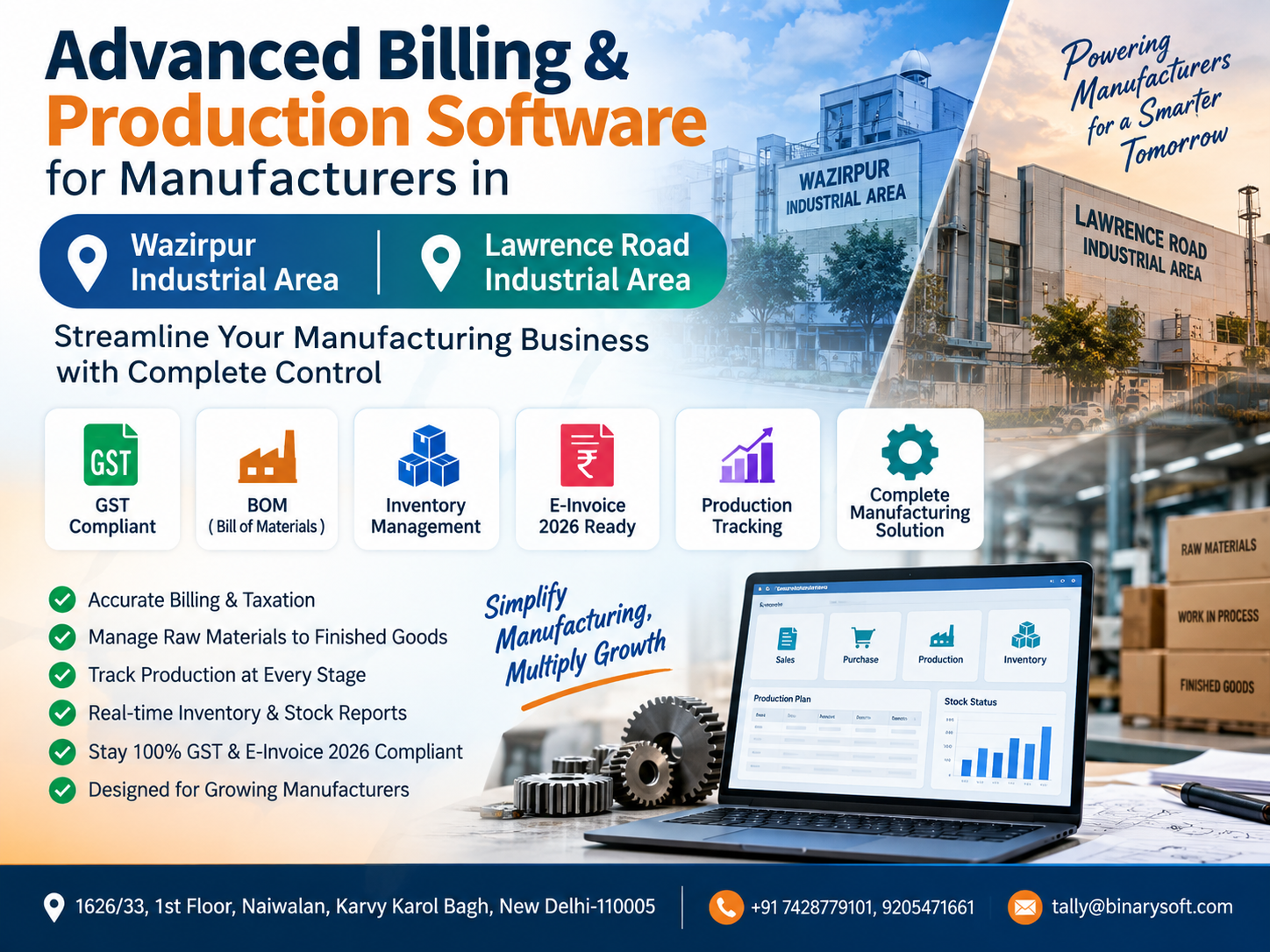
What Changed for Manufacturers in 2026?
Manufacturing businesses in Wazirpur Industrial Area and Lawrence Road Industrial Area are entering 2026 with greater pressure to control production costs, maintain accurate inventory, manage GST-compliant billing and keep financial data ready for faster business decisions. When raw materials, work-in-progress, finished goods, purchase orders and sales invoices are maintained separately, even a small mismatch can affect production planning and profitability. The opportunity is equally significant: an integrated billing and production system can connect BOM-based manufacturing, stock consumption, GST invoicing, e-invoicing and accounting within a structured workflow. Instead of spending hours reconciling spreadsheets and registers, manufacturers can obtain clearer visibility into material usage, finished stock, outstanding payments and production costs. For growing manufacturing units in Delhi, 2026 is therefore not simply about replacing manual billing—it is about building a connected financial and production process that can scale with the business.
Manufacturing Businesses Need More Than Basic Billing Software
Manufacturing accounting is very different from simple retail billing.
A trader may primarily purchase finished goods and sell them to customers. A manufacturer, however, needs to track raw materials, components, semi-finished goods, finished products, wastage, production quantities, purchase costs and sales.
Consider a manufacturing unit that purchases steel sheets, electrical components, packaging materials and accessories to produce finished products. Recording only the purchase and final sales invoice does not provide sufficient information to understand what happened inside the factory.
Management may need answers to questions such as:
How much raw material was consumed?
What quantity was produced?
How much material is currently available?
Which components are running below required stock levels?
What was the approximate cost of production?
How much finished stock is available for dispatch?
Which customers have outstanding payments?
Are GST invoices being generated correctly?
Does a transaction require an e-invoice?
This is where advanced accounting, billing, inventory and production management become important.
Manufacturing Challenges in Wazirpur Industrial Area
Wazirpur Industrial Area is home to a wide variety of manufacturing, processing, fabrication and trading businesses. Depending on the nature of the unit, businesses may handle metals, machinery, components, industrial goods, consumer products and numerous other materials.
As transaction volumes increase, manufacturers frequently face difficulties maintaining accurate records of material movement.
For example, the physical warehouse may show 500 units of a component while accounting records show 540. Another production batch may have consumed more material than expected, but that difference might remain unnoticed until month-end stock verification.
Such discrepancies can create several problems.
Purchase decisions may be based on incorrect stock quantities. Production may be delayed because an important component is unavailable. Excess purchasing can unnecessarily block working capital. Incorrect finished-goods quantities can also create problems when customers place urgent orders.
A properly configured inventory and manufacturing accounting system helps connect these activities.
Lawrence Road Industrial Area Manufacturers Need Connected Data
Businesses operating around Lawrence Road Industrial Area also work in a competitive environment where speed matters.
Customers increasingly expect quick quotations, accurate GST invoices and timely dispatches. At the same time, owners need better control over purchases, production, inventory and receivables.
When departments operate through separate spreadsheets, communication gaps can develop.
The purchase team may have one stock figure.
The production team may maintain another register.
The accounts department may have different quantities in accounting software.
The sales team may promise delivery based on outdated stock information.
Integrated business software reduces these information gaps by maintaining transactions within a common accounting and inventory framework.
From Raw Material Purchase to Final Invoice
A well-designed manufacturing workflow can connect the complete business cycle.
The process can begin when raw materials are purchased from suppliers. The purchase transaction updates inventory and supplier accounts.
Materials are subsequently issued for production.
Based on the configured Bill of Materials, required components can be consumed against the production of finished goods.
After manufacturing is recorded, finished-goods inventory increases.
When goods are sold, a GST-compliant sales invoice is generated, stock is reduced and the customer's receivable is updated.
Where applicable, e-invoice information can also form part of the invoicing workflow.
This creates a connected cycle:
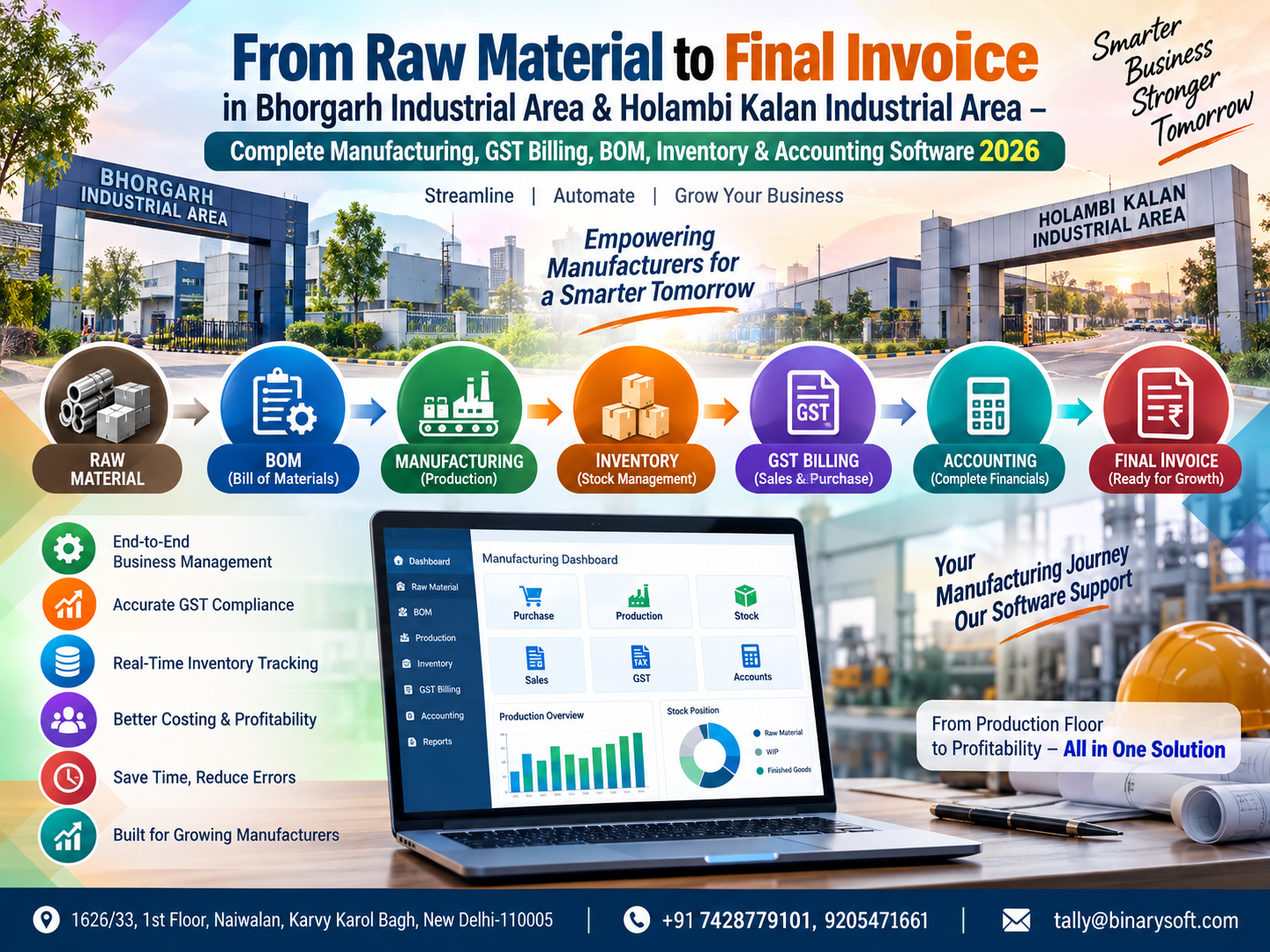
Purchase → Raw Material Inventory → Production → Finished Goods → GST Invoice → Dispatch → Receivable → Accounting Reports
The major advantage is continuity of information.
Instead of repeatedly entering the same transaction into separate systems, businesses can maintain a structured flow of data.
BOM Management: The Foundation of Production Control
Bill of Materials, commonly known as BOM, is an important concept for manufacturing businesses.
A BOM defines the materials or components required to manufacture a particular finished product.
Suppose a manufacturer produces an industrial product called Product A.
To manufacture one unit, the business may require:
2 units of Component X
4 units of Component Y
1 unit of Component Z
Packaging material
Additional consumable material
This combination can be defined as the Bill of Materials.
When production is recorded, the relevant raw materials can be consumed according to the configured manufacturing process while finished stock is created.
Why BOM Matters
Without a structured BOM, material consumption may depend heavily on manual entries.
That makes it harder to compare expected consumption with actual usage.
BOM-based production records can help manufacturers achieve better consistency in material tracking, production planning and stock control.
It can also help management identify situations where material consumption is unexpectedly high.
For manufacturers working with multiple products and components, this becomes increasingly valuable as production volumes grow.
A Story from the Factory Floor: When One Missing Component Stopped an Entire Order
A manufacturing business had received an important customer order that needed to be dispatched quickly.
According to the spreadsheet maintained by the office, sufficient raw material was available.
The production manager confidently scheduled the job.
Workers prepared the machines and production started.
Then the team discovered that one small but essential component was almost finished.
The spreadsheet showed enough quantity. The actual rack did not.
Production stopped.
The purchasing team immediately contacted suppliers, but same-day delivery was unavailable. The customer was waiting, employees were waiting and the owner was trying to understand how a component worth relatively little could delay an entire order.
The problem was not simply shortage of stock.
It was lack of visibility.
After the business began maintaining purchases, consumption, production and finished goods through a more structured inventory process, the owner could review stock levels before committing to production schedules.
That change brought something more valuable than another report: confidence.
The team could plan orders using information that was far closer to the actual movement of materials.
Real-Time Inventory Management for Manufacturers
Inventory is working capital.
Every unnecessary carton, component or kilogram of raw material sitting unused in a warehouse represents money that cannot currently be used elsewhere.
At the same time, insufficient inventory can interrupt production.
Manufacturers therefore need a balance between overstocking and stock-outs.
An effective inventory management setup can help businesses monitor:
Raw material stock
Finished goods
Semi-finished goods, where applicable
Stock groups and categories
Godown or warehouse-wise inventory
Batch-related information where relevant
Units of measurement
Purchase and consumption quantities
Sales and dispatch quantities
Reorder requirements
Stock valuation
Slow-moving items
The objective is not merely to know how much stock exists. The real objective is to understand how inventory is moving through the business.
GST Billing for Manufacturing Businesses
GST billing remains an essential part of day-to-day operations for registered manufacturers.
A properly configured accounting system can help maintain transaction information such as GSTIN, HSN/SAC details where applicable, taxable value and relevant tax components.
Depending on the transaction, businesses may need to account for CGST and SGST or IGST.
Correct configuration at the ledger, stock item and transaction level is therefore important.
Manufacturers should also periodically review GST configurations and transaction data rather than assuming that every invoice is automatically correct simply because it was generated through software.
The quality of the output still depends heavily on the accuracy of the underlying masters and transaction entries.
E-Invoicing and Manufacturing Operations
For businesses covered by applicable e-invoicing requirements, invoice generation involves more than preparing a normal sales document.
The accounting workflow should support the information required for the e-invoicing process and help businesses maintain relevant invoice references in their records.
For manufacturers handling high transaction volumes, an integrated workflow can reduce the need to repeatedly enter invoice information across separate systems.
This is especially useful when production, billing and dispatch happen continuously throughout the day.
Businesses should verify their current applicability and compliance requirements based on the latest GST rules applicable to their organisation.
Better Production Planning Through Inventory Visibility
Production planning becomes difficult when stock information is unreliable.
Suppose a manufacturer receives orders for 2,000 finished units.
Before committing to a delivery date, management should know whether sufficient raw materials are available.
If the BOM requires four units of a particular component for every finished product, production of 2,000 units could require 8,000 units of that component.
Accurate inventory information allows the business to compare this requirement with current stock and pending purchases.
This helps purchasing and production teams coordinate more effectively.
The result can be fewer emergency purchases, better scheduling and improved ability to meet customer commitments.
Purchase Management and Supplier Control
Manufacturing operations depend heavily on suppliers.
A delay in one important material can affect an entire production schedule.
Accounting and inventory software can help businesses maintain supplier transactions, purchase records, outstanding balances and material receipts in a structured manner.
Management can then review purchasing patterns and outstanding liabilities alongside production requirements.
This provides better visibility into both inventory and cash flow.
Finished Goods Management
Manufacturing does not end when production is completed.
Finished products must be stored, invoiced and dispatched.
Businesses need to know exactly what is available for sale and what has already been committed to customers.
Maintaining finished goods within the same inventory environment as raw materials helps management see the complete stock position.
It can also reduce the risk of accepting orders based on outdated information.
Manufacturing Cost Visibility
A manufacturer can achieve strong sales and still face margin pressure if production costs are not monitored properly.
Raw material prices may increase.
Wastage may rise.
Purchase costs can change.
Certain products may consume more resources than expected.
Although detailed costing requirements vary considerably between manufacturers, maintaining structured accounting and production data creates a stronger foundation for cost analysis.
Management can use this information to review whether product pricing remains commercially sustainable.
Multi-Godown and Location-Based Inventory
Some manufacturers maintain raw materials and finished goods at different physical locations.
For example, one location may store raw materials while another holds finished goods ready for dispatch.
Without location-wise stock tracking, management may know that 1,000 units exist overall but may not know where those units are physically stored.
Godown-wise inventory records can provide greater clarity.
This is particularly useful for businesses expanding beyond a single warehouse or production location.
Reduce Duplicate Data Entry
Duplicate data entry is one of the hidden costs of manual business processes.
A sales team prepares an invoice in one application.
Accounts enters it again.
Inventory is updated separately.
GST information is maintained elsewhere.
Management finally combines everything in Excel.
Every additional entry creates another opportunity for error.
Integrated accounting and inventory workflows reduce unnecessary duplication by allowing one transaction to update multiple related records according to the system configuration.
TallyPrime for Manufacturing and Accounting Workflows
TallyPrime can be configured to support accounting, inventory, taxation and manufacturing-related workflows for many businesses.
For manufacturers, the appropriate configuration depends on the nature of production, number of products, raw-material structure, warehouse requirements, billing process and reporting expectations.
A carefully planned implementation may include inventory masters, units, godowns, BOM structures, manufacturing entries, purchase and sales processes, GST configuration and reporting.
The key is configuration.
Simply installing accounting software does not automatically create an efficient manufacturing process. Masters, workflows and user practices need to reflect how the business actually operates.
Why Manufacturers Should Avoid Uncontrolled Excel Dependency
Excel remains extremely useful for analysis and reporting, but problems can arise when it becomes the only source of operational inventory information.
Multiple copies of spreadsheets can exist.
Someone may forget to update a quantity.
A formula may be overwritten.
Two employees may maintain different versions.
Production consumption may be recorded late.
These issues become more serious as transaction volume grows.
Manufacturers can instead maintain core transactions in an accounting and inventory system and use Excel where additional analysis or customized reporting is required.
Management Reports That Matter
Business owners should not have to wait until year-end to understand what is happening inside their company.
Regular reports can provide visibility into sales, purchases, stock, outstanding receivables, payables and profitability-related information.
For manufacturing businesses, stock and production information can be particularly valuable.
Management can review which materials are available, which items need purchasing, what finished stock exists and where money is tied up.
This supports faster operational decisions.
How Automation Can Improve Day-to-Day Manufacturing
Consider the difference between two factories.
Factory A relies heavily on paper registers and separate spreadsheets.
Before starting production, someone calls the storekeeper for stock information. The storekeeper checks manually. Accounts updates purchases later. Production consumption is entered at the end of the week.
Factory B maintains transactions through a structured system.
Purchase entries update stock.
Production records consume materials.
Finished goods are recorded.
Sales invoices reduce finished inventory.
Accounts and inventory remain connected.
Factory B still requires proper processes and disciplined data entry, but management has a much clearer operational picture.
That visibility is the practical value of automation.
Benefits for Wazirpur Industrial Area Manufacturers
Manufacturers in Wazirpur Industrial Area can use integrated billing and production systems to improve control over raw materials, production and finished stock.
For businesses dealing with multiple materials and frequent purchases, better inventory visibility can help reduce shortages and unnecessary purchasing.
BOM-based production can also provide a more systematic method for recording material consumption.
GST billing and accounting integration further reduce the need to maintain disconnected records.
Benefits for Lawrence Road Industrial Area Businesses
For businesses around Lawrence Road Industrial Area, an integrated solution can support faster billing, better inventory management and more organized accounting.
Manufacturers serving wholesalers, distributors, retailers or institutional customers often handle repeat orders and tight dispatch schedules.
Having current stock and receivable information available within the accounting environment can help owners make quicker decisions.
It also becomes easier to coordinate between accounts, stores, sales and production.
Choosing Manufacturing Software in 2026
Before implementing any billing and production solution, manufacturers should evaluate their actual workflow.
The right solution depends on the complexity of the business.
A small manufacturer producing five finished products has very different requirements from a factory managing hundreds of raw materials and multiple production stages.
Important areas to evaluate include BOM requirements, number of inventory items, godowns, production processes, GST requirements, e-invoice applicability, number of users, reporting requirements and existing data.
Businesses should also consider implementation support and user training.
Software becomes useful when employees can operate it correctly.
Implementation Is as Important as Software Selection
Many businesses purchase software expecting immediate automation.
However, poor implementation can reproduce old problems in a new system.
Before migration, businesses should review their existing stock masters, ledger masters, GST details, units of measurement and opening balances.
Duplicate and outdated masters should be identified.
BOM structures should be reviewed carefully.
User responsibilities should also be clearly defined.
For example, who enters purchases?
Who records production?
Who generates invoices?
Who reviews inventory?
Who checks GST-related information?
Clear responsibilities improve data quality.
Data Backup and Business Continuity
Accounting and production records are important business assets.
Manufacturers should establish appropriate backup procedures based on their deployment environment.
Backups should not merely be created; they should also be periodically checked to ensure that business data can be recovered when necessary.
Access permissions are equally important.
Employees should have access appropriate to their responsibilities rather than unrestricted access to every function.
Moving from Reactive Management to Planned Manufacturing
The biggest improvement created by connected business information is not necessarily faster invoice printing.
It is better decision-making.
Instead of discovering a shortage after production stops, businesses can review inventory beforehand.
Instead of finding customer dues months later, receivables can be monitored regularly.
Instead of waiting until stock verification to discover discrepancies, inventory reports can be reviewed throughout the year.
Instead of calculating everything manually before management meetings, reports can provide a structured starting point for analysis.
This moves the organization from reactive management toward planned operations.
Why 2026 Is the Right Time to Modernize Manufacturing Accounting
Manufacturers are dealing with increasingly digital business processes.
Customers expect quicker documentation.
Management expects faster reports.
GST compliance requires structured transaction information.
Inventory needs tighter control as material costs and working-capital requirements remain important.
For businesses still dependent on disconnected spreadsheets, handwritten production registers and separately maintained billing systems, modernization can remove unnecessary administrative work.
The goal should not be automation simply for the sake of technology.
The goal should be accurate information, better control and faster decisions.
Binarysoft Technologies – Tally Solutions for Delhi Manufacturers
Binarysoft Technologies provides Tally-related solutions and support for businesses looking to improve accounting, billing, GST, inventory and manufacturing workflows.
Manufacturing businesses in Wazirpur Industrial Area, Lawrence Road Industrial Area and other parts of Delhi can evaluate their existing processes before deciding how their Tally environment should be configured.
Requirements may include:
Manufacturing and BOM configuration
Inventory management
GST billing
E-invoice-related setup
Purchase and sales accounting
Godown-wise inventory
Outstanding management
Data migration
TallyPrime implementation
User training
Technical support
The appropriate setup should be based on the actual workflow and compliance requirements of the business.
Conclusion
Manufacturing businesses in Wazirpur Industrial Area and Lawrence Road Industrial Area need more than a system that simply prints invoices. Effective manufacturing management requires visibility from raw-material purchase to production, finished goods, GST billing, dispatch, receivables and financial reporting.
BOM-based production records, structured inventory management, GST-compliant billing, e-invoice workflows where applicable and connected accounting can reduce dependence on scattered spreadsheets and manual registers.
For manufacturers planning growth in 2026, the focus should be on creating one reliable flow of business information.
When production, inventory, billing and accounting work together, management gains something particularly valuable: the ability to understand what is happening in the business and make decisions using structured, timely information.
Powered by Binarysoft Technologies
Authorized Tally Partner
Location: 1626/33, 1st Floor, Naiwalan, Karol Bagh, New Delhi – 110005, INDIA
Contact us: +91 7428779101, 9205471661
Email us: tally@binarysoft.com
Working Hours: 10:00 AM – 6:00 PM, Mon–Fri
Frequently Asked Questions
What is manufacturing billing and production software?
Manufacturing billing and production software connects activities such as raw-material purchases, inventory, production, finished goods, sales invoices and accounting. Depending on the software and configuration, it can also support GST and other business processes.
What is BOM in manufacturing?
BOM stands for Bill of Materials. It defines the raw materials or components required to manufacture a particular finished product. A structured BOM can help businesses maintain more consistent production and material-consumption records.
CA. Praneet Bansaal is a Chartered Accountant with experience in taxation, accounting controls, and financial process reviews. He has advised businesses on aligning inventory movement with accounting and GST requirements. His content focuses on compliance, accuracy, and long-term sustainability.