Call CA Tally HelpDesk
+91 9205471661,
7428779101
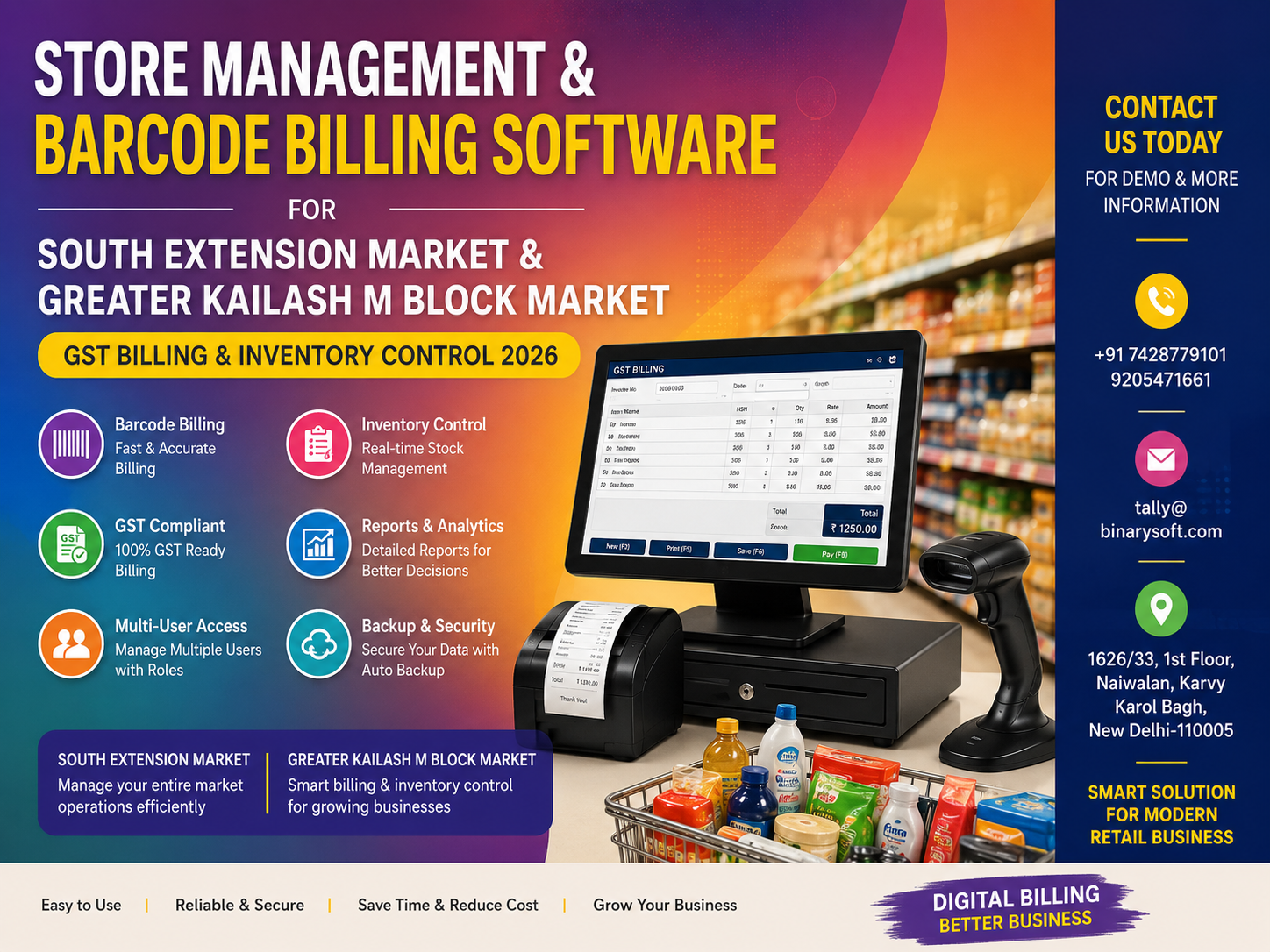
What Changed in 2026: Retail Stores Need Faster Billing and Tighter Stock Control
In 2026, running a retail or wholesale store in busy commercial areas such as South Extension Market and Greater Kailash M Block Market is becoming more demanding. Customers expect faster checkout, digital payment options, accurate GST invoices and immediate information about product availability. At the same time, business owners are under pressure to control inventory, avoid stock mismatches, track purchases, manage multiple product variants and maintain reliable accounts without increasing administrative workload. Manual billing or disconnected software can make these everyday tasks unnecessarily difficult. A modern Store Management and Barcode Billing Software brings billing, barcode scanning, GST invoicing, inventory control, purchase management and accounting into one connected system. The benefit is practical: quicker billing at the counter, better visibility of stock, fewer manual mistakes and more dependable business reports. For competitive Delhi retailers in 2026, accurate real-time information is becoming as important as the products displayed on the shelves.
Why South Extension and Greater Kailash Stores Need Modern Store Management Software
South Extension and Greater Kailash are among Delhi's well-known shopping destinations. Stores operating in these markets can deal with a combination of regular customers, premium buyers, seasonal shoppers and high-volume sales periods.
Whether the business deals in garments, footwear, cosmetics, accessories, electronics, home furnishings, gifts, lifestyle products, grocery items or other retail categories, the underlying management challenges are often similar.
A store owner needs to know:
- What was sold today?
- Which products are running low?
- Which items are selling quickly?
- Which products have remained unsold for months?
- How much stock is physically available?
- Which supplier needs to be paid?
- How much money is receivable?
- What GST is applicable to a transaction?
- Which products need to be reordered?
- What is the current value of inventory?
- How much profit is the store actually generating?
A well-configured store management solution can bring these answers together instead of forcing the business owner to depend on multiple registers, spreadsheets and disconnected applications.
Barcode Billing: Make Every Counter Faster
During busy shopping hours, billing speed directly affects the customer experience. If staff members have to manually search for every product, enter prices and check tax rates, even a simple transaction can take longer than necessary.
Barcode billing changes this process.
A barcode can be assigned to each product or product variant. At the billing counter, the employee scans the barcode and the software can retrieve the corresponding product information.
Depending on the business configuration, this may include product name, item code, selling price, GST rate, unit, discount and other relevant details.
This can significantly reduce repetitive data entry.
Benefits of Barcode Billing
Barcode-enabled billing can help a store achieve:
Faster Invoice Generation
Scanning products is generally quicker than manually selecting every item.
Reduced Data Entry Errors
Correctly configured barcodes reduce the chances of selecting a similarly named product or entering an incorrect price manually.
Automatic Inventory Adjustment
When a sale is recorded, the corresponding inventory can be updated in the system.
Better Product Identification
Different sizes, colours, models, designs and variants can be managed using separate stock items and barcode identification.
Improved Checkout Experience
Faster processing can reduce queues during weekends, festive periods and seasonal sales.
A South Extension Retailer's Busy Saturday
Imagine a clothing retailer operating in South Extension.
For years, the store had relied on a combination of basic billing software and spreadsheets for inventory management. Business was manageable on ordinary weekdays, but Saturdays and festive periods were different.
One evening, the store became unusually crowded.
Customers were waiting near the billing counter. Staff members were repeatedly walking to the stockroom to check whether different sizes were available. One customer wanted the same shirt in another colour. Another wanted to exchange an item purchased earlier.
At the counter, an employee accidentally selected the wrong product variation while preparing an invoice.
The customer noticed the difference.
The correction took only a few minutes, but the queue had already become longer.
Later that night, the owner stayed back to reconcile the day's sales with the remaining stock. The numbers did not match.
It was not a massive financial loss that concerned him most.
It was the feeling that the business was growing faster than the system being used to manage it.
After implementing a structured barcode billing and inventory management process, the store began assigning proper stock codes and barcodes to individual variants. Billing became faster, stock movement became easier to trace and employees could check availability through the system instead of repeatedly searching shelves.
The biggest difference was visible at closing time.
Instead of spending hours trying to understand what happened during the day, the owner could review structured sales and stock reports.
For a growing retail business, that visibility can bring confidence to everyday decision-making.
GST Billing Software for Retail Businesses in 2026
GST billing is another important part of store operations.
Businesses need invoices that correctly capture relevant transaction details. Depending on the nature of the business and transaction, this can include GSTIN details, taxable value, applicable tax rates, CGST, SGST or IGST, HSN information, discounts and invoice totals.
A properly configured GST billing system can automate much of the calculation based on predefined masters and transaction information.
This helps reduce repetitive calculations while keeping sales records connected with accounting.
Inventory Control: Know What Is Actually in Your Store
Inventory is money sitting on shelves.
Too little inventory can result in missed sales. Too much inventory can block working capital.
This is why inventory control should go beyond simply recording purchases and sales.
A useful inventory management system should help business owners understand stock quantity, stock value, inward and outward movement, fast-moving products, slow-moving items, reorder requirements and category-wise performance.
For stores with hundreds or thousands of SKUs, this visibility becomes particularly valuable.
Real-Time Stock Visibility
Suppose a Greater Kailash store carries 2,000 product variants.
Without systematic inventory tracking, finding the exact quantity of one particular size, model or colour can become difficult.
With structured inventory records, staff can search the item and view its recorded stock position quickly.
This improves internal efficiency while also helping staff respond to customers faster.
Manage Size, Colour, Model and Product Variants
Fashion, footwear, accessories and lifestyle businesses frequently deal with multiple variations of the same basic product.
For example:
Product: Men's Formal Shirt
Sizes: S, M, L, XL, XXL
Colours: White, Blue, Black
Designs: Multiple patterns
Treating all these products as a single stock item can create inventory confusion.
A structured system can maintain separate stock records for each variation where required.
The business can then understand which sizes or colours are selling and which ones are accumulating.
Purchase Management and Supplier Tracking
Store management begins before products reach the shelves.
Businesses need to track purchases from suppliers, purchase invoices, quantities received, rates, taxes, outstanding balances and stock additions.
When purchase and inventory records are integrated, goods purchased can automatically increase the relevant stock balance.
This reduces duplicate data entry and improves inventory visibility.
Supplier-wise reports can also help management understand purchase patterns and outstanding obligations.
Reorder Management: Avoid Losing Sales Because of Stock-Outs
A customer entering your store and asking for a popular product is an opportunity.
If the product is unavailable because nobody noticed that inventory had fallen below the required level, the sale may go to another shop.
Reorder levels can help address this issue.
Businesses can define minimum stock requirements for important products and periodically review items approaching those limits.
This can help the purchasing team plan replenishment more systematically.
Identify Fast-Moving and Slow-Moving Products
Not every product deserves the same amount of shelf space or investment.
Some items may sell every day, while others remain unsold for months.
Sales and inventory reports can help management identify these patterns.
Fast-moving products may require frequent replenishment. Slow-moving stock may need different pricing, promotional activity or reduced future purchasing.
This turns inventory data into actionable business information.
Reduce Dead Stock and Blocked Working Capital
Dead stock is particularly challenging for businesses dealing in fashion, seasonal products, electronics or frequently changing product ranges.
When products remain unsold for extended periods, capital remains blocked.
Store management reports can help identify older inventory so management can consider appropriate commercial action.
This might involve promotions, bundled offers, supplier discussions or revised purchasing decisions.
The objective is not simply to hold stock—it is to hold the right stock.
Sales Return and Exchange Management
Returns and exchanges are common in retail.
A customer may want to exchange a size, replace a defective item or return a product according to the store's applicable policy.
If such transactions are handled informally, stock records can become inaccurate.
A systematic return or exchange process helps ensure that inventory and accounts reflect the actual transaction.
Discount Management
Discounting needs control.
If employees can apply arbitrary discounts without oversight, margins may gradually decline without management noticing.
Depending on the configured system and business policy, businesses can establish structured discount practices and review invoice-level discount information.
Management can then compare gross sales with actual realization.
Multi-Counter Billing for Busy Stores
A single billing counter may be sufficient for a small store, but busy outlets may require multiple counters.
A properly planned billing environment can enable different users or counters to process transactions while maintaining centralized business records.
This can be especially useful during festive shopping, weekends and promotional events.
User-Level Controls
Not every employee should necessarily have access to every part of the accounting and inventory system.
Management may want billing staff to create sales invoices while restricting access to sensitive reports or configuration options.
User-level permissions and controls, where supported and properly configured, can help businesses separate responsibilities.
Better Accounting Through Integrated Billing
One major advantage of integrating billing with accounting is the reduction of duplicate work.
When a transaction is recorded correctly, the accounting impact can be captured along with the commercial transaction rather than requiring the same information to be entered again into another system.
This can help businesses maintain better visibility over sales, purchases, receivables, payables, cash, bank transactions and taxation-related records.
Business Reports That Help Owners Make Decisions
Software becomes more valuable when the data recorded every day can be converted into useful reports.
A business owner may want to review:
- Daily and monthly sales
- Item-wise sales
- Category-wise performance
- Stock summaries
- Inventory valuation
- Purchase analysis
- Supplier outstanding
- Customer outstanding
- Fast-moving products
- Slow-moving products
- Profitability information
- Tax-related reports
- Cash and bank positions
Instead of waiting until the end of the month, management can review business performance more regularly.
Why Accurate Inventory Matters for Profitability
Consider a simple situation.
The accounting system shows that 100 units of a product should be available, but only 92 are physically present.
Those eight missing units represent a discrepancy.
If similar differences exist across dozens of products, the financial impact can become significant.
Barcode-based processes, controlled stock movements and regular reconciliation can help businesses investigate and reduce such discrepancies.
Store Management for Fashion and Garment Retailers
South Extension and Greater Kailash have a strong presence of fashion and lifestyle businesses.
Garment stores often need detailed inventory classification based on brand, category, design, size, colour, season and price range.
A structured inventory system helps maintain these distinctions and makes it easier to understand which combinations are selling.
For example, management may discover that medium and large sizes of a particular design sell quickly while another variation remains unsold.
That information can influence the next purchase order.
Software for Footwear Stores
Footwear retailers face similar challenges.
A single shoe design can have multiple sizes and colours.
Inventory accuracy becomes essential because a customer asking for size 8 cannot simply be offered size 10.
Barcode-based stock identification and variant-level inventory can make product searches more efficient.
Software for Electronics and Accessories Stores
Electronics retailers may need to track product categories, models, brands, purchase rates, selling prices, warranties or serial-related information depending on their business requirements and software configuration.
Connecting billing and inventory helps ensure that product movement is recorded systematically.
Software for Cosmetics and Lifestyle Stores
Cosmetics and lifestyle stores may manage large numbers of SKUs, shades, brands, product types and price points.
Barcode billing can significantly reduce the time required to locate products during checkout.
Where relevant, batch and expiry-related inventory capabilities can also be considered during software configuration.
Store Management for Wholesale Businesses
The same principles are valuable for wholesale businesses.
Wholesalers generally deal with larger quantities, supplier purchases, customer credit, outstanding balances and higher transaction values.
An integrated billing, inventory and accounting solution can help them monitor both stock and financial exposure.
From Daily Billing to Business Intelligence
The purpose of digital store management should not stop at printing invoices.
Every properly recorded transaction creates data.
Over time, this data can answer important questions:
Which products generate the most sales?
Which categories produce stronger margins?
Which items are repeatedly out of stock?
Which inventory is ageing?
Which periods generate maximum revenue?
Which customers have outstanding balances?
Which suppliers account for major purchases?
This is where store management software moves from an operational tool to a decision-support system.
Preparing Your Store for Festive and Seasonal Demand
Delhi's retail markets can experience major changes in customer traffic around festivals, wedding seasons and promotional periods.
Stores should prepare before the rush begins.
Inventory can be reviewed in advance, fast-moving products identified, stock replenished, barcodes verified and billing counters tested.
A well-prepared system reduces the chances of operational problems appearing at the busiest possible moment.
Importance of Proper Software Implementation
Buying software alone does not solve every business problem.
Implementation matters.
Product masters need to be created carefully. GST-related information should be configured appropriately. Opening stock must be reviewed. Barcode structures should be planned. Users should understand the billing workflow.
Poor data entered into a powerful system still produces poor reports.
Businesses should therefore treat implementation and staff training as important parts of the digitization process.
Why Choose an Authorized Tally Partner?
Businesses implementing Tally-based accounting, billing and inventory solutions can benefit from working with an experienced Authorized Tally Partner for requirements assessment, software implementation, configuration, training and support.
The objective should be to configure the solution according to the actual workflow of the business rather than simply installing software and leaving the business to determine everything independently.
Binarysoft Technologies – Store Management and Tally Solutions in Delhi
Binarysoft Technologies provides Tally and business software solutions for retailers, wholesalers and other businesses looking to improve billing, accounting and inventory management.
Businesses in South Extension Market, Greater Kailash M Block Market and other commercial areas of Delhi can evaluate solutions according to their operational requirements, transaction volumes, number of users and inventory complexity.
Powered by Binarysoft Technologies
Authorized Tally Partner
Location:
1626/33, 1st Floor, Naiwalan, Karol Bagh, New Delhi – 110005, INDIA
Contact Us:
+91 7428779101, 9205471661
Email:
tally@binarysoft.com
Business Hours:
10:00 AM – 6:00 PM, Mon–Fri
Conclusion
Retail competition in South Extension Market and Greater Kailash M Block Market is no longer based only on product selection, location and pricing. Operational speed and accurate business information increasingly influence profitability and customer experience.
A well-implemented Store Management and Barcode Billing Software can connect barcode billing, GST invoicing, inventory control, purchases, sales and accounting into a more structured workflow.
For business owners, the most important benefit is visibility.
Knowing what is selling, what is available, what needs replenishment, where money is blocked and how the business is performing can lead to better decisions.
In 2026, retailers that continue relying heavily on manual inventory tracking may find it increasingly difficult to manage growing product ranges and customer expectations. Moving toward integrated billing and inventory management can help a store become faster, more controlled and better prepared for future growth.
Frequently Asked Questions
What is Store Management Software?
Store Management Software is a business solution designed to help manage activities such as billing, inventory, purchases, sales, customer transactions and business reporting. Features vary according to the software and configuration selected.
What is Barcode Billing Software?
Barcode Billing Software allows products to be identified through barcodes. At checkout, a barcode scanner can retrieve configured product details, making billing faster and reducing repetitive manual product selection.
CA. Pankaj Bhadoria brings practical experience in GST, accounting, and business process consulting. He works closely with MSMEs to resolve compliance challenges and improve operational transparency. His articles aim to simplify complex regulations for everyday business use.