Call CA Tally HelpDesk
+91 9205471661,
7428779101
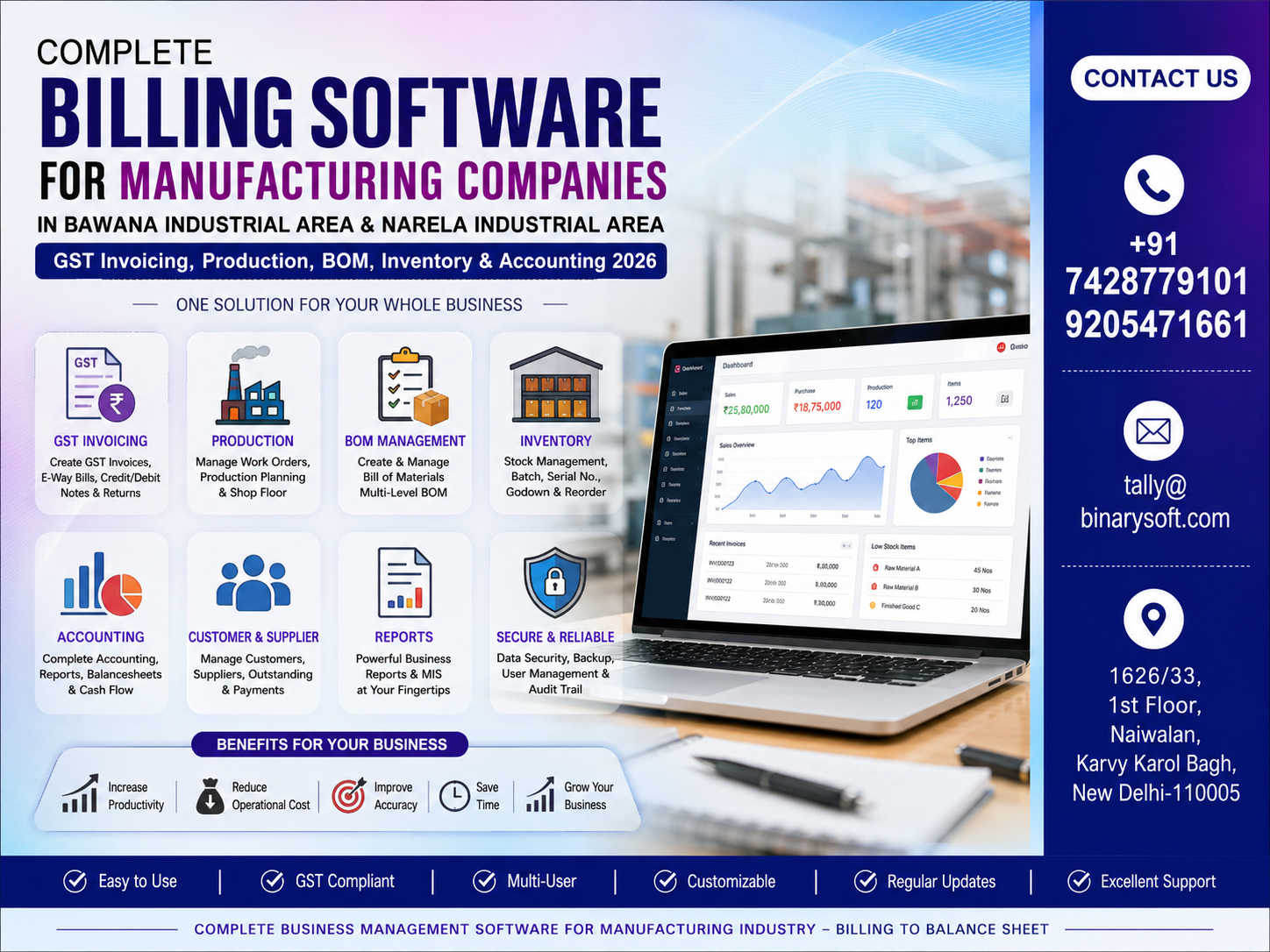
What Changed in 2026: Manufacturing Businesses Need More Than Basic Billing
In 2026, manufacturing companies are under growing pressure to connect billing with production, inventory, purchasing, GST compliance and financial accounting instead of managing each activity separately. For manufacturers in Bawana Industrial Area and Narela Industrial Area, even a small mismatch between raw-material consumption, finished-goods production and invoice quantities can affect stock visibility, costing and delivery planning. Customers expect faster invoices, management needs accurate production information, and GST-related transactions require disciplined records. Recent business digitization has also made disconnected spreadsheets and handwritten production registers increasingly difficult to manage as transaction volumes grow. A complete manufacturing billing system can bring GST invoicing, Bill of Materials (BOM), production entries, raw-material inventory, finished-goods stock, purchases, sales, receivables and accounting into a more structured workflow. The benefit is not simply faster billing—it is better control from raw-material purchase to production and final customer invoice.
Manufacturing Billing Software Is No Longer Just an Invoice Generator
For a trading company, billing can sometimes be relatively straightforward: purchase a product, maintain stock and sell it.
Manufacturing is different.
A manufacturer purchases raw materials, consumes those materials, processes or assembles them, creates finished products and then sells those products.
Between the purchase invoice and sales invoice lies the most important part of the business: production.
This is why a manufacturing company needs more than ordinary billing software.
A properly configured manufacturing business system should help connect:
Raw-material purchases
Raw-material inventory
Bill of Materials
Production
Material consumption
Finished-goods creation
Wastage and scrap
Job work where applicable
Sales orders
GST invoicing
E-Invoice processes where applicable
E-Way Bill processes where applicable
Customer receivables
Supplier payables
Accounting
Management reports
For factories and manufacturing units in Bawana Industrial Area and Narela Industrial Area, bringing these processes together can provide far greater control over day-to-day operations.
Why Manufacturing Companies in Bawana Industrial Area Need Integrated Software
Bawana Industrial Area is home to a wide range of manufacturing and industrial businesses.
Manufacturers may deal in engineering products, electrical goods, plastics, packaging, garments, components, furniture, consumer products, metal products, machinery parts and many other categories.
As production volumes increase, manual processes become difficult to control.
A manufacturer may know that 10,000 units were sold during the month.
But management needs deeper answers.
How many units were manufactured?
How much raw material was consumed?
What was the expected consumption according to the BOM?
What is the remaining raw-material stock?
How much finished stock is available?
How much production is pending?
What material needs to be purchased?
Which customers have outstanding payments?
Which suppliers need to be paid?
How much GST is associated with recorded transactions?
What is the profitability of the business?
These questions cannot be answered effectively by a billing counter alone.
They require connected business information.
Why Narela Industrial Area Manufacturers Need Better Production Visibility
Manufacturing businesses in Narela Industrial Area can face similar operational challenges.
When a factory is small, the owner may personally supervise purchasing, production and dispatch.
As the business expands, responsibilities are divided among employees.
One person purchases materials.
Another supervises production.
Another handles the warehouse.
Another prepares invoices.
The accountant manages books.
The owner reviews everything.
If these departments maintain separate records, the owner can receive five different versions of the same business.
Production says 5,000 pieces were manufactured.
Stores show 4,850.
Dispatch records show 4,700.
Accounts have invoices for 4,600.
Nobody immediately knows where the difference came from.
Integrated manufacturing software helps create a more structured flow of information between these activities.
A Factory Owner Who Could Sell More but Didn't Know If He Could Produce More
Consider a fictional example of a manufacturer named Rajesh who runs a small electrical-components unit in Bawana Industrial Area.
His company has been operating for several years.
Orders are growing.
That should be good news.
One Monday morning, an important customer calls.
"We need another 8,000 pieces this week. Can you supply them?"
Rajesh wants to say yes immediately.
It is a valuable order.
But he hesitates.
He calls the production supervisor.
"Raw material kitna hai?"
The supervisor says he will check.
Rajesh calls the storekeeper.
The storekeeper gives another figure.
The purchase executive says more material was received on Saturday, but the invoice has not yet reached accounts.
The accountant's stock report shows something else.
Twenty minutes pass.
The customer calls again.
Rajesh still cannot confidently commit to the delivery date.
The painful part is not that his factory lacks orders.
It is that he cannot immediately determine whether he has enough material to accept another profitable order.
That evening, he looks around the factory.
Machines are running.
Employees are working.
Finished cartons are stacked near dispatch.
Raw material is sitting in the warehouse.
Business is clearly happening.
But reliable information is not moving at the same speed.
After implementing a structured process connecting BOM, material consumption, production, purchases, finished-goods stock and billing, Rajesh begins to see the factory differently.
Before accepting a large order, he can review available stock and production requirements more systematically.
The biggest improvement is not a prettier invoice.
It is confidence.
Confidence that operational decisions are being made from better information.
This story is fictional, but the underlying problem is familiar to many growing manufacturers.
What Is Manufacturing Billing Software?
Manufacturing billing software is a business solution that combines sales invoicing with manufacturing-related inventory and accounting processes.
Depending on the software, configuration and business requirements, it can support activities such as:
GST invoicing
Purchase management
Raw-material inventory
Bill of Materials
Manufacturing or production entries
Finished-goods inventory
Stock transfers
Material consumption
Scrap and wastage recording
Customer accounts
Supplier accounts
Receivables
Payables
Financial accounting
Tax-related records
Business reporting
The objective is to create a traceable path from raw material to finished product to customer invoice.
1. GST Invoicing for Manufacturing Companies
Manufacturers need professional and properly configured sales invoices.
Depending on the nature of the transaction and applicable requirements, an invoice may contain information such as:
Supplier details
GSTIN
Customer details
Customer GSTIN
Invoice number
Invoice date
Place of supply
Product description
HSN information
Quantity
Rate
Taxable value
CGST
SGST
IGST
Discount
Other applicable charges
Invoice total
A structured billing system reduces repetitive calculations and helps maintain consistent transaction records.
GST configurations should always be maintained according to the business's applicable legal and tax requirements.
2. Bill of Materials: The Foundation of Manufacturing Inventory
One of the most important concepts in manufacturing software is the Bill of Materials, commonly called BOM.
A BOM defines which raw materials and quantities are required to manufacture a finished product.
Suppose a manufacturer produces an electrical assembly.
For one finished unit, the business may require:
1 plastic housing
2 connectors
1 PCB
4 screws
1 wire assembly
1 packaging box
The BOM creates a standard relationship between these materials and the finished product.
If the company produces 1,000 units, the system can use the defined BOM structure to support material-consumption and production records.
Why BOM Management Matters
Without a BOM, manufacturers often rely heavily on manual calculations.
That creates several risks.
Materials can be over-issued.
Consumption can be recorded incorrectly.
Purchase planning can become inaccurate.
Production costing becomes harder.
Stock discrepancies become difficult to investigate.
A properly configured BOM provides a standard production structure.
It tells the business:
What goes into the product?
How much is normally required?
What comes out of production?
This becomes a foundation for stronger manufacturing control.
3. Raw-Material Inventory Management
Raw materials represent working capital.
Too little material can stop production.
Too much material can lock cash into inventory.
Manufacturing software should therefore help businesses maintain visibility into raw-material quantities.
For each material, management may need to know:
Opening stock
Purchases
Material issued
Material consumed
Returns
Adjustments
Closing stock
Available quantity
Reorder requirement
This allows purchasing decisions to be based more on actual inventory information and less on assumptions.
4. Finished-Goods Inventory
Production converts raw material into finished goods.
When manufacturing entries are recorded correctly, finished-goods stock can be updated accordingly.
Management can then review how much finished inventory is available for sale or dispatch.
This is particularly important when sales teams are accepting orders.
A salesperson should not promise immediate delivery of 10,000 units simply because an old spreadsheet says they are available.
Accurate finished-goods information helps improve customer commitments.
5. Production Management
Production management connects inventory with manufacturing activity.
A structured system can help record production quantities and related material consumption.
For example:
Raw Material A: consumed
Raw Material B: consumed
Raw Material C: consumed
Finished Product X: produced
This creates a more meaningful inventory trail than simply increasing finished stock manually.
6. Production Planning
Manufacturers need to know what they can produce with the materials currently available.
Suppose an order requires 5,000 finished units.
The business needs to evaluate:
Required raw material
Available raw material
Shortage quantity
Expected production capacity
Pending purchase orders
Existing finished stock
Delivery requirements
A well-organized manufacturing system provides the underlying data needed for better production planning.
7. Material Requirement Planning
When production requirements increase, purchasing also needs to respond.
BOM-based planning can help management estimate material requirements for planned production.
For example, if 10 units of Material A are needed for one finished product and the business plans to manufacture 1,000 finished units, expected consumption is 10,000 units of Material A, subject to the actual BOM and production process.
The business can compare this requirement against available inventory.
This makes purchase planning more systematic.
8. Purchase Management
Manufacturing begins with purchasing.
A company may deal with dozens or hundreds of suppliers.
Management needs to know:
What was purchased?
From whom?
At what price?
In what quantity?
When was it received?
How much is payable?
What was the previous purchase rate?
How frequently is the material purchased?
Purchase records integrated with inventory and accounts help provide these answers.
9. Supplier Payables
Manufacturing companies frequently purchase raw materials on credit.
When many suppliers are involved, payment planning becomes important.
Supplier ledger and outstanding reports can help businesses monitor amounts payable and review pending obligations.
Better payable visibility supports cash-flow planning and supplier relationships.
10. Customer Receivables
Manufacturers often sell to distributors, dealers, wholesalers, institutional buyers or other businesses on credit.
That means sales growth can also create receivable risk.
A business may report strong sales while a significant portion of its money remains unpaid.
Customer outstanding reports can help track:
Invoice-wise receivables
Customer balances
Receipts
Pending amounts
Older outstanding invoices
Credit exposure
This can support a more disciplined collection process.
11. Sales Order Management
Production decisions often begin with customer orders.
If sales orders are properly recorded, management gains greater visibility into future demand.
The production team can review pending orders.
The purchase team can assess material requirements.
Management can prioritize deliveries.
This helps create a connection between sales commitments and production activity.
12. Purchase Order Management
Purchase orders help create a structured procurement process.
Instead of placing material requirements through informal calls and messages alone, companies can maintain documented purchase requirements.
This can improve visibility into:
Materials ordered
Suppliers selected
Order quantities
Pending receipts
Expected material
Purchase commitments
Structured procurement becomes increasingly important as the factory grows.
13. Inventory Reorder Levels
Production should not stop because somebody forgot to order a routine material.
Businesses can establish minimum or reorder levels for critical inventory items where suitable.
When stock approaches the defined level, management can identify the need for replenishment.
This is particularly useful for frequently consumed raw materials.
14. Batch-Wise Inventory Where Required
Some manufacturers need batch-wise stock management.
This may be relevant where production lots, expiry information or batch traceability are important.
The requirement depends on the industry and product.
Proper batch identification can help businesses trace inventory movement more accurately.
15. Godown and Warehouse Management
A manufacturing company may maintain inventory across several locations.
For example:
Raw Material Store
Production Floor
Finished Goods Warehouse
Quality Control Area
Dispatch Warehouse
Secondary Godown
Software capable of location-wise inventory management can provide better visibility into where stock is physically expected to be.
16. Stock Transfers Between Locations
Materials frequently move inside a manufacturing business.
Raw material may move from the main warehouse to production.
Finished products may move from production to the finished-goods warehouse.
Stock may also move between factories or godowns.
Recording these transfers systematically helps maintain location-wise stock accuracy.
17. Scrap and Wastage Management
Manufacturing does not always convert every unit of input into perfect finished output.
Depending on the industry, production may create:
Scrap
Wastage
Rejections
By-products
Damaged material
These should not simply disappear from inventory records.
A properly designed manufacturing process should account for relevant material movements according to the business's operational requirements.
This can improve stock visibility and production analysis.
18. Manufacturing Cost Visibility
Knowing the selling price is not enough.
Manufacturers need to understand the cost of producing goods.
Costs may involve:
Raw materials
Packaging
Labour
Power
Freight
Machine costs
Job work
Other direct expenses
Factory overheads
The level of costing available depends on the accounting and manufacturing system being used.
However, structured production and inventory data creates a stronger foundation for cost analysis.
19. E-Invoice Management
For businesses covered by applicable e-invoicing requirements, invoice processes need to align with prevailing GST rules.
A suitable business software environment can help streamline the preparation and management of transaction information required for e-invoicing.
Businesses should verify current applicability, turnover conditions and compliance requirements from official GST sources or their tax professional because statutory rules can change.
20. E-Way Bill Management
Manufacturing businesses frequently dispatch goods to customers, distributors, warehouses and other locations.
Where an E-Way Bill is applicable, accurate invoice and movement information becomes important.
Integrated billing processes can reduce duplicate entry and improve consistency between invoice and dispatch-related information.
Businesses should follow the prevailing statutory requirements applicable to their transactions.
21. Accounting Integrated with Manufacturing
Manufacturing accounting becomes much easier to manage when commercial transactions are connected to financial records.
Purchases create supplier obligations.
Sales create customer receivables.
Receipts reduce receivables.
Payments reduce payables.
Inventory represents business value.
Expenses affect profitability.
Taxes affect statutory liabilities.
Integrated accounting brings these elements together.
22. Cash and Bank Management
A manufacturing business can be profitable on paper and still face cash-flow pressure.
This happens when money is tied up in inventory or customer receivables while suppliers and operating expenses need to be paid.
Accounting software can help businesses maintain structured records of:
Cash receipts
Cash payments
Bank receipts
Bank payments
Customer collections
Supplier payments
Other financial transactions
This gives management better financial visibility.
23. Profit and Loss Reporting
Manufacturers should regularly review financial performance.
Sales alone do not determine business success.
A company with growing turnover can still face margin pressure if material costs, operating expenses, discounts or wastage rise significantly.
Profit and Loss reports help management review overall financial performance based on the accounting records maintained.
24. Balance Sheet Visibility
A Balance Sheet provides a broader view of the financial position of a business.
It can help management and accounting professionals review assets, liabilities and capital positions according to the records maintained.
For growing manufacturing companies, regular financial review is important for better decision-making.
25. GST Accounting and Tax Reports
Manufacturing companies handle both purchases and sales, often involving substantial transaction volumes.
A properly configured accounting system can help maintain structured GST-related transaction data.
This can support reconciliation and return-preparation workflows.
However, software should complement—not replace—professional review of tax compliance where required.
26. HSN-Wise Product Management
Manufacturers dealing with multiple product categories need organized item masters.
Products and materials can be configured with relevant information, including HSN details where applicable.
A clean item master improves invoice consistency and reporting.
Poorly maintained masters, on the other hand, can create duplicate items and inconsistent transaction records.
27. Multiple Units of Measurement
Manufacturing companies may purchase material in one unit and consume or sell products using another.
Common units can include:
Kilograms
Grams
Pieces
Meters
Litres
Boxes
Bundles
Dozens
Sets
Rolls
The required unit structure should be configured according to the actual business process.
28. Job Work Management
Some manufacturers outsource part of their production process.
For example, material may be sent outside for:
Cutting
Polishing
Painting
Printing
Fabrication
Assembly
Packaging
Processing
Businesses involved in job work need a clear process for tracking material sent, material received and associated transactions.
The exact workflow should be configured according to the nature of the job-work process and applicable compliance requirements.
29. Multi-User Operations for Manufacturing Companies
A manufacturing company rarely operates through one person.
Different users may handle:
Sales
Purchases
Accounts
Stores
Production
Dispatch
Management
A multi-user business environment can allow authorized employees to perform their respective functions simultaneously.
This can be especially valuable for larger factories in Bawana and Narela.
30. User-Level Security
Not every employee should have access to every business report.
The billing executive may need invoice access.
The storekeeper may need inventory information.
The accountant may need accounting access.
Management may require financial reports.
Appropriate user rights can help businesses control who can view or modify specific information.
31. Production and Inventory Reports Management Should Review
Manufacturing software becomes truly valuable when reports are reviewed regularly.
Useful information can include:
Raw-material stock
Finished-goods stock
Stock movement
Production quantities
Material consumption
Purchase reports
Sales reports
Outstanding receivables
Outstanding payables
Location-wise stock
Inventory valuation
Profitability information
The exact reports available depend on the software configuration.
32. Why Excel Alone Becomes Difficult as Manufacturing Grows
Spreadsheets remain useful business tools.
The problem begins when dozens of spreadsheets become the primary operating system of the factory.
One employee maintains purchases.xlsx.
Another maintains production.xlsx.
The warehouse uses stock.xlsx.
Sales maintains dispatch.xlsx.
Accounts works in separate accounting software.
The owner receives reports through WhatsApp.
Each file may individually look correct.
But they may not represent the same reality.
Integrated software reduces this fragmentation by creating a more centralized transaction process.
33. Manual Manufacturing vs Integrated Manufacturing Management
Consider the difference.
In a manual environment:
Material is received.
Somebody writes it in a register.
Accounts enters the purchase later.
Production receives material through another register.
Finished goods are updated in Excel.
Sales creates an invoice.
The warehouse maintains another dispatch sheet.
Management then attempts to reconcile everything.
In an integrated environment, these activities can be structured around connected records.
That reduces repeated data entry and improves traceability.
34. Manufacturing Software and TallyPrime
TallyPrime is widely used by Indian businesses for accounting, invoicing, inventory management, taxation-related processes and business reporting.
Depending on the business requirements and configuration, TallyPrime can support inventory and manufacturing-related workflows such as stock items, godowns, BOM-related processes, manufacturing entries and accounting.
However, every factory is different.
A simple assembly business may have straightforward requirements.
A complex manufacturer with multiple production stages, specialized planning, machine scheduling and detailed shop-floor requirements may require additional solutions or integrations.
The correct approach is to analyze the workflow before selecting the implementation.
35. Questions to Ask Before Selecting Manufacturing Billing Software
Before implementing software, management should understand its own requirements.
Ask:
How many raw materials do we maintain?
How many finished products?
Do we use BOMs?
Do products have multiple BOMs?
How many warehouses are involved?
Do we use job work?
Do we need batch tracking?
How many employees need access?
Do we need multi-user operation?
How are production entries currently recorded?
Do we need sales-order tracking?
Do we need purchase-order tracking?
What GST processes are required?
Is E-Invoice applicable to our business?
What reports does management need daily?
What backup process will be used?
Do we require customized reports or integrations?
These questions can prevent the business from choosing software based only on a demonstration of the billing screen.
36. Implementation Matters as Much as the Software
Manufacturing software needs careful implementation.
Important areas include:
Ledger creation
Stock-item creation
Raw-material classification
Finished-goods classification
BOM configuration
Opening stock
Godown setup
GST configuration
Customer masters
Supplier masters
Production workflow
User rights
Backup policy
Reporting structure
Incorrect masters at the beginning can create reporting problems later.
Implementation should therefore be treated as a business project rather than simply a software installation.
37. Clean Item Masters Are Essential
Imagine that the same raw material is entered under four names:
Steel Sheet 2MM
Steel Sheet 2 mm
2MM Steel
Steel-2MM
To employees, these may mean the same thing.
To software, they may be four separate inventory items.
This leads to inaccurate stock reports.
Standardized naming and item coding are therefore critical.
38. Employee Training Is Essential
Even excellent software produces poor reports when users enter transactions inconsistently.
Production employees need to understand production entries.
Warehouse employees need to understand stock movement.
Purchase staff need to follow procurement procedures.
Billing teams need to create accurate invoices.
Accounts teams need to review transactions.
The owner needs to understand reports.
Training creates consistency across departments.
39. Data Backup for Manufacturing Companies
Manufacturing data can represent years of transactions and operational history.
It can contain:
Customer information
Supplier information
Accounting records
Inventory information
Production records
Purchase history
Sales history
Outstanding balances
Losing this data can create serious operational problems.
A documented and regularly tested backup process should therefore form part of the software implementation.
40. How Better Software Helps Management Make Faster Decisions
The purpose of digital manufacturing management is not to generate more reports.
It is to make better decisions.
When a large order arrives, management needs to know whether it can be produced.
When material prices rise, purchasing needs historical information.
When cash becomes tight, management needs receivable and payable visibility.
When inventory increases, the owner needs to know what is moving.
When production falls, management needs accurate numbers.
Better information shortens the distance between a problem and a decision.
From Billing Software to Manufacturing Control
A business should not evaluate manufacturing software only by asking:
"Invoice ban jayega?"
The more important questions are:
Can we track raw materials?
Can we maintain BOMs?
Can we record production?
Can we track finished goods?
Can we understand stock availability?
Can purchases and sales connect with accounts?
Can management see customer outstanding?
Can we review supplier outstanding?
Can we get meaningful reports?
Can the system grow with our business?
That is the difference between simple billing software and a complete manufacturing management system.
Manufacturing Billing Software for Bawana Industrial Area
Manufacturing companies in Bawana Industrial Area can consider a structured solution covering:
GST invoicing
Raw-material inventory
Finished-goods inventory
BOM
Production entries
Purchases
Sales
Warehouses
Receivables
Payables
Accounting
GST-related reporting
E-Invoice workflows where applicable
E-Way Bill workflows where applicable
Management reports
User-level security
The appropriate implementation depends on the size and complexity of the factory.
Manufacturing Billing Software for Narela Industrial Area
Manufacturers in Narela Industrial Area can benefit from connecting factory operations with financial information.
Instead of maintaining production, inventory, billing and accounting as isolated activities, businesses can establish a structured workflow from purchase to production to dispatch.
This can help improve:
Stock visibility
Purchase planning
Production information
Billing accuracy
Customer collection tracking
Supplier payment planning
Financial reporting
Management control
For growing manufacturers, these improvements can become increasingly valuable as transaction volumes increase.
Why Local Support Matters
Manufacturing software requirements change as businesses grow.
A company may initially have one warehouse.
Later it may add another.
It may begin job work.
It may introduce additional product lines.
Management may require new reports.
More employees may need access.
Processes may change.
Having access to implementation and support professionals can help businesses adapt their software environment as these requirements evolve.
Powered by Binarysoft Technologies
Binarysoft Technologies provides Tally-related business software solutions and implementation support for businesses looking to improve billing, accounting, GST processes, inventory management and operational reporting.
As an Authorized Tally Partner, Binarysoft Technologies can assist manufacturing businesses in evaluating their requirements and planning a suitable Tally-based environment.
For manufacturers in Bawana Industrial Area, Narela Industrial Area and other industrial locations across Delhi, the objective should be more than simply installing accounting software.
The goal should be to build a structured business information system that connects purchasing, inventory, manufacturing, billing and accounts.
Conclusion
Manufacturing companies in 2026 need much more than software that can print GST invoices.
They need visibility across the complete business cycle.
Raw material comes into the factory.
Production consumes it.
Finished goods are created.
Products move to warehouses.
Customer orders are received.
Goods are dispatched.
GST invoices are generated.
Customers make payments.
Suppliers need to be paid.
Accounting records capture the financial impact.
When these processes remain disconnected, management spends valuable time reconciling information instead of using it.
For manufacturers in Bawana Industrial Area and Narela Industrial Area, complete billing and manufacturing software can help connect GST invoicing, production management, BOM, raw-material inventory, finished-goods stock, purchasing, receivables, payables and accounting.
The biggest advantage is control.
A manufacturer who knows what material is available, what production has occurred, what stock is ready, what customers owe and what suppliers need to be paid can make faster and more confident business decisions.
The right software should therefore not merely record what happened yesterday.
It should give management the information needed to run tomorrow's production more effectively.
Frequently Asked Questions
What is manufacturing billing software?
Manufacturing billing software combines invoicing with inventory, production and accounting processes. Depending on the solution, it can help manage raw materials, BOMs, finished goods, purchases, sales, GST and financial records.
What is BOM in manufacturing software?
BOM stands for Bill of Materials. It defines the raw materials and quantities normally required to manufacture a particular finished product.
CA. Ankit Vardiya works closely with traders, wholesalers, and service businesses on accounting automation, GST reporting, and audit readiness. His professional exposure to day-to-day business operations allows him to translate complex accounting concepts into practical guidance for Indian business owners.