Call CA Tally HelpDesk
+91 9205471661,
7428779101
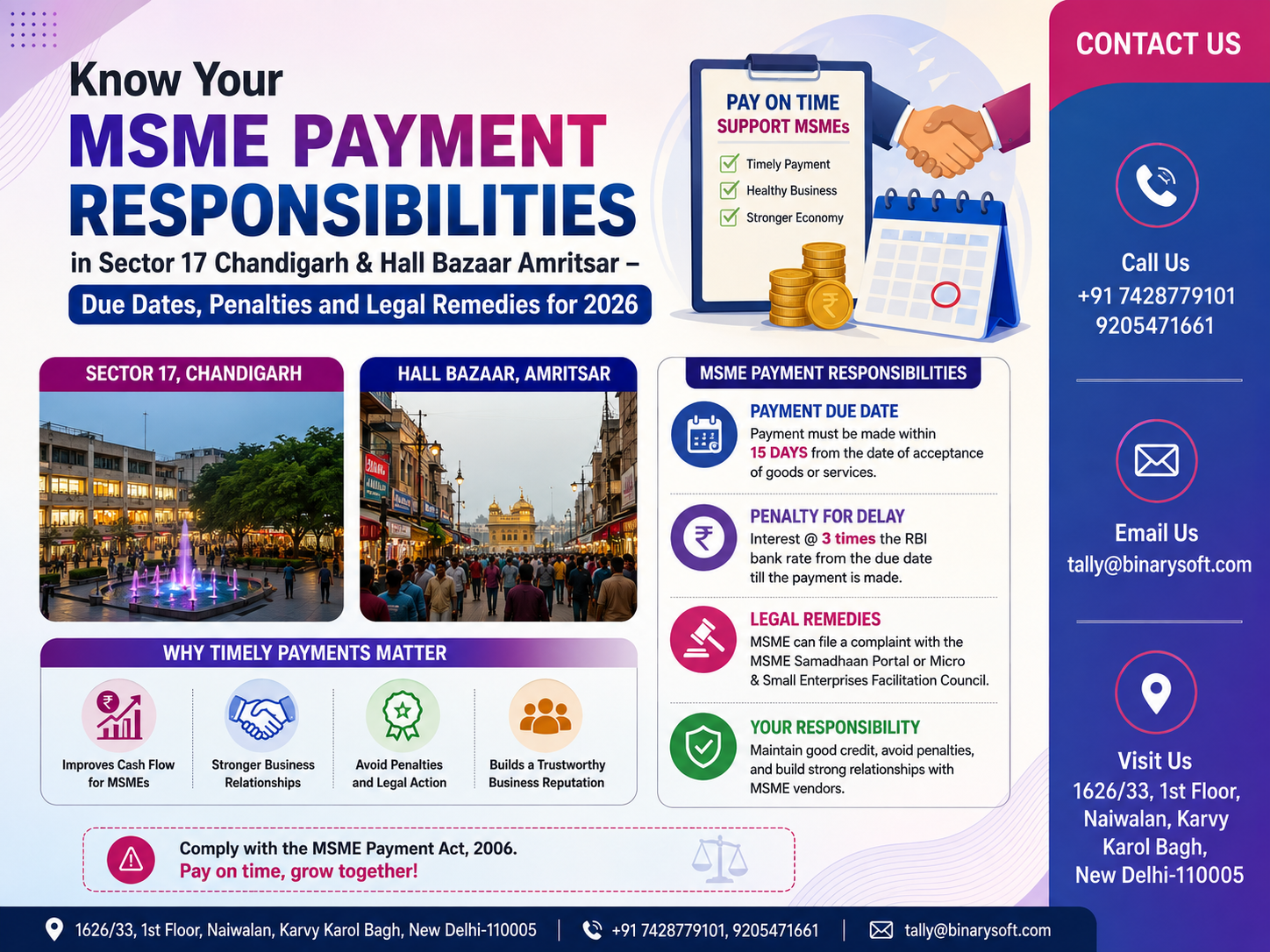
What Changed in 2026: Delayed MSME Payments Can No Longer Be Treated as Routine Business Credit
In 2026, businesses buying goods or services from registered micro and small enterprises need to watch payment timelines much more carefully. The MSMED Act continues to protect eligible MSE suppliers against delayed payments, with an agreed credit period generally not permitted to extend beyond 45 days from acceptance or deemed acceptance. Delay can trigger compound interest with monthly rests at three times the RBI-notified bank rate, while eligible suppliers can approach the Micro and Small Enterprises Facilitation Council for recovery. For traders and businesses in Sector 17 Chandigarh and Hall Bazaar Amritsar, this creates pressure on accounts payable, purchase documentation, invoice tracking and year-end tax planning. The benefit of acting early is equally clear: disciplined vendor payment controls can reduce disputes, protect supplier relationships, prevent avoidable interest exposure and make financial reporting more dependable.
Why MSME Payment Rules Matter in 2026
Delayed payment has always been one of the biggest working-capital challenges for smaller businesses.
A supplier may complete an order, deliver goods, pay employees, incur GST liability, purchase raw material and arrange transport before receiving payment from the buyer.
When the buyer then delays settlement for several months, the supplier effectively finances the buyer's business.
The Micro, Small and Medium Enterprises Development Act, 2006, commonly called the MSMED Act, contains specific provisions dealing with delayed payments to micro and small enterprises.
The Ministry of MSME confirms that Sections 15 to 24 of the MSMED Act address delayed-payment issues and that Micro and Small Enterprise Facilitation Councils have been established for dispute resolution.
For businesses in busy commercial areas such as Sector 17 Chandigarh and Hall Bazaar Amritsar, these rules are relevant from both sides.
You could be:
A micro or small enterprise trying to recover overdue money.
Or:
A buyer purchasing goods or services from registered micro and small suppliers.
Understanding the rules helps both sides manage commercial relationships more professionally.
The Basic MSME Payment Rule: 15 Days or Maximum 45 Days
One of the most important concepts under the MSMED Act concerns the time within which a buyer should pay an eligible micro or small supplier.
Where there is no written agreement specifying a payment date, payment is generally required within the period prescribed under the Act following acceptance or deemed acceptance of goods or services.
Where there is an agreement between the buyer and supplier, the agreed credit period cannot exceed 45 days from the day of acceptance or deemed acceptance for the purposes of the statutory delayed-payment protection.
The Ministry's official delayed-payment guidance states that where a buyer fails to pay the MSE supplier on the agreed date, the maximum permitted period under this framework is 45 days from acceptance of the goods or services.
This means an invoice stating:
"Payment after 90 days"
does not automatically eliminate the statutory MSME delayed-payment protection where the MSMED Act applies.
What Does the 15-Day Rule Mean?
The Act distinguishes between situations where there is an agreement and where there is no such agreed payment period.
In practical terms, businesses often describe the framework as:
No agreed credit period: payment within 15 days.
Agreed credit period: payment according to the agreement, but the statutory period cannot exceed 45 days.
Businesses should calculate the due date based on the actual facts of the transaction, including acceptance of goods or services and any valid written objections.
Because disputes about acceptance dates can affect calculations, businesses should keep proper documentary evidence.
What Is "Acceptance" of Goods or Services?
The payment clock does not always depend simply on the invoice date.
The MSMED framework refers to the day of acceptance or deemed acceptance.
For practical business control, buyers should therefore maintain evidence relating to:
Purchase order date
Goods receipt date
Service completion date
Invoice date
Delivery challan
Quality inspection
Written objection, if any
Acceptance confirmation
Contractual payment terms
Without proper documentation, it may become difficult later to establish exactly when the statutory payment period began.
A Hall Bazaar Supplier Who Kept Hearing "Next Week"
Consider a fictional story of Gurpreet, who operated a small packaging and printing unit supplying material to several businesses around Amritsar.
One customer had been buying from him regularly for years.
The relationship was friendly.
The customer usually said:
"Don't worry. Payment will come next week."
At first, Gurpreet trusted him.
One invoice became two.
Two became five.
Soon, more than ₹8 lakh was outstanding.
Meanwhile, Gurpreet still had responsibilities of his own.
Paper suppliers needed payment.
Employees expected salaries.
Electricity bills had to be paid.
GST obligations did not disappear simply because his customer had delayed settlement.
One evening, after an employee asked whether salaries would be credited on time, Gurpreet sat alone in his office looking at the outstanding receivables report.
The business appeared profitable on paper.
But the bank balance told another story.
His biggest problem was no longer lack of orders.
It was money trapped in unpaid invoices.
Gurpreet then began reviewing whether his enterprise's Udyam registration and supplies qualified for delayed-payment protection under the MSMED Act.
He organized purchase orders, invoices, delivery evidence and correspondence and started pursuing the claim formally.
The emotional lesson was simple.
For a micro or small enterprise, delayed payment is not merely an accounting entry.
It can decide whether salaries are paid, whether another order can be accepted and whether the owner sleeps peacefully at night.
That is why both buyers and suppliers should treat MSME payment deadlines seriously.
What Happens If the Buyer Pays After the Permitted Period?
Delayed payment can trigger statutory interest.
Official Ministry guidance states that where the buyer fails to make payment within the permitted period, the buyer can become liable to pay compound interest with monthly rests at three times the bank rate notified by the Reserve Bank of India.
This can make prolonged delays significantly more expensive.
The statutory interest is therefore not comparable to a normal supplier finance charge.
Its purpose is to discourage buyers from using micro and small suppliers as an involuntary source of working capital.
Simple Example of MSME Payment Delay
Suppose a business in Sector 17 Chandigarh purchases services from an eligible small enterprise.
Invoice amount: ₹5,00,000
Assume the parties validly agree to payment within 45 days.
The 45-day period expires, but the buyer does not pay.
The buyer may potentially become liable for statutory delayed-payment interest in addition to the principal amount.
The exact interest calculation will depend on the statutory provisions, applicable RBI bank rate, dates and facts of the case.
Because the law specifies compound interest with monthly rests, businesses should not estimate the liability using a simple ordinary-interest calculation.
Is the Rule Applicable to All MSMEs?
This is a very important distinction.
Delayed-payment protections under Sections 15 to 24 are primarily designed for qualifying micro and small enterprises, not every enterprise falling within the broader MSME classification.
Official Ministry material refers specifically to delayed payments to Micro and Small Enterprises.
Therefore, businesses should not assume that every enterprise labelled "MSME" receives identical protection.
The supplier's classification, registration status and activity need to be checked.
Revised MSME Classification Relevant in 2026
MSME classification limits were revised from 1 April 2025.
The Ministry of MSME's published material shows the revised limits as:
Micro Enterprise
Investment: not exceeding ₹2.5 crore
Turnover: not exceeding ₹10 crore
Small Enterprise
Investment: not exceeding ₹25 crore
Turnover: not exceeding ₹100 crore
Medium Enterprise
Investment: not exceeding ₹125 crore
Turnover: not exceeding ₹500 crore
These revised classification limits followed the 2025 changes that increased investment limits by 2.5 times and turnover limits by two times.
Businesses evaluating payment obligations in 2026 should therefore use the current classification framework rather than outdated MSME limits found in older articles.
Udyam Registration and Delayed-Payment Remedies
Udyam registration plays an important role in establishing the enterprise's MSME status.
The Ministry's current RAMP information states that a micro or small enterprise with valid Udyam Registration can apply through the delayed-payment mechanism.
Suppliers should therefore maintain their Udyam details carefully.
Buyers should also collect appropriate MSME/Udyam declarations from vendors so their accounting teams can identify suppliers that may be covered by special payment rules.
Important Point for Traders
There has historically been an important distinction regarding certain Udyam registrations for wholesale and retail trading activities.
An official Ministry delayed-payment guideline states that MSEs registered under trading activities carrying NIC codes 45, 46 and 47 were not eligible under the delayed-payment provisions described in that guidance.
Because MSME registration and scheme eligibility rules can evolve, a wholesale or retail trader seeking recovery should verify the current eligibility applicable to its specific Udyam activity and claim rather than assuming that Udyam registration by itself guarantees access to every MSMED Act remedy.
What Is MSME Samadhaan?
MSME Samadhaan is the Government's delayed-payment grievance mechanism for eligible micro and small enterprises.
The Ministry launched the portal to allow eligible MSEs to file complaints relating to delayed payments online.
The Ministry's annual report states that the Samadhaan portal was launched in October 2017 and enables MSEs to submit delayed-payment complaints online.
It is an important recovery route for suppliers whose invoices remain unpaid beyond the statutory period.
What Is the Micro and Small Enterprise Facilitation Council?
Each State or Union Territory can have a Micro and Small Enterprise Facilitation Council, commonly called the MSEFC.
The Council deals with eligible delayed-payment disputes referred under the MSMED Act.
Official Ministry information states that the MSEFC examines cases filed by MSE units and can issue directions regarding payment of outstanding dues along with applicable interest under the Act.
This gives eligible suppliers a specialized statutory mechanism rather than forcing every payment dispute to begin as a conventional civil recovery case.
Chandigarh Businesses and MSEFC Jurisdiction
A micro or small enterprise located in Chandigarh should examine which Facilitation Council has jurisdiction over its claim based on its registered location and applicable rules.
Similarly, businesses located in Punjab, including enterprises operating around Hall Bazaar Amritsar, should check the relevant Punjab MSEFC procedures.
Jurisdiction should be verified before filing because the appropriate Council generally depends on statutory rules and the supplier's relevant registered location rather than simply where the buyer happens to operate.
Documents an MSE Should Keep Ready
A delayed-payment claim is much easier to support when documentation has been maintained from the beginning.
Useful records may include:
- Udyam Registration Certificate
- Purchase order
- Work order
- Agreement or contract
- Tax invoices
- Delivery challans
- Goods receipt acknowledgement
- Service completion certificate
- Emails confirming delivery
- Acceptance communication
- Ledger account
- Outstanding statement
- Bank statement
- Payment reminders
- Email correspondence
- WhatsApp or other relevant business communication
- Credit notes, if any
- Debit notes, if any
- Written objection from the buyer, if any
A supplier should not wait until a dispute arises before organizing these records.
What If the Buyer Disputes the Goods?
The acceptance date becomes important where a buyer claims that goods or services were defective.
Businesses should document objections promptly and formally.
A vague verbal complaint several months later may create unnecessary dispute.
If goods are rejected because of quality, quantity or specification issues, buyers should maintain:
Inspection report
Rejection note
Email communication
Date of objection
Quantity rejected
Reason for rejection
Return documentation
Replacement details
The supplier should likewise preserve its evidence of satisfactory delivery or completion.
Can the Buyer Simply Refuse to Pay Because of a Commercial Dispute?
A legitimate contractual or quality dispute can certainly require resolution.
However, a buyer should not assume that simply calling an invoice "disputed" automatically removes every obligation under the MSMED framework.
The nature, timing and evidence of the objection may matter.
For material disputes, both parties should seek professional legal advice rather than relying on informal assumptions.
The 75% Deposit Rule
One of the strongest enforcement features of the MSMED framework concerns challenges to an award.
Official Ministry guidance states that an application to set aside a decree, award or order arising from the Facilitation Council mechanism is not entertained from a buyer unless the buyer deposits 75% of the award amount, subject to the applicable statutory conditions.
This is significant.
It can discourage buyers from using prolonged litigation simply to postpone payment after an adverse award.
Online Dispute Resolution for MSME Delayed Payments
The Ministry has also introduced an MSE Scheme on Online Dispute Resolution for Delayed Payments.
The Ministry's current FAQ confirms that an ODR scheme exists for delayed-payment disputes.
Its published guidelines provide for a pre-MSEFC stage intended to be completed within 15 days of filing, with limited continuation where both parties consent.
This demonstrates the Government's continuing focus on faster technology-enabled resolution of MSME receivable disputes.
Section 43B(h) and Why Buyers Need Strong Vendor Controls
MSME payment rules also became important for income-tax compliance through the introduction of Section 43B(h) of the Income-tax Act, 1961.
The Income Tax Department explains that the provision was introduced by the Finance Act, 2023 and applies to sums payable to micro or small enterprises where payment is not made within the period permitted under Section 15 of the MSMED Act.
In practical terms, the provision increased the tax significance of identifying MSE vendors correctly and monitoring overdue balances.
For periods governed by the Income-tax Act, 1961, businesses should review the applicable Section 43B(h) consequences with their tax adviser.
Important 2026 Income-Tax Transition
There is an additional consideration in 2026.
India's Income-tax Act, 2025 came into operation for the new tax-year regime beginning from 1 April 2026, and the Income Tax Department has introduced new rules, forms and corresponding section numbering.
The Department has specifically advised businesses to update ERP and other systems to reflect the new section numbering and reporting requirements during the transition.
Therefore, when preparing a 2026-27 tax computation, businesses should not blindly copy references from older Section 43B(h) articles.
The underlying commercial payment discipline remains important, but the exact income-tax provision and reporting treatment for Tax Year 2026-27 should be checked under the Income-tax Act, 2025 and Income-tax Rules, 2026.
Why March-End Payments Need Careful Review
Many businesses traditionally manage vendor payments according to cash flow rather than legal classification.
At year-end, the accounts team may discover a long list of unpaid creditors.
If some suppliers are eligible micro or small enterprises, delayed-payment rules can create both legal and tax consequences.
Businesses should therefore review outstanding vendor balances well before year-end, not on the final day.
A useful process is to classify every supplier as:
Micro enterprise
Small enterprise
Medium enterprise
Non-MSME
Status unknown or pending verification
Then review the ageing of each invoice.
Do Not Rely Only on Vendor Names
A supplier's business name will not reveal whether it is a micro or small enterprise.
For example:
"ABC Industries Pvt. Ltd."
could potentially be an MSE.
Likewise:
"XYZ Enterprises"
might not qualify.
Accounts teams should therefore obtain Udyam information and maintain vendor master data systematically.
Vendor Onboarding Checklist for Buyers
Whenever a new supplier is added, businesses should consider collecting:
Legal name
PAN
GSTIN
Udyam Registration Number
MSME classification
Nature of activity
Bank details
Contact details
Applicable payment terms
Date of declaration
Supporting Udyam certificate
A structured onboarding process helps avoid the difficult situation where the company discovers at year-end that a long-overdue vendor was an eligible MSE.
Accounts Payable Ageing Can Prevent MSME Disputes
One of the most useful reports for managing MSME compliance is the vendor ageing report.
Businesses can divide outstanding invoices into periods such as:
0–15 days
16–30 days
31–45 days
Above 45 days
Invoices approaching the statutory limit can then be escalated internally.
This creates a proactive system rather than relying on suppliers repeatedly calling the accounts department.
Responsibility of Purchase Teams
MSME compliance should not be treated as an accounts-department issue alone.
The purchase team controls:
Vendor selection
Purchase orders
Negotiated payment terms
Product acceptance
Delivery confirmation
Disputes
Credit notes
If the purchase department delays acceptance documentation, the accounts department may not know when payment obligations actually began.
Purchase and finance teams should therefore work together.
Responsibility of Store and Receiving Teams
For businesses buying physical goods, the receiving team should accurately record:
Date goods arrived
Quantity received
Shortages
Damage
Inspection results
Rejection
Acceptance
These details become important if there is later disagreement about the payment due date.
Responsibility of Business Owners
Owners and directors should monitor total MSME exposure.
A useful monthly dashboard can show:
Total MSE purchases
Outstanding MSE balance
Invoices approaching 45 days
Invoices above 45 days
Disputed invoices
Interest exposure
Claims received
MSEFC cases
This converts compliance from an emergency into a management process.
How Tally and Accounting Software Can Help
Accounting software can help businesses maintain structured records of suppliers, purchases, outstanding balances and ageing.
Where properly configured, businesses can monitor:
Supplier ledger balances
Bill-wise outstanding
Invoice due dates
Purchase transactions
Payment transactions
Ageing
GST details
Vendor classifications
Credit notes
Debit notes
Cash and bank payments
This does not replace legal compliance or professional advice, but it gives management the information needed to take timely action.
Example: Sector 17 Business Managing 150 Vendors
Imagine a distributor near Sector 17 Chandigarh dealing with 150 suppliers.
Twenty-five are micro or small enterprises.
If staff simply treat all suppliers as ordinary creditors, some payments may cross the statutory period without management noticing.
A better system marks those 25 vendors separately.
Every Monday, the finance manager reviews invoices that have reached 30 days.
At 35 days, the department confirms acceptance and any disputes.
By 40 days, undisputed invoices are escalated for payment approval.
This five-minute weekly exercise could prevent numerous invoices from becoming statutory delayed-payment cases.
Supplier-Side Strategy: Do Not Wait Indefinitely
Suppliers should also manage receivables systematically.
A small enterprise should maintain:
Invoice-wise ageing
Customer credit limits
Payment follow-up schedules
Documentation of promises
Escalation procedures
Legal recovery thresholds
Instead of repeatedly accepting "next week," businesses should establish a clear commercial credit policy.
Send Payment Reminders in Writing
Verbal reminders are difficult to prove.
Suppliers should send polite written reminders.
A typical escalation process could be:
Initial reminder before due date
Reminder immediately after due date
Second reminder with outstanding statement
Formal escalation to finance head or management
Final notice before statutory/legal action
This creates a clear documentary trail while still allowing commercial relationships to continue professionally.
Interest Is Not a Substitute for Good Cash Flow
Although the MSMED Act provides strong delayed-payment interest protection, suppliers should not intentionally allow receivables to remain unpaid simply because interest may be recoverable.
Legal recovery takes time and effort.
The better commercial objective is still:
Get the principal payment on time.
Statutory interest should be viewed as protection against delay, not as a normal financing strategy.
Why Buyers Should Care About Supplier Cash Flow
Paying an MSE on time is not only a compliance matter.
It can improve your supply chain.
A supplier receiving timely payments can purchase material, maintain staff, fulfil your next order and offer more dependable service.
Repeated payment delays may force the supplier to:
Reduce credit limits
Demand advance payment
Increase prices
Decline urgent orders
Move to other customers
Use expensive short-term finance
This can eventually increase the buyer's own costs.
Sector 17 Chandigarh: Why Payment Discipline Matters
Sector 17 and surrounding Chandigarh commercial areas include retailers, service providers, distributors, offices and professional businesses.
A buyer may procure from small enterprises providing:
Printing
IT support
Software
Fabrication
Packaging
Maintenance
Interior work
Advertising
Electrical services
Office supplies
Logistics
Professional services
Each vendor should be evaluated properly rather than assuming that MSME rules apply only to factories.
Hall Bazaar Amritsar: Trading and Supply-Chain Risks
Hall Bazaar and nearby Amritsar commercial areas involve substantial wholesale and retail activity.
Businesses may purchase:
Garments
Packaging
Textiles
Food products
Machinery parts
Printing
Fixtures
Transport services
Fabrication
Technology services
Before relying on delayed-payment protections, suppliers—particularly pure traders—should verify whether their specific Udyam registration activity qualifies under the current delayed-payment framework. Official delayed-payment guidance has historically excluded Udyam registrations falling solely under certain wholesale and retail trading NIC codes from these particular protections.
What Can an Eligible Supplier Do When Payment Is Delayed?
An eligible supplier may generally consider the following path:
First, reconcile the invoice and ledger.
Second, confirm that goods or services were accepted.
Third, issue written payment reminders.
Fourth, send a statement of outstanding dues.
Fifth, calculate the contractual and statutory position.
Sixth, preserve all supporting documentation.
Seventh, consider filing through the MSME delayed-payment mechanism/MSEFC where eligibility requirements are satisfied.
The exact legal strategy should be decided with professional advice for significant disputes.
Can a Supplier Approach MSME Samadhaan Directly?
The Ministry's current information states that validly registered micro and small enterprises can apply through the delayed-payment mechanism, subject to eligibility.
The online system helps initiate the claim, but filing requirements, documents and subsequent Council procedures should be checked for the relevant State or Union Territory.
How Long Does MSEFC Resolution Take?
The MSMED framework envisages an expedited dispute-resolution mechanism, though actual timelines can vary depending on case complexity, Council workload, notices, documentation and legal proceedings.
The newer ODR framework is specifically intended to improve speed. Its guidelines provide for a short pre-MSEFC digital stage, demonstrating the policy direction toward faster settlement.
Businesses should nevertheless avoid assuming that a disputed claim will always be recovered immediately.
Common Mistake 1: "Our Vendor Never Told Us It Was an MSME"
This is exactly why vendor declarations should be collected at onboarding and updated periodically.
Buyers should establish a written process for suppliers to declare Udyam status.
Suppliers should also communicate their status clearly.
Poor communication increases the likelihood of disputes.
Common Mistake 2: "Our Contract Says 90 Days, So We Are Safe"
Where the MSMED Act's delayed-payment protection applies, a contractual period beyond the statutory maximum does not automatically override the Act.
Buyers should therefore review payment terms for qualifying MSE suppliers.
Common Mistake 3: "We Will Pay Before Filing the Tax Return"
This approach can be risky.
The MSMED payment obligation and the tax deduction rules are not simply based on whichever date is convenient for the buyer.
Businesses should consider the statutory due date under the MSMED Act and the applicable income-tax provisions for the relevant tax year.
Common Mistake 4: "Only Manufacturing MSMEs Are Protected"
Services can also qualify where the enterprise and activity meet the applicable requirements.
Businesses frequently buy services from micro and small enterprises without realizing that MSME delayed-payment provisions may be relevant.
Common Mistake 5: "Medium Enterprises Get the Same 45-Day Recovery Protection"
Businesses should distinguish carefully between the general MSME classification system and the specific delayed-payment provisions applicable to micro and small enterprises.
The Ministry describes the relevant mechanism specifically as delayed-payment protection for MSEs—Micro and Small Enterprises.
Common Mistake 6: Ignoring Interest Exposure
Long delays can substantially increase exposure because the statutory framework provides for compound interest with monthly rests at three times the RBI bank rate.
An invoice left unresolved for months can therefore become considerably more expensive.
Monthly MSME Payment Compliance Process for 2026
A practical business process can include:
Week 1: Update vendor MSME/Udyam status.
Week 2: Review invoice ageing.
Week 3: Resolve disputed goods and pending approvals.
Week 4: Prioritize invoices approaching statutory timelines.
At month-end, management should review all invoices above the internal threshold.
This is far more effective than waiting for an annual audit.
Powered by Binarysoft Technologies
Businesses looking to strengthen their accounting, supplier tracking, bill-wise outstanding management and business reporting can use properly configured accounting software to support their internal payment-control process.
Binarysoft Technologies
Authorized Tally Partner
Location:
1626/33, 1st Floor, Naiwalan, Karol Bagh, New Delhi – 110005, INDIA
Contact Us:
+91 7428779101, 9205471661
Email Us:
tally@binarysoft.com
Business Hours:
10:00 AM – 6:00 PM, Mon–Fri
Conclusion
For businesses in Sector 17 Chandigarh and Hall Bazaar Amritsar, MSME payment compliance in 2026 should be treated as a regular accounts-payable responsibility rather than a year-end formality.
The central rule is straightforward: where the MSMED Act applies to an eligible micro or small supplier, an agreed payment period cannot extend beyond the statutory maximum of 45 days from acceptance or deemed acceptance. Delay can lead to compound interest with monthly rests at three times the RBI-notified bank rate, and eligible suppliers can pursue recovery through the Micro and Small Enterprise Facilitation Council framework.
The smartest approach for buyers is prevention.
Identify MSE vendors.
Capture Udyam details.
Set proper due dates.
Track invoice ageing.
Resolve disputes quickly.
Pay undisputed invoices within the applicable period.
For suppliers, equally important steps are maintaining proper Udyam status, keeping purchase and delivery evidence, monitoring receivables and escalating unpaid invoices in writing.
The 2026 environment also brings an important income-tax transition because the Income-tax Act, 2025 and Income-tax Rules, 2026 now govern the new tax-year framework from 1 April 2026. Businesses should therefore confirm the tax treatment and new provision numbering applicable to Tax Year 2026-27 instead of relying only on old Section 43B(h) references.
Ultimately, timely MSME payments are not simply about avoiding penalties. They protect cash flow across the entire supply chain.
When small suppliers get paid on time, they can pay employees, purchase inventory, fulfil new orders and continue serving their customers.
Good payment discipline therefore benefits both the buyer and the MSME.
Frequently Asked Questions
What is the MSME payment time limit in 2026?
For eligible micro and small enterprise supplies covered by the MSMED Act, an agreed payment period cannot extend beyond 45 days from acceptance or deemed acceptance. Where there is no agreed period, the statutory framework provides a shorter payment timeline.
Is the MSME payment limit always 45 days?
No. Forty-five days is the statutory maximum where an agreement specifies a payment period. Businesses should also understand the shorter period applicable where there is no such agreed credit term.
CA. Arinav Chakraborty advises businesses on taxation, accounting systems, and financial planning. His professional interests include digital transformation, compliance management, and improving business efficiency through technology.