Call CA Tally HelpDesk
+91 9205471661,
7428779101
What Changed in 2026: Wholesale Businesses Need Faster Billing, Better Stock Visibility and Stronger Financial Control
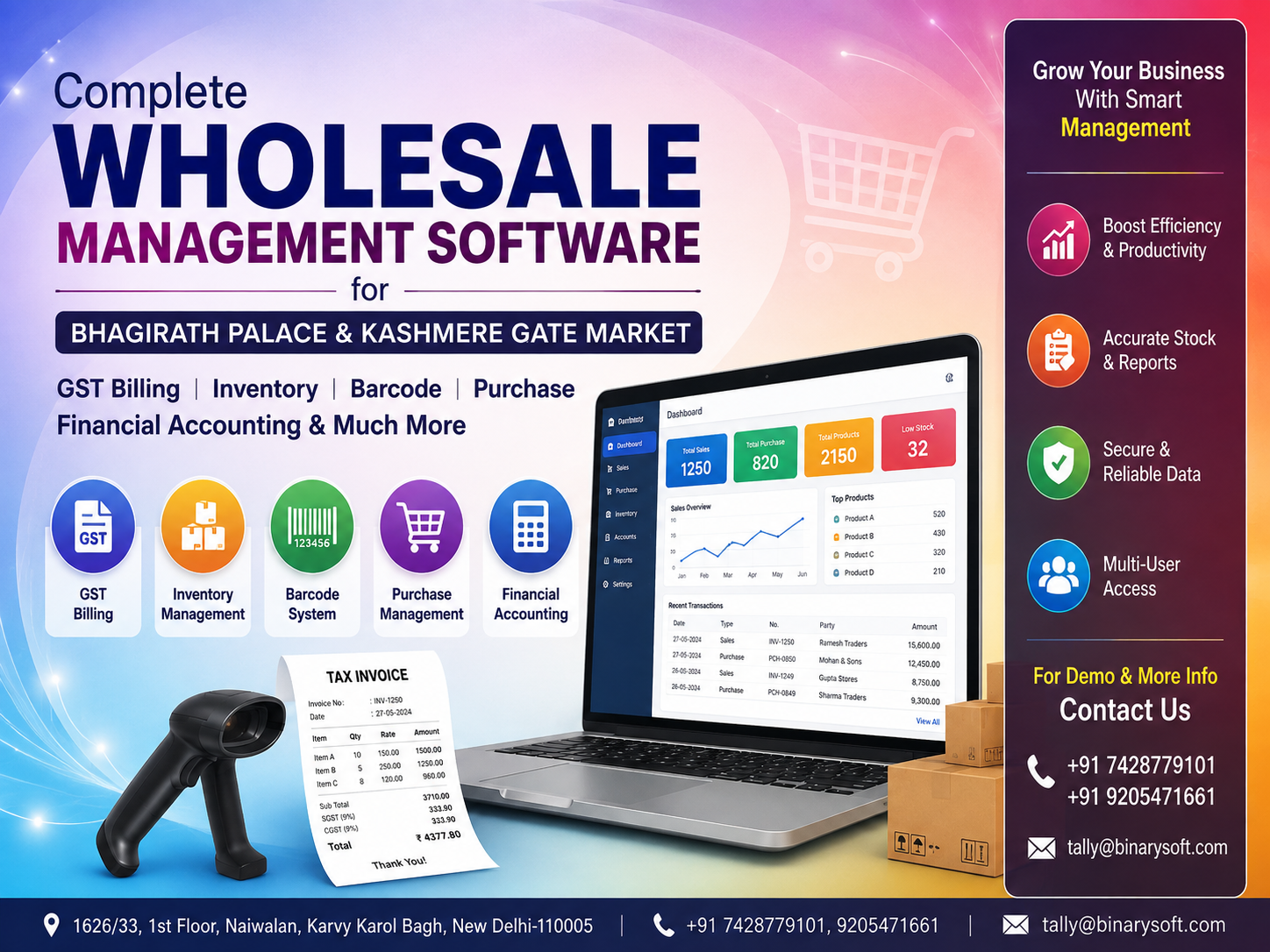
In 2026, wholesale businesses in Bhagirath Palace and Kashmere Gate Market are dealing with faster order cycles, tighter margins, larger product ranges and customers who expect immediate quotations, GST invoices and accurate stock confirmation. The pressure is especially high for wholesalers handling hundreds or thousands of SKUs, multiple suppliers, bulk purchases, credit customers, barcode-based items and frequent price changes. Manual registers and disconnected spreadsheets can create delays in billing, mismatched inventory, duplicate purchase entries and weak visibility over receivables and payables. A modern Wholesale Management Software can connect GST billing, inventory tracking, barcode operations, purchase management and financial accounting in one structured workflow. The practical benefit is clear: quicker invoicing, improved stock control, better supplier tracking, accurate outstanding reports and stronger decision-making. For competitive wholesale businesses in Delhi, real-time information is becoming essential for protecting margins and keeping daily operations under control.
Why Wholesale Businesses in Bhagirath Palace and Kashmere Gate Need Better Software
Bhagirath Palace and Kashmere Gate are among Delhi's major commercial zones, serving buyers from across the city and beyond.
Wholesalers operating in these markets may deal in electrical goods, lighting products, automotive parts, tools, machinery components, batteries, accessories, hardware, industrial supplies, electronic items and other high-volume categories.
The operational challenge is not simply generating an invoice.
A wholesale business may need to manage:
- Thousands of stock items
- Multiple price levels
- Bulk quantities
- Credit customers
- Purchase orders
- Supplier invoices
- GST rates
- HSN information
- Stock transfers
- Warehouses or godowns
- Barcode items
- Customer outstanding
- Supplier outstanding
- Cash and bank transactions
- Profitability
- Sales returns
- Purchase returns
- Debit and credit notes
When these activities are managed through separate systems, information can become fragmented.
A wholesale management solution brings these areas together.
What Is Wholesale Management Software?
Wholesale Management Software is a business system designed to manage the complete transaction cycle of a wholesale operation.
Depending on configuration, it can help businesses handle:
GST billing
Sales orders
Purchases
Inventory
Barcode management
Receivables
Payables
Accounting
Taxation
Banking
Business reports
Customer information
Supplier information
The objective is to reduce repetitive work and give business owners a clearer picture of day-to-day operations.
GST Billing for Wholesale Businesses
GST billing is one of the most important functions in a wholesale business.
Wholesalers commonly deal with B2B customers who require accurate invoices containing relevant GST details.
A properly configured GST billing system can capture information such as:
Customer name
GSTIN
Invoice number
Invoice date
Product details
HSN or SAC information where applicable
Quantity
Rate
Taxable value
Discount
CGST
SGST
IGST
Applicable cess, where relevant
Invoice total
The tax treatment depends on the nature and place of supply.
Using software helps automate calculations based on configured data, reducing repetitive manual work.
A Bhagirath Palace Wholesaler Who Nearly Lost a Major Customer
Consider a fictional electrical goods wholesaler operating in Bhagirath Palace.
The business had grown steadily over fifteen years.
The owner, Rakesh, knew many customers personally.
His staff could recognize popular products without even looking at the packaging.
But the business had one weakness.
Inventory was being managed partly through software and partly through handwritten notes.
One Monday morning, a large contractor called.
He urgently needed 300 units of a particular electrical component.
Rakesh checked the system.
It showed 420 units available.
He immediately confirmed the order.
The customer arranged transport and sent his purchasing team.
When warehouse staff began picking the goods, they discovered only 185 units.
The remaining quantity had already been dispatched against earlier orders but had not been properly updated.
The customer was furious.
His project had a deadline.
For Rakesh, the embarrassment was worse than losing one order.
The customer had trusted him because he had promised immediate availability.
That evening, Rakesh reviewed the entire workflow.
The real issue was not a shortage of stock.
It was a shortage of reliable information.
After implementing stricter inventory procedures, bill-wise stock updates and barcode-based identification for relevant products, the business became more disciplined.
The next time a customer asked for 300 units, Rakesh did not rely on memory or a handwritten slip.
He checked the system.
The stock figure reflected the latest transactions.
That confidence changed the way he handled large orders.
For wholesale businesses, accurate inventory is not merely an internal accounting requirement.
It directly affects customer trust.
Real-Time Inventory Management
Inventory is one of the largest investments for many wholesalers.
If stock data is incorrect, purchasing and sales decisions can also become incorrect.
A wholesale inventory management system can help track:
Opening stock
Purchases
Sales
Purchase returns
Sales returns
Stock transfers
Damaged goods
Adjustments
Closing stock
Businesses can view item-wise quantities and monitor movement over time.
Avoid Overstocking
Buying too much inventory can block working capital.
A wholesaler may purchase heavily because a supplier offers a discount, only to discover later that demand has slowed.
The goods remain in the warehouse while money remains tied up.
Inventory reports can help management identify:
Slow-moving items
Non-moving products
High-value stock
Old inventory
Excess quantities
Management can then make more informed purchasing decisions.
Avoid Stock-Outs
The opposite problem is equally serious.
If a popular item runs out repeatedly, customers may begin buying from competitors.
A well-managed inventory system can help identify products approaching reorder levels.
Wholesalers can then place orders before stock reaches a critical level.
Barcode Management for Wholesale Businesses
Barcode systems are commonly associated with retail billing, but they can also be valuable for wholesale operations.
Barcodes can assist with:
Product identification
Stock inward
Stock outward
Picking
Packing
Billing
Warehouse movement
Physical verification
When a product has a unique barcode, staff can reduce dependence on manually typing item names or codes.
This can be particularly helpful when many products have similar names or model numbers.
Barcode Benefits for Bhagirath Palace Businesses
Electrical and electronic wholesale businesses can carry hundreds of similar-looking products.
For example:
Different wattages
Different brands
Different sizes
Different specifications
Different pack quantities
Different models
Barcode-based identification can reduce the chance of selecting the wrong variant.
Barcode Benefits for Kashmere Gate Businesses
Kashmere Gate businesses dealing in automotive parts, accessories and industrial components often manage large numbers of product codes.
A single product family may contain dozens of models.
Barcode scanning can make inward and outward stock processes faster and more systematic.
Purchase Management
Wholesale profitability depends heavily on purchasing.
A small difference in purchase price can affect margins across large quantities.
Purchase management software can help businesses maintain records of:
Suppliers
Purchase invoices
Purchase rates
Tax details
Quantities
Discounts
Freight
Other charges
Outstanding amounts
Due dates
This information can support both operational and financial decision-making.
Supplier Comparison
Suppose three suppliers offer the same product.
Supplier A offers a lower price but slower delivery.
Supplier B offers a slightly higher rate but longer credit.
Supplier C offers better bulk discounts.
With structured purchase history, management can compare supplier performance instead of relying only on memory.
Purchase Order Management
For larger transactions, purchase orders help create control.
A purchase order can record:
Supplier
Products
Quantity
Rate
Terms
Expected delivery
Payment conditions
The goods received can then be compared with the original order.
This reduces the risk of incorrect quantities or rates being accepted without review.
Goods Receipt and Purchase Verification
When stock arrives, warehouse staff should verify:
Quantity
Product code
Physical condition
Batch, where relevant
Serial details, where relevant
Purchase order reference
Invoice details
Discrepancies should be recorded promptly.
This helps both inventory accuracy and supplier reconciliation.
Sales Order Management
Wholesale customers may place orders through phone calls, WhatsApp, email or sales representatives.
A structured sales order process helps capture the requirement before billing.
Management can review:
Customer
Items ordered
Quantity
Agreed rate
Discount
Expected dispatch date
Outstanding credit exposure
Stock availability
The order can then move toward dispatch and invoicing.
Customer-Specific Pricing
Wholesale businesses often do not sell every item at the same rate to every customer.
Pricing may vary according to:
Customer relationship
Order quantity
Payment terms
Location
Distributor status
Dealer category
Seasonal promotions
Volume commitments
A structured system can help businesses manage different rate policies where supported by the chosen configuration.
Credit Customer Management
Credit sales are common in wholesale businesses.
They also create risk.
A business may record strong sales but still experience cash-flow problems if customers delay payment.
A wholesale management system can help track customer outstanding balances.
Management can review:
Invoice amount
Amount received
Balance due
Due date
Ageing
Overdue invoices
This makes collection follow-up more systematic.
Receivables Ageing
Receivables ageing can divide outstanding amounts into periods such as:
0–30 days
31–60 days
61–90 days
Above 90 days
Businesses can identify customers whose balances are becoming risky.
This allows sales and finance teams to intervene earlier.
Customer Credit Limits
Some wholesalers provide customer-specific credit limits.
For example:
Customer A: ₹2 lakh
Customer B: ₹5 lakh
Customer C: ₹10 lakh
Before confirming a new order, the business can review existing outstanding and determine whether additional credit should be allowed.
Supplier Payables
Just as customer payments need monitoring, supplier obligations also require attention.
A payable report can show:
Supplier-wise outstanding
Invoice due dates
Overdue bills
Upcoming payments
Purchase history
Businesses can plan cash flow accordingly.
Financial Accounting
Wholesale management becomes significantly stronger when operational transactions are connected with accounting.
A good accounting system can help maintain:
Sales
Purchases
Receipts
Payments
Journal entries
Cash
Bank
Debtors
Creditors
Expenses
Duties and taxes
Profit and loss
Balance sheet
Cash flow information
This creates a more complete financial picture.
Why Integrated Accounting Is Better Than Separate Systems
Suppose billing happens in one application while accounting is maintained separately.
The same sale may need to be entered twice.
This increases:
Workload
Possibility of mismatch
Risk of omission
Reconciliation time
An integrated setup can reduce duplicate entry because the accounting effect is generated from the business transaction itself.
Cash and Bank Management
Wholesale businesses may receive payments through:
Cash
Cheque
NEFT
RTGS
IMPS
UPI
Bank transfer
Payment gateway
Accurate recording of these transactions helps management understand available cash and bank balances.
Bank reconciliation can also help identify differences between accounting records and bank statements.
GST and Financial Accounting Together
When GST billing and accounting are connected, businesses can maintain better visibility over:
Output tax
Input tax
Tax liability
Purchases
Sales
Debit notes
Credit notes
Business expenses
The system can support the preparation of records required for GST reconciliation.
However, businesses should still review compliance with their accountant or tax professional.
Item-Wise Profitability
One of the biggest advantages of detailed business data is the ability to analyse profitability.
Two products may generate similar sales but very different margins.
For example:
Product A sells frequently but provides a 4% margin.
Product B sells less frequently but provides a 15% margin.
Management should know the difference.
Reports can help businesses understand which categories deserve more working capital.
Category-Wise Sales Analysis
Wholesalers can group products into categories such as:
Electrical fittings
Lighting
Cables
Switches
Automotive parts
Bearings
Tools
Accessories
Hardware
Reports can then show which categories are performing better.
Brand-Wise Performance
Businesses handling multiple brands may want to know:
Which brand sells fastest?
Which brand generates higher margin?
Which brand has more returns?
Which brand blocks more inventory?
This can influence future purchasing agreements.
Fast-Moving and Slow-Moving Inventory
A fast-moving item may require frequent replenishment.
A slow-moving item may need:
Discounting
Bundling
Reduced future purchasing
Supplier return discussions
Promotional activity
Inventory reports make these decisions more data-driven.
Godown and Warehouse Management
Many wholesalers operate from:
Main shop
Warehouse
Secondary godown
Dispatch location
Different stock locations should be tracked separately where required.
A system can help businesses understand which location holds which quantity.
Stock Transfer Between Locations
Suppose stock needs to move from a Kashmere Gate warehouse to a retail counter.
The transfer should be recorded.
Otherwise, one location may appear overstocked while the other appears short.
Proper transfer entries improve inventory visibility.
Physical Stock Verification
Software records should periodically be compared with physical stock.
Differences can arise because of:
Damage
Breakage
Wrong dispatch
Theft
Incorrect entry
Unrecorded returns
Counting mistakes
Regular physical verification helps identify problems early.
Serial Number Tracking
Some products may need serial number tracking.
This is especially relevant for certain electrical, electronic, machinery or automotive products.
Serial tracking can help businesses identify:
Which unit was purchased
Which supplier supplied it
When it was sold
Which customer purchased it
Whether warranty or service history exists
Availability depends on the software configuration used.
Batch Management
For applicable product categories, batch tracking may also be useful.
Businesses can maintain information about:
Batch number
Purchase date
Quantity
Expiry or manufacturing details where applicable
This is more relevant to specific product categories.
Sales Return Management
Wholesale businesses frequently receive returns.
Reasons may include:
Wrong product
Incorrect specification
Damage
Excess supply
Customer cancellation
Quality issue
A systematic sales-return entry ensures that inventory and accounting both reflect the transaction correctly.
Purchase Return Management
Similarly, goods returned to suppliers should be properly recorded.
Purchase returns can affect:
Stock
Supplier outstanding
GST treatment
Purchase value
Maintaining accurate return records avoids later reconciliation issues.
Debit Notes and Credit Notes
Wholesale businesses may issue or receive debit and credit notes due to:
Rate differences
Returns
Discount adjustments
Damages
Quantity differences
Commercial settlements
These documents should be integrated with accounting so balances remain accurate.
E-Invoicing and Other GST Requirements
Certain businesses may become subject to e-invoicing requirements depending on applicable GST turnover thresholds and notifications.
Businesses should check current GST rules and ensure their billing environment supports the relevant compliance process if applicable.
This is particularly important for growing wholesalers whose turnover may cross statutory thresholds.
E-Way Bill Considerations
Goods movement may also require an e-way bill where the applicable conditions are met.
Wholesale businesses dispatching goods across Delhi or to other states should understand when e-way bill requirements arise.
Accurate invoice and dispatch information helps simplify the process.
Why Bhagirath Palace Businesses Need Strong Stock Coding
Bhagirath Palace is known for businesses dealing in products with numerous technical specifications.
A product description such as:
"LED Driver"
may not be enough.
There may be:
12W
18W
24W
36W
Different brands
Different voltages
Different models
Without proper item coding, staff may select the wrong product.
Clear stock codes and barcode structures can reduce this confusion.
Why Kashmere Gate Businesses Need Part-Level Inventory
Kashmere Gate wholesalers may manage automobile and industrial parts.
Parts can vary according to:
Vehicle
Model
Year
Brand
Size
Specification
Part number
A reliable inventory system makes search and identification easier.
Mobile and Remote Business Visibility
Business owners increasingly expect access to information even when they are away from the shop.
Depending on the software and setup selected, remote access or cloud-hosted environments can help authorized users view business information from outside the office.
This can be valuable for owners managing multiple locations or travelling frequently.
Security and access controls should be configured properly.
User-Level Security
Different employees need different access.
Billing staff may require sales functionality.
Purchase staff may need supplier and purchase access.
Management may require reports.
Accounts staff may require financial data.
User permissions can help reduce unauthorized changes.
Audit Trail and Transaction Control
Businesses should maintain proper visibility over transaction changes.
Where supported, audit and edit tracking can help management understand:
What changed
Who changed it
When it changed
This improves internal control.
Daily Reports Every Wholesaler Should Review
Business owners do not need to study hundreds of reports every day.
A few reports can provide strong visibility:
Daily sales
Cash and bank position
Customer outstanding
Supplier outstanding
Stock availability
Low-stock items
High-value transactions
These reports can highlight issues quickly.
Weekly Management Review
A weekly review can include:
Fast-moving stock
Slow-moving stock
Overdue receivables
Purchase commitments
Upcoming payments
Gross profit trends
Salesperson performance
Large customer orders
This helps management take corrective action before problems grow.
Monthly Wholesale Business Review
At month-end, businesses should review:
Sales versus previous month
Gross profit
Purchases
Inventory value
Receivables
Payables
Expenses
Cash flow
GST records
Stock discrepancies
This turns accounting data into business intelligence.
Preparing for Festive and Seasonal Demand
Delhi wholesale markets experience major demand changes during:
Festivals
Wedding season
Financial year-end
Construction cycles
Vehicle demand cycles
Promotional seasons
Wholesalers should analyse historical sales before increasing inventory.
Data-based planning can reduce both stock-outs and overstocking.
Better Purchase Planning
Before placing a large purchase order, management should check:
Current stock
Pending sales orders
Previous sales
Supplier lead time
Current purchase price
Customer demand
Available cash
Outstanding supplier payments
This creates more disciplined buying decisions.
Reduce Dependence on Memory
Many wholesale businesses are built by owners who have extraordinary knowledge of their products and customers.
But as a business grows, knowledge cannot remain only in one person's head.
Software creates institutional memory.
Staff can find information even when the owner is unavailable.
This makes the business easier to scale.
Support for Business Expansion
A wholesaler may eventually:
Open another branch
Add a warehouse
Hire more sales staff
Increase product categories
Add new suppliers
Serve new cities
Handle more online orders
A structured management system makes expansion easier because basic processes are already standardized.
Choosing the Right Wholesale Management Software
Before implementing software, businesses should evaluate:
Number of users
Number of stock items
Daily transaction volume
Number of locations
GST requirements
Barcode requirements
Accounting needs
Remote access needs
Reporting requirements
Existing data
Staff capability
Integration needs
The best solution is not necessarily the one with the most features.
It is the one that fits the business process properly.
Importance of Proper Implementation
Software implementation should include:
Business requirement analysis
Ledger creation
Stock master setup
GST configuration
Opening balances
Opening inventory
Customer master
Supplier master
Barcode setup
User permissions
Report configuration
Staff training
A rushed implementation can create confusion later.
Data Cleanup Before Migration
Businesses moving from older software or spreadsheets should clean their data first.
Review:
Duplicate customer names
Duplicate suppliers
Inactive stock items
Incorrect GSTINs
Old balances
Wrong item codes
Unused ledgers
Migration is an opportunity to improve data quality.
Staff Training
Even the best software will fail if employees do not use it correctly.
Training should cover:
Sales invoice
Purchase invoice
Receipt
Payment
Return entry
Barcode scanning
Stock transfer
Customer creation
Supplier creation
Reports
Error correction
This reduces dependence on one experienced employee.
Backup and Data Security
Accounting and inventory data are critical business assets.
Businesses should maintain appropriate backup procedures.
Depending on the setup, this may include:
Local backup
External backup
Cloud backup
Access controls
Strong passwords
Authorized users
Recovery procedures
Data security should be planned before an emergency occurs.
How TallyPrime Can Support Wholesale Management
TallyPrime can support accounting, billing, GST, inventory and business reporting requirements for many wholesale businesses.
Depending on the implementation, businesses can manage:
Sales
Purchases
Stock items
Godowns
Receivables
Payables
GST
Banking
Financial reports
Order processing
Additional functionality can be evaluated based on business requirements.
Why Work with an Authorized Tally Partner?
Software selection is only one part of successful implementation.
An Authorized Tally Partner can assist with:
Requirement analysis
License selection
Installation
Configuration
Data migration
GST setup
Inventory setup
Training
Customization or add-on evaluation
Support
The objective should be to create a system aligned with the actual business workflow.
Powered by Binarysoft Technologies
Binarysoft Technologies provides TallyPrime, GST billing, inventory management and accounting solutions for wholesalers, retailers, distributors and other businesses.
Businesses operating in Bhagirath Palace, Kashmere Gate Market and other commercial areas of Delhi can evaluate a software setup based on their transaction volume, product range, number of users and operational requirements.
Binarysoft Technologies
Authorized Tally Partner
Location:
1626/33, 1st Floor, Naiwalan, Karol Bagh, New Delhi – 110005, INDIA
Contact Us:
+91 7428779101, 9205471661
Email Us:
tally@binarysoft.com
Business Hours:
10:00 AM – 6:00 PM, Mon–Fri
Conclusion
For wholesalers in Bhagirath Palace and Kashmere Gate Market, business growth creates both opportunity and complexity.
As product ranges expand and daily transaction volumes increase, relying on manual stock records, separate spreadsheets and disconnected accounting processes can make it harder to understand what is actually happening inside the business.
A well-implemented Wholesale Management Software can connect GST billing, barcode operations, inventory, purchases, customer receivables, supplier payables and financial accounting into one structured workflow.
The biggest advantage is visibility.
A business owner should be able to answer important questions quickly:
What stock is available?
Which products are selling?
Which customers owe money?
Which suppliers need payment?
How much inventory is blocked?
What is the current sales position?
Is the business actually profitable?
When these answers are available through accurate data, decisions become faster and more reliable.
For competitive wholesale businesses in 2026, technology is no longer simply about replacing handwritten bills.
It is about building a more controlled, scalable and financially disciplined operation.
Businesses that maintain accurate inventory, structured purchasing and integrated accounting can reduce operational surprises and serve customers with greater confidence.
CA. Lakshy Vermaa advises small and mid-sized businesses on accounting discipline, tax compliance, and process improvement. With exposure to retail and trading environments, he writes practical articles aimed at helping business owners gain better financial visibility and control.