Call CA Tally HelpDesk
+91 9205471661,
7428779101
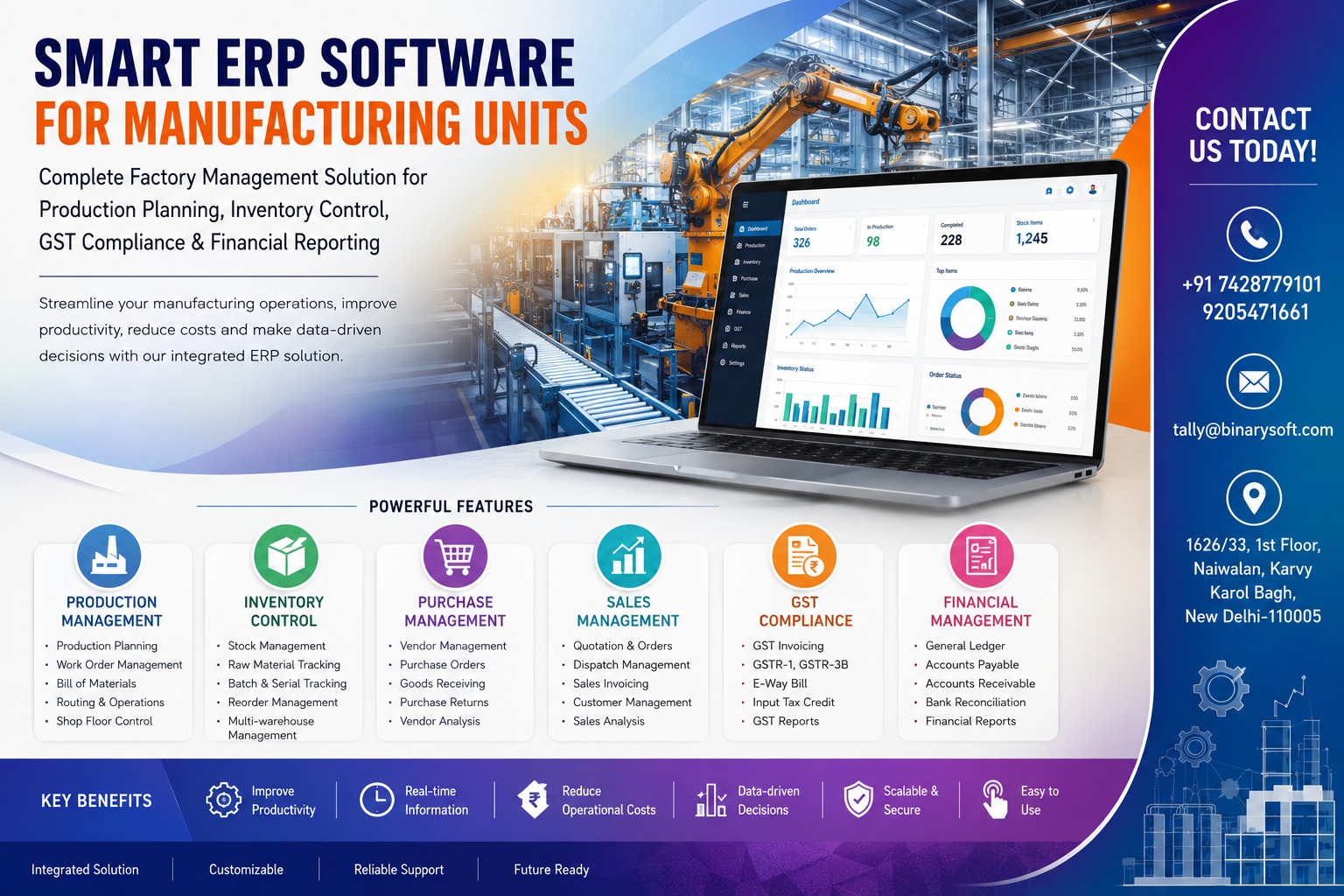
In 2026, manufacturing businesses are facing a completely different operational reality. Rising raw material costs, stricter GST compliance requirements, digital reporting expectations, production delays, and increasing customer demand for faster delivery have forced factory owners to rethink how they manage operations. In recent months, manufacturers using traditional spreadsheets and manual systems have struggled with inventory mismatches, production bottlenecks, delayed dispatches, and inaccurate financial reporting. Smart ERP software has become a necessity rather than a luxury. Modern manufacturing ERP solutions now combine production planning, inventory management, GST compliance, purchase tracking, quality control, and financial reporting into one centralized platform. Factories adopting ERP systems in 2026 are reducing wastage, improving productivity, gaining real-time business visibility, and making faster decisions. Businesses that continue relying on disconnected systems risk operational losses, compliance issues, and slower growth in an increasingly competitive manufacturing market.
What is Smart ERP Software for Manufacturing Units?
ERP stands for Enterprise Resource Planning. Manufacturing ERP software is a complete business management solution designed specifically for factories and production units.
Instead of managing operations through multiple separate systems, ERP integrates every department into one platform, including:
- Production planning
- Inventory management
- Purchase and procurement
- Sales and dispatch
- GST compliance
- Accounting
- Financial reporting
- Warehouse operations
- Human resource management
- Business analytics
This creates a centralized ecosystem where every department shares real-time information.
Why Manufacturing Businesses Need ERP in 2026
Manufacturing companies today face increasing pressure due to:
- Rising operational costs
- Complex supply chains
- Strict GST regulations
- Raw material shortages
- Delivery commitments
- Real-time inventory requirements
- Multi-location business operations
Manual processes often create:
- Production delays
- Stock shortages
- Duplicate purchases
- Financial inaccuracies
- Reporting delays
- Human errors
Smart ERP software eliminates these problems through automation and centralized management.
A Story Every Factory Owner Can Relate To
Rohit Malhotra owned a mid-sized manufacturing unit producing industrial packaging materials. Initially, his factory operations were managed through spreadsheets, manual registers, and separate accounting software.
As business expanded, complications increased.
The purchase department ordered raw materials without checking actual stock levels. Production managers faced delays because materials were unavailable when needed. Inventory records frequently differed from physical stock. Month-end financial reporting became stressful and time-consuming.
One day, a large client order was delayed because of inventory confusion and inaccurate production planning.
The client moved part of its business elsewhere.
That moment changed everything.
In early 2026, Rohit implemented a Smart Manufacturing ERP system with integrated production planning, inventory tracking, GST compliance, and financial reporting.
Within months:
- Production schedules became organized
- Inventory visibility improved
- Raw material wastage reduced
- GST reporting became faster
- Delivery timelines improved
- Financial reports became available instantly
Today, Rohit says ERP gave him complete control over the factory rather than forcing him to react to daily operational chaos.
This transformation is becoming common across modern manufacturing businesses.
Key Features of Manufacturing ERP Software
Production Planning and Scheduling
Production planning is the backbone of every manufacturing business.
ERP software helps businesses:
- Create production schedules
- Track work orders
- Allocate resources
- Monitor machine utilization
- Plan manufacturing capacity
- Optimize production cycles
This ensures smooth production flow and minimizes downtime.
Smart Inventory Control
Inventory management directly affects profitability.
Manufacturing ERP provides:
- Real-time stock monitoring
- Raw material tracking
- Finished goods management
- Batch-wise inventory
- Warehouse management
- Reorder alerts
- Inventory valuation
This prevents overstocking and stock shortages.
Bill of Materials Management
Manufacturers often manage complex product structures.
ERP systems help maintain:
- Multi-level Bill of Materials
- Component tracking
- Raw material consumption
- Production formulas
- Cost calculations
This improves production accuracy and cost control.
Purchase and Procurement Automation
Manual procurement creates delays and purchasing errors.
ERP software automates:
- Purchase requests
- Supplier management
- Vendor performance analysis
- Purchase orders
- Approval workflows
- Procurement tracking
Businesses gain better purchasing efficiency.
GST Compliance and Tax Management
GST management has become increasingly complex for manufacturers.
ERP systems provide:
- GST invoices
- Tax calculations
- Input tax tracking
- E-invoice support
- GST return reports
- Compliance reporting
Automation significantly reduces tax-related risks.
Financial Reporting and Accounting Integration
Accounting is directly connected to manufacturing performance.
ERP integrates:
- Ledger management
- Profit and loss reporting
- Cash flow reports
- Balance sheets
- Cost center accounting
- Receivables and payables
Business owners gain real-time financial visibility.
Warehouse and Dispatch Management
Manufacturing businesses often struggle with logistics.
ERP software improves:
- Dispatch planning
- Goods movement tracking
- Warehouse visibility
- Delivery scheduling
- Shipment status monitoring
This ensures smoother customer order fulfillment.
Major Benefits of Smart Manufacturing ERP
Improved Production Efficiency
ERP optimizes workflows and reduces delays.
Reduced Operational Costs
Automation lowers wastage and improves resource utilization.
Better Inventory Accuracy
Real-time stock visibility prevents shortages and excess inventory.
Faster Business Decisions
Business owners access reports instantly.
Improved Customer Satisfaction
Timely delivery and accurate production improve client trust.
Stronger GST Compliance
Automated tax management reduces penalties and filing mistakes.
Industries Benefiting from Manufacturing ERP
Smart ERP software is useful for:
- Textile manufacturing
- Packaging industries
- Chemical manufacturers
- Food processing businesses
- Plastic manufacturing units
- Pharmaceutical companies
- Furniture manufacturers
- Automobile component factories
- Engineering industries
- Electronics production units
ERP systems adapt to different manufacturing workflows.
Why Manufacturers Are Upgrading in 2026
Several changes are driving ERP adoption:
- Digital transformation initiatives
- Increasing GST compliance demands
- Rising labor costs
- Growing customer expectations
- Competitive market pressure
- Need for operational visibility
Businesses that invest in ERP now gain long-term efficiency advantages.
Future of ERP in Manufacturing
The future of manufacturing ERP includes:
- Artificial Intelligence forecasting
- Machine learning analytics
- Predictive maintenance
- IoT-enabled manufacturing
- Automated quality control
- Real-time factory dashboards
- Mobile ERP monitoring
Factories adopting these technologies early will gain stronger market positions.
How to Choose the Right Manufacturing ERP Software
Before implementing ERP, businesses should evaluate:
- Production planning capability
- Inventory features
- GST support
- Financial reporting options
- User-friendliness
- Scalability
- Technical support
- Industry-specific customization
Choosing an experienced implementation partner also matters significantly.
Contact Details
Powered by Binarysoft Technologies – Authorized Tally Partner
1626/33, 1st Floor, Naiwalan, Karol Bagh,
New Delhi – 110005, INDIA
Contact Us:
+91 9205471661
+91 7428779101
Email:
tally@binarysoft.com
Working Hours:
10:00 AM – 6:00 PM (Mon–Fri)
Conclusion
Smart ERP software has become essential for manufacturing units seeking efficiency, transparency, and growth in 2026. Businesses can no longer depend on isolated systems and manual operations when production planning, inventory control, GST compliance, and financial reporting require real-time visibility.
Modern ERP systems streamline factory operations, improve productivity, reduce wastage, and support faster business decisions. Manufacturers adopting ERP solutions today are positioning themselves for stronger growth and better competitiveness in the future.
Frequently Asked Questions
What is manufacturing ERP software?
Manufacturing ERP software is a centralized business management system that integrates production, inventory, accounting, GST, purchasing, and reporting functions.
Why do manufacturing units need ERP software?
ERP improves operational efficiency, inventory management, production planning, and financial visibility while reducing errors.
Can ERP manage production planning?
Yes, ERP systems help create schedules, monitor work orders, and optimize production resources.
Does ERP support GST compliance?
Yes, manufacturing ERP software supports GST invoicing, tax calculations, compliance reporting, and return preparation.
CA. Priya Tanvi specializes in accounting compliance, GST advisory, and business reporting for small and growing enterprises. She works with business owners to improve record-keeping and financial clarity. Her articles focus on practical compliance solutions and operational discipline.