Call CA Tally HelpDesk
+91 9205471661,
7428779101
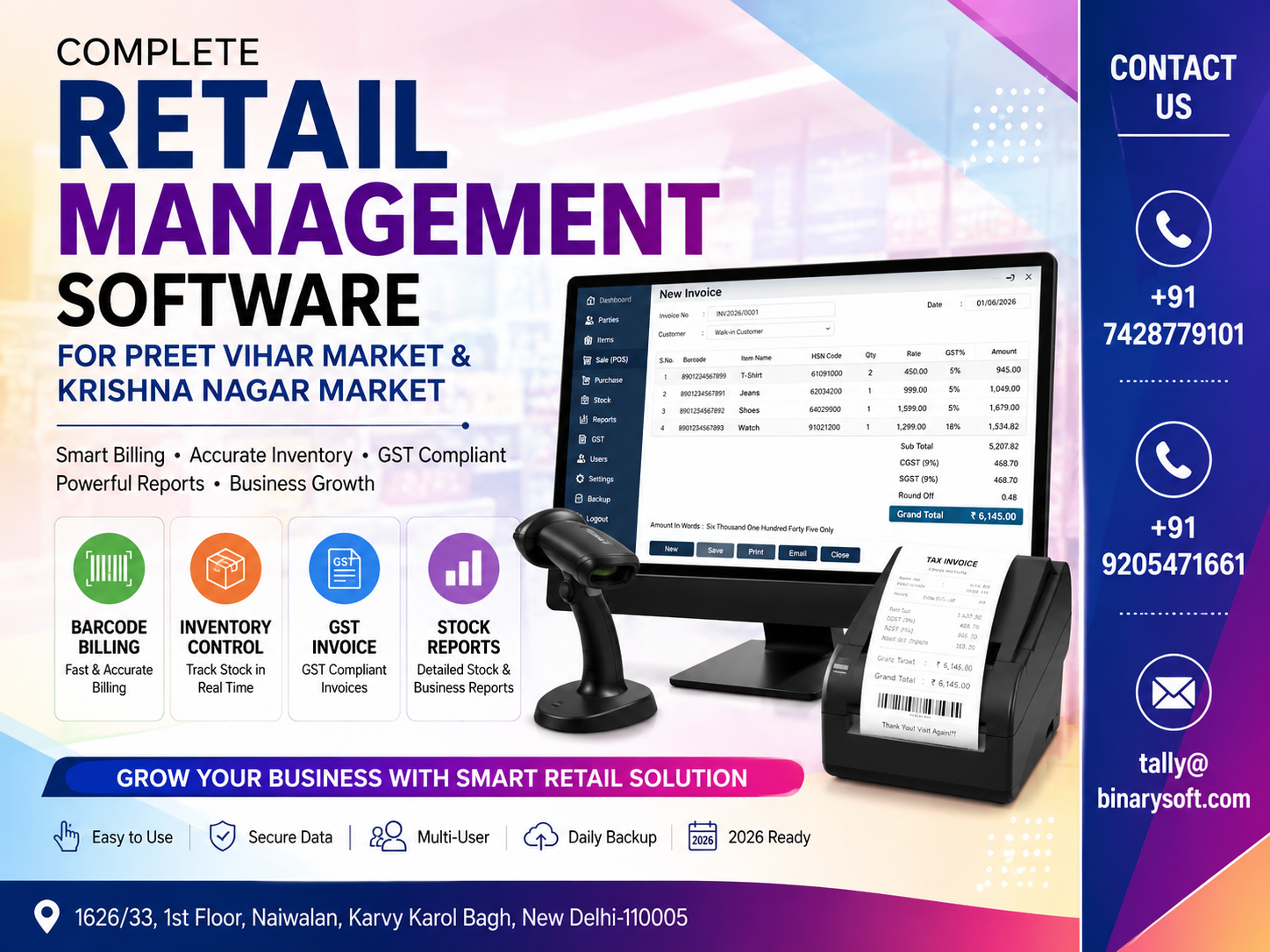
Retail Management Is Changing Fast in 2026
In 2026, retail businesses in Preet Vihar Market and Krishna Nagar Market are facing a different kind of pressure. Customers expect faster checkout, accurate prices and immediate invoices, while retailers must simultaneously control stock, manage GST billing, monitor outstanding payments and understand which products are actually generating profit. In recent months, the need for connected billing and inventory systems has become even more important as businesses handle larger product ranges, multiple payment modes and increasingly digital operations. A billing counter that depends heavily on manual product entry or disconnected spreadsheets can quickly create stock mismatches and reporting delays. Modern retail management software brings barcode billing, GST invoicing, inventory control, purchase management and stock reports into one organized system. For retailers, the benefit is practical: quicker billing, better stock visibility, fewer avoidable errors and more time to focus on customers and business growth.
Why Retail Businesses in Preet Vihar and Krishna Nagar Need Better Software
Preet Vihar and Krishna Nagar are important commercial areas in East Delhi, serving customers across a wide range of retail categories. From apparel and footwear to electronics, cosmetics, household products, accessories, stationery and general merchandise, retailers may deal with hundreds or thousands of different stock items.
As the number of products and daily transactions increases, managing everything manually becomes increasingly difficult.
A retailer needs to know:
- What is currently available in stock?
- Which items are selling quickly?
- Which products need to be reordered?
- What is the purchase cost and selling price?
- How much GST is applicable?
- Which invoices are outstanding?
- What stock is lying unsold?
- What was today's total sale?
- Which product category is generating higher revenue?
- What is the current cash and bank position?
A complete retail management system is designed to bring these different activities together instead of maintaining separate records for billing, stock and accounts.
A Retailer's Story: When a Busy Evening Exposed a Bigger Problem
Consider the example of a fictional retailer operating a busy store near Krishna Nagar Market.
For years, the owner had managed billing with a basic computer system while maintaining some inventory information separately. The process seemed manageable when the store had a limited product range.
As the business expanded, things became complicated.
One Saturday evening, customers were waiting at the billing counter. A customer picked several products, but the staff had difficulty finding the correct item codes and prices. Another customer requested an exchange, while a supplier called asking about an outstanding payment.
At the same time, one of the employees told the owner that a popular item was unavailable.
The owner was surprised because the records showed several units in stock.
After closing the store, the team spent hours checking shelves, purchase records and previous bills. They discovered that some stock entries had not been updated correctly.
The owner realized that the real problem was not simply a missing product.
It was the absence of one connected system.
After introducing structured barcode billing and inventory management, every sale started updating stock records automatically. Product identification became faster, stock reports became easier to review and management could identify low-stock items before customers asked for them.
The biggest change was not just faster billing.
It was confidence.
The owner could finally look at the system and get a clearer picture of what was happening inside the business.
What Is Retail Management Software?
Retail management software is a business solution that helps retailers manage daily operations from a centralized system.
Depending on the implementation, it can combine:
Billing and invoicing
Create professional sales invoices quickly.
Barcode management
Identify products through barcode scanning and reduce repetitive manual entry.
Inventory management
Track stock quantities as purchases and sales are recorded.
GST invoicing
Maintain GST-related information and prepare appropriate invoices according to the business configuration.
Purchase management
Record supplier purchases and update inventory.
Accounting
Maintain sales, purchases, expenses, receipts, payments, ledgers and financial records.
Reporting
Review sales, purchases, stock, outstanding balances and profitability-related information.
Instead of operating several disconnected systems, retailers can maintain a more organized workflow.
Barcode Billing Software for Faster Retail Checkout
Speed matters at a retail counter.
During peak hours, manually searching for products and entering rates can make billing unnecessarily slow.
Barcode-enabled billing can simplify this process.
A product can be assigned a barcode connected with information such as:
- Item name
- Stock item code
- Selling price
- Tax information
- Unit of measurement
- Product category
- Batch information where applicable
When the barcode is scanned, the corresponding product can be selected quickly for billing.
Benefits of Barcode Billing
Barcode-based operations can provide several advantages.
Faster Invoice Creation
Instead of repeatedly typing product names or searching through long lists, staff can identify items by scanning their barcodes.
Reduced Product Selection Errors
Products with similar names, sizes or variants can be easier to distinguish when the barcode structure is properly configured.
Better Customer Experience
Faster checkout can reduce queues, especially during weekends, festivals and seasonal sales.
Easier Staff Training
A properly configured barcode workflow can make billing simpler for employees who may not remember every item code.
Better Stock Integration
When barcode billing is connected with inventory records, the stock quantity can be adjusted as transactions are recorded.
Inventory Control for Retail Businesses
Inventory is one of the most important investments for a retailer.
Too little stock can result in lost sales.
Too much stock can lock working capital into products that are not moving.
Retail inventory software helps management understand stock movement more clearly.
Businesses can monitor information such as:
- Opening stock
- Purchase quantity
- Sales quantity
- Closing stock
- Stock value
- Item-wise movement
- Category-wise stock
- Godown or location-wise inventory
- Fast-moving items
- Slow-moving items
- Reorder requirements
This information can support better purchasing decisions.
Know What Is Actually Available
Imagine that your system shows 50 units of a product but only 35 units are physically available.
That difference can affect customer commitments, purchasing and profitability.
When purchases, sales, returns and stock adjustments are recorded consistently, management gets a much more reliable view of inventory.
Low-Stock and Reorder Management
One of the biggest benefits of computerized inventory management is the ability to identify products that require attention.
Instead of waiting until an employee says:
"This item is finished."
Management can regularly review stock reports and plan purchases.
This becomes particularly useful for high-demand retail items.
Retailers in Preet Vihar Market and Krishna Nagar Market can use reorder-related information to maintain sufficient quantities without unnecessarily overstocking every product.
GST Invoice Management for Retail Businesses
GST billing is an important part of retail accounting in India.
A retail billing system should allow businesses to maintain appropriate tax information and create invoices according to their transaction requirements.
Depending on the business, the system may need to maintain:
- GSTIN
- HSN/SAC information where applicable
- CGST
- SGST
- IGST
- Taxable value
- Tax rate
- Discount
- Invoice number
- Customer details
- Place-of-supply information where relevant
- Sales returns
- Purchase returns
Correct configuration and accurate master data are essential.
Software can automate calculations, but businesses should still ensure that their GST setup and transactions follow applicable legal and accounting requirements.
Sales and Purchase Management
Retail management does not end at the billing counter.
Every product sold must first enter the business through purchase or opening inventory.
A connected system helps maintain the complete movement:
Purchase → Inventory → Sale → Payment → Accounting → Reports
When these activities are connected, retailers can reduce duplicate work.
For example, recording a purchase can update the supplier ledger and inventory. Recording a sale can affect customer accounts, revenue and available stock according to the configured accounting workflow.
This creates a more organized information flow.
Stock Reports That Help Owners Make Decisions
Data becomes useful when it can answer business questions.
A retail management system should provide meaningful reports rather than simply storing transactions.
Stock Summary
Understand the quantity and value of inventory currently available.
Item-Wise Stock Report
Review the stock position of individual products.
Sales Report
Analyze sales for a particular day, week, month or selected period.
Purchase Report
Understand what products were purchased and from which suppliers.
Fast-Moving Stock Report
Identify products that are selling frequently.
Slow-Moving Stock Analysis
Find inventory that may be occupying shelf and warehouse space without sufficient sales movement.
Profitability Analysis
Depending on the accounting configuration and available data, businesses can analyze revenue, cost and profitability-related information.
Outstanding Reports
Review receivables and payables so that pending collections and supplier obligations can be followed up.
Retail Software for Different Types of Businesses
Retail management software can be useful across multiple sectors in Preet Vihar and Krishna Nagar.
Garment and Fashion Stores
Manage products by relevant attributes such as size, design, category or other configured variants.
Footwear Shops
Maintain different styles and sizes while improving product identification through barcodes.
Electronics Retailers
Manage products, accessories, purchases, sales and inventory systematically.
Cosmetics Stores
Handle large product ranges, brands and item variations more efficiently.
Grocery and General Stores
Speed up billing and maintain better visibility of frequently moving products.
Stationery Stores
Manage hundreds or thousands of low-value SKUs without relying completely on manual identification.
Hardware and Electrical Stores
Maintain item-wise quantities, prices, purchase information and customer billing.
Gift and Lifestyle Stores
Manage diverse product categories through structured stock masters.
Multi-Location Inventory Management
Some businesses begin with one store and later expand to another outlet, warehouse or godown.
At that stage, stock visibility becomes more complicated.
Businesses may need to understand:
- Stock available at Store A
- Stock available at Store B
- Warehouse stock
- Stock transferred between locations
- Combined inventory position
A properly implemented inventory system can support structured location-wise stock management, depending on the selected software and configuration.
Accounting Integration Makes Retail Management Stronger
Billing software that only generates invoices provides limited visibility.
A complete business management approach connects billing with accounting.
Retailers can maintain:
- Sales
- Purchases
- Receipts
- Payments
- Expenses
- Cash
- Bank
- Debtors
- Creditors
- GST-related records
- Profit and Loss Account
- Balance Sheet
This means business owners do not need to wait until the end of the month to start understanding their financial position.
Regularly updated books can provide better visibility throughout the accounting period.
Customer Outstanding Management
Not every retailer operates purely on immediate cash sales.
Businesses selling to regular customers, offices, dealers or other businesses may provide credit.
Retail software can help maintain customer ledgers and outstanding balances.
Management can identify:
- Customer-wise outstanding
- Invoice-wise outstanding
- Overdue amounts
- Payment received
- Balance payable
This makes collection follow-up more systematic.
Supplier and Purchase Outstanding Management
Retailers also need to manage supplier payments.
The system can help track:
- Supplier purchases
- Credit purchases
- Payments
- Pending bills
- Outstanding amounts
Better payable visibility can help retailers plan working capital and maintain supplier relationships.
Sales Return and Purchase Return Management
Returns are a normal part of many retail businesses.
Customers may return products because of size, defect, incorrect selection or another valid reason.
Similarly, retailers may need to return products to suppliers.
A structured software system can record sales returns and purchase returns so that inventory and accounting records remain aligned with the transactions entered.
Why Real-Time Stock Visibility Matters
Consider a customer asking:
"Do you have this product in another size?"
Without reliable stock information, staff may need to physically search the store or warehouse.
With updated inventory records, they can check availability more quickly.
For a retailer, this can mean the difference between completing a sale and losing the customer.
Reduce Dependence on Manual Excel Sheets
Spreadsheets can be useful for many business activities, but managing an expanding retail operation entirely through manually updated sheets can become difficult.
Common problems may include:
- Duplicate entries
- Wrong formulas
- Outdated stock quantities
- Multiple versions of the same file
- Missing purchase entries
- Incorrect product names
- Limited transaction control
- Difficulty tracing changes
Dedicated retail management software creates a more structured transaction environment.
Business Reports for Better Planning
Retailers should not have to depend only on intuition.
Reports can support decisions such as:
- Which products should we purchase again?
- Which items are not selling?
- Which category generates the most sales?
- How much money is outstanding?
- How much stock is currently held?
- Which supplier has pending payments?
- What were today's sales?
- How is this month performing compared with previous periods?
A business that regularly reviews its numbers can react more quickly to changes.
TallyPrime for Retail Business Management
Tally Solutions offers TallyPrime as a business management and accounting platform used by businesses for accounting, inventory, taxation and related operations.
For retailers, a properly configured TallyPrime environment can support functions such as:
- Accounting
- Inventory management
- GST invoicing
- Purchase and sales transactions
- Receivables and payables
- Stock reporting
- Financial statements
- Business reports
The exact setup should be planned according to the retailer's products, billing workflow, number of users and operational requirements.
Retail Software Implementation: Configuration Matters
Buying software alone does not solve every operational problem.
Implementation matters.
Before moving to a computerized retail system, businesses should consider how they want to structure:
- Stock groups
- Stock categories
- Units
- Product names
- Opening balances
- GST details
- HSN information
- Customer ledgers
- Supplier ledgers
- Godowns
- Barcode structure
- User access
- Backup procedures
Poorly structured master data can create confusion even when the underlying software is powerful.
A good implementation begins by understanding the business workflow first and configuring the software accordingly.
Data Backup Should Be Part of Daily Operations
Business data is valuable.
Retailers should maintain appropriate backup procedures rather than depending on a single computer or storage location.
A sensible backup policy can include regular backups, periodic verification and controlled access to important business information.
Businesses should also determine who is authorized to create, access and restore backups.
User Access and Internal Control
If multiple employees use the system, every employee may not require access to every function.
For example, billing staff may need sales-entry access while management may require broader financial reports.
Appropriate access controls can reduce unnecessary exposure of sensitive business information and improve accountability.
Choosing Retail Management Software in 2026
Before selecting a solution for your retail store, evaluate what your business actually needs.
Important considerations include:
Billing volume: How many invoices are generated every day?
Number of products: Are you managing hundreds or thousands of SKUs?
Barcode requirements: Do you need barcode scanning or structured product identification?
GST requirements: Does your billing workflow require detailed GST configuration?
Inventory complexity: Do you have one store or multiple stock locations?
Accounting requirements: Do you need integrated financial accounting?
Users: How many employees will use the system?
Reports: What information does management need daily?
Growth plans: Will the business add more products, employees or locations?
Selecting software according to these requirements is usually more effective than choosing solely on price.
Benefits for Preet Vihar Market Retailers
For retailers operating in and around Preet Vihar, an integrated retail system can help organize growing sales and inventory operations.
Businesses can benefit from faster product billing, systematic stock records, GST invoice management, purchase tracking and improved financial visibility.
The objective is to reduce unnecessary administrative work while giving management more useful information.
Benefits for Krishna Nagar Market Retailers
Krishna Nagar's busy retail environment can create significant pressure during peak shopping periods.
Barcode-based product identification and organized inventory management can help stores process transactions faster while maintaining better stock records.
Retailers can also use business reports to understand sales patterns, stock requirements and outstanding balances.
From Billing Software to Business Management
The biggest shift in retail technology is understanding that software should do more than print a bill.
A useful retail system should connect different parts of the business.
When a product is purchased, inventory changes.
When it is sold, stock changes again.
When payment is received, accounts change.
When expenses are entered, profitability changes.
When all these transactions are recorded systematically, management gets a clearer picture of the business.
That is the real value of integrated retail management.
Preparing Your Retail Business for Future Growth
A small store today may become a larger retail operation tomorrow.
The system selected in 2026 should therefore support not only today's requirements but also expected growth.
As transaction volume increases, structured inventory, accounting and reporting become increasingly important.
The objective should be to create a digital foundation that can support more customers, more products and more transactions without losing financial control.
Why Work with an Authorized Tally Partner?
Businesses considering TallyPrime can benefit from working with an authorized partner for understanding licensing, installation, configuration and support requirements.
Binarysoft Technologies provides Tally-related solutions and assistance for businesses looking to improve accounting, GST billing, inventory and business operations.
For retailers in Preet Vihar Market, Krishna Nagar Market and other parts of Delhi, the first step should be understanding the existing workflow and identifying where billing, inventory or accounting processes need improvement.
Conclusion
Retail businesses in Preet Vihar Market and Krishna Nagar Market are operating in an environment where speed, accuracy and stock visibility increasingly matter.
Barcode billing can accelerate checkout. Inventory management can provide better visibility of available products. GST invoicing can organize tax-related billing. Purchase and sales management can connect stock movement with business transactions. Accounting integration can provide clearer financial information, while stock and outstanding reports can help owners make better decisions.
The goal of retail management software in 2026 is not simply computerization.
It is control.
A well-configured system helps retailers understand what they sold, what they purchased, what remains in stock, what customers owe, what suppliers need to be paid and how the business is performing.
For growing retailers, that visibility can become a significant operational advantage.
Frequently Asked Questions
What is retail management software?
Retail management software helps businesses manage activities such as billing, inventory, purchases, sales, customer accounts, supplier accounts, GST invoicing and business reporting from a structured system.
Is barcode billing useful for small retail shops?
Yes. Even smaller stores with a substantial number of products can benefit from barcode-based product identification because it can make billing faster and reduce manual product searching.
CA. Arinav Chakraborty advises businesses on taxation, accounting systems, and financial planning. His professional interests include digital transformation, compliance management, and improving business efficiency through technology.