Call CA Tally HelpDesk
+91 9205471661,
7428779101
What Changed in 2026: Delhi Businesses Need More Than Basic Accounting Software
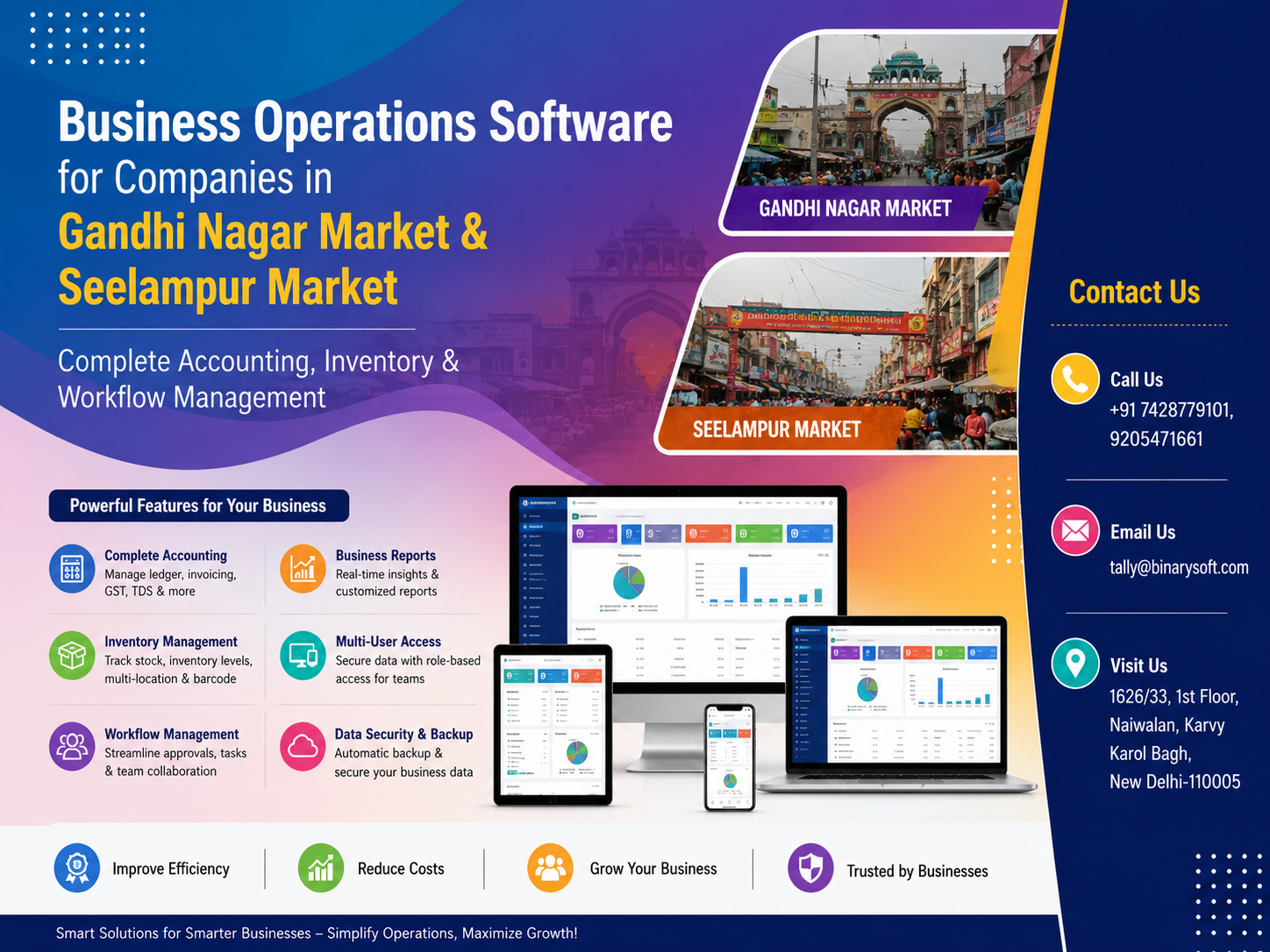
In 2026, businesses operating in Gandhi Nagar Market and Seelampur Market are facing a different kind of operational pressure. Faster GST-driven processes, growing transaction volumes, tighter inventory margins, digital payments, multiple sales channels and the need for real-time business information have made manual registers and disconnected spreadsheets increasingly difficult to manage. A delayed stock update can result in an incorrect customer commitment, while an accounting mistake can affect GST reporting, outstanding payments and management decisions. This is why companies are increasingly looking beyond simple billing tools toward integrated business operations software. A modern system can bring accounting, GST, inventory, purchasing, sales, receivables, payables and management reporting into one connected workflow. For growing businesses, the real benefit is not merely faster billing—it is gaining better control over everyday operations, reducing repetitive work and giving owners clearer information for faster, more confident decisions.
Why Business Operations Software Matters in Gandhi Nagar and Seelampur
Gandhi Nagar Market and Seelampur Market are important commercial areas of Delhi where businesses often deal with high transaction volumes, multiple suppliers, wholesalers, retailers, distributors and frequent movement of inventory.
For such businesses, managing operations is rarely limited to creating an invoice.
A typical business may need to handle:
- Customer and supplier accounts
- GST-compliant invoicing
- Purchase management
- Inventory tracking
- Multiple product categories
- Outstanding receivables
- Supplier payments
- Bank transactions
- Cash flow
- Sales orders
- Purchase orders
- Stock transfers
- Returns and adjustments
- Business reports
- User responsibilities
- Management-level financial information
When these activities are maintained separately, management can lose visibility over what is actually happening in the business.
An integrated accounting, inventory and workflow management solution can connect these processes and create a more organized operational environment.
From Billing Software to Complete Business Management
Many companies begin their digital journey with one basic requirement: computerized billing.
As the business grows, the requirements change.
The owner may initially need only invoices and ledgers. Later, the same company may need stock management, GST reporting, customer outstanding reports, supplier balances, profitability analysis, order tracking and departmental controls.
This is where a scalable business operations platform becomes valuable.
Instead of maintaining one application for billing, another spreadsheet for inventory and additional manual records for outstanding payments, companies can work toward maintaining business information through a connected accounting environment.
Solutions such as TallyPrime can support accounting, inventory, taxation and business reporting requirements, depending on the company's configuration and operational needs.
A Story from a Busy Delhi Market: When One Missing Stock Update Changed the Day
Imagine a garment wholesaler operating near Gandhi Nagar Market.
For years, the business had grown through relationships, market knowledge and the owner's remarkable memory. He knew his major customers, remembered supplier rates and could often estimate available stock without opening a register.
But the business had changed.
His son had joined the company. Orders were arriving through phone calls and messaging applications. Different employees were handling billing, dispatch and purchasing.
One afternoon, a long-standing customer called for a large quantity of a fast-moving product.
The salesperson checked an old stock sheet and confidently confirmed availability.
The customer arranged transport.
Only when the warehouse team began preparing the material did they discover that much of the stock had already been sold that morning.
The stock sheet had not been updated.
The customer was angry. The salesperson was embarrassed. The owner spent hours calling suppliers and arranging replacement material.
The financial loss was manageable.
What bothered him more was the feeling that his growing business was becoming harder to control.
The company did not have a sales problem. It had an information problem.
After reorganizing its accounting and inventory process, the team started recording transactions through a centralized system. Sales entries affected inventory, purchase information was recorded systematically, and management could review stock and outstanding information more easily.
The biggest change was not on the computer screen.
It was in the owner's routine.
Instead of asking five different people, "What happened today?" he could begin reviewing structured business information himself.
For many growing companies, that feeling of control is the real value of business operations software.
Complete Accounting Management for Growing Companies
Accounting is the financial foundation of business operations.
Companies in Gandhi Nagar Market and Seelampur Market may process hundreds or thousands of transactions involving customers, suppliers, expenses, taxes and banking activities.
A structured accounting system can help businesses maintain:
Sales Accounting
Record sales transactions systematically and maintain customer-wise information.
Businesses can review sales according to customers, products, periods and other configured reporting structures.
Purchase Accounting
Purchases directly affect inventory, supplier balances and cash requirements.
Proper purchase accounting helps companies understand:
- What was purchased
- From which supplier
- At what value
- Applicable taxes
- Payment outstanding
- Purchase returns
- Inventory impact
Ledger Management
Well-maintained ledgers help businesses monitor customers, suppliers, expenses, income, banks and other accounts.
Receivables Management
Sales do not automatically mean available cash.
Companies need to know how much money customers owe and how long individual invoices have remained unpaid.
Receivables reporting can help management prioritize collection activities.
Payables Management
Supplier relationships are critical in wholesale and distribution businesses.
A clear payable position enables companies to plan payments and manage working capital more effectively.
Cash and Bank Management
Businesses can maintain cash and bank-related entries and use accounting reports for reconciliation and financial monitoring.
Inventory Management: Know What You Have Before You Sell It
Inventory is one of the largest investments for many trading, wholesale and distribution businesses.
Poor inventory visibility can create two opposite problems.
The first is overstocking.
Money remains blocked in products that are not moving.
The second is stock shortage.
Customers request products, but the company cannot fulfill the order because the required quantity is unavailable.
Business operations software can help companies create a more structured inventory process.
Stock Item Management
Businesses can organize products using appropriate stock groups, categories, units and item-level records according to their requirements.
A systematic product structure becomes especially useful when the company deals with hundreds or thousands of SKUs.
Real-Time Stock Visibility
When inventory transactions are recorded correctly and promptly, management can get a clearer view of available stock.
This helps sales teams make better commitments to customers.
Location-Wise Inventory
Businesses operating warehouses, shops or multiple stock locations may need location-wise stock tracking.
This can help answer questions such as:
"How much stock is available?"
"Where is the stock located?"
"Which location needs replenishment?"
Reorder Planning
Instead of waiting until stock reaches zero, businesses can use inventory information to identify products approaching minimum desired quantities.
Better reorder planning can reduce lost sales and unnecessary emergency purchasing.
Slow-Moving and Fast-Moving Products
Not every product contributes equally to business performance.
Management should identify which products move regularly and which products remain in inventory for long periods.
Such information can support better purchasing and working-capital decisions.
GST-Ready Accounting and Billing
GST compliance remains an important consideration for Indian businesses.
Companies need accurate transaction data because GST-related processes depend heavily on the quality of accounting records.
A properly configured accounting solution can support GST-related invoicing and reporting requirements applicable to the business.
This can include maintaining information related to:
- GSTIN
- HSN/SAC
- Taxable value
- CGST
- SGST
- IGST
- Tax rates
- Sales and purchase transactions
- Debit and credit notes
- GST reports
Businesses should ensure that their tax configurations and processes are reviewed according to their specific compliance requirements and current regulations.
E-Invoicing and E-Way Bill Requirements
Depending on applicability under current government rules, businesses may also need to manage e-invoicing and e-way bill processes.
For companies processing a high number of transactions, reducing repetitive data entry can be particularly valuable.
The objective should be to maintain accurate transaction information from the beginning so that subsequent compliance activities become easier to manage.
Workflow Management: Connect People, Transactions and Responsibilities
Business operations are not only about accounting.
They are also about people and processes.
Consider a normal order cycle:
Customer Requirement → Sales Order → Stock Verification → Invoice → Dispatch → Payment Follow-Up → Accounting → Management Review
If each stage is handled independently without proper information flow, delays and mistakes can occur.
A structured system can improve coordination by ensuring that transactions are recorded and accessible to authorized users.
Sales Order Management
Sales orders can help businesses track customer requirements before final invoicing.
This is particularly useful when an order is received today but material will be supplied later.
Purchase Order Management
Purchase orders can create better discipline around procurement.
Management can maintain clearer information about what was ordered from suppliers and compare it with actual purchases and deliveries according to the company's process.
Delivery and Dispatch Control
For companies handling frequent dispatches, connecting sales documentation with inventory processes can improve operational visibility.
User-Level Responsibilities
Not every employee should necessarily have identical access.
Depending on the software and configuration used, businesses can establish user-level controls and responsibilities.
For example:
Sales Team → Customer and sales activities
Accounts Team → Accounting and banking
Purchase Team → Supplier and purchase processes
Management → Reports and business review
This can improve accountability while protecting sensitive business information.
Management Reports That Turn Transactions into Decisions
A company may record thousands of transactions every month.
But data itself has limited value unless management can understand it.
Business reports can help transform everyday entries into useful management information.
Important reports may include:
- Profit and Loss Account
- Balance Sheet
- Cash Flow information
- Receivables
- Payables
- Stock Summary
- Sales Reports
- Purchase Reports
- Item-wise performance
- Customer-wise sales
- Supplier-wise purchases
- Outstanding ageing
- GST-related reports
Instead of depending entirely on manually prepared spreadsheets, business owners can review reports generated from recorded transactions.
Why Outstanding Management Is Especially Important
Credit sales are common in many wholesale markets.
A company may appear profitable while simultaneously experiencing cash pressure because customers have not paid on time.
Suppose a business records ₹50 lakh in monthly sales.
If ₹20 lakh remains outstanding for extended periods, the owner may still struggle to pay suppliers, salaries, rent and other expenses.
An outstanding report can help identify:
- Customer-wise outstanding
- Invoice-wise outstanding
- Ageing of receivables
- Long-pending amounts
- Total receivable position
This gives the accounts and collection teams a clearer starting point for follow-up.
Better Supplier Management
Suppliers are equally important.
A business needs reliable information about:
- Supplier balances
- Purchase history
- Pending bills
- Payment obligations
- Product purchases
- Purchase returns
Proper accounting and purchase records can help management maintain healthier supplier relationships and plan payments according to available cash.
Suitable for Different Types of Businesses
Business operations software can be useful across a wide range of organizations operating in and around Gandhi Nagar and Seelampur.
Garment and Textile Businesses
Gandhi Nagar is widely associated with garment and textile trading activity.
Such businesses may require product-wise inventory, purchase management, customer billing, outstanding tracking and GST accounting.
Wholesale Businesses
Wholesalers generally handle high quantities, multiple customers and frequent supplier transactions.
Accurate stock and outstanding information becomes critical.
Distributors
Distributors need strong sales, purchase and inventory coordination to keep products moving efficiently.
Retail Businesses
Retail businesses need quick invoicing combined with reliable stock and accounting information.
Manufacturing Businesses
Depending on operational complexity, manufacturers may require raw-material tracking, finished goods information, production-related records and financial accounting.
Service Companies
Businesses that do not maintain significant physical inventory can still benefit from accounting, invoicing, receivables, expenses and GST-related management.
Moving Away from Excel-Dependent Operations
Excel remains a valuable business tool.
The problem begins when it becomes the primary database for every operational activity.
One employee may maintain stock.xlsx.
Another may maintain outstanding.xlsx.
The accountant has accounts.xlsx.
Management receives monthly-report-final-v3.xlsx.
Soon, nobody is completely sure which file contains the latest information.
Integrated business software can reduce this fragmentation by creating a more centralized transaction-recording process.
Excel can continue to be useful for specialized analysis, but core accounting and inventory records should ideally follow a controlled and consistent workflow.
Reduce Duplicate Data Entry
Duplicate work is one of the hidden costs of inefficient business operations.
For example:
The salesperson writes an order.
The billing operator enters it again.
The stock employee updates another sheet.
The accountant records the transaction separately.
Management then asks someone to prepare a report.
The same transaction has been processed multiple times.
A better-designed workflow aims to capture information systematically and use that recorded data across related business processes wherever supported.
This can save time and reduce the opportunity for human error.
Business Data Security and Backup
Accounting information is among a company's most important digital assets.
Losing years of customer, supplier, inventory or accounting data can severely disrupt operations.
Companies should establish appropriate data-protection practices, including:
- Regular backups
- Controlled user access
- Secure systems
- Appropriate antivirus and endpoint protection
- Backup verification
- Offsite or cloud-based backup where suitable
- Recovery procedures
Buying accounting software without planning data backup is incomplete digitalization.
Multi-User Operations for Growing Teams
As a company expands, multiple employees may need to work with business data.
For example, one employee may prepare invoices while another enters purchases and management reviews reports.
Businesses should select an appropriate software edition, licensing model and technical environment according to the number of users and operational requirements.
An Authorized Tally Partner can help assess the requirements before implementation.
Why Software Configuration Matters
Simply installing software does not automatically improve business operations.
Configuration matters.
The accounting structure should reflect the company's actual workflow.
Important implementation considerations can include:
- Ledger structure
- Stock groups
- Units
- GST configuration
- Customer and supplier masters
- Godowns or locations
- User access
- Voucher types
- Reporting requirements
- Opening balances
- Existing data migration
- Backup policy
A poorly planned setup can create confusion later.
A well-structured implementation can make daily operations significantly easier.
Training Employees Is Equally Important
Software delivers results when employees know how to use it correctly.
Businesses should ensure that relevant staff understand their responsibilities.
The billing employee should know the correct invoice process.
The purchase team should understand purchase entries.
The accounts department should know reconciliation and reporting procedures.
Management should understand how to access and interpret key reports.
Training reduces dependency on individual employees and improves data quality.
Signs Your Business Needs Better Operations Software
Your company may need a more integrated system if you regularly experience situations such as:
- Stock figures do not match physical inventory
- Customer outstanding information takes too long to prepare
- Employees maintain separate Excel files
- Sales and accounting figures differ
- GST data requires extensive corrections
- Management reports are always delayed
- Supplier balances are difficult to verify
- The owner depends on employees for every small report
- Duplicate entries are common
- Business growth has made existing software difficult to manage
These problems are often not isolated accounting issues.
They indicate that the company's operational information is fragmented.
How Better Information Improves Decision-Making
Consider two business owners.
Owner A asks:
"How is business going?"
The accountant replies:
"Sales look good."
Owner B can review:
Monthly sales: ₹42 lakh
Receivables: ₹11 lakh
Receivables above 60 days: ₹3.2 lakh
Inventory value: ₹19 lakh
Slow-moving inventory: ₹4 lakh
Supplier outstanding: ₹7 lakh
Both businesses may have similar sales.
But Owner B has more information to make decisions.
That is the difference between simply recording transactions and using accounting information as a management tool.
Choosing Business Operations Software for Gandhi Nagar Market & Seelampur Market
Before selecting software, businesses should evaluate their actual requirements.
Ask:
How many users need access?
How many invoices are generated daily?
Does the company maintain inventory?
How many stock items are managed?
Are multiple locations involved?
Is GST functionality required?
Does the business require e-invoicing or e-way bill capabilities based on applicability?
Are customer outstanding reports important?
Does management require detailed financial reports?
Does the business need remote access or another deployment arrangement?
What type of backup and security process is required?
Will existing accounting data need migration?
The answers help determine the right configuration and implementation approach.
Why TallyPrime Can Be Considered for Business Operations
TallyPrime is widely used by Indian businesses for accounting and related business-management activities.
Depending on the edition, configuration and business requirements, it can support areas such as:
- Accounting
- Invoicing
- Inventory
- GST-related processes
- Receivables
- Payables
- Banking-related accounting
- Order processing
- Business reporting
- User management
- Financial statements
Businesses should select the appropriate configuration after assessing their operational requirements rather than choosing software solely on price.
Local Tally Support for Gandhi Nagar and Seelampur Businesses
Software implementation does not necessarily end with installation.
Businesses may require assistance with configuration, migration, training, troubleshooting, upgrades and ongoing support.
Working with an Authorized Tally Partner can provide businesses with professional assistance for understanding licensing and configuring the solution according to their requirements.
Binarysoft Technologies provides Tally-related sales, implementation and support services for businesses looking to improve accounting, inventory and operational management.
Building a More Organized Business in 2026
Technology does not replace business experience.
It makes experience easier to apply.
A business owner may already know which customers are important, which suppliers are reliable and which products sell fastest.
The challenge is maintaining that knowledge as the organization grows.
When transactions, inventory and financial information are systematically recorded, the business becomes less dependent on memory and disconnected files.
Employees can work with clearer information.
Accounts teams can prepare reports more efficiently.
Management can review business performance more regularly.
And owners can spend less time searching for information and more time making decisions.
Conclusion
Companies in Gandhi Nagar Market and Seelampur Market operate in fast-moving commercial environments where accounting accuracy, inventory visibility, GST-related processes, customer outstanding management and workflow coordination can directly influence business performance.
In 2026, relying exclusively on manual registers, disconnected spreadsheets or basic billing tools can make growing operations increasingly difficult to control.
A well-configured business operations solution can connect accounting, sales, purchases, inventory, receivables, payables and management reporting into a more organized workflow.
The objective is not simply to computerize existing work.
It is to create a system in which business information becomes timely, structured and useful.
For companies planning to implement or improve TallyPrime for accounting, inventory, GST and business operations, professional assessment, configuration, employee training and ongoing support can make the transition more effective.
Frequently Asked Questions
What is business operations software?
Business operations software is a system designed to help companies manage everyday activities such as accounting, billing, inventory, purchases, sales, receivables, payables and management reporting through a structured digital process.
Is business operations software useful for Gandhi Nagar Market businesses?
Yes. Businesses dealing with garments, textiles, wholesale products, distribution and other trading activities can benefit from integrated accounting and inventory management, particularly when transaction and stock volumes are high.
CA. Rishubh Talrejaa specializes in GST, business accounting, and compliance advisory for growing enterprises. With experience in handling real-time transactional data and audits, he writes practical insights on inventory control, taxation, and digital transformation for Indian businesses operating in competitive markets.