Call CA Tally HelpDesk
+91 9205471661,
7428779101
GSTR-9 FY 2026-27: What Businesses Need to Know Now
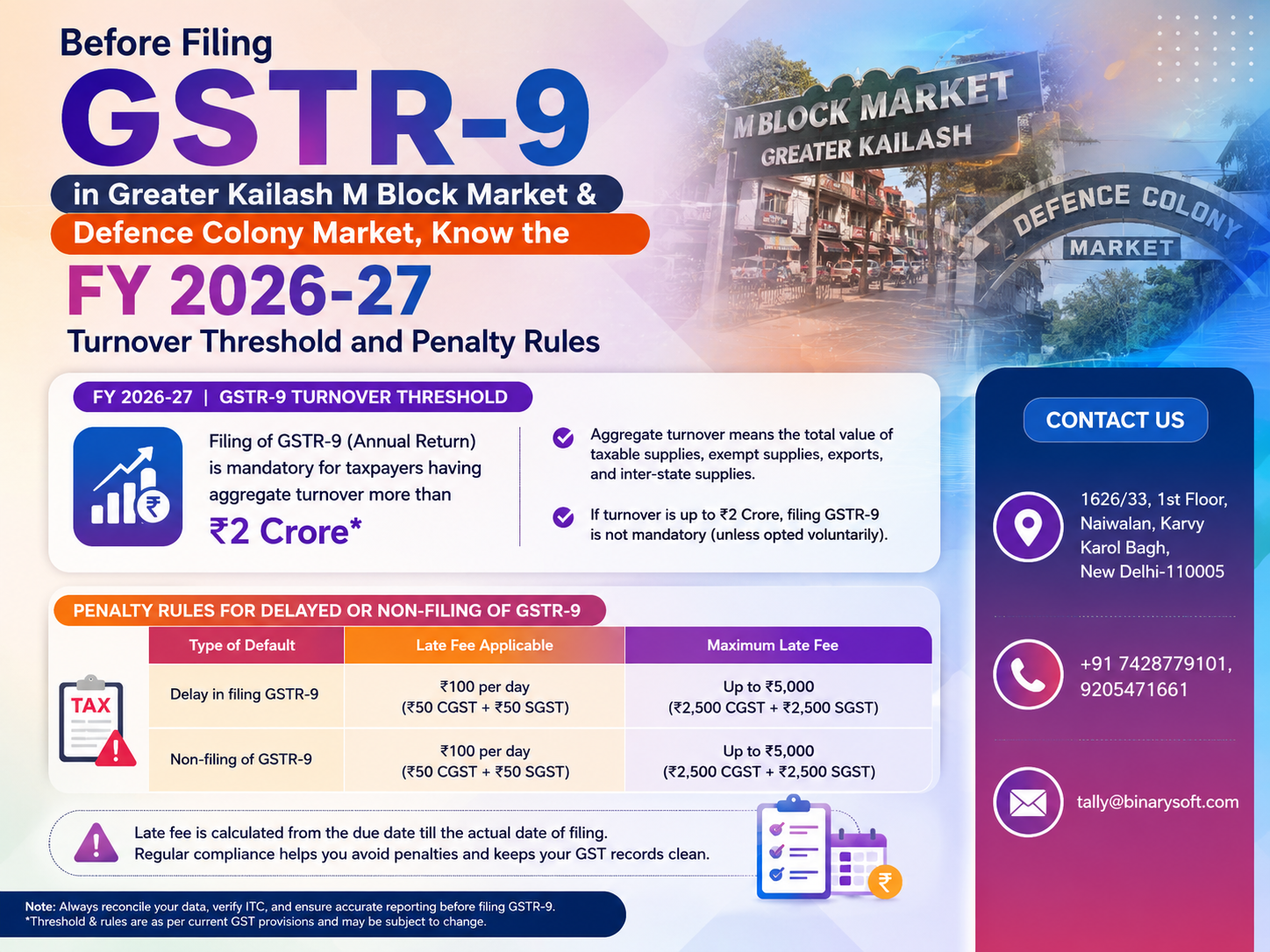
In 2026, GST compliance is becoming increasingly data-driven, and businesses in Greater Kailash M Block Market and Defence Colony Market can no longer treat the annual return as a simple year-end formality. GSTR-9 consolidates a full financial year's GST position, making differences between sales books, GSTR-1, GSTR-3B, input tax credit and other records much easier to identify. The pressure is especially important for growing retailers, restaurants, wholesalers, service providers and other GST-registered businesses whose turnover may move across the applicable annual-return threshold. The benefit of starting early is equally significant: businesses get more time to identify reconciliation gaps, review ITC, verify turnover and prepare supporting records before filing. For FY 2026-27, taxpayers should also avoid assuming that a turnover-based exemption automatically applies until the government issues the relevant notification for that financial year. The safest strategy is to maintain GSTR-9-ready accounts throughout the year instead of waiting for the filing deadline.
Important Note About the FY 2026-27 Turnover Threshold
One of the most important points for taxpayers reading about the "₹2 crore GSTR-9 limit" is that the statutory framework and the annual exemption notification need to be distinguished.
Under Rule 80 of the CGST Rules, regular registered persons covered by the annual-return requirement generally furnish GSTR-9. The normal due date is the 31st day of December following the end of the relevant financial year. The rules also prescribe GSTR-9C for applicable registered persons whose aggregate turnover during the financial year exceeds ₹5 crore.
However, exemptions from filing GSTR-9 for taxpayers up to a specified turnover have historically been provided for particular financial years through government notifications. For example, Notification No. 14/2024-Central Tax exempted registered persons with aggregate turnover up to ₹2 crore from filing the annual return specifically for FY 2023-24.
Therefore, businesses should not assume in August 2026 that an exemption for FY 2026-27 has already been finalized merely because the ₹2 crore exemption applied in earlier years.
The practical message is simple:
Check the notification applicable specifically to FY 2026-27 before deciding that GSTR-9 is not required.
This distinction is particularly important for businesses operating close to the ₹2 crore turnover level.
What Is GSTR-9?
GSTR-9 is the GST annual return applicable to specified regular registered taxpayers. It provides a consolidated annual picture of GST-related transactions and information reported during the financial year.
According to the GST portal's GSTR-9 guidance, the annual return includes information relating to purchases, sales, input tax credit, refunds, demands and other relevant GST particulars.
Think of GSTR-9 as an annual consolidation and review of your GST records.
A business may have filed GSTR-1 and GSTR-3B throughout the year, but the annual return requires management to look at the complete financial year together.
This is why reconciliation becomes so important.
GSTR-9 Turnover Limit for FY 2026-27
For businesses in Greater Kailash M Block Market, Defence Colony Market and elsewhere in India, there are two figures that should not be confused.
₹2 Crore: Watch the Annual Exemption Notification
The ₹2 crore figure has commonly been associated with exemption from GSTR-9 because the government has issued financial-year-specific exemptions for eligible taxpayers in earlier years.
But an exemption notification is financial-year specific.
Therefore, for FY 2026-27, taxpayers should confirm the notification ultimately issued for that year rather than relying only on a previous year's threshold.
₹5 Crore: GSTR-9C Threshold Under Rule 80
Rule 80 currently provides that a registered person covered by the rule whose aggregate turnover during a financial year exceeds ₹5 crore must also furnish a self-certified reconciliation statement in Form GSTR-9C along with the annual return.
This means the ₹5 crore figure relates to GSTR-9C and should not be confused with a GSTR-9 exemption threshold.
Simple Understanding
| Aggregate Turnover | What Businesses Should Check |
|---|
| Up to ₹2 crore |
Check whether the government has issued an exemption for GSTR-9 specifically for FY 2026-27 |
| Above ₹2 crore up to ₹5 crore |
GSTR-9 may apply subject to the final applicable notification/rules; GSTR-9C threshold is not crossed |
| Above ₹5 crore |
GSTR-9 plus self-certified GSTR-9C generally becomes relevant under the current Rule 80 framework |
| Any turnover near a threshold |
Calculate aggregate turnover carefully before determining applicability |
The final position should always be verified against the notification and GST rules applicable when FY 2026-27 filing becomes due.
What Does Aggregate Turnover Mean for GSTR-9?
A common mistake among businesses is to look only at sales under one GSTIN or one shop.
GST aggregate turnover is broader.
For determining GST applicability, businesses need to consider turnover on an all-India PAN basis according to the applicable GST definition rather than simply looking at one store's taxable sales.
This becomes particularly relevant when a business has:
- multiple branches;
- GST registrations in different states;
- taxable and exempt supplies;
- exports;
- inter-state transactions;
- more than one business operated under the same PAN.
A retailer operating in Greater Kailash may, for example, also operate another outlet in Gurugram or Noida.
Looking only at the Greater Kailash store's sales could therefore lead to an incorrect conclusion regarding annual turnover.
A Greater Kailash Business Owner's Year-End Wake-Up Call
Consider a fictional example.
Rajiv operates a premium home-furnishing business near Greater Kailash M Block Market. His business has grown steadily through repeat customers, online orders and interior-design projects.
For most of the year, Rajiv focused on sales.
His accountant filed GSTR-1 and GSTR-3B regularly, invoices were generated every day, suppliers were paid, and the business appeared financially healthy.
As the financial year moved towards closure, Rajiv believed GST annual-return compliance would be straightforward.
Then the reconciliation began.
The accounting software showed one turnover figure.
The GST returns showed another.
Several credit notes issued to customers had been recorded in the books but needed to be checked against GST reporting. A few invoices had been amended in later periods. There were also questions surrounding input tax credit appearing in GST records versus the ITC actually booked.
The differences individually looked small.
Together, they were enough to make Rajiv uncomfortable.
His concern was not simply the possibility of paying a late fee.
He was worried that an incorrect annual return could permanently present an inconsistent picture of his business's GST records.
Instead of filing immediately, his accounts team performed a complete reconciliation.
They compared sales ledgers, GST returns, credit notes, purchase records and ITC.
After several days of checking, the discrepancies were mapped and the annual records became much clearer.
Rajiv learned an important lesson:
GSTR-9 preparation should begin with reconciliation, not with opening the GSTR-9 form.
That lesson is equally relevant for businesses in Defence Colony Market, Greater Kailash and across Delhi.
Why GSTR-9 Reconciliation Is Important in FY 2026-27
GST compliance today leaves businesses with records across multiple systems.
A typical business may have:
Accounting software
GST portal data
GSTR-1
GSTR-3B
Purchase records
Electronic credit ledger
Electronic cash ledger
E-invoice records
E-way bill information
Credit and debit notes
Banking records
If these systems do not tell a consistent story, year-end reconciliation becomes essential.
Businesses should therefore perform multiple checks before filing.
1. Books of Accounts vs GSTR-1
Start by reconciling outward supplies recorded in your accounting software against GSTR-1.
Check:
Taxable sales
B2B invoices
B2C sales
Exports, where applicable
Credit notes
Debit notes
Invoice amendments
Cancelled invoices
Tax rates
Place of supply
Even a small difference can affect the annual totals.
2. GSTR-1 vs GSTR-3B
Next, compare outward supplies declared through GSTR-1 with the liability reported and discharged through GSTR-3B.
Look for differences caused by:
Timing differences
Amended invoices
Credit notes
Incorrect tax periods
Wrong GST rates
Missed invoices
Manual data-entry errors
Do not simply copy figures into the annual return without understanding these differences.
3. Books vs GSTR-3B
The turnover and tax liability in the accounting books should also be reconciled against GSTR-3B.
Businesses with multiple sales channels should pay particular attention.
For example, a Defence Colony retailer may have:
Store sales
Website sales
Marketplace sales
Corporate orders
Home deliveries
Inter-state supplies
All these channels ultimately need to be correctly reflected in the GST records.
4. Input Tax Credit Reconciliation
ITC is one of the most sensitive parts of GST compliance.
Businesses should examine:
ITC recorded in purchase books
ITC claimed through GSTR-3B
Relevant GST auto-populated information
Ineligible ITC
Reversals
Reclaims
RCM-related credit
Capital-goods credit
Supplier-related mismatches
The GST portal itself provides annual-return data and supporting information that taxpayers can use while preparing GSTR-9.
5. Review Credit Notes and Debit Notes
Retail and trading businesses often issue credit notes because of:
Product returns
Price adjustments
Discounts
Damaged products
Order cancellation
Post-sale negotiations
A credit note entered in accounting software but incorrectly reflected in GST reporting can produce differences in annual turnover.
Therefore, credit and debit notes should be reconciled invoice by invoice where necessary.
6. Check HSN-Wise Information
HSN reporting should not be left until the final day.
Businesses with hundreds or thousands of stock items may find it difficult to generate an accurate HSN summary if inventory masters have been poorly maintained throughout the year.
Product masters should therefore contain consistent:
HSN codes
GST rates
Units of measurement
Item descriptions
Tax classifications
Good inventory accounting throughout FY 2026-27 can dramatically reduce year-end work.
7. Verify GSTINs of Customers and Suppliers
Incorrect GSTINs can create problems in B2B reporting.
Businesses should regularly review:
Customer GSTIN
Supplier GSTIN
Invoice type
Place of supply
State code
Tax classification
An incorrect customer classification may also affect whether CGST/SGST or IGST should have been charged.
GSTR-9C: The ₹5 Crore Threshold Businesses Must Remember
GSTR-9 and GSTR-9C are related but different.
Under the current Rule 80 framework, registered persons covered by the rule whose aggregate turnover exceeds ₹5 crore during a financial year are required to furnish a self-certified reconciliation statement in Form GSTR-9C along with GSTR-9.
Therefore, a rapidly growing business should monitor the ₹5 crore level well before the financial year ends.
Do not wait until December to discover that GSTR-9C preparation is also required.
GSTR-9 Due Date for FY 2026-27
Under the standard Rule 80 timeline, the annual return is due on or before 31 December following the end of the relevant financial year.
FY 2026-27 ends on:
31 March 2027
Accordingly, under the normal statutory timeline, GSTR-9 for FY 2026-27 would be due by:
31 December 2027
This is subject to any future extension, notification or legal change.
Businesses should not plan their compliance around the expectation of an extension.
GSTR-9 and GSTR-9C Late Fee: An Important Clarification
Businesses crossing the GSTR-9C threshold need to pay particular attention to timely completion.
CBIC Circular No. 246/03/2025-GST clarified that where GSTR-9C is required, the annual return is not considered complete merely because GSTR-9 has been filed.
The complete annual return consists of GSTR-9 together with GSTR-9C where GSTR-9C is applicable.
The circular clarified that late fee under Section 47(2) can continue until the complete annual return has been furnished.
This means a business should not follow the strategy:
"File GSTR-9 today and worry about GSTR-9C later."
If GSTR-9C applies, both parts need proper planning.
Why Businesses Should Not Wait Until December
December is already a busy month for accountants.
Businesses continue to handle:
Monthly GST compliance
TDS compliance
Payroll
Vendor payments
Customer collections
Accounting entries
Inventory
Year-end commercial activity
Adding a complete annual GST reconciliation at the last moment creates unnecessary pressure.
A better approach is to prepare throughout FY 2026-27.
Quarterly GSTR-9 Readiness Strategy
April to June 2026
Review opening balances and previous-year GST adjustments.
Clean up customer, supplier, GST and inventory masters.
July to September 2026
Reconcile the first six months of:
Sales
GSTR-1
GSTR-3B
Purchases
ITC
Investigate mismatches while transactions are still relatively recent.
October to December 2026
Perform another reconciliation and identify recurring errors.
Check whether turnover is approaching important annual-return or GSTR-9C levels.
January to March 2027
Complete the final quarter carefully.
Avoid unnecessary year-end accounting adjustments without examining their GST impact.
April 2027 Onwards
Begin full-year reconciliation immediately after closing FY 2026-27.
Do not wait until November or December 2027.
Special Considerations for Greater Kailash M Block Market Businesses
Greater Kailash M Block Market contains businesses operating in segments where high-value transactions and complex inventory can make GST reconciliation more demanding.
These may include:
Fashion and apparel
Restaurants and cafés
Jewellery and accessories
Beauty and wellness
Home furnishing
Electronics
Professional services
Specialty retail
Food businesses
A business with thousands of monthly invoices needs reliable accounting data.
Manual spreadsheets may become increasingly difficult to manage as transaction volume increases.
Special Considerations for Defence Colony Market Businesses
Defence Colony has a diverse commercial ecosystem including restaurants, retailers, professional offices, boutiques and service businesses.
For such businesses, year-end GST preparation may involve reconciling several types of transactions.
A restaurant, for example, needs accurate sales classification.
A retailer needs reliable inventory and HSN records.
A professional service firm needs correct invoicing, GSTIN and place-of-supply information.
A multi-location company needs consolidated turnover visibility.
The fundamental requirement remains the same:
Your accounting books and GST returns should tell a consistent financial story.
Accounting Software Can Make GSTR-9 Preparation Easier
Reliable accounting software can significantly reduce annual GST compliance pressure.
The objective should not simply be generating invoices.
A good business accounting system should help management maintain structured information throughout the financial year.
Useful capabilities include:
GST-compliant invoicing
Sales and purchase accounting
Inventory management
HSN/SAC management
GST rate configuration
Customer and supplier GSTIN management
Credit and debit note tracking
Input tax credit review
Ledger reporting
Outstanding receivables
Outstanding payables
Stock reporting
Financial statements
GST-related reports
Data backup
User-level security
When transactions are properly recorded from April onwards, annual reconciliation becomes far easier.
How TallyPrime Can Support GST Accounting
Businesses using TallyPrime can maintain accounting, inventory, taxation and transaction records within an integrated business system.
Depending on the business configuration and applicable features, companies can use structured reports to review:
Sales
Purchases
GST transactions
Input tax credit
Tax liability
Inventory
Outstanding balances
Ledgers
Profit and loss
Balance sheet
The important factor is configuration.
Even powerful accounting software cannot automatically correct incorrect data entered by users.
Businesses should therefore ensure that:
GST ledgers are properly configured
HSN/SAC codes are accurate
GST rates are correct
Party GSTINs are maintained
Voucher types are used consistently
Credit notes are correctly recorded
Purchase invoices are entered accurately
Common GSTR-9 Mistakes Businesses Should Avoid
Mistake 1: Assuming ₹2 Crore Exemption Automatically Applies
Do not apply an earlier year's exemption notification automatically to FY 2026-27.
Wait for and verify the notification applicable to the relevant financial year.
Mistake 2: Confusing GSTR-9 with GSTR-9C
GSTR-9 is the annual return.
GSTR-9C is the self-certified reconciliation statement applicable when the prescribed turnover condition is met.
Mistake 3: Checking Only One GSTIN's Turnover
Aggregate turnover needs careful PAN-level consideration under GST.
Mistake 4: Preparing GSTR-9 Directly From GSTR-3B
GSTR-3B alone does not provide the complete picture.
Books, GSTR-1, GSTR-3B and relevant ITC records should be reconciled.
Mistake 5: Ignoring Small Differences
Several small monthly differences can become a significant annual mismatch.
Mistake 6: Waiting Until the Due Date
Late reconciliation gives businesses very little time to investigate discrepancies.
Mistake 7: Forgetting GSTR-9C
Businesses crossing ₹5 crore should separately assess GSTR-9C applicability under Rule 80.
GSTR-9 FY 2026-27 Pre-Filing Checklist
Before filing the annual return, review at least the following:
- Confirm applicability of GSTR-9 for FY 2026-27.
- Check the final government exemption notification for the financial year.
- Calculate aggregate turnover correctly.
- Determine whether the ₹5 crore GSTR-9C threshold is crossed.
- Reconcile books with GSTR-1.
- Reconcile GSTR-1 with GSTR-3B.
- Reconcile books with GSTR-3B.
- Review purchase records and ITC.
- Check credit and debit notes.
- Review amendments.
- Verify HSN/SAC information.
- Check GSTIN and place-of-supply information.
- Review exempt, nil-rated and other relevant supplies.
- Verify tax liability and payments.
- Review RCM transactions.
- Check applicable ITC reversals.
- Review refunds and demands, where relevant.
- Verify GSTR-9 draft carefully.
- Prepare GSTR-9C if applicable.
- File before the statutory deadline.
Why Early Reconciliation Is Better Than Last-Minute Correction
The biggest advantage of early reconciliation is not merely avoiding a late fee.
It gives the business time to understand its own numbers.
Suppose your accounting software reports annual taxable turnover of ₹4.80 crore while GST returns collectively indicate ₹4.73 crore.
The correct response is not to arbitrarily change one figure to match the other.
The ₹7 lakh difference needs to be identified.
It could arise from:
Credit notes
Invoice amendments
Timing differences
Cancelled transactions
Missed reporting
Incorrect classification
Accounting adjustments
Reconciliation identifies the reason.
That is far more valuable than simply forcing two totals to match.
Search and Discover Perspective: Why GSTR-9 Matters More as Businesses Grow
For small businesses, monthly GST filing may initially feel like the main compliance responsibility.
As turnover and transaction volume increase, annual reconciliation becomes more important.
A growing business can quickly move from:
₹1 crore turnover
to
₹2 crore
to
₹5 crore and beyond.
At every stage, compliance requirements and the scale of reconciliation can change.
Therefore, turnover monitoring should be a monthly management exercise rather than something calculated only after 31 March.
GSTR-9 Compliance for Multi-Branch Businesses
Suppose a business owner has:
One shop in Greater Kailash
One office in Defence Colony
One warehouse in Delhi
One branch in Haryana
The business should not determine annual-return applicability simply by checking the turnover of each location independently.
Aggregate turnover under GST requires a wider PAN-based assessment.
Businesses operating across multiple locations should therefore maintain consolidated management reports alongside GSTIN-wise reports.
Use FY 2026-27 to Build Cleaner GST Data
Instead of viewing GSTR-9 as a December 2027 project, businesses should use FY 2026-27 to improve their accounting process itself.
Every month:
Record transactions correctly.
Every quarter:
Reconcile them.
At year-end:
Consolidate them.
Before filing:
Verify them.
This approach can reduce the workload substantially.
Need TallyPrime and GST Accounting Support in Delhi?
Businesses in Greater Kailash M Block Market, Defence Colony Market and other parts of Delhi looking to strengthen accounting, GST billing, inventory management and business reporting can contact Binarysoft Technologies for Tally-related solutions and support.
Powered by Binarysoft Technologies
Authorized Tally Partner
Binarysoft Technologies provides Tally-related business solutions for retailers, wholesalers, service providers, professionals and growing organizations.
Services may include:
TallyPrime licensing
TallyPrime implementation
GST accounting configuration
Inventory configuration
Business accounting setup
Tally customization requirements
Data migration assistance
Tally support and training
Multi-user solutions
Business reporting solutions
Location:
1626/33, 1st Floor, Naiwalan, Karol Bagh, New Delhi – 110005, INDIA
Contact Us:
+91 7428779101
+91 9205471661
Email:
tally@binarysoft.com
Business Hours:
10:00 AM – 6:00 PM, Monday to Friday
Conclusion
For businesses in Greater Kailash M Block Market and Defence Colony Market, GSTR-9 preparation for FY 2026-27 should begin long before the annual-return deadline.
The most important issue is understanding the turnover thresholds correctly.
The often-mentioned ₹2 crore threshold should not be treated as an automatic FY 2026-27 exemption until the government issues or confirms the relevant financial-year-specific notification. In contrast, the current Rule 80 framework prescribes GSTR-9C where aggregate turnover exceeds ₹5 crore, subject to the applicable law at the time of filing.
Under the normal timeline, FY 2026-27 ends on 31 March 2027 and its annual return would ordinarily fall due on 31 December 2027, unless the government changes or extends the deadline.
Businesses should use the intervening period to reconcile turnover, GSTR-1, GSTR-3B, ITC, credit notes, debit notes, HSN information and accounting records.
Good GSTR-9 compliance does not start with the annual-return form.
It starts with accurate accounting throughout the financial year.
Frequently Asked Questions
What is GSTR-9?
GSTR-9 is the annual GST return prescribed for applicable regular registered taxpayers. It consolidates information relating to supplies, purchases, input tax credit and other GST particulars for a financial year.
Is GSTR-9 compulsory below ₹2 crore for FY 2026-27?
Businesses should not assume the answer based solely on previous financial years. The government has provided turnover-based exemptions through financial-year-specific notifications in earlier years. The notification applicable specifically to FY 2026-27 should be checked before determining filing responsibility.
CA. Praneet Bansaal is a Chartered Accountant with experience in taxation, accounting controls, and financial process reviews. He has advised businesses on aligning inventory movement with accounting and GST requirements. His content focuses on compliance, accuracy, and long-term sustainability.