Call CA Tally HelpDesk
+91 9205471661,
7428779101
Introduction: Why Business Management Needs a Smarter Approach in 2026
In 2026, Indian businesses are operating in an environment where rising operational costs, intense competition, digital transactions, customer credit demands and GST compliance responsibilities require greater financial discipline. Business owners can no longer rely only on sales figures to measure success. A company may generate substantial revenue yet struggle with delayed collections, excessive inventory, uncontrolled expenses and insufficient working capital.
Traditional business management methods involving separate spreadsheets, handwritten registers and disconnected accounting records often create confusion. Important decisions may be delayed because reliable financial information is unavailable.
Modern business management brings accounting, inventory, taxation, banking, cash flow and operational reporting into a structured process. TallyPrime helps businesses record financial transactions, manage stock, monitor receivables and payables, and review financial performance.
For small and medium enterprises, adopting an organised management approach can improve efficiency, reduce avoidable mistakes and create a stronger foundation for long-term growth.
1. What Is Business Management and Why Is It Important?
Business management involves planning, organising, monitoring and controlling activities to achieve organisational objectives.
It combines financial management, operational efficiency, employee coordination, customer relationships, compliance and strategic decision-making.
Effective business management helps owners understand three essential questions:
-
Is the business earning enough profit?
-
Does the business have sufficient cash to meet its obligations?
-
Are resources being used efficiently?
For example, a garment wholesaler may record monthly sales of ₹30 lakh. However, if ₹12 lakh remains unpaid by customers and substantial capital is tied up in slow-moving inventory, the business may face financial pressure despite strong sales.
A structured management system helps identify such problems early.
2. Business Planning: Creating a Roadmap for Sustainable Growth
Every successful business requires a clear plan covering financial targets, operational priorities and market opportunities.
A practical business plan should define revenue objectives, customer segments, expected expenses, funding requirements, inventory needs and growth strategies.
Financial planning
Businesses should estimate monthly income, fixed expenditure, variable costs and expected profitability.
Sales planning
Sales targets should reflect market demand, historical performance and available resources rather than unrealistic expectations.
Resource planning
Management must determine the people, equipment, inventory and technology required to achieve business goals.
Risk planning
Businesses should prepare for customer defaults, supplier delays, price increases, operational disruptions and unexpected expenses.
TallyPrime can support planning by providing historical sales, purchase, expense and financial reports that help management develop more realistic forecasts.
3. Accounting: The Financial Foundation of Every Business
Accounting records the financial activities of an organisation and converts transactions into meaningful information.
Accurate accounting is necessary for profitability analysis, statutory reporting, loan applications, expense control and financial decision-making.
Important accounting activities include maintaining customer and supplier ledgers, recording purchases and sales, managing cash and bank transactions, tracking expenses and preparing financial statements.
How TallyPrime helps
TallyPrime supports common accounting vouchers, including sales, purchase, receipt, payment, journal and contra entries.
Businesses can organise accounts under appropriate ledger groups and review the Profit & Loss Account, Balance Sheet and other financial reports.
For example, a trading business can compare monthly revenue with purchase costs and administrative expenses to understand whether profit margins are improving or declining.
The greatest benefit of structured accounting is the ability to make decisions using verified financial information.
4. Cash Flow Management: Keeping the Business Financially Healthy
Cash flow represents money entering and leaving a business.
A company can report accounting profits while experiencing a shortage of available funds.
This situation commonly occurs when customers purchase on credit, suppliers require early payment or inventory remains unsold.
Businesses should regularly review expected customer collections, supplier obligations, salary payments, taxes, loan instalments and other commitments.
Practical cash flow strategies
-
Establish clear customer credit terms.
-
Review overdue invoices regularly.
-
Avoid unnecessary inventory purchases.
-
Negotiate suitable supplier payment schedules.
-
Maintain a reasonable emergency reserve.
-
Prepare short-term cash flow forecasts.
TallyPrime for cash flow visibility
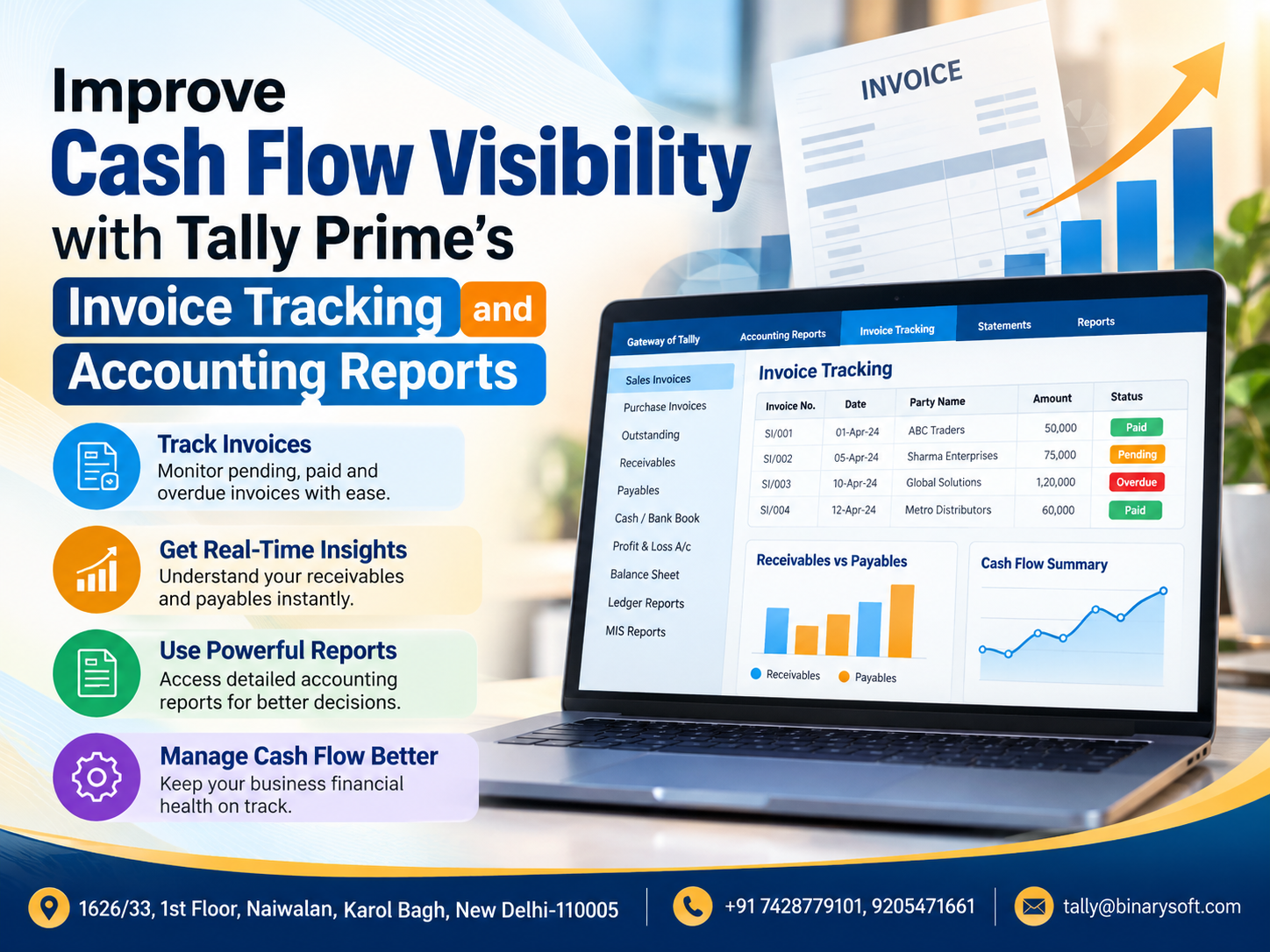
TallyPrime provides receivable, payable, cash, bank and financial information that businesses can use to evaluate liquidity.
Management can review outstanding customer balances and prioritise collections before important payment deadlines.
Reliable cash flow management improves business stability and reduces dependence on emergency borrowing.
5. Inventory Management: Reduce Stock Problems and Improve Working Capital
Inventory is often one of the largest investments for trading and manufacturing businesses.
Poor inventory control can lead to excess purchases, stock shortages, damaged products, outdated goods and unnecessary storage expenses.
Effective inventory management requires accurate stock records, regular physical verification and analysis of product movement.
How TallyPrime supports inventory management
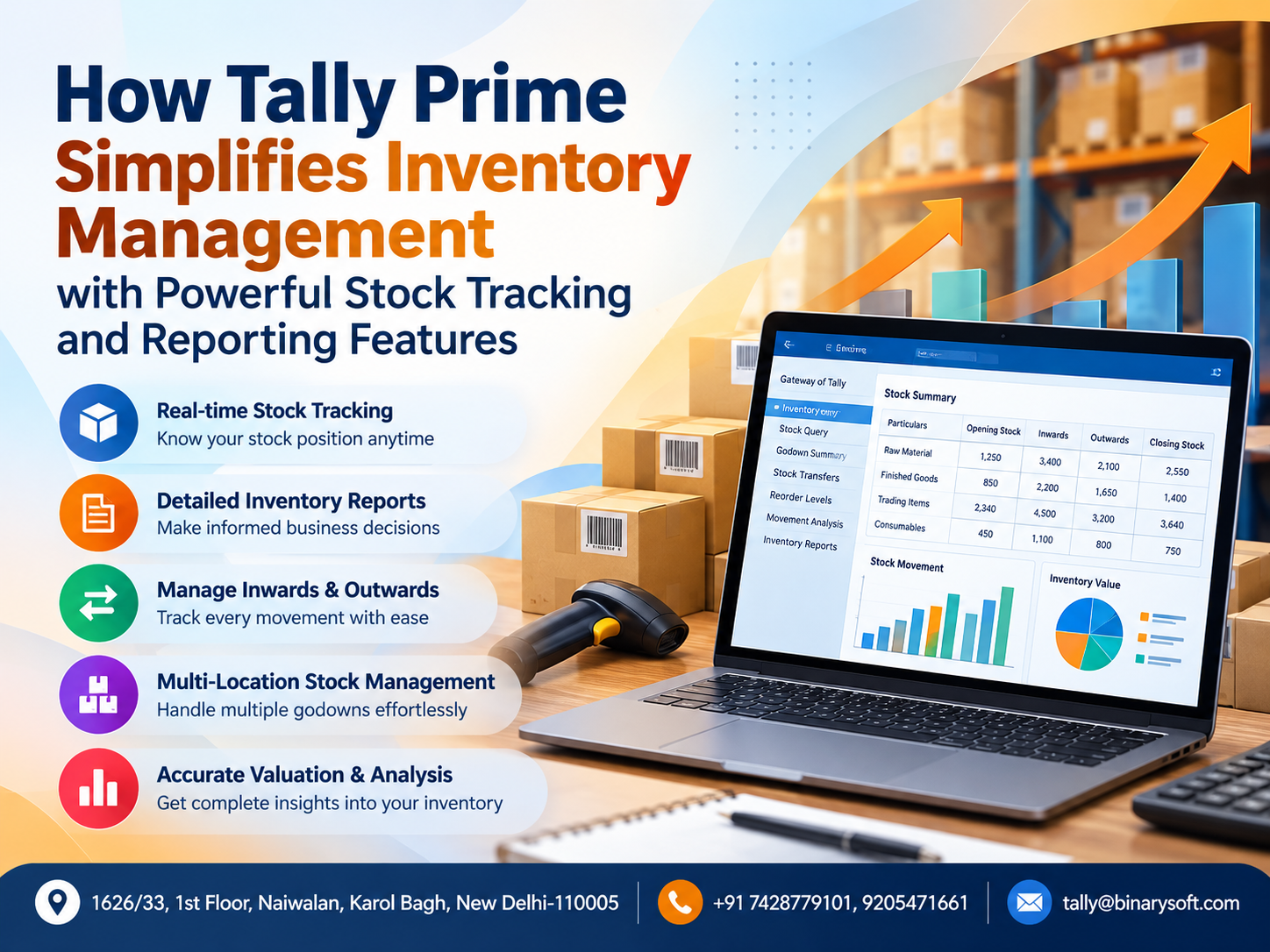
Businesses can maintain stock items, stock groups, units of measurement and godown records.
Depending on configuration, TallyPrime supports batch-wise inventory tracking, stock transfers, inventory vouchers and valuation reports.
A wholesale electronics distributor, for example, can review available stock before placing new purchase orders.
Inventory reports also help identify products with slow movement, enabling management to reduce unnecessary capital investment.
Integrated accounting and inventory management improves visibility into both stock quantities and their financial impact.
6. GST Compliance and Tax Management for Indian Businesses
GST compliance is an important responsibility for registered businesses.
Incorrect tax classification, missing purchase invoices, reconciliation differences and delayed filing can create additional work and potential compliance exposure.
Businesses should maintain accurate GST-related sales and purchase records, applicable tax rates, customer and supplier GSTIN details, and relevant supporting documents.
Using TallyPrime for GST management
TallyPrime helps businesses record GST transactions and generate applicable GST reports.
Supported connected GST workflows can assist with return-related activities and reconciliation, depending on the software release and configuration.
Businesses can review transaction classifications, identify mismatches and examine purchase-related information for input tax credit assessment.
However, input tax credit eligibility, return filing and statutory treatment must always be verified against applicable law and current requirements.
Technology simplifies compliance administration, but proper accounting review remains essential.
7. Sales and Customer Relationship Management
Customers are central to business growth, but increasing sales without managing collections can create financial problems.
Businesses should maintain accurate customer records, invoice histories, credit limits and payment terms.
A structured sales process includes timely invoicing, correct pricing, applicable tax calculations and systematic payment follow-up.
TallyPrime in sales management
TallyPrime helps maintain customer ledgers, record sales invoices and track bill-wise outstanding balances.
Businesses can review overdue invoices and evaluate customer payment behaviour.
For example, a distributor can identify customers who regularly delay payments and reconsider their credit arrangements.
Consistent sales records also help management understand revenue trends and identify important customers.
Better customer management supports both revenue growth and financial discipline.
8. Purchase and Supplier Management
Reliable suppliers help businesses maintain product availability, quality and continuity.
However, poorly managed purchases can increase costs and create inventory imbalances.
Businesses should establish clear procedures for supplier selection, purchase approval, invoice verification and payment scheduling.
Purchase records should be compared with actual goods received and relevant supporting documents.
TallyPrime for purchasing
Purchase vouchers, supplier ledgers and inventory records help businesses maintain structured purchasing information.
Supplier outstanding reports provide visibility into unpaid invoices.
Management can use historical purchase information to assess spending patterns and plan procurement more effectively.
Strong purchasing controls help reduce duplicate entries, unnecessary buying and payment disputes.
9. Banking and Financial Reconciliation
Banking transactions form a major part of everyday business activity.
Businesses receive customer payments, pay suppliers, settle expenses and transfer funds through multiple banking channels.
When accounting records do not match bank statements, management may have an inaccurate understanding of available funds.
Bank reconciliation helps identify unrecorded charges, outstanding transactions, duplicate entries and other differences.
TallyPrime supports bank-related accounting and reconciliation workflows. The availability of connected banking capabilities varies according to the bank, product release and configuration.
Regular reconciliation helps businesses maintain dependable cash and bank records.
10. Financial Reporting for Better Business Decisions
Financial reports transform accounting transactions into information that management can use.
The Profit & Loss Account helps assess revenue, expenses and profitability.
The Balance Sheet shows assets, liabilities and equity at a particular date.
Receivable and payable reports help management monitor outstanding amounts.
Inventory reports provide information about stock quantities and valuations.
Key business indicators
|
Indicator
|
Management purpose
|
|---|
|
Gross Profit Margin
|
Measures profitability after direct costs
|
|
Net Profit Margin
|
Measures overall profitability
|
|
Current Ratio
|
Assesses short-term financial position
|
|
Inventory Turnover
|
Evaluates stock movement
|
|
Receivable Days
|
Tracks collection efficiency
|
|
Expense-to-Sales Ratio
|
Monitors operating costs
|
TallyPrime provides underlying financial and operational reports that can help businesses calculate and review these indicators.
Management should examine trends over several periods rather than making decisions from a single month's results.
11. Emotional Story: A Family Business That Almost Lost Its Confidence
The following story is fictional and illustrates common business management challenges.
For nearly twenty years, Amit managed a family-owned hardware store in Delhi.
His father had started the business with limited savings, and Amit had worked hard to expand it.
The shop was busy throughout the day. Customers arrived regularly, suppliers delivered goods and employees handled invoices.
From the outside, everything appeared successful.
But every evening, Amit faced the same uncomfortable question: Why was there never enough money in the bank?
Customers owed substantial amounts. Supplier payments were approaching. Several products remained unsold in the warehouse.
One night, Amit's father noticed him reviewing invoices long after the shop had closed.
His father quietly asked whether the business they had built together was in trouble.
Amit could not answer confidently because his records were scattered across notebooks and spreadsheets.
He decided to reorganise the business using structured accounting and inventory processes supported by TallyPrime.
The transition was not immediate. Opening balances required verification, customer accounts needed reconciliation and stock quantities had to be checked.
Gradually, however, the financial picture became clearer.
Amit began reviewing overdue payments every week. He stopped purchasing products that were already overstocked and started planning supplier payments more carefully.
The business did not become successful overnight.
But one evening, when his father again asked about its financial position, Amit could show him the figures.
For the first time in months, both felt confident about their next steps.
The lesson: Business management is not only about increasing revenue. It is also about protecting the effort, investment and dreams behind every enterprise.
12. Case Study One: Wholesale Distributor Improves Financial Control
Illustrative case study with hypothetical figures.
Business background
A wholesale electrical goods distributor in Delhi handled hundreds of invoices every month and supplied products to retailers across the region.
The business maintained separate accounting and inventory spreadsheets.
Challenges
Customer payments were frequently delayed, stock records were inconsistent and management had difficulty identifying outstanding supplier obligations.
TallyPrime implementation
The business introduced structured customer and supplier ledgers, bill-wise accounting, inventory records and weekly financial reviews.
Illustrative results
|
Performance indicator
|
Before
|
After
|
|---|
|
Overdue customer payments
|
₹15 lakh
|
₹9 lakh
|
|
Monthly reconciliation effort
|
24 hours
|
9 hours
|
|
Excess inventory
|
₹10 lakh
|
₹7 lakh
|
These figures demonstrate a possible improvement scenario, not verified customer outcomes.
Key learning
Integrated accounting and inventory records can improve visibility, but results depend on accurate data, regular reviews and effective management decisions.
13. Case Study Two: Manufacturing Business Improves Cost Management
Illustrative case study with hypothetical figures.
Business background
A small packaging manufacturer in Delhi NCR faced increasing raw material prices and difficulty analysing production expenses.
Challenges
The business maintained separate purchase, production and accounting records. Management could not easily compare material consumption with finished goods output.
TallyPrime implementation
The manufacturer configured inventory masters, relevant manufacturing vouchers, cost centres and financial reports according to its operational requirements.
Illustrative results
|
Performance indicator
|
Before
|
After
|
|---|
|
Monthly stock discrepancies
|
₹90,000
|
₹30,000
|
|
Reporting preparation time
|
16 hours
|
5 hours
|
|
Excess material holdings
|
₹8 lakh
|
₹5.5 lakh
|
Key learning
Better material tracking and cost visibility can support purchasing, production planning and pricing decisions.
14. How to Implement TallyPrime for Business Management
A structured implementation is important for reliable results.
Step 1: Assess business requirements. Identify accounting, inventory, taxation, reporting and user-access needs.
Step 2: Create the company. Configure the financial year, accounting details and applicable statutory information.
Step 3: Establish master records. Create ledgers, stock items, customer accounts, supplier accounts and relevant inventory locations.
Step 4: Verify opening balances. Reconcile cash, bank, customer, supplier and inventory balances before migration.
Step 5: Configure GST. Apply relevant tax details and classifications according to the business's compliance requirements.
Step 6: Train employees. Explain voucher entry procedures, document verification and reporting responsibilities.
Step 7: Review reports. Establish weekly and monthly procedures for reviewing financial statements, outstanding balances and inventory.
Step 8: Protect business data. Maintain suitable backups, access permissions and recovery procedures.
Proper implementation helps ensure that TallyPrime becomes part of a dependable business management process.
15. TallyPrime on Cloud for Multi-Location Businesses
Businesses operating from multiple offices, warehouses or branches may require access to accounting information from different locations.
A suitable cloud-hosted TallyPrime environment can support authorised remote access, centralised data management and collaboration between distributed teams.
This can be useful for business owners travelling between locations, accountants working remotely and organisations coordinating financial activities across branches.
Cloud arrangements must be evaluated for licensing, infrastructure performance, user access, data security, backups and recovery commitments.
Cloud hosting is not a substitute for proper internal controls. Businesses should select an arrangement appropriate to their operational requirements.
16. Common Business Management Mistakes to Avoid
Many business problems arise from weak financial discipline rather than insufficient sales.
Common mistakes include mixing personal and business expenditure, allowing excessive customer credit, purchasing inventory without reviewing existing stock and ignoring overdue supplier payments.
Other mistakes include delaying accounting entries, failing to reconcile bank transactions, overlooking GST discrepancies and making expansion decisions without analysing cash flow.
Businesses should establish clear responsibilities and regular review procedures.
Even a small enterprise can benefit from a monthly management meeting focused on profitability, cash availability, receivables, payables and inventory.
Reliable information enables earlier corrective action.
17. Business Growth Strategies for 2026 and Beyond
Sustainable business growth requires balancing revenue expansion with financial stability.
Businesses should focus on profitable customers, efficient inventory movement, controlled operating expenses and disciplined collections.
Digital recordkeeping can help management identify trends and respond more quickly to changing business conditions.
Financial reports should be used to evaluate whether expansion is affordable and whether additional borrowing is justified.
TallyPrime supports this process by providing structured accounting and operational information.
The objective is not simply to increase turnover. It is to build a business that can grow while maintaining healthy finances and dependable operations.
Conclusion: Build a More Efficient and Financially Strong Business
Successful business management requires accurate accounting, disciplined cash flow planning, efficient inventory control, reliable GST records and informed financial decisions.
For Indian SMEs, retailers, wholesalers and manufacturers, integrating these activities can reduce confusion and improve operational visibility.
TallyPrime provides tools for managing accounting transactions, inventory, customer balances, supplier obligations and financial reporting in a structured environment.
With appropriate implementation, employee training and regular financial reviews, businesses can use these capabilities to strengthen financial control and support sustainable growth.
The most important step is turning accurate business information into timely, practical decisions.
Powered by Binarysoft Technologies
Authorized Tally Partner
Location: 1626/33, 1st Floor, Naiwalan, Karol Bagh, New Delhi – 110005, INDIA
Contact us: +91 7428779101, 9205471661
Email us: tally@binarysoft.com
Business Hours: 10:00 AM – 6:00 PM, Monday to Friday
Website: tallyatcloud.com
Frequently Asked Questions
How does TallyPrime help small businesses?
TallyPrime supports accounting, invoicing, inventory management, GST-related records, outstanding payment tracking and financial reporting through an integrated business application.
Can TallyPrime manage accounting and inventory together?
Yes. TallyPrime supports integrated accounting and inventory records, allowing businesses to monitor relevant stock movements and financial transactions.
How does TallyPrime support GST compliance?
TallyPrime provides GST-related transaction recording, reporting and supported reconciliation workflows. Businesses must still verify statutory requirements and return information.
Which reports should business owners review regularly?
Important reports include Profit & Loss Accounts, Balance Sheets, cash flow information, outstanding receivables, supplier balances and inventory summaries.
Where can businesses get assistance with TallyPrime?
Businesses can contact Binarysoft Technologies, an Authorized Tally Partner, for assistance with TallyPrime implementation, configuration, training, data migration and related services.
CA. Shivesh Khandelwaal is a practicing Chartered Accountant experienced in accounting automation, compliance management, and audit support. He has worked with trading and distribution businesses to improve inventory visibility and financial reporting. His articles focus on real-world applicability.