Call CA Tally HelpDesk
+91 9205471661,
7428779101
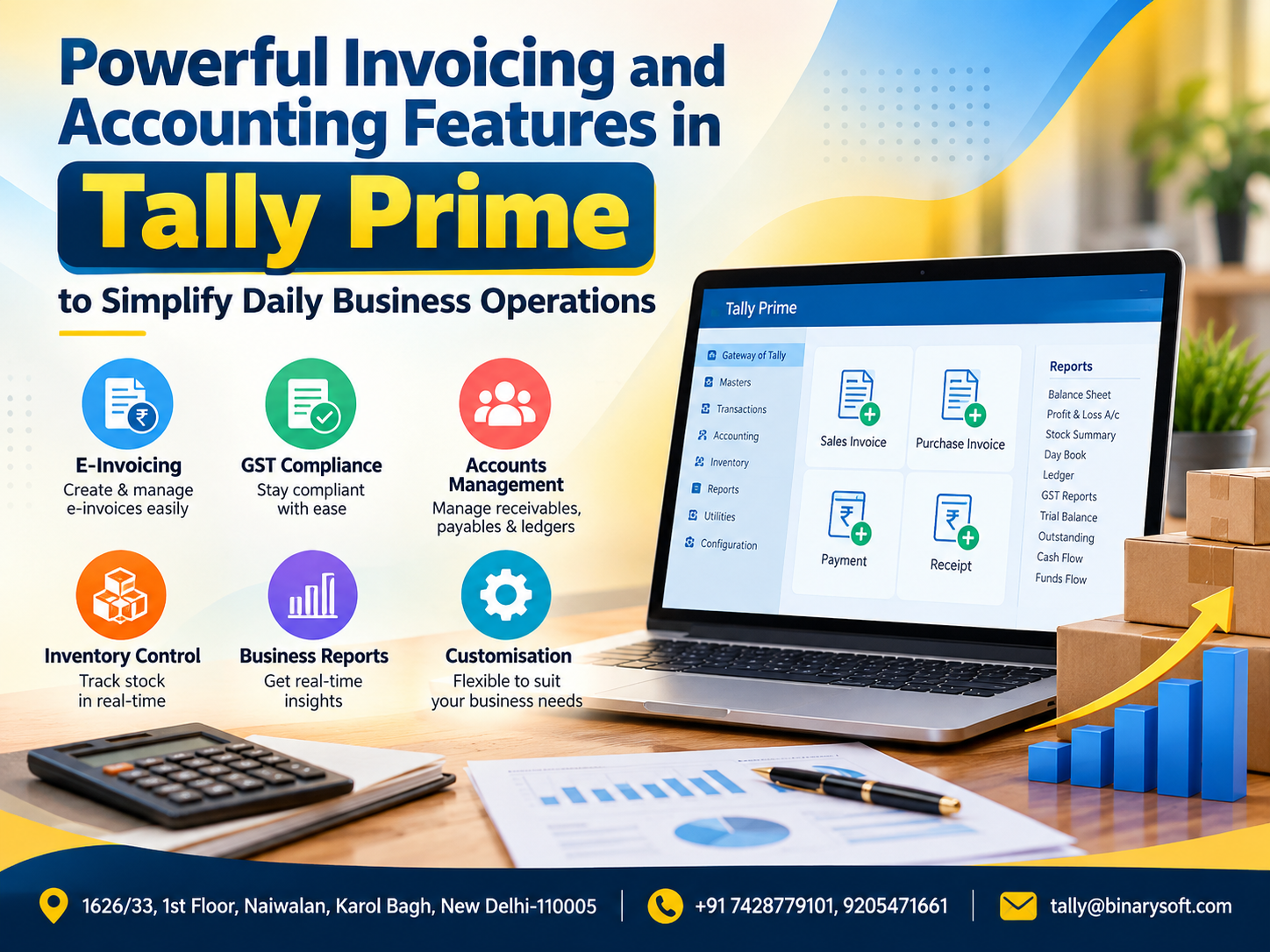
Introduction: Why Businesses Need Smarter Invoicing and Accounting in 2026
In 2026, Indian businesses are managing increasingly demanding accounting responsibilities as transaction volumes grow, customers expect faster billing, and GST compliance requires accurate financial records. Retailers, wholesalers, distributors, manufacturers and service providers must handle invoices, payments, purchases, tax calculations and financial reporting without allowing small mistakes to disrupt daily operations. A delayed invoice can postpone payment, while an incorrect ledger entry can create reconciliation problems and affect business decisions. Traditional paperwork and disconnected spreadsheets often make these challenges more difficult.
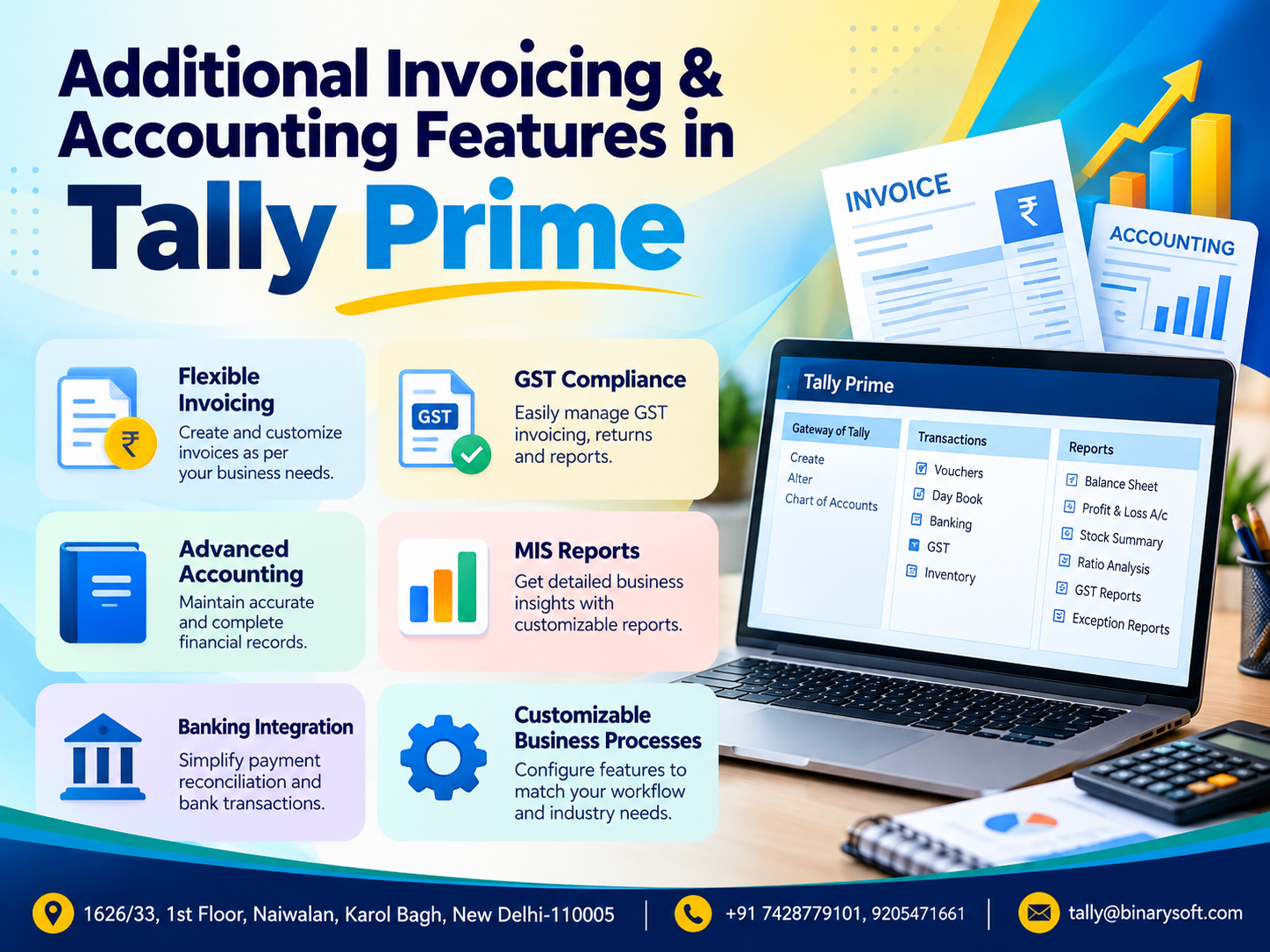
Tally Prime brings invoicing, accounting, inventory and financial reporting into one coordinated business management environment. Its features help businesses create professional invoices, maintain customer and supplier ledgers, track outstanding payments, manage GST transactions and review financial performance. By reducing duplicate recordkeeping and improving access to organized business information, Tally Prime can help owners spend less time searching for figures and more time serving customers, managing cash flow and planning growth.
1. Understanding Invoicing and Accounting in Modern Businesses
Invoicing and accounting are closely connected activities that influence the financial health of every business.
Invoicing involves preparing bills for products or services supplied to customers. Accounting involves recording, classifying and reporting financial transactions such as sales, purchases, expenses, receipts and payments.
When these activities are managed separately, businesses may experience duplicate entries, inconsistent balances and delayed reporting.
For example, a wholesale trader may create a sales invoice in one application and later enter the same transaction into accounting software.
If the accountant forgets to record the transaction or enters a different amount, the customer ledger may become inaccurate.
Tally Prime helps address this problem by integrating invoicing and accounting within a common system.
When an invoice is recorded with the appropriate ledgers and configurations, the relevant accounting entries are created as part of the transaction.
This improves consistency and reduces the need to maintain multiple independent records.
2. Powerful Invoicing Features in Tally Prime
Invoicing is one of the most frequently performed activities in retail, wholesale and service businesses.
Tally Prime provides configurable invoicing options for different transaction requirements.
Professional sales invoices
Businesses can prepare sales invoices containing customer details, product descriptions, quantities, rates, applicable taxes and transaction totals.
Invoice layouts can be configured to include relevant business information and statutory particulars.
GST tax invoices
Businesses registered under GST can configure tax details and prepare invoices reflecting the applicable tax treatment.
Credit and debit notes
Sales returns, purchase returns and relevant adjustments can be recorded through appropriate vouchers.
Item-wise billing
Retailers and wholesalers can prepare invoices containing multiple stock items, quantities and rates.
Service invoicing
Service providers can create accounting invoices for professional fees, maintenance services, consulting and other activities.
Discounts and additional charges
Businesses can record discounts, freight and other charges through suitable invoice configurations.
Invoice printing and sharing
Invoices can be printed or exported in supported formats and shared using available communication options.
These capabilities make Tally Prime useful for businesses that require both operational flexibility and consistent financial records.
3. GST Billing and Tax Compliance Features
GST accounting is an important responsibility for businesses operating in India.
Incorrect tax classifications, customer GSTIN details or invoice values can lead to reconciliation differences and additional compliance work.
Tally Prime provides GST-related features that help businesses organize tax transactions and prepare relevant reports.
Businesses can configure GST registration information, tax ledgers, stock classifications and applicable tax details.
For example, a wholesale distributor selling goods within Delhi may need to record CGST and SGST, while an applicable interstate transaction may require IGST.
Correct tax treatment depends on the nature and place of supply and the relevant GST rules.
Tally Prime also provides GST reporting and supported connected-service capabilities, depending on the software release and configuration.
These may include GST return preparation, reconciliation assistance, e-invoicing and e-way bill workflows.
However, accounting software does not independently guarantee GST compliance. Businesses must maintain accurate records and review transactions according to applicable legal requirements.
4. Sales Invoice Management for Retailers and Wholesalers
Businesses with high transaction volumes need a dependable sales invoicing process.
Tally Prime helps employees create sales invoices while maintaining related customer and inventory records.
Consider a hardware wholesaler selling 50 electrical switches, 100 LED bulbs and 20 circuit breakers.
Instead of calculating each item manually, the billing operator can select configured stock items, enter quantities and rates, and apply relevant invoice details.
Illustrative sales invoice
|
Particulars
|
Quantity
|
Rate
|
Amount
|
|---|
|
LED Bulbs
|
100
|
₹120
|
₹12,000
|
|
Modular Switches
|
50
|
₹80
|
₹4,000
|
|
Circuit Breakers
|
20
|
₹350
|
₹7,000
|
|
Taxable value
|
|
|
₹23,000
|
|
GST at illustrative 18%
|
|
|
₹4,140
|
|
Invoice total
|
|
|
₹27,140
|
The GST rate shown is hypothetical. Actual rates must be determined using the correct product classification and current tax rules.
The completed transaction can update the relevant sales and customer accounting records, along with stock quantities when inventory is properly configured.
This helps reduce repeated data entry and improves coordination between billing and accounts departments.
5. Purchase Accounting and Supplier Management
Purchasing is another important part of daily business operations.
Wholesale traders and manufacturers frequently purchase goods from multiple suppliers under different payment terms.
Tally Prime allows businesses to record purchase invoices, supplier balances and applicable tax details.
For example, a distributor purchasing goods worth ₹2 lakh can record the transaction against the appropriate supplier ledger.
If the purchase is made on credit, the amount can appear in the supplier's outstanding balance.
When payment is made, the relevant payment voucher can be recorded and allocated against the outstanding bill.
This creates a more organized record of supplier obligations.
Businesses can use payable reports to identify upcoming payments and avoid unnecessary delays.
Effective purchase accounting also supports cash-flow planning because management can compare expected collections with upcoming supplier commitments.
6. Customer Outstanding Payments and Credit Control
Many businesses generate significant sales but experience financial pressure because customer payments are delayed.
Credit sales create receivables that must be monitored carefully.
Tally Prime supports bill-wise outstanding tracking, credit periods, credit limits and receivable reports.
A business can configure a customer's default credit period and record individual invoices with due dates.
Example of outstanding receivables
|
Customer
|
Invoice amount
|
Payment received
|
Outstanding
|
|---|
|
Customer A
|
₹1,50,000
|
₹1,00,000
|
₹50,000
|
|
Customer B
|
₹85,000
|
₹35,000
|
₹50,000
|
|
Customer C
|
₹2,00,000
|
₹1,50,000
|
₹50,000
|
|
Total
|
₹4,35,000
|
₹2,85,000
|
₹1,50,000
|
With bill-wise tracking, management can identify unpaid invoices and review the age of outstanding balances.
This information helps employees prioritize collection follow-ups and make more informed credit decisions.
7. Banking Features and Bank Reconciliation
Banking transactions are an essential part of business accounting.
Businesses receive customer payments through bank transfers, cheques and other payment methods while making payments to suppliers, employees and service providers.
Tally Prime provides banking utilities for recording and reviewing these transactions.
Supported features include bank ledgers, payment and receipt vouchers, cheque management and bank reconciliation.
In compatible releases, businesses can import supported bank statements and use reconciliation facilities to identify matching and unmatched transactions.
For example, a business may record a customer receipt of ₹75,000 but later discover that the corresponding bank transaction has not been reconciled.
Reviewing bank reconciliation information can help identify such differences.
Regular reconciliation improves the reliability of accounting records and helps management detect omissions or duplicate entries.
8. Expense Tracking and Daily Accounting
Daily business operations involve numerous expenses, including rent, electricity, transportation, salaries, repairs and administrative costs.
If these expenses are not recorded consistently, management may underestimate the actual cost of running the business.
Tally Prime allows businesses to create expense ledgers and record transactions through appropriate accounting vouchers.
For example, a distributor can maintain separate ledgers for freight, warehouse rent, delivery expenses and office maintenance.
At the end of the month, management can review these expenses through relevant financial reports.
This helps identify spending patterns and evaluate opportunities to control operating costs.
9. Inventory and Accounting Integration
Businesses selling physical goods need accurate coordination between inventory movement and accounting transactions.
Tally Prime supports stock items, stock groups, godowns and inventory-related vouchers.
When inventory-based sales and purchases are recorded correctly, stock information and related accounting records can be maintained together.
This is especially useful for wholesalers, retailers and distributors handling large product catalogues.
A business can review stock quantities before accepting customer orders and examine inventory values while preparing financial reports.
The integration reduces dependence on separate spreadsheets and helps create a more consistent operational workflow.
10. Financial Reports for Smarter Business Decisions
Accounting records become more valuable when management can transform them into useful financial information.
Tally Prime provides reports such as the Profit & Loss Account, Balance Sheet, Trial Balance, Cash Flow, Day Book and outstanding statements.
|
Financial report
|
Business purpose
|
|---|
|
Profit & Loss Account
|
Review income, expenses and profitability
|
|
Balance Sheet
|
Understand assets, liabilities and financial position
|
|
Trial Balance
|
Review ledger balances
|
|
Cash Flow
|
Evaluate cash inflows and outflows
|
|
Sales Register
|
Examine recorded sales
|
|
Purchase Register
|
Review purchasing activity
|
|
Receivables
|
Monitor customer dues
|
|
Payables
|
Plan supplier payments
|
|
Day Book
|
Review daily accounting transactions
|
These reports help business owners evaluate performance without relying entirely on manually prepared summaries.
For example, strong sales growth may appear encouraging, but a review of receivables and cash flow may reveal that collections are not keeping pace.
By examining several reports together, management can make better-informed decisions.
11. An Emotional Story: The Small Invoice Error That Threatened a Family Business
The following is a fictional story illustrating a common accounting challenge.
Ramesh had spent eighteen years building a wholesale trading business in Delhi.
His father had started the company with a small shop and a handful of customers. Over time, the family expanded its operations and earned a reputation for reliable service.
Ramesh believed that customer relationships were the most valuable asset his father had passed down to him.
However, the business still depended heavily on handwritten notes, spreadsheets and separate billing records.
One morning, an important customer called about a payment dispute.
The customer had already paid for an invoice, but the business's accounting records continued to show the amount as outstanding.
The customer was upset and questioned the accuracy of the company's records.
Ramesh searched through bank statements, old invoices and payment registers.
After several hours, he discovered that the payment had been received but had never been adjusted against the correct invoice.
The mistake was small, but the damage to customer confidence was significant.
That evening, Ramesh remembered his father's advice: a business grows when people trust its promises.
He realized that dependable accounting was part of maintaining that trust.
Ramesh decided to organize invoicing, customer ledgers and payment tracking using Tally Prime.
He introduced bill-wise receivable tracking, trained employees to record receipts against invoices and established a regular bank reconciliation routine.
Over time, his team developed more consistent accounting practices.
Customer payment queries became easier to investigate because invoice references and receipt details were maintained together.
For Ramesh, the change was not simply about faster billing.
It was about protecting the reputation his family had spent decades building.
12. Case Study One: Wholesale Electrical Distributor in Delhi
Illustrative case study; all figures and results are hypothetical.
Business background
An electrical goods distributor supplied retailers and contractors across Delhi NCR.
The company handled frequent sales invoices, supplier purchases and customer credit transactions.
Challenges
Employees prepared invoices through one system while maintaining customer outstanding information separately.
Management experienced delays in identifying overdue payments and preparing monthly sales reports.
Proposed Tally Prime implementation
The company introduced an integrated accounting workflow using sales vouchers, purchase vouchers, customer ledgers and bill-wise outstanding tracking.
Relevant stock items and GST configurations were reviewed.
Employees received training in receipt allocation and daily transaction verification.
Illustrative improvement targets
|
Activity
|
Previous process
|
Implementation target
|
|---|
|
Sales invoice preparation
|
10 minutes
|
4 minutes
|
|
Customer balance verification
|
15 minutes
|
3 minutes
|
|
Monthly sales reporting
|
Manual compilation
|
Report-based review
|
|
Payment follow-up
|
Separate spreadsheet
|
Bill-wise receivables
|
|
Bank reconciliation
|
Irregular manual checks
|
Scheduled reconciliation
|
Expected business impact
The proposed workflow would reduce duplicate recordkeeping and make it easier to review customer balances.
Management could also access more consistent sales and accounting information.
The case demonstrates that improved invoicing accuracy depends on appropriate software configuration and disciplined transaction recording.
13. Case Study Two: Manufacturing and Distribution Business
Illustrative case study; figures are hypothetical.
Business background
A small manufacturing company purchased raw materials, produced finished goods and supplied products to regional distributors.
Its accounting team handled supplier invoices, production-related expenses, sales billing and customer collections.
Challenges
The business maintained separate records for production materials and financial accounting.
This made it difficult to review expenses and outstanding balances efficiently.
Proposed solution
The company configured Tally Prime for purchase accounting, sales invoicing, inventory recording and financial reporting.
Relevant cost centres were introduced to support expense analysis.
The accounts team also established procedures for supplier bill tracking and customer receipt allocation.
Expected benefits
The proposed implementation would help the company organize purchasing, sales and accounting information more consistently.
Management could review relevant financial reports, monitor supplier obligations and assess expenses associated with different activities.
The most important lesson is that accurate accounting requires both suitable software and well-defined internal processes.
14. Step-by-Step Guide to Using Tally Prime for Daily Accounting
Businesses planning to improve invoicing and accounting should follow a structured implementation process.
Step 1: Create or configure the company. Enter the appropriate company details, financial year, accounting settings and statutory information.
Step 2: Configure GST. Enable applicable GST features and verify registration information, tax ledgers and transaction classifications.
Step 3: Create accounting ledgers. Establish customer, supplier, sales, purchase, expense, cash and bank ledgers.
Step 4: Configure inventory. Create stock items, units, groups and godowns if the business maintains physical inventory.
Step 5: Prepare sales invoices. Use the Sales voucher, generally accessed through F8, to record relevant customer transactions.
Step 6: Record purchase invoices. Use the Purchase voucher, generally accessed through F9, to record supplier transactions.
Step 7: Enter receipts and payments. Record customer collections and supplier payments using the appropriate vouchers and bill references.
Step 8: Review outstanding balances. Examine customer receivables and supplier payables to identify overdue amounts.
Step 9: Reconcile bank transactions. Compare bank records with accounting entries and investigate unmatched transactions.
Step 10: Review financial reports. Regularly examine sales, purchases, expenses, cash flow and profitability.
A consistent daily closing routine can help businesses identify errors before they accumulate.
15. Tally Prime on Cloud for Remote Accounting
Businesses operating across multiple offices may benefit from a properly configured cloud-hosted Tally Prime environment.
Cloud hosting can allow authorized users to access the accounting application from approved locations through a secure remote connection.
For example, a business owner visiting suppliers may review customer balances, sales figures and financial reports without returning to the office.
The accounts department can continue recording daily transactions in the centralized environment.
Cloud hosting may also reduce dependence on a single physical office computer.
However, remote access requires appropriate internet connectivity, software licensing, security controls and hosting infrastructure.
Businesses should verify backup arrangements, access permissions, concurrent-user support and service availability before choosing a cloud solution.
16. Best Practices for Accurate Invoicing and Accounting
Even powerful accounting software requires disciplined business procedures.
Businesses should maintain consistent customer and supplier masters, verify tax classifications and review invoices before issuing them.
Receipts should be allocated against the correct customer bills, while supplier payments should be matched with relevant purchase invoices.
Bank reconciliation should be performed regularly.
Employees should receive suitable access permissions, and important accounting data should be backed up according to a documented schedule.
Management should also review financial reports periodically rather than waiting until the end of the financial year.
These practices help businesses maintain reliable records and reduce avoidable accounting problems.
17. How Binarysoft Technologies Can Help Businesses
Binarysoft Technologies, an Authorized Tally Partner based in Karol Bagh, New Delhi, helps businesses evaluate Tally Prime solutions for their accounting and operational requirements.
Businesses can discuss software licensing, invoicing configuration, GST accounting, inventory management, outstanding payment tracking and financial reporting.
For organizations requiring remote working, suitable cloud-hosting arrangements can also be evaluated according to their licensing, security and infrastructure requirements.
The objective is to develop an accounting workflow that supports accurate recordkeeping, operational efficiency and informed financial decisions.
Conclusion
Powerful invoicing and accounting features in Tally Prime can help businesses simplify daily operations by bringing sales, purchases, expenses, customer balances, inventory and financial reporting into a coordinated environment.
For retailers and wholesalers, integrated invoicing reduces the need to maintain disconnected records. For manufacturers and service providers, organized accounting information supports better expense control and financial planning.
Bill-wise outstanding tracking, banking utilities, GST-related functionality and financial reports can help management identify operational problems before they become more serious.
However, the benefits depend on correct configuration, employee training, accurate transaction entry and regular review.
With a structured implementation approach, Tally Prime can support faster billing, more dependable accounting records, improved cash-flow visibility and better business decisions.
Powered by Binarysoft Technologies
Authorized Tally Partner
Location: 1626/33, 1st Floor, Naiwalan, Karol Bagh, New Delhi – 110005, INDIA
Contact us: +91 7428779101, 9205471661
Email us: tally@binarysoft.com
Business Hours: 10:00 AM – 6:00 PM, Monday to Friday
Website: www.tallyatcloud.com
Frequently Asked Questions
What are the main invoicing features in Tally Prime?
Tally Prime supports sales invoicing, GST-related billing, item-wise invoices, service invoices, discounts, additional charges, credit notes and invoice printing.
Can Tally Prime automatically record accounting entries from sales invoices?
Yes. When a sales invoice is recorded correctly, Tally Prime creates the corresponding accounting entries according to the configured ledgers and transaction details.
Is Tally Prime suitable for GST billing?
Yes. It provides GST-related invoicing, accounting and reporting functionality for businesses that configure the applicable statutory details correctly.
Can Tally Prime track customer outstanding payments?
Yes. Businesses can maintain bill-wise receivables, review due dates and monitor unpaid customer invoices.
CA. Rudransh Suryavanshi focuses on GST compliance, financial management, and internal controls. He regularly contributes content on business accounting solutions and effective tax planning strategies.