Call CA Tally HelpDesk
+91 9205471661,
7428779101
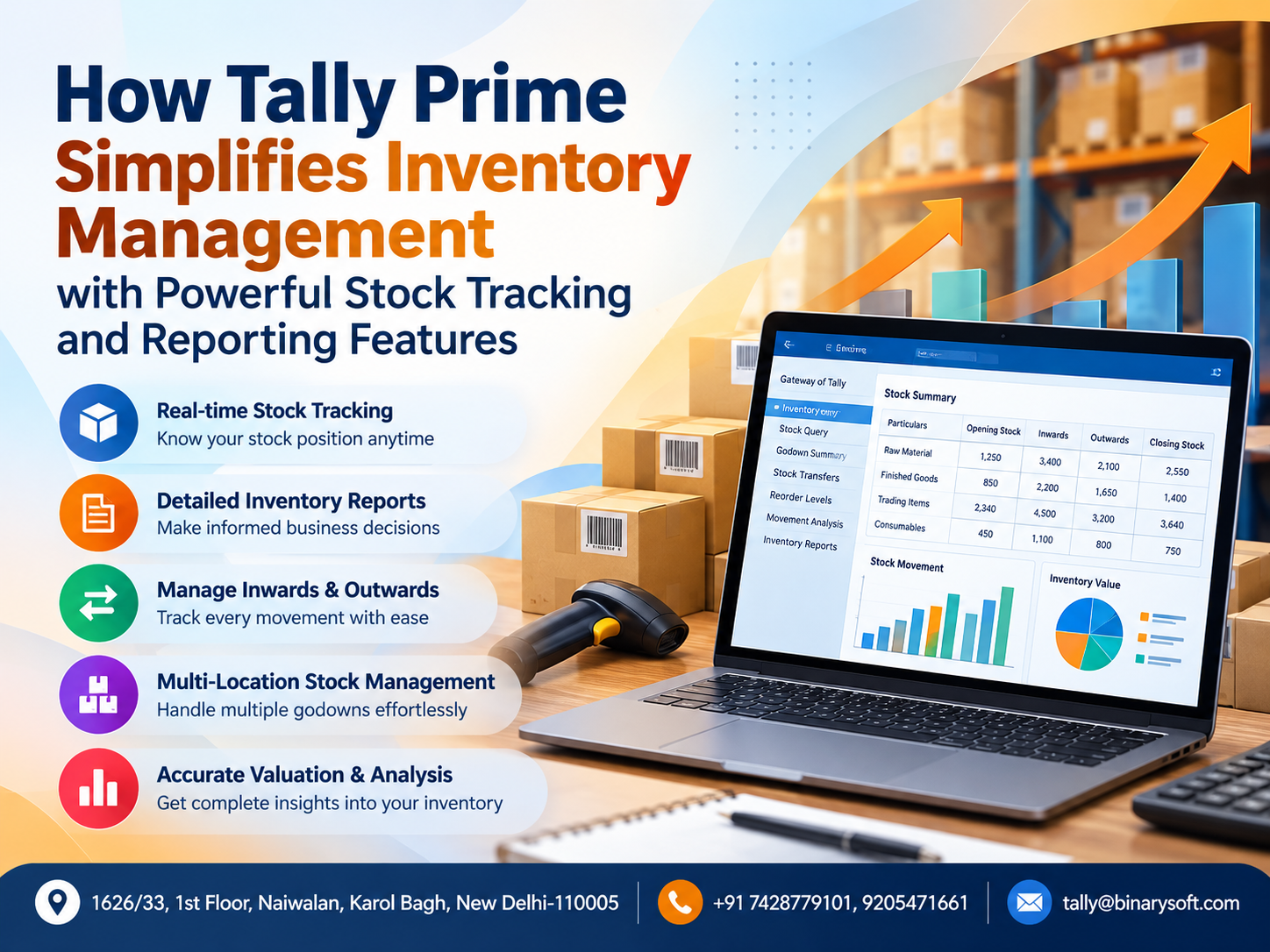
Introduction: Why Smarter Inventory Management Matters More Than Ever in 2026
In 2026, businesses across India are under increasing pressure to maintain accurate stock records while managing rising operating costs, changing customer demand, supplier delays and GST compliance requirements. For retailers, wholesalers, distributors and manufacturers, even a small inventory mistake can result in lost sales, unnecessary purchases or blocked working capital. Traditional stock registers and disconnected spreadsheets often make it difficult to identify which products are available, which items are moving slowly and when fresh stock should be ordered.
Tally Prime helps businesses bring inventory tracking, accounting and reporting into a coordinated system. From recording purchases and sales to monitoring godown-wise quantities, batch details and stock valuation, its inventory features can improve everyday operational visibility. Businesses can use these capabilities to reduce manual recordkeeping, improve purchase planning and make more informed decisions.
For growing enterprises, effective inventory management is no longer simply about counting products. It is about protecting profitability, maintaining customer trust and ensuring that the right stock is available when required.
1. Understanding Inventory Management and Its Importance
Inventory management is the process of recording, monitoring and controlling goods purchased, stored, transferred and sold by a business.
It includes maintaining stock quantities, tracking goods movement, reviewing inventory value and planning replenishment.
For a wholesale trader, inventory may include thousands of products stored across different warehouses. For a retailer, it may involve monitoring fast-selling items and seasonal products. For a manufacturer, it can include raw materials, work-in-progress and finished goods.
Poor inventory management can lead to several operational difficulties:
-
Stockouts that result in missed customer orders.
-
Excess purchases that block business capital.
-
Incorrect stock valuation affecting financial reports.
-
Unrecorded damage, shortages and wastage.
-
Difficulty locating products across warehouses.
-
Inaccurate purchase and sales planning.
-
Delays in preparing inventory-related reports.
Tally Prime provides inventory recording and reporting tools that help businesses organize these activities.
By connecting inventory transactions with accounting records, businesses can improve consistency between stock movement and financial information.
2. How Tally Prime Makes Inventory Management Easier
Tally Prime combines accounting and inventory functions within a single business management environment.
Instead of maintaining separate stock registers and financial spreadsheets, businesses can configure inventory masters and record transactions through appropriate vouchers.
For example, when a business records a sales invoice containing inventory items, the corresponding stock quantities can be updated according to the transaction and configuration.
Similarly, purchase transactions can increase recorded inventory quantities.
This integrated approach reduces the need to manually update separate stock records after every transaction.
Important inventory capabilities
Stock item management: Create and organize individual products with relevant units and classifications.
Stock groups and categories: Arrange products into meaningful reporting structures.
Godown management: Maintain stock information for different storage locations.
Batch tracking: Record batch-related details where applicable.
Stock valuation: Evaluate inventory value using supported valuation methods.
Inventory vouchers: Record receipts, deliveries, transfers and adjustments.
Reorder planning: Review replenishment requirements based on configured reorder levels.
Stock reporting: Analyze available quantities, stock movement and inventory value.
These features help businesses maintain better visibility over their inventory without requiring every activity to be managed through disconnected manual processes.
3. Stock Item Management for Accurate Product Tracking
Stock items form the foundation of inventory management in Tally Prime.
Each stock item represents a product or material that a business wants to track.
Consider an electrical wholesaler selling LED bulbs, copper wires, switches, sockets and circuit breakers.
The business can create separate stock items for each product and define the relevant units of measurement.
For example:
|
Stock item
|
Unit
|
Opening quantity
|
|---|
|
LED Bulb 12W
|
Nos.
|
500
|
|
Copper Wire 1.5 mm
|
Metres
|
2,000
|
|
Modular Switch 6A
|
Nos.
|
800
|
|
Circuit Breaker 32A
|
Nos.
|
150
|
|
PVC Conduit Pipe
|
Metres
|
1,200
|
Illustrative inventory data for explaining stock master configuration.
When purchase and sales transactions are recorded correctly, Tally Prime can calculate the updated stock balance.
A business owner can review stock availability without manually counting every product each time a customer requests a quotation.
Accurate item naming is important. Businesses should establish consistent product codes, units and descriptions to prevent duplicate masters and reporting confusion.
4. Stock Groups and Categories for Better Organization
Businesses handling hundreds or thousands of products need a logical inventory structure.
Tally Prime supports stock groups and stock categories to help organize items for reporting.
A hardware distributor may create stock groups such as Electrical Accessories, Plumbing Materials, Industrial Tools and Safety Equipment.
Within these groups, products can be classified further according to business requirements.
Stock categories can provide an additional classification dimension independent of the main stock group hierarchy.
For example, products belonging to different stock groups may be analyzed by brand or another common characteristic.
This organization makes inventory reports more useful.
Management can review product families instead of examining a long, unstructured list of individual items.
Well-planned stock masters also simplify training for employees responsible for billing, purchasing and inventory control.
5. Multi-Godown Inventory Management
Businesses operating multiple warehouses often struggle to identify where products are physically stored.
Tally Prime allows businesses to create multiple godowns or locations and allocate inventory to them.
For example, a wholesale distributor may operate a main warehouse in Karol Bagh, a dispatch facility in Naraina and a secondary storage location in Rohini.
The business can maintain location-wise stock balances and record transfers between these godowns.
Example of godown-wise inventory
|
Location
|
Product
|
Quantity
|
|---|
|
Karol Bagh
|
LED Bulbs
|
350
|
|
Naraina
|
LED Bulbs
|
200
|
|
Rohini
|
LED Bulbs
|
150
|
|
Total
|
LED Bulbs
|
700
|
With location-wise reporting, employees can identify where goods are available before committing to delivery.
Stock transfers can be recorded through appropriate inventory vouchers, including Stock Journal.
This helps maintain accurate records of goods movement between company locations.
6. Batch-Wise Inventory and Expiry Date Tracking
Batch management is particularly useful for pharmaceutical distributors, FMCG suppliers, food wholesalers and other businesses handling products with limited shelf lives.
Tally Prime supports batch-wise inventory tracking, including manufacturing and expiry details where configured.
For example, a pharmaceutical distributor may purchase the same medicine in different batches with different expiry dates.
Maintaining these batches separately helps the business identify available quantities and review products approaching expiry.
Example
|
Batch number
|
Quantity
|
Expiry date
|
|---|
|
MED-101
|
500
|
March 2027
|
|
MED-102
|
750
|
August 2027
|
|
MED-103
|
400
|
December 2027
|
Employees can review batch information and select appropriate batches during stock transactions.
Stock ageing and expiry-related reports help management identify items requiring attention.
However, physical dispatch procedures and appropriate controls remain necessary to prevent expired or unsuitable goods from being supplied.
7. Powerful Inventory Reports in Tally Prime
Inventory reports turn transaction records into useful business information.
Tally Prime offers several reporting options that help businesses review stock balances, product movement, ageing and replenishment requirements.
Stock Summary
Stock Summary provides information about recorded stock quantities and values.
It helps answer questions such as how much inventory is available, which products require attention and what value is represented by closing stock.
Movement Analysis
Movement Analysis helps businesses examine the movement of inventory associated with relevant accounting transactions.
This information can support purchasing decisions and identify slow-moving products.
Stock Ageing Analysis
Stock Ageing Analysis helps identify inventory that has remained in stock for longer periods.
Older stock may require special attention because of changing demand, deterioration or obsolescence.
Godown Summary
Godown Summary helps businesses review inventory maintained at individual storage locations.
Reorder Status
Reorder Status helps businesses identify stock replenishment requirements based on configured reorder information.
Batch Summary
Batch Summary helps review quantities and transactions associated with specific product batches.
Together, these reports support more informed inventory planning and operational decisions.
8. Reorder Levels and Stock Replenishment
Running out of popular products can damage customer relationships.
At the same time, purchasing too much inventory creates unnecessary storage expenses and blocks working capital.
Tally Prime allows businesses to define reorder-related information for stock items.
Consider a wholesale trader selling 100 units of a product each week.
If the supplier generally requires two weeks to deliver fresh stock, management must consider expected demand during that period before deciding when to reorder.
A simplified reorder calculation is:
Reorder Point = Expected Demand During Supplier Lead Time + Safety Stock
Suppose:
The reorder point would be:
(100 × 2) + 50 = 250 units
When stock approaches this level, the purchasing team should review replenishment requirements.
Actual ordering decisions must also consider pending purchase orders, demand fluctuations and supplier reliability.
9. Inventory Valuation and Business Profitability
Inventory valuation affects the financial position and reported profitability of a business.
Tally Prime supports different stock valuation approaches, allowing businesses to review inventory values according to their configured accounting policies.
Businesses should select a valuation method appropriate to their circumstances and applicable accounting standards.
Accurate valuation helps management understand the amount of capital invested in stock.
For example, a business may hold inventory worth ₹25 lakh but discover that a significant portion consists of products with low sales movement.
Reviewing stock value alongside movement and ageing reports can help identify opportunities to improve working capital.
Inventory management therefore supports not only warehouse operations but also broader financial planning.
10. A Story of Lost Orders and Renewed Confidence
The following is a fictional story illustrating a common inventory challenge.
For twelve years, Amit had operated a small electrical wholesale business in Delhi.
His father had established the shop with limited savings, and Amit had worked hard to expand its customer base.
Every morning, he opened the shop before the market became busy. His customers trusted him because he understood their requirements and worked hard to deliver products on time.
But as the business grew, inventory management became increasingly difficult.
Stock quantities were maintained partly in registers and partly in spreadsheets. Employees frequently needed to visit the warehouse to confirm product availability.
One afternoon, an important customer placed a large order for electrical accessories.
Amit confidently accepted the order because his spreadsheet showed sufficient stock.
When the warehouse staff began preparing the goods, they discovered that several products were unavailable.
The customer needed immediate delivery for a construction project.
Unable to fulfill the commitment, Amit lost the order.
That evening, he sat alone in the shop, looking at the shelves his father had helped him install years earlier.
The financial loss was painful, but losing the customer's confidence hurt even more.
He realized that hard work alone could not solve problems created by unreliable information.
Amit decided to organize his stock records using Tally Prime.
He created stock items, configured warehouse locations and trained employees to record purchases, sales and transfers consistently.
Gradually, the business developed a more dependable inventory workflow.
Before accepting large orders, employees could review recorded stock availability and confirm physical quantities when necessary.
Amit also began examining stock reports to identify products requiring replenishment.
For him, the greatest benefit was not simply reducing paperwork.
It was rebuilding confidence in the business his family had worked so hard to establish.
11. Case Study One: Electrical Wholesale Distributor in Delhi
Illustrative case study; figures are hypothetical.
Business background
An electrical wholesale distributor supplied lighting products, cables and accessories to retailers across Delhi NCR.
The company maintained a large product catalogue and operated two warehouses.
Challenges
The business experienced stock discrepancies, delayed order confirmations and difficulty identifying products stored at different locations.
Employees also spent considerable time preparing inventory summaries manually.
Tally Prime implementation
The company introduced a structured inventory process using stock groups, item masters, godown allocation and inventory vouchers.
Employees received training to record purchase receipts, sales and warehouse transfers.
Management began reviewing Stock Summary and Godown Summary reports regularly.
Illustrative performance targets
|
Operational measure
|
Before
|
Target after implementation
|
|---|
|
Stock confirmation
|
20 minutes
|
5 minutes
|
|
Monthly stock reporting
|
4 hours
|
30 minutes
|
|
Warehouse visibility
|
Separate registers
|
Centralized reports
|
|
Replenishment review
|
Reactive
|
Scheduled review
|
These are example targets, not measured customer results.
Business outcome
The proposed workflow would help employees access more consistent inventory information and reduce unnecessary manual compilation.
The case demonstrates the importance of accurate master data, disciplined voucher entry and regular physical stock verification.
12. Case Study Two: FMCG Distributor with Batch-Wise Stock
Illustrative case study; figures are hypothetical.
Business background
An FMCG distributor supplied packaged foods, beverages and consumer products to retail stores.
The business handled products with different manufacturing dates, expiry dates and storage requirements.
Challenges
Employees struggled to identify older batches, review expiry dates and plan purchases.
The business also needed better visibility into slow-moving products.
Tally Prime implementation
The distributor configured batch-wise inventory tracking and expiry-related information for applicable products.
Employees began recording batch details during purchases and selecting relevant batches during sales.
Management introduced periodic reviews of Stock Ageing Analysis and Movement Analysis.
Expected improvements
The proposed system would make it easier to identify products approaching expiry, evaluate ageing stock and plan replenishment.
The distributor could also use stock reports to support decisions about product promotions and purchase quantities.
Key lesson
Inventory software becomes most effective when digital records are supported by physical warehouse controls, accurate data entry and regular management review.
13. Integrating Inventory with GST Billing and Accounting
One important advantage of Tally Prime is the ability to maintain inventory and accounting records within a coordinated workflow.
When a business records inventory-based purchase or sales transactions, relevant stock and accounting information can be updated together.
This reduces the need to maintain separate records for every transaction.
For example, a wholesale trader selling 100 units of a product can prepare an inventory invoice with relevant tax details.
The transaction can affect recorded stock quantities, sales accounts and applicable GST ledgers according to the configuration.
This integrated approach helps businesses maintain consistency between inventory movement and financial reporting.
However, correct GST classifications, units, tax rates and transaction details remain essential.
14. Step-by-Step Guide to Starting Inventory Management in Tally Prime
Businesses planning to implement inventory management should follow a structured process.
Step 1: Review inventory requirements. Identify products, storage locations, units, batch requirements and reporting needs.
Step 2: Configure company features. Enable relevant inventory options according to the business workflow.
Step 3: Create stock groups and categories. Organize products into meaningful classifications.
Step 4: Create stock items. Enter item names, units and applicable opening balances.
Step 5: Configure godowns. Establish storage locations where location-wise tracking is required.
Step 6: Enable batch tracking where needed. Configure batch details and expiry information for relevant products.
Step 7: Record transactions. Use appropriate vouchers for purchases, sales, receipts, deliveries and stock transfers.
Step 8: Review reports. Examine Stock Summary, Movement Analysis, Stock Ageing and other relevant reports.
Step 9: Verify physical stock. Compare recorded quantities with physical counts and investigate differences.
Step 10: Improve the workflow. Train employees, correct recurring errors and review inventory policies periodically.
Successful implementation depends on both software configuration and consistent operational discipline.
15. Tally Prime Inventory Management with Cloud Access
Businesses with multiple offices or remote management requirements may consider using Tally Prime in a suitable cloud-hosted environment.
Cloud hosting can allow authorized employees to access a centralized TallyPrime installation from different locations.
For example, an owner travelling to meet suppliers may review recorded stock availability and purchase information without returning to the office.
A warehouse manager and accounts team may also coordinate through the hosted environment, provided the software licence and hosting setup support their requirements.
Cloud access does not automatically provide live warehouse scanning, unrestricted simultaneous users or integration with every external system.
Such requirements should be evaluated separately.
16. Why Businesses Should Choose Binarysoft Technologies
Implementing inventory management requires more than installing accounting software.
Businesses need appropriate stock structures, transaction workflows, reporting arrangements and employee training.
Binarysoft Technologies, an Authorized Tally Partner based in Karol Bagh, New Delhi, can assist businesses in evaluating their Tally Prime accounting and inventory requirements.
Businesses can discuss stock master configuration, inventory reporting, GST workflows, multi-godown requirements and suitable cloud-access arrangements.
The objective should be to establish a dependable inventory process that supports everyday operations and future growth.
Conclusion
Effective inventory management plays a vital role in business profitability, customer satisfaction and operational efficiency.
Tally Prime helps businesses organize stock records, monitor inventory movement, manage multiple godowns, track batches and review useful inventory reports.
By integrating inventory transactions with accounting workflows, businesses can reduce duplicate recordkeeping and improve the consistency of financial and stock information.
Features such as Stock Summary, Movement Analysis, Stock Ageing and Reorder Status can support purchasing decisions and help identify products requiring attention.
For retailers, wholesalers, distributors and manufacturers, the greatest benefit comes from combining appropriate software features with accurate data entry, physical verification and employee training.
With the right implementation approach, Tally Prime can help businesses develop more organized inventory operations and make better-informed decisions.
Powered by Binarysoft Technologies
Authorized Tally Partner
Location: 1626/33, 1st Floor, Naiwalan, Karol Bagh, New Delhi – 110005, INDIA
Contact us: +91 7428779101, 9205471661
Email us: tally@binarysoft.com
Business Hours: 10:00 AM – 6:00 PM, Monday to Friday
Website: www.tallyatcloud.com
Frequently Asked Questions
What is inventory management in Tally Prime?
Inventory management in Tally Prime involves recording and monitoring stock items, purchases, sales, stock transfers, inventory valuation and related reports within the accounting environment.
Can Tally Prime track stock automatically?
Tally Prime updates recorded stock balances when relevant inventory transactions are entered. The accuracy of the balances depends on correct and timely transaction recording.
Does Tally Prime support multiple warehouses?
Yes. Businesses can configure multiple godowns or locations and maintain location-wise inventory records.
Can Tally Prime manage batch-wise inventory?
Yes. Batch tracking is available for relevant products, including manufacturing and expiry details where configured.
CA. Aviraj Kothari focuses on business accounting, GST compliance, and management reporting. He helps businesses organize financial data and establish practical accounting processes for better visibility and smoother compliance.