Call CA Tally HelpDesk
+91 9205471661,
7428779101
What Changed in 2026: Why Store Owners Need Better Control Now
In 2026, running a retail or wholesale store is becoming increasingly dependent on speed, accurate stock information, GST-ready billing and reliable business data. For traders in Rajouri Garden Market and Tilak Nagar Market, the pressure is especially visible during busy hours: customers expect faster checkout, owners need to know what is actually available on the shelf, purchase costs keep changing, and accounting records must remain organized for GST compliance. A store that still depends heavily on handwritten bills, disconnected spreadsheets or manual stock registers can lose valuable time and may discover inventory mistakes only after they affect sales. The benefit of modern store management software is simple: billing, barcode scanning, inventory tracking, purchases, GST accounting, receivables and management reports can work together. Instead of spending the evening reconciling counters and stock registers, owners can use structured business information to make quicker and better decisions.
Store Management Is No Longer Just About Generating Bills
For years, many shop owners considered billing software primarily a replacement for handwritten invoices. That definition is now too narrow.
A modern store management system can become the operational backbone of a retail, wholesale or distribution business. It connects what happens at the billing counter with what happens in the stock room, purchase department, accounts desk and owner's office.
For businesses operating in busy commercial areas such as Rajouri Garden and Tilak Nagar, this integration can be particularly valuable.
Consider what happens during an ordinary business day.
A customer selects a product. The cashier scans its barcode. The software identifies the item, retrieves the configured price and tax details, generates the bill and reduces the available stock. The transaction becomes part of the day's sales information and accounting records.
Meanwhile, management can review sales, inventory movement, outstanding amounts and other reports without manually rebuilding the same information in separate registers.
That is the real purpose of complete store management software in 2026: turning individual transactions into useful business information.
Why Rajouri Garden Market Businesses Need Smarter Store Management
Rajouri Garden is known for its active retail environment, with businesses dealing in clothing, fashion, footwear, accessories, jewellery, electronics, food products, lifestyle products and numerous other categories.
A busy retail environment creates several operational challenges.
A store may have hundreds or thousands of individual stock items. The same product can exist in different colours, sizes, designs, brands, batches or price ranges.
Customers want quick billing, particularly during weekends, festive periods and seasonal sales.
At the same time, the owner needs answers to questions such as:
Which products are selling quickly?
Which products have not moved for months?
What stock needs to be reordered?
How much inventory is available?
Which items generate stronger margins?
What is today's sales value?
What amount is outstanding from customers?
What needs to be paid to suppliers?
Without an integrated system, answering even a simple question can require checking multiple files or registers.
Store management software helps bring this information together.
Why Tilak Nagar Market Traders Can Benefit from Integrated Software
Tilak Nagar has a diverse business environment with retailers, wholesalers, distributors, service providers and family-operated businesses serving customers across West Delhi.
Many such businesses grow gradually.
A shop may begin with one counter and a manageable number of products. Over time, the owner adds more product categories, suppliers, employees, customers or even another branch.
The business becomes bigger, but the original management process often remains unchanged.
This creates a hidden problem.
The owner may have a successful business but increasingly limited visibility into what is actually happening inside it.
Sales may be growing while inventory discrepancies also grow.
Purchases may increase without a clear understanding of slow-moving stock.
Credit sales can rise while collections remain unmonitored.
Store management software helps create a structured system capable of supporting that growth.
A Rajouri Garden Store Owner Who Stayed Back Every Night
Imagine a fictional retailer named Amit who runs a clothing and accessories store in Rajouri Garden.
The shop is busy.
Customers come throughout the day, and weekends can be extremely demanding. From the outside, the business looks successful.
But every evening after the shutters come down, Amit has another job.
He checks counter totals.
Then he looks at purchase entries.
Then he asks an employee whether certain items are still available.
Sometimes the answer is:
"Sir, system mein stock hai, lekin shelf par nahi mil raha."
Other times, a popular item is sold out, but nobody noticed early enough to reorder it.
During a festive week, Amit receives a customer asking for a particular design. His billing record suggests stock should be available.
Three employees search the store.
Nothing.
The customer waits, becomes impatient and eventually leaves.
The sale is lost.
But what troubles Amit more is that he does not know why the stock was wrong.
Was an item sold without being entered?
Was the purchase quantity entered incorrectly?
Was stock damaged?
Was an exchange missed?
Was an old entry duplicated?
That evening, instead of going home on time, he remains at the store checking records.
His young daughter calls and asks:
"Papa, aaj bhi late aaoge?"
That question changes his thinking.
He realizes the problem is not simply that his business is busy.
The problem is that too much of the business depends on him personally remembering, checking and correcting everything.
After implementing a structured barcode billing and inventory process, the biggest improvement is not merely faster billing.
It is visibility.
Stock movement becomes easier to trace. Reorder decisions become more systematic. Sales reports become readily available. The team has a clearer process to follow.
And Amit no longer needs to treat every evening as an accounting investigation.
This story is fictional, but the operational challenge will feel familiar to many growing retailers.
What Is Complete Store Management Software?
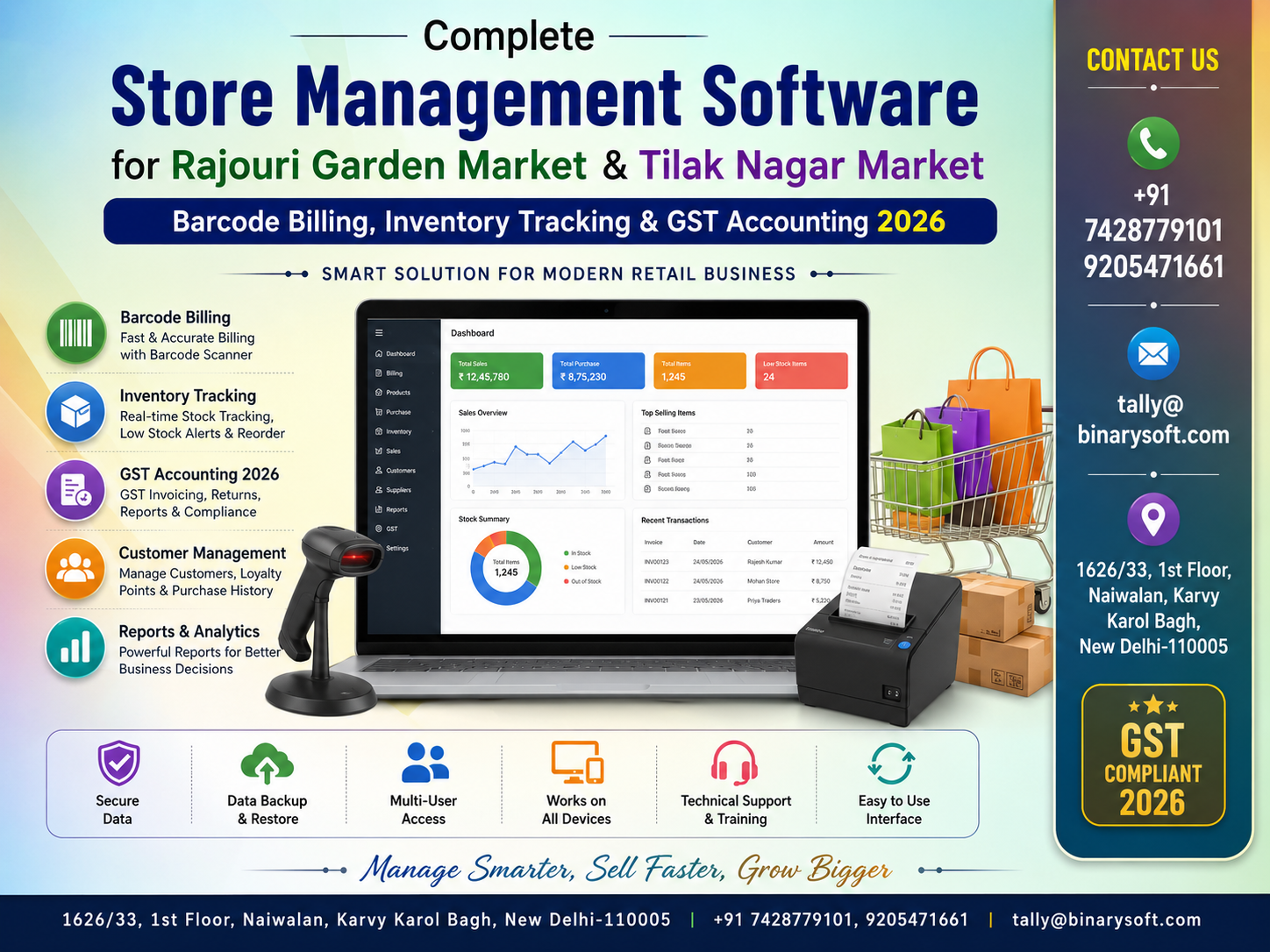
Store management software is a business application designed to manage multiple operational functions from an integrated system.
Depending on the configuration and business requirements, it may cover:
- Barcode billing and POS operations
- Sales invoicing
- Purchase management
- Inventory tracking
- Stock movement
- GST accounting
- Customer accounts
- Supplier accounts
- Receivables and payables
- Cash and bank transactions
- Pricing
- Discounts
- Returns
- Stock reports
- Sales analysis
- Purchase analysis
- Outstanding reports
- Management information
The objective is not simply computerization.
The objective is control.
1. Barcode Billing for Faster Checkout
Barcode billing can significantly improve counter efficiency for businesses handling standardized products.
Instead of manually searching for every item, the cashier scans the barcode.
The software can retrieve information associated with that product, such as its name, rate, tax configuration and other relevant details.
The transaction can then be added to the invoice.
This reduces repetitive manual work and can help minimize selection errors.
Barcode Billing Can Be Useful For
Garment stores
Footwear shops
Cosmetic stores
Gift shops
Mobile accessory stores
Electronics shops
Grocery and general stores
Stationery stores
Lifestyle retailers
Departmental stores
Hardware businesses
Auto-parts businesses
Toy stores
Home furnishing businesses
And many other product-based businesses.
2. Create and Print Barcode Labels
Businesses do not necessarily need to depend only on manufacturer-provided barcodes.
For products that arrive without suitable labels, businesses can create internal item codes and print barcode labels according to their operational requirements and compatible setup.
This can be particularly useful for retailers dealing with:
Local products
Unbranded goods
Garments
Accessories
Custom products
In-house packaged items
Products received from smaller suppliers
A properly planned barcode structure makes product identification easier and supports more systematic inventory control.
3. Real-Time Inventory Tracking
Inventory is money sitting inside the business.
If stock records are inaccurate, purchasing and sales decisions can also become inaccurate.
A properly configured inventory system records movements such as purchases, sales, sales returns, purchase returns and stock adjustments.
This gives the owner a clearer view of available inventory.
Instead of asking:
"Kitna stock bacha hai?"
the owner can check the system.
4. Avoid Stock-Out Situations
One of the most frustrating situations for a retailer is discovering that a popular product is unavailable only when a customer asks for it.
This represents more than a stock problem.
It can become a lost-sales problem.
Reorder-level monitoring can help businesses identify products approaching minimum stock levels so that purchasing decisions can be made earlier.
For fast-moving businesses in Rajouri Garden and Tilak Nagar, this can be especially useful during festivals, wedding seasons, weekends and promotional periods.
5. Identify Slow-Moving and Non-Moving Stock
Too much inventory can be almost as problematic as too little inventory.
Suppose ₹5 lakh worth of merchandise has remained unsold for months.
That is capital that could potentially have been used for faster-moving inventory, supplier payments, marketing or other business requirements.
Inventory reports can help management identify products with limited movement.
Owners can then consider actions such as:
Discounting old stock
Creating promotional offers
Bundling products
Reducing future purchases
Moving stock between locations
Changing the product mix
This turns inventory management from guesswork into a more data-supported process.
6. Manage Size, Colour and Product Variations
For apparel, footwear and fashion businesses, knowing that "50 shirts" are available may not be enough.
The owner may need to know exactly how many units exist by size and colour.
For example:
Blue Shirt – Small
Blue Shirt – Medium
Blue Shirt – Large
Black Shirt – Medium
Black Shirt – Large
White Shirt – XL
A well-structured inventory setup helps businesses track such variations more accurately.
This can make stock planning considerably more useful for fashion retailers in Rajouri Garden Market and Tilak Nagar Market.
7. GST-Ready Sales Invoicing
GST compliance remains an important part of business operations.
Store management and accounting software can help businesses create properly configured GST invoices based on the nature of their transactions and applicable requirements.
Invoice information may include:
GSTIN
Invoice number
Invoice date
Customer details
Item description
HSN/SAC information where applicable
Taxable value
CGST
SGST
IGST
Discounts
Total invoice amount
Businesses should ensure their tax configurations and processes are reviewed according to applicable GST requirements.
8. GST Accounting Integrated with Daily Transactions
One advantage of integrated billing and accounting is that transactions do not need to exist in completely separate systems.
When properly configured, a sales transaction can affect sales accounts, customer balances, taxes and inventory records as applicable.
Similarly, purchase transactions can update supplier balances, purchase records, applicable tax information and stock.
This reduces duplicate data entry and creates a more consistent accounting workflow.
9. Purchase Management
Inventory control begins before products reach the shelf.
A complete store management system should also help organize purchasing.
Businesses can maintain supplier information, record purchases, review purchase history and analyze product procurement.
This helps answer important questions:
Which supplier provides a particular item?
What was the previous purchase rate?
How much was purchased?
When was it purchased?
What amount is payable?
How frequently are we purchasing this item?
Better purchase visibility can directly support better margins.
10. Supplier Outstanding Management
Retailers often purchase goods on credit.
When purchases come from multiple suppliers with different payment terms, manually tracking outstanding amounts becomes difficult.
Accounting software can provide supplier-wise payable reports.
This helps management plan cash flow and supplier payments more systematically.
11. Customer Outstanding Tracking
Wholesalers and certain retailers may provide credit to regular customers.
Without systematic tracking, outstanding balances can remain unpaid longer than expected.
Customer ledger and ageing information can help businesses monitor:
Invoice amount
Amount received
Balance outstanding
Older unpaid invoices
Customer account history
This can make collection follow-up more structured.
12. Sales Return Management
Returns are a normal part of retail.
Customers may return products because of size problems, defects, exchanges or other reasons.
If returns are handled informally, inventory and accounting records can quickly become inaccurate.
A structured sales-return process helps ensure that the returned quantity and associated financial entries are appropriately recorded.
13. Purchase Returns
Businesses also return products to suppliers because of damage, incorrect supply, quality problems or excess stock.
Recording these transactions correctly helps maintain accurate supplier balances and inventory quantities.
14. Discount and Pricing Management
Retail pricing can become complicated when a business operates with:
MRP
Standard selling price
Wholesale rate
Retail rate
Customer-specific rate
Seasonal discount
Quantity discount
Promotional price
A systematic pricing structure reduces dependence on individual employees remembering prices.
It also helps management maintain better control over discounts.
15. Cash and Bank Management
Store management is not complete without financial visibility.
Integrated accounting software can help record cash receipts, cash payments, bank transactions, supplier payments and customer receipts.
Owners can review the financial position instead of relying solely on counter sales figures.
Because high sales do not automatically mean high available cash.
16. Daily Sales Reports
At the end of the day, the owner should be able to answer a basic question quickly:
"How did the store perform today?"
Useful reports can include:
Total sales
Cash sales
Credit sales
Returns
Discounts
Product-wise sales
Category-wise sales
Employee or counter-wise information where configured
Payment-mode information
This gives management a clearer picture of daily operations.
17. Product-Wise Sales Analysis
Knowing total sales is useful.
Knowing what produced those sales is even more useful.
Product-wise reports can help identify best-selling and weak-performing items.
For example, management may discover that a product generating a lot of attention is contributing little actual revenue, while another less-visible category is driving repeat sales.
That insight can influence future purchasing and merchandising decisions.
18. Category-Wise Inventory Analysis
Businesses with thousands of products need meaningful categorization.
Inventory can be organized according to business requirements, such as:
Brand
Category
Subcategory
Size
Colour
Material
Department
Season
Supplier
Product line
Better classification makes reports easier to interpret.
19. Stock Valuation
Inventory value has a major impact on business planning.
Owners need to understand not only how many units are available but also what those units represent financially.
Proper stock valuation reports can support accounting, purchasing decisions and management analysis, subject to the valuation method used by the business.
20. Multiple Counter Billing
A busy Rajouri Garden store may have several billing counters.
If each counter works independently without centralized information, reporting and inventory control can become complicated.
A multi-user setup can allow authorized users to work within a shared business environment, depending on the software architecture and deployment.
This can support faster billing while maintaining centralized records.
21. Multi-User Business Operations
A growing store may require different employees to handle different responsibilities.
For example:
Cashier – Billing
Store manager – Inventory
Accountant – Accounting
Purchase executive – Procurement
Owner – Reports
A multi-user business setup can make simultaneous operations possible while maintaining centralized information.
22. User-Level Security and Access Control
Not every employee needs access to every part of the business system.
A cashier may need billing access but not confidential financial reports.
A stock employee may need inventory access without permission to modify accounting records.
Role-based access can help restrict users according to their responsibilities.
This becomes increasingly important as the number of employees grows.
23. Better Control Over Manual Errors
Manual processes are vulnerable to mistakes.
A wrong quantity can be written.
A product can be selected incorrectly.
A purchase may not be entered.
A sales return may be forgotten.
A payment can be posted to the wrong ledger.
Software does not automatically eliminate every mistake, but structured processes, validations and integrated records can significantly improve control.
24. Faster Month-End Accounting
When billing and accounting are disconnected, accountants often spend substantial time collecting information from different sources.
They may need sales summaries from the counter, purchase files from the owner, bank statements and separate expense records.
Integrated accounting reduces some of this fragmentation.
When transactions are recorded consistently throughout the month, reconciliation and review can become more manageable.
25. Business Reports for the Owner
The most valuable feature of business software may not be the invoice screen.
It may be the reports.
Management should be able to obtain meaningful answers without manually calculating everything.
Useful reports can include:
Sales reports
Purchase reports
Stock summaries
Outstanding receivables
Outstanding payables
Cash information
Bank information
Profitability reports
Item movement
Customer ledgers
Supplier ledgers
Inventory valuation
Tax-related reports
The exact availability of reports depends on the software and configuration selected.
How Store Management Software Helps Different Businesses
Garment and Fashion Stores
Manage sizes, colours, styles, seasonal collections, pricing, barcodes and inventory movement.
Footwear Stores
Track product models by size, colour, brand and price.
Electronics Stores
Manage product categories, purchase and sales transactions, supplier accounts and inventory.
Mobile and Accessories Shops
Track multiple small items, fast-moving accessories and pricing.
Cosmetic Stores
Manage brands, product variants and inventory.
Grocery and General Stores
Use barcode-based billing for high transaction volumes and large product catalogues.
Hardware Stores
Track numerous items, suppliers, rates and customer accounts.
Wholesale Businesses
Manage large purchase quantities, customer credit, supplier outstanding balances and stock.
Distribution Businesses
Maintain products, dealers, purchases, sales and receivables within a structured accounting environment.
Manual Store Management vs Integrated Store Management
A manual system may appear inexpensive initially, but its hidden cost increases as the business grows.
The owner spends time checking information.
Employees spend time finding products.
Accountants spend time reconciling records.
Purchasing decisions may be made without reliable stock information.
Customers can wait longer at checkout.
Integrated software aims to reduce this operational friction.
The question is therefore not simply:
"What does the software cost?"
A better question is:
"How much time, stock visibility and business control are we losing without a proper system?"
Why Barcode Billing Matters During Peak Hours
Imagine a Saturday evening in Rajouri Garden.
The store has eight customers waiting.
One customer wants three garments.
Another wants to exchange a product.
Another is asking for a discount.
The phone is ringing.
An employee is checking stock upstairs.
This is precisely when inefficient billing becomes visible.
Barcode-based product identification can reduce manual item searching and help move customers through checkout more efficiently.
For high-volume stores, saving even a small amount of time per invoice can create a meaningful difference across hundreds of transactions.
Inventory Accuracy Is More Important Than Inventory Quantity
A business can have ₹20 lakh of inventory and still lose sales because the right products are unavailable.
Therefore, successful inventory management is not simply about maintaining more stock.
It is about maintaining the right stock.
That requires information.
Which products move quickly?
Which sizes sell most?
Which brands perform better?
Which categories are declining?
What should be reordered?
What should not be reordered?
Accurate inventory information helps answer these questions.
Connecting Store Operations with Accounting
One of the strongest advantages of integrated business software is the relationship between operations and accounts.
Sales affect inventory.
Purchases affect inventory.
Credit sales affect receivables.
Credit purchases affect payables.
Cash transactions affect cash balances.
Bank transactions affect bank accounts.
Taxes affect statutory records.
When these areas are managed within a connected workflow, business information becomes easier to analyze.
Store Management Software and TallyPrime
For many Indian businesses, TallyPrime is used for accounting, inventory management, invoicing, GST-related processes and business reporting.
The exact implementation should depend on the nature and complexity of the business.
A small single-counter retailer may have different requirements from a multi-counter showroom.
Similarly, a wholesaler with hundreds of credit customers has different priorities from a cash-and-carry retail store.
Before implementation, businesses should therefore evaluate:
Number of users
Number of billing counters
Number of stock items
Inventory complexity
Barcode requirements
GST requirements
Accounting workflow
Customer credit
Supplier credit
Number of locations
Reporting requirements
Data backup requirements
User access requirements
Integration needs
Single-User vs Multi-User Setup
A smaller business where only one person needs to work at a time may be able to operate with a single-user setup.
A larger store where billing, accounting and inventory activities happen simultaneously may require multi-user capabilities.
The decision should be based on actual workflow rather than simply the current number of employees.
What to Check Before Choosing Store Management Software in 2026
Choosing software only because it can print invoices is not enough.
A retailer should evaluate whether the solution can support the business as it grows.
Consider these areas carefully:
- Billing speed
- Barcode compatibility
- Inventory management
- GST configuration
- Accounting integration
- Purchase management
- Sales returns
- Purchase returns
- Customer outstanding tracking
- Supplier outstanding tracking
- Product categorization
- Reporting
- User security
- Multi-user requirements
- Backup strategy
- Scalability
- Training requirements
- Support availability
The right solution should simplify operations instead of introducing unnecessary complexity.
Implementation Is as Important as Software Selection
Buying software is only the beginning.
Successful implementation requires proper planning.
Product masters must be structured.
Ledger accounts need to be configured.
GST-related information needs to be reviewed.
Opening stock needs to be entered accurately.
Barcode processes must be planned.
Users need training.
Backup procedures should be established.
Reports should be explained to management.
A powerful software package with poor implementation can still create poor results.
Importance of Staff Training
Employees should understand not only which buttons to click but also why accurate entry matters.
For example, if a cashier bypasses barcode scanning and repeatedly selects a generic item, inventory reports may become unreliable.
If sales returns are not recorded correctly, physical stock and system stock may differ.
If purchase invoices are entered late, reorder decisions can be affected.
Training creates discipline.
Discipline creates better data.
Better data creates better decisions.
Data Backup Should Be Part of Daily Store Management
Business data represents years of transactions, customer history, supplier information and accounting records.
Backup should therefore not be treated as an optional technical activity.
Businesses should establish a regular backup policy appropriate to their software environment and operational requirements.
Backups should also be periodically checked to ensure that they are usable.
The Owner's Dashboard: What Should You Check?
Technology becomes valuable when management actually uses the information it produces.
Store owners can develop a routine for reviewing key business indicators.
For example:
Today's sales
Current cash position
Customer outstanding
Supplier outstanding
Fast-moving stock
Low-stock items
Slow-moving inventory
Major purchases
Returns
Stock value
Profitability information
The objective is not to watch every transaction.
It is to identify exceptions before they become expensive problems.
How Better Store Management Can Improve Customer Experience
Customers may never see your accounting software.
But they experience its impact.
They experience it when billing is fast.
They experience it when the product they want is actually available.
They experience it when exchanges are handled efficiently.
They experience it when employees can quickly check stock.
They experience it when invoices are professional and accurate.
Operational efficiency therefore becomes part of customer service.
From Shopkeeper to Business Manager
There is an important difference between operating a shop and managing a business.
A shopkeeper may spend the entire day reacting to transactions.
A business manager creates systems so transactions can happen consistently even when the owner is not personally supervising every detail.
Store management software supports this transition.
It creates processes.
It records information.
It creates accountability.
It provides reports.
Most importantly, it gives the owner greater visibility.
Why Growing Stores Should Digitize Before Problems Become Bigger
Many businesses wait until their existing process becomes impossible to manage.
That is usually late.
When inventory has already expanded to thousands of products and historical records are inconsistent, migration becomes more complicated.
It can be better to create a structured system while the business is growing.
This gives employees time to adopt standardized processes before transaction volumes become significantly larger.
Store Management Software for Rajouri Garden Market
Retailers in Rajouri Garden can particularly benefit from solutions designed around:
Fast barcode billing
Fashion and product variants
Inventory tracking
Multi-counter operations
Purchase management
GST invoicing
Customer management
Supplier management
Sales analysis
Stock reports
User access controls
Management reporting
The appropriate configuration will vary by business.
Store Management Software for Tilak Nagar Market
Businesses in Tilak Nagar may require a combination of retail, wholesale and accounting capabilities.
A solution can be planned around:
Barcode billing
GST invoicing
Stock control
Purchase tracking
Customer outstanding
Supplier outstanding
Cash and bank management
Accounting
Inventory reports
Sales reports
Business performance analysis
The objective should be to create a system that matches the actual workflow rather than forcing every business into the same configuration.
Why Local Implementation and Support Matter
Business software is not simply installed and forgotten.
Questions arise.
Employees change.
New products are introduced.
Business processes evolve.
GST-related requirements can change.
Reporting requirements can expand.
Businesses may add users, counters or locations.
Access to knowledgeable implementation and support professionals can therefore be an important part of the overall solution.
Powered by Binarysoft Technologies
Binarysoft Technologies provides business software and Tally-related solutions for organizations looking to improve accounting, billing, inventory management and operational control.
As an Authorized Tally Partner, Binarysoft Technologies can assist businesses in evaluating their requirements and planning an appropriate Tally-based solution.
For retailers, wholesalers, distributors and other businesses in Rajouri Garden Market, Tilak Nagar Market and surrounding Delhi areas, the objective is not simply software installation.
The objective is to create a business system that employees can use consistently and management can rely on.
Conclusion
The retail environment of 2026 demands more than fast billing. Businesses need accurate inventory information, organized purchasing, GST-ready accounting, customer and supplier tracking, controlled access and useful management reports.
For businesses in Rajouri Garden Market and Tilak Nagar Market, complete store management software can bring barcode billing, inventory tracking, purchases, sales, accounting and reporting into a more connected workflow.
The greatest benefit is visibility.
When owners know what is selling, what is available, what needs to be purchased, what customers owe, what suppliers need to be paid and how the business is performing, they can make decisions with greater confidence.
Technology should not make store management more complicated.
It should reduce repetitive work, improve control and give owners more time to focus on customers and growth.
A successful implementation therefore starts with understanding the business first and choosing the software configuration second.
CA. Pankaj Bhadoria brings practical experience in GST, accounting, and business process consulting. He works closely with MSMEs to resolve compliance challenges and improve operational transparency. His articles aim to simplify complex regulations for everyday business use.