Call CA Tally HelpDesk
+91 9205471661,
7428779101
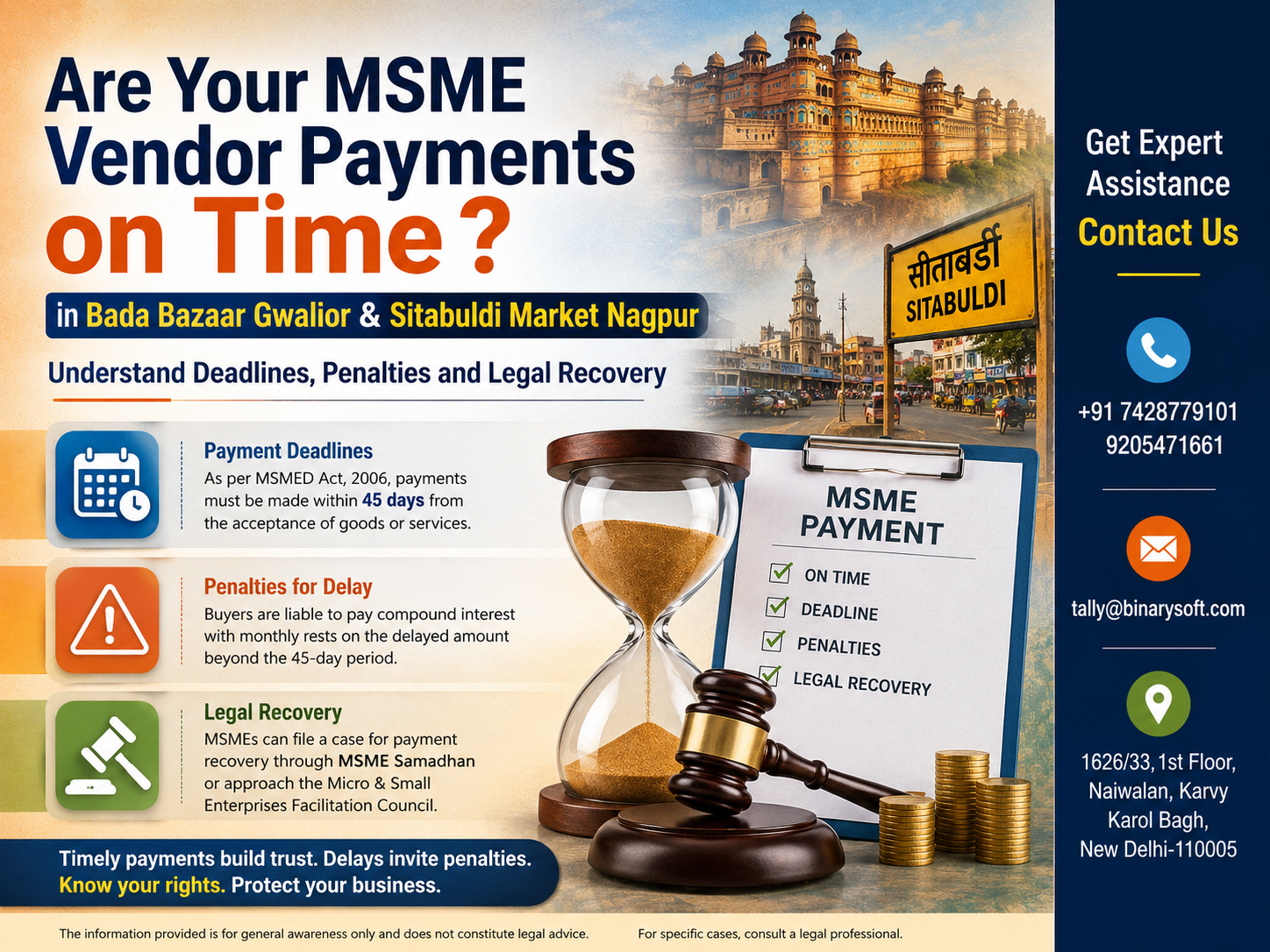
What Changed in 2026: Delayed MSME Payments Are Becoming a Bigger Business Risk
In 2026, MSME vendor payment management is no longer something businesses in Bada Bazaar, Gwalior and Sitabuldi Market, Nagpur can afford to treat as a routine accounts-payable task. The statutory delayed-payment framework for Micro and Small Enterprises continues to put strong pressure on buyers to clear eligible supplier dues within the prescribed period, while digital dispute-resolution mechanisms are making it easier for qualifying suppliers to pursue outstanding payments. The Ministry of MSME states that delayed-payment disputes can arise where payment is not made by the agreed date and, in any event, the agreed credit period cannot exceed 45 days from acceptance or deemed acceptance. Delays can expose buyers to statutory compound interest and recovery proceedings. For growing traders, wholesalers, retailers, distributors and service businesses, the benefit of acting early is significant: better cash-flow planning, cleaner vendor ledgers, fewer disputes, stronger supplier relationships and lower compliance risk.
Why MSME Vendor Payments Matter More in 2026
Bada Bazaar in Gwalior and Sitabuldi Market in Nagpur represent the kind of active commercial ecosystems where businesses may deal with dozens or even hundreds of vendors.
Every month can involve purchases of stock, packaging material, professional services, transport, repairs, technology, office supplies and other business requirements.
When several vendors are Micro or Small Enterprises, businesses need more than a simple list of outstanding creditors. They need to know:
- Which suppliers qualify for the relevant MSME delayed-payment protection
- When goods or services were accepted
- What payment terms were agreed
- Which invoices are approaching their due dates
- Which invoices have crossed the permitted payment period
- Whether disputes have been raised regarding goods or services
- How much is outstanding vendor-wise
- What supporting documents are available
- Whether the accounts team has correctly classified vendors
The Ministry of MSME's 2025–26 Annual Report says Sections 15–24 of the MSMED Act provide the statutory mechanism for delayed payments to Micro and Small Enterprises. It also reports that, up to December 31, 2025, MSEs had filed 2,56,892 delayed-payment applications involving ₹55,244.31 crore, demonstrating the scale of the issue nationally.
A Story from a Busy Market: When a Small Outstanding Invoice Became a Big Problem
Consider a fictional example inspired by the everyday realities of busy Indian trading markets.
Rajesh operates a growing wholesale business serving customers around Bada Bazaar, Gwalior. Over the years, he built excellent relationships with suppliers. His business expanded quickly, but his accounting processes did not grow at the same speed.
Purchase invoices arrived through email, WhatsApp and printed bills. Payment dates were maintained partly in accounting software and partly in spreadsheets.
One supplier had delivered packaging material regularly for several months.
Rajesh's team believed the supplier had agreed to a long credit cycle. The supplier believed payment would be released much earlier.
Invoices kept accumulating.
Whenever the supplier called, the accounts team responded:
"Payment will be cleared next week."
Next week became next month.
Eventually, the supplier informed Rajesh that it was a registered Micro Enterprise and was considering formal delayed-payment recovery.
Rajesh was surprised.
The amount itself was manageable. The real problem was that nobody had properly tracked the supplier's MSME status, invoice acceptance dates and outstanding age.
His team then spent days reconciling purchase bills, bank transactions, debit notes and correspondence.
The experience changed the way Rajesh managed his business.
Instead of asking only:
"How much do we owe vendors?"
he started asking:
"Which payment becomes risky if we don't clear it today?"
That single change transformed vendor management from a bookkeeping exercise into a compliance and cash-flow control process.
For businesses in Sitabuldi Market, Nagpur, Bada Bazaar, Gwalior and similar commercial centres, that distinction can be extremely important.
Understanding the MSME Payment Deadline
Under the delayed-payment provisions applicable to qualifying Micro and Small Enterprise suppliers, the basic concept is straightforward.
Where there is a written agreement between buyer and supplier, payment should be made according to the agreed date. However, the agreed period cannot exceed 45 days from the day of acceptance or deemed acceptance.
Where there is no agreement regarding the payment date, the statutory framework uses the "appointed day", linked to acceptance or deemed acceptance of the goods or services.
Therefore, businesses should not simply assume:
"Our normal vendor credit period is 60 or 90 days, so there is no problem."
For a qualifying MSE supplier, contractual payment practices need to be checked against the statutory framework.
Is the 45-Day Rule Applicable to Every MSME?
This is one of the most important distinctions for business owners.
The delayed-payment provisions discussed here are specifically focused on eligible Micro and Small Enterprises, rather than automatically applying in exactly the same manner to every business casually described as an "MSME."
The Ministry's current RAMP information states that a Micro or Small Enterprise with valid Udyam Registration can apply under the delayed-payment mechanism. Businesses should therefore verify the supplier's classification and registration details instead of relying solely on an invoice carrying the words "MSME Registered."
This verification should ideally happen when the vendor is onboarded.
What Happens When a Buyer Delays Payment?
The consequences can become financially significant.
Under Section 16 of the MSMED Act framework, where the buyer fails to make payment as required, the buyer may become liable for compound interest with monthly rests at three times the Bank Rate notified by the Reserve Bank of India.
This means delayed MSME payments should not be viewed like ordinary overdue trade creditors.
An invoice may start as a simple purchase liability, but continued delay can create additional statutory financial exposure.
Businesses therefore need systems that flag the problem before it becomes expensive.
Example of the Payment Risk
Suppose a business in Sitabuldi Market purchases goods from an eligible Micro Enterprise.
The invoice amount is ₹5,00,000.
The accounts department records the purchase correctly but does not identify the vendor as an eligible MSE.
The payment subsequently becomes overdue.
If the delay continues, the issue is no longer simply:
₹5,00,000 payable to supplier.
There may also be statutory interest implications, possible dispute-resolution costs, management time, documentation requirements and damage to the supplier relationship.
The lesson is simple:
Good MSME compliance starts before an invoice becomes overdue.
MSME Payment Management for Bada Bazaar Businesses
Businesses operating in and around Bada Bazaar, Gwalior may deal with suppliers across Madhya Pradesh and other states.
Wholesale businesses especially can have large numbers of purchase transactions.
A typical operation may involve:
Purchases → Goods Receipt → Invoice Verification → Stock Entry → Accounting → Payment Approval → Bank Payment → Reconciliation.
If the business cannot connect these stages, determining the correct payment timeline becomes difficult.
For example, the accounts team may know the invoice date but not the actual date goods were received.
The purchase department may know when material was accepted but not whether the supplier is registered as a Micro or Small Enterprise.
Management may see total outstanding creditors but not the invoices approaching important deadlines.
Integrated accounting and inventory information can reduce these gaps.
MSME Payment Management for Sitabuldi Market Businesses
Sitabuldi is one of Nagpur's prominent commercial areas, with businesses ranging from retail and wholesale trading to services and distribution.
For growing businesses, vendor management can become increasingly complicated.
Imagine having:
100 active suppliers
400 purchase invoices in a month
Different payment terms
Multiple bank accounts
Credit notes
Purchase returns
Part payments
Advance payments
Disputed invoices
MSME and non-MSME suppliers
A simple Excel sheet can quickly become difficult to control.
Businesses should therefore maintain a structured vendor master with appropriate registration and payment information.
Build an MSME Vendor Master
One of the most practical controls is maintaining a proper vendor master.
For each relevant supplier, businesses should consider maintaining details such as:
Supplier name
GSTIN
PAN
Udyam Registration details
Enterprise classification
Registration status
Address
Contact details
Payment terms
Bank details
Outstanding amount
Invoice date
Acceptance or relevant receipt information
Payment due date
Payment status
The objective is not to collect information unnecessarily.
The objective is to make sure the accounts department can identify potentially time-sensitive supplier payments.
Do Not Depend Only on Invoice Date
A common mistake is calculating everything from the invoice date without considering the statutory concepts of acceptance and deemed acceptance.
Under the delayed-payment framework, the timing of acceptance or deemed acceptance of goods or services can matter. The Ministry's ODR guidelines explain that where there is no agreement, the relevant delayed-payment framework is connected to acceptance/deemed acceptance, while an agreed period cannot extend beyond 45 days.
Businesses should therefore preserve appropriate documentation.
This could include purchase orders, goods receipt records, service completion confirmations, invoices and written correspondence concerning genuine objections.
Why Purchase Orders Matter
A properly prepared purchase order can help prevent future confusion.
The purchase order should clearly state important commercial terms, including:
Payment terms
Description of goods/services
Quantity
Price
Delivery terms
Acceptance process
Tax treatment
Other agreed conditions
When terms are vague, disputes become harder to resolve.
Good documentation protects both buyer and supplier.
What Is MSME Samadhaan?
MSME Samadhaan has been an important government mechanism for delayed-payment cases.
The Ministry of MSME explains that the portal was launched to enable eligible MSE suppliers to file delayed-payment complaints and track cases.
More recently, the government has been moving toward an end-to-end digital Online Dispute Resolution system. The Ministry's 2025–26 Annual Report states that new delayed-payment cases have been filed on the MSME ODR Portal from October 15, 2025, with integration with Samadhaan underway.
This development is especially relevant in 2026.
It means businesses should not assume that recovery always requires the supplier to immediately begin a conventional court case.
MSME ODR: A Major 2026 Development
The MSME ODR initiative is designed to make delayed-payment dispute resolution more digital, efficient and accessible.
According to the Ministry's scheme information, the initiative includes development of the ODR Portal, support for MSE Facilitation Councils and financial assistance for legal support. The Ministry identifies Udyam/UAP-registered MSEs as eligible under the scheme.
The official portal describes the process as an end-to-end digital mechanism intended to support dispute avoidance, containment and resolution.
For buyers, this reinforces an important message:
Outstanding MSE invoices should be actively monitored rather than left indefinitely in the creditors ledger.
Role of the Micro and Small Enterprises Facilitation Council
The Micro and Small Enterprises Facilitation Council, commonly called MSEFC, plays a central role in the delayed-payment framework.
State Governments establish MSEFCs for dealing with disputes involving delayed payments to eligible MSE suppliers.
After examining a qualifying case, the Council can deal with the dispute under the statutory framework and the buyer may ultimately face liability for the principal amount together with applicable interest.
Challenging an MSEFC Award Can Also Carry a Financial Burden
Businesses should also understand that the statutory framework can make challenges to awards financially demanding.
The Ministry's delayed-payment guidance notes that an application by a buyer to set aside an MSEFC decree or award is subject to the statutory 75% deposit requirement under Section 19.
This is another reason businesses should focus on preventing avoidable disputes.
Why Delayed Payments Hurt the Supplier
For a small supplier, an unpaid invoice is not merely an accounting number.
It can represent:
Employee salaries
Raw-material purchases
GST and other tax obligations
Rent
Electricity
Loan instalments
Transportation expenses
Future inventory
Working capital
A ₹3 lakh payment delayed by a large buyer may create a serious cash-flow problem for a small manufacturer.
This is why timely vendor payments can also strengthen the buyer's supply chain.
Suppliers that receive predictable payments are often better positioned to maintain stock, deliver on time and support urgent requirements.
Why Delayed Payments Hurt the Buyer Too
Buyers sometimes assume delaying vendor payments improves cash flow.
In the short term, it may appear that way.
But uncontrolled payment delays can create other costs:
Statutory interest exposure
Supplier disputes
Supply interruptions
Loss of negotiated discounts
Stricter future credit terms
Advance-payment demands
Legal and professional expenses
Management time
Damaged business reputation
Therefore, working-capital management should not mean paying everyone as late as possible.
It should mean paying each liability at the right time.
Accounts Payable Ageing Is Essential
An ageing report categorises outstanding vendor invoices according to how long they have remained unpaid.
For example:
0–15 days
16–30 days
31–45 days
46–60 days
61–90 days
Above 90 days
For MSME payment monitoring, businesses can make this even more useful by separating eligible Micro and Small Enterprise suppliers from other creditors.
Management can then immediately see invoices requiring attention.
Create a 30-Day Warning
Do not wait until Day 45.
A better process is to generate internal alerts earlier.
For example:
Day 15 – Normal monitoring
Day 25 – Verify approval status
Day 30 – Payment planning warning
Day 35 – Escalate pending approval
Day 40 – High-priority payment review
Before applicable deadline – Release or resolve appropriately
The exact internal workflow can vary, but advance alerts reduce last-minute problems.
Part Payments Need Proper Tracking
Businesses often make partial payments to vendors.
Suppose an invoice is ₹8 lakh.
The buyer pays ₹5 lakh and leaves ₹3 lakh outstanding.
The accounting system should clearly show the balance against the original invoice rather than simply showing an unexplained ledger difference.
Bill-wise accounting becomes extremely important here.
Without bill-wise tracking, the accounts team may know the vendor balance but not which invoice remains unpaid.
Purchase Returns and Debit Notes
Another frequent source of disagreement is purchase returns.
A supplier raises an invoice for ₹4 lakh.
Goods worth ₹50,000 are subsequently returned.
If the debit note is not properly recorded and communicated, the buyer's books may show ₹3.5 lakh payable while the supplier continues to demand ₹4 lakh.
Such mismatches should be reconciled immediately.
Do not allow them to remain unresolved until a delayed-payment dispute begins.
Document Genuine Disputes Promptly
If goods are damaged, quantities are incorrect or services are incomplete, businesses should document the issue promptly.
Do not wait several weeks before raising an objection.
Maintain evidence such as:
Goods receipt notes
Inspection reports
Emails
Purchase orders
Delivery documents
Debit notes
Photographs where appropriate
Service completion reports
This creates a clear audit trail.
Conduct Monthly MSME Reconciliation
Businesses in Bada Bazaar and Sitabuldi Market should consider a dedicated monthly review.
The review can examine:
Total MSE creditors
Invoices due in the next 15 days
Invoices nearing the applicable statutory limit
Overdue invoices
Disputed invoices
Unadjusted advances
Debit notes
Part payments
Vendor registration changes
Management should receive this information before month-end payment planning.
How Accounting Software Can Help
A properly configured accounting system can provide much stronger control than manually checking hundreds of invoices.
Useful capabilities include:
Vendor-wise outstanding reports
Bill-wise ageing
Payment due-date tracking
Purchase registers
Cash-flow reports
Bank reconciliation
Payment vouchers
Debit/credit note management
Inventory integration
GST-related accounting
Document references
Management reports
Technology cannot replace legal or tax advice, but it can greatly improve the accuracy and visibility of the underlying transaction records.
Using TallyPrime for Better Vendor Payment Control
For businesses already using TallyPrime, structured accounting can help management maintain purchase transactions, supplier ledgers, bill-wise outstanding information and payment records.
The most important factor is configuration.
Software alone cannot identify every compliance risk if the underlying vendor master is incomplete.
Businesses should therefore combine accounting software with proper internal procedures.
A practical process could be:
Vendor Registration → Udyam Details → Purchase Entry → Bill-wise Tracking → Due-Date Monitoring → Payment Approval → Payment Entry → Bank Reconciliation → Monthly Review.
This creates a much stronger payment-control environment.
Why Business Owners Need a Dashboard
Owners should not need to open every vendor ledger.
A useful management dashboard should answer questions such as:
How much do we owe suppliers?
How much is due this week?
Which eligible MSE invoices require urgent attention?
Which invoices are disputed?
How much cash will be required during the next 15 or 30 days?
Which suppliers have the highest outstanding balances?
Which purchase invoices remain unapproved?
When these questions can be answered quickly, payment management becomes proactive.
Cash-Flow Forecasting and MSME Compliance
Some businesses delay payments not because they want to, but because they suddenly discover that several large invoices are due simultaneously.
This is fundamentally a cash-flow planning problem.
Suppose payments expected over the next four weeks are:
Week 1 – ₹8 lakh
Week 2 – ₹12 lakh
Week 3 – ₹5 lakh
Week 4 – ₹14 lakh
Management can plan collections and banking requirements accordingly.
Without forecasting, the same ₹39 lakh may appear as an unexpected crisis.
Build Payment Compliance into Your Weekly Routine
A weekly review can be simple.
The owner, accounts manager and purchase manager can review:
Upcoming supplier dues
Urgent MSE payments
Cash available
Customer collections expected
Disputed purchases
Vendor reconciliation
Payment approvals
Even a short weekly review can prevent months of future complications.
Legal Recovery Options for Eligible MSE Suppliers
Where payment remains outstanding, qualifying Micro and Small Enterprise suppliers may use the delayed-payment dispute-resolution framework.
The current government framework includes the MSEFC mechanism and the newer MSME ODR infrastructure.
The ODR guidelines provide for digital pathways that may include negotiation and, depending on the applicable process, mediation/arbitration through the statutory ecosystem.
For specific disputes, both suppliers and buyers should obtain advice from qualified legal and financial professionals because eligibility, documentation, contractual facts and procedural requirements can materially affect the case.
Important Point for Buyers: Do Not Ignore Notices
If your business receives a communication concerning an MSME delayed-payment claim, do not leave it with the accounts department without action.
Immediately:
Verify the supplier
Check Udyam details
Identify invoices involved
Reconcile payments
Check purchase orders
Check delivery/acceptance records
Collect correspondence
Identify debit notes and returns
Speak with your CA or legal adviser
Respond through the appropriate process
Early reconciliation can sometimes prevent a commercial disagreement from becoming a prolonged dispute.
Important Point for Suppliers: Maintain Evidence
Suppliers seeking recovery should also maintain organised records.
Invoices alone may not tell the complete commercial story.
Maintain:
Purchase orders
Invoices
Delivery challans
Goods receipt acknowledgement
Service completion proof
Email correspondence
Ledger statements
Bank records
Udyam registration information
Payment reminders
Debit/credit notes
Accurate documentation makes reconciliation and professional advice much easier.
2026 Checklist for Businesses in Bada Bazaar Gwalior and Sitabuldi Market Nagpur
Businesses should review the following:
- Identify eligible Micro and Small Enterprise vendors.
- Obtain and verify appropriate Udyam details.
- Maintain accurate supplier masters.
- Record purchase invoices promptly.
- Track acceptance and relevant supporting documents.
- Define payment terms clearly.
- Monitor invoices before they become overdue.
- Use bill-wise outstanding reports.
- Review part payments and debit notes.
- Document genuine disputes promptly.
- Reconcile supplier balances regularly.
- Forecast cash requirements.
- Escalate approaching deadlines internally.
- Preserve payment and banking evidence.
- Seek professional advice where a material dispute exists.
Why 2026 Is the Right Time to Modernize Vendor Payment Management
The broader direction is clear: MSME payment disputes are becoming increasingly digitised.
The Ministry's 2025–26 Annual Report notes that the ODR system is being integrated with the established delayed-payment framework, while the dedicated ODR portal describes an end-to-end digital process aimed at more timely and cost-efficient dispute resolution.
For businesses, this creates a strong incentive to improve records before a dispute occurs.
Good compliance should be preventive rather than reactive.
How Binarysoft Technologies Can Help
Businesses in Bada Bazaar, Gwalior, Sitabuldi Market, Nagpur and other commercial centres can improve their accounting and vendor-management processes through better implementation of Tally and related business systems.
Binarysoft Technologies can assist businesses with areas such as:
TallyPrime implementation
Accounting system setup
Purchase accounting
Bill-wise vendor tracking
Outstanding management
Inventory management
GST accounting workflows
Management reporting
Bank reconciliation processes
Business accounting automation
Tally support and training
The goal is to make business information easier to access so owners can make decisions before problems become urgent.
Better Payment Discipline Creates Better Vendor Relationships
MSME payment compliance should not be viewed only through the lens of penalties.
Reliable payments can create a competitive advantage.
A supplier who trusts your payment process may be more willing to:
Provide better commercial terms
Prioritise urgent deliveries
Maintain inventory for you
Support seasonal demand
Offer customised products
Extend reasonable credit
Continue the relationship during difficult periods
Strong vendor relationships are an invisible asset on a business balance sheet.
Conclusion
For businesses operating in Bada Bazaar, Gwalior and Sitabuldi Market, Nagpur, MSME vendor payments deserve continuous management attention in 2026.
The key principle is straightforward: qualifying Micro and Small Enterprise payments should be tracked against the applicable statutory timeline, and an agreed payment period cannot simply be extended indefinitely beyond the maximum contemplated under the MSMED framework. Delayed payments can attract compound interest with monthly rests at three times the RBI-notified Bank Rate, while eligible suppliers have access to the MSEFC delayed-payment mechanism and increasingly digital ODR infrastructure.
The best approach is prevention.
Maintain accurate vendor information. Record purchases properly. Track invoices bill-wise. Monitor ageing. Reconcile disputes quickly. Forecast cash flow. Escalate approaching payment deadlines.
When accounting software, internal controls and management discipline work together, MSME payment compliance becomes far easier to manage.
For a growing business, paying the right supplier at the right time is not merely good accounting.
It is good business.
Frequently Asked Questions
What is the maximum payment period for an eligible Micro or Small Enterprise supplier?
Where payment terms are agreed in writing, the period cannot exceed 45 days from acceptance or deemed acceptance of the goods or services under the MSMED delayed-payment framework. Where there is no such agreement, the statutory appointed-day rules become relevant.
Does the delayed-payment protection automatically apply to every business called an MSME?
No. The delayed-payment mechanism discussed here specifically concerns eligible Micro and Small Enterprises. Current Ministry guidance states that Micro or Small Enterprises with valid Udyam Registration can apply under the mechanism. Businesses should verify the supplier's actual eligibility and registration.
CA. Lakshy Vermaa advises small and mid-sized businesses on accounting discipline, tax compliance, and process improvement. With exposure to retail and trading environments, he writes practical articles aimed at helping business owners gain better financial visibility and control.