Call CA Tally HelpDesk
+91 9205471661,
7428779101
Introduction: Why Cash Accounting Still Matters for Businesses in 2026
In 2026, many small businesses, retailers, freelancers and service providers face a familiar challenge: sales may be increasing, but available cash does not always reflect that growth. Delayed customer payments, rising operating expenses and unexpected business commitments can create financial pressure even when revenue appears healthy. For business owners who need a straightforward understanding of money entering and leaving their operations, cash accounting provides a practical starting point. Under the cash basis, income is generally recorded when payment is received, while expenses are recognized when money is paid. This approach makes cash movements easier to understand and can simplify recordkeeping for eligible businesses. However, cash accounting also has limitations, particularly when credit transactions, outstanding liabilities and financial reporting requirements become more complex. By understanding cash accounting and using accounting software such as TallyPrime to monitor receipts, payments and balances, businesses can strengthen financial discipline and make more informed decisions.
1. What Is Cash Accounting?
Cash accounting, also known as cash basis accounting, is an accounting method in which revenue is generally recognized when money is received and expenses are recognized when payments are made.
Unlike accrual accounting, cash accounting focuses on actual cash movements rather than the timing of earning income or incurring expenses.
For example, suppose a freelance consultant provides services worth ₹50,000 in March but receives payment in April.
Under cash basis accounting, the ₹50,000 income is generally recognized in April.
Similarly, if an office electricity bill relates to March but is paid in April, the expense is generally recognized in April under the cash basis.
This approach provides a straightforward record of cash receipts and payments.
However, the term cash in cash basis accounting can include qualifying payments received or made through banking channels, not only physical currency.
2. How Does Cash Accounting Work?
Cash accounting operates on two fundamental principles.
Recognition of income: Income is generally recorded when payment is actually received.
Recognition of expenses: Expenses are generally recorded when payment is made.
Consider a small service business with the following transactions:
|
Transaction
|
Amount
|
Cash basis treatment
|
|---|
|
Cash received from customers
|
₹80,000
|
Record income
|
|
Office rent paid
|
₹20,000
|
Record expense
|
|
Electricity bill paid
|
₹5,000
|
Record expense
|
|
Services provided on credit
|
₹30,000
|
Generally not yet recorded as cash-basis income
|
|
Unpaid internet bill
|
₹3,000
|
Generally not yet recorded as cash-basis expense
|
In this simplified example, cash-basis income is ₹80,000 and expenses are ₹25,000.
The resulting cash-basis surplus is ₹55,000.
This is not necessarily the same as accrual-based profit or the net increase in cash, because other cash transactions, such as asset purchases, loans and owner contributions, may also occur.
3. Important Terms Used in Cash Accounting
Understanding common accounting terminology makes it easier to maintain accurate records.
Cash receipts
Cash receipts represent money received by the business.
Examples include customer payments, cash sales and other incoming funds.
Not every cash receipt is revenue. Loan proceeds and capital contributions, for instance, increase cash without necessarily creating income.
Cash payments
Cash payments represent money paid by the business for expenses, purchases, liabilities or other purposes.
Payments for assets or loan principal should be distinguished from ordinary operating expenses.
Opening cash balance
The opening cash balance is the amount of cash available at the beginning of an accounting period.
Closing cash balance
The closing cash balance represents the cash remaining at the end of the period.
Formula:
\[ \text{Closing Cash}=\text{Opening Cash}+\text{Cash Receipts}-\text{Cash Payments} \]
Cash book
A cash book is an accounting record used to track cash receipts, cash payments and cash balances.
Cash flow
Cash flow refers to the movement of money into and out of a business over a particular period.
Petty cash
Petty cash is a small amount maintained for minor routine expenses, such as local transport, stationery and refreshments.
4. Main Features of Cash Accounting
Cash accounting is generally simpler than accrual accounting because it emphasizes payments and receipts.
Businesses can monitor actual money movements without making all the period-end accrual adjustments required under accrual accounting.
The method can be easier for small businesses with straightforward transactions.
However, cash accounting may not show the full value of outstanding customer invoices or unpaid supplier bills in income and expense reporting.
Consequently, it may provide an incomplete picture of financial performance where significant credit transactions exist.
Another important consideration is that cash accounting and cash management are not identical.
Cash accounting determines when income and expenses are recognized. Cash management involves planning, monitoring and controlling the availability and use of funds.
5. Types of Cash Books Used in Accounting
Businesses may use different cash book formats depending on their transaction volume and recordkeeping requirements.
Single-column cash book
A single-column cash book records cash receipts and cash payments in separate amount columns.
It is suitable for businesses primarily tracking physical cash transactions.
Double-column cash book
A double-column cash book commonly includes cash and bank columns, allowing businesses to record transactions involving both.
Triple-column cash book
A triple-column cash book generally includes cash, bank and discount columns.
This format provides additional information about cash discounts allowed or received.
Petty cash book
A petty cash book records smaller routine payments.
For example, a business may use petty cash for stationery, local conveyance or minor office expenses.
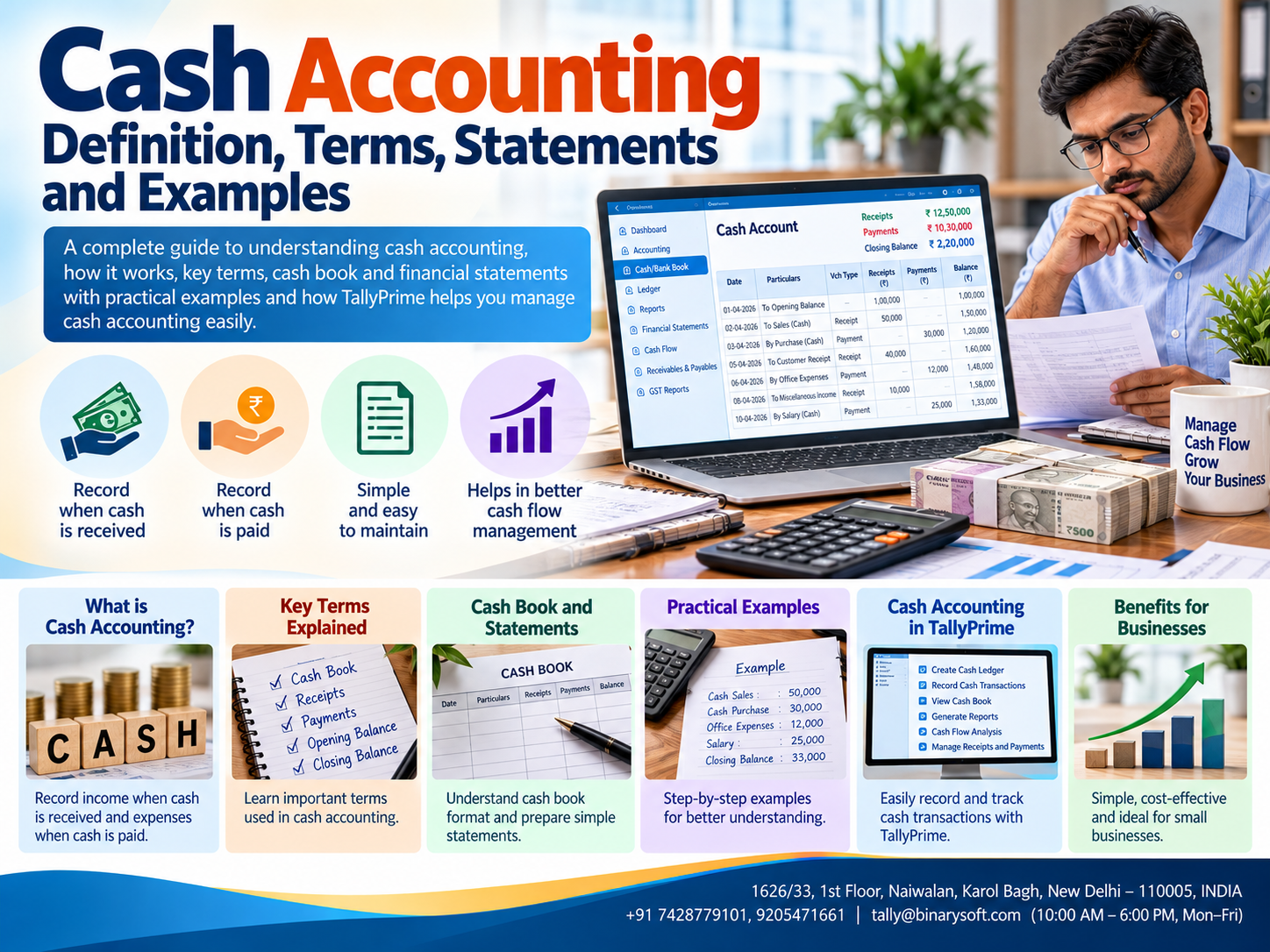
In TallyPrime, cash and bank transactions can be maintained through appropriate ledgers and vouchers, while relevant reports help users review the recorded activity.
6. Cash Book Format with Practical Example
Consider a small trading business with an opening cash balance of ₹40,000.
During the month, it receives ₹70,000 from customers and pays ₹25,000 for purchases, ₹10,000 for rent and ₹5,000 for office expenses.
|
Date
|
Particulars
|
Receipts
|
Payments
|
Balance
|
|---|
|
1 April
|
Opening balance
|
₹40,000
|
—
|
₹40,000
|
|
3 April
|
Customer receipts
|
₹70,000
|
—
|
₹1,10,000
|
|
5 April
|
Purchases
|
—
|
₹25,000
|
₹85,000
|
|
8 April
|
Office rent
|
—
|
₹10,000
|
₹75,000
|
|
10 April
|
Office expenses
|
—
|
₹5,000
|
₹70,000
|
Closing cash balance = ₹70,000
This example demonstrates how a cash book helps a business monitor available funds.
A cash book is a transaction record. It should not be confused with a complete Statement of Cash Flows or a cash-basis income statement.
7. Cash Accounting vs Accrual Accounting
The main difference between cash and accrual accounting is the timing of income and expense recognition.
|
Particulars
|
Cash accounting
|
Accrual accounting
|
|---|
|
Revenue recognition
|
When payment is received
|
When earned under applicable rules
|
|
Expense recognition
|
Generally when paid
|
When incurred under applicable rules
|
|
Outstanding receivables
|
Not reflected as earned unpaid revenue under pure cash basis
|
Recognized where appropriate
|
|
Unpaid expenses
|
Generally not recognized until paid
|
Recognized where appropriate
|
|
Complexity
|
Usually simpler
|
More comprehensive
|
|
Suitability
|
Certain eligible small businesses
|
Businesses requiring accrual financial reporting
|
For example, a company may provide services in March and receive payment in April.
Cash accounting generally recognizes the income in April.
Accrual accounting generally recognizes it in March if the relevant revenue recognition criteria are satisfied.
In India, the accounting method used for statutory reporting and income-tax purposes must comply with applicable legal requirements. Businesses should not assume that cash basis accounting is permitted for every entity or type of transaction.
8. Advantages of Cash Accounting
Simple recordkeeping
Cash accounting is relatively easy to understand because it follows actual receipts and payments.
Clear visibility of money movements
Business owners can identify when funds enter or leave their accounts.
Lower administrative complexity
Eligible businesses with straightforward transactions may require fewer accrual adjustments.
Useful for cash-focused decisions
Cash transaction records can help owners monitor liquidity and plan upcoming payments.
Practical for certain small operations
Some freelancers, professionals and small service providers may find cash basis accounting suitable, subject to applicable rules.
9. Limitations of Cash Accounting
Despite its simplicity, cash accounting has several disadvantages.
It may not accurately reflect business performance when substantial sales or purchases occur on credit.
A business might report strong cash-basis income in one month because old invoices were collected, even though little new work was completed.
Similarly, delaying payments can make cash-basis expenses appear lower temporarily.
Cash accounting may also be unsuitable for organizations required to prepare accrual-based financial statements.
Businesses should therefore evaluate accounting requirements, transaction complexity and reporting objectives before adopting the method.
10. Cash Accounting Journal Entries with Examples
Although cash basis accounting focuses on receipts and payments, businesses using double-entry bookkeeping must still record the relevant debit and credit effects correctly.
Example 1: Cash received from services
A consultant receives ₹25,000 for services.
|
Particulars
|
Debit
|
Credit
|
|---|
|
Cash A/c Dr.
|
₹25,000
|
|
|
To Service Income A/c
|
|
₹25,000
|
Narration: Being cash received for professional services.
Example 2: Office rent paid in cash
A business pays ₹12,000 towards office rent.
|
Particulars
|
Debit
|
Credit
|
|---|
|
Rent Expense A/c Dr.
|
₹12,000
|
|
|
To Cash A/c
|
|
₹12,000
|
Narration: Being office rent paid in cash.
Example 3: Cash deposited into bank
A business deposits ₹30,000 into its bank account.
|
Particulars
|
Debit
|
Credit
|
|---|
|
Bank A/c Dr.
|
₹30,000
|
|
|
To Cash A/c
|
|
₹30,000
|
This is a transfer between cash and bank accounts, not business revenue or expenditure.
In TallyPrime, such transfers are commonly recorded through a Contra Voucher.
11. Cash Accounting Statements and Financial Reports
Cash accounting information can be organized into reports that help business owners understand their financial position.
Cash receipts and payments statement
A receipts and payments statement summarizes actual cash and bank inflows and outflows during a period.
It can include operating transactions, capital expenditure, loans and other cash movements.
Cash-basis income statement
A cash-basis income statement summarizes income received and expenses paid, subject to the accounting policies applied.
It is different from a conventional accrual-based Profit and Loss Account.
Cash flow statement
A formal Statement of Cash Flows generally classifies cash flows into operating, investing and financing activities under the applicable reporting framework.
It should not be confused with a simple cash book.
Cash balance report
A cash balance report shows available cash at a specific point in time.
Businesses can use these reports to identify shortages, review transaction patterns and plan upcoming commitments.
12. How TallyPrime Helps Manage Cash Accounting
TallyPrime provides practical features for recording cash and bank transactions, monitoring balances and generating accounting reports.
It is important to distinguish these features from the adoption of a pure cash-basis accounting policy. TallyPrime supports cash transaction management, but its standard financial reporting should not automatically be assumed to produce fully compliant cash-basis financial statements.
12.1 Create a cash ledger
Businesses can create or use a cash ledger under the Cash-in-Hand group.
To create a cash ledger:
-
Open the relevant company in TallyPrime.
-
Navigate to ledger creation.
-
Enter the ledger name, such as Office Cash or Petty Cash.
-
Select the Cash-in-Hand group.
-
Save the ledger.
Separate cash ledgers can be useful when businesses need to track distinct cash balances.
12.2 Record cash receipts
Receipt Vouchers help businesses record money received.
For example, when a customer pays ₹15,000 in cash, the accountant can record the receipt against the relevant account.
Where an outstanding customer invoice exists, the receipt should be adjusted against that receivable rather than recognized again as sales revenue.
12.3 Record cash payments
Payment Vouchers are used to record cash or bank payments.
Common examples include office expenses, local conveyance, employee reimbursements and supplier payments.
The appropriate ledger selection depends on the underlying transaction.
12.4 Manage cash and bank transfers
Contra Vouchers help record transfers between cash and bank accounts.
Examples include withdrawing cash from the bank for office use or depositing cash collections into the bank.
These transfers do not create income or expenses.
12.5 View cash and bank books
TallyPrime allows users to review cash and bank books containing transaction details and balances.
These reports can help accountants verify entries and identify unusual cash movements.
12.6 Review financial reports
Businesses can review the Profit and Loss Account, Balance Sheet, ledger reports and other available accounting statements.
The interpretation of these reports depends on the company's accounting configuration and the recognition basis used.
For formal cash-basis reporting, businesses may need additional adjustments or external reporting procedures.
13. A Story of Financial Pressure: When a Busy Shop Ran Short of Cash
Ramesh operated a small stationery and office supply shop in Delhi.
His shop served nearby offices, schools and local traders.
Every day, customers visited his store, employees prepared orders and sales continued to grow.
From the outside, the business appeared successful.
However, Ramesh frequently struggled to arrange money for supplier payments.
He maintained sales records but did not regularly review cash collections, expenses and upcoming obligations.
One evening, a supplier called requesting payment for an overdue invoice.
Ramesh checked his bank balance and realized he did not have enough available funds.
He felt disappointed because he had worked long hours and believed the business was performing well.
The following week, he sat with his accountant and examined the cash book, customer receivables and supplier commitments.
They discovered that a significant portion of sales had been made on credit, while many expenses required immediate payment.
Ramesh introduced daily cash reviews, more disciplined customer collection procedures and weekly payment planning.
His accountant used TallyPrime to maintain cash and bank records, track outstanding invoices and review financial reports.
Over time, Ramesh became more confident about planning payments and maintaining sufficient working capital.
The most important lesson was simple: a business can generate sales without having enough cash available to meet its obligations.
This is an illustrative fictional story reflecting common cash management challenges.
14. Case Study 1: Improving Cash Visibility in a Retail Business
Business background
Consider a hypothetical retail business operating in Karol Bagh, New Delhi.
The shop sells consumer goods and receives payments through cash, UPI and bank transfers.
The challenge
The business maintained separate records for physical cash collections and digital payments.
Management frequently struggled to reconcile daily receipts and understand available funds.
The solution using TallyPrime
The accountant introduced separate cash and bank ledgers and recorded transactions using appropriate Receipt, Payment and Contra Vouchers.
Daily cash and bank books were reviewed, and payment records were reconciled against available bank statements.
Illustrative outcome
|
Particulars
|
Monthly amount
|
|---|
|
Opening cash and bank balance
|
₹1,00,000
|
|
Total cash and bank receipts
|
₹6,00,000
|
|
Total cash and bank payments
|
₹5,20,000
|
|
Closing cash and bank balance
|
₹1,80,000
|
The company gained better visibility into receipts, payments and available balances.
This helped management plan supplier payments more effectively.
Key lesson: Accurate transaction recording and regular reconciliation improve cash visibility, even when the business maintains accrual-based financial accounts.
15. Case Study 2: Cash Management for a Professional Services Firm
Business background
A hypothetical consulting firm in Gurugram provides accounting and advisory services to small businesses.
The company receives payments from clients through bank transfers and incurs recurring office expenses.
The challenge
Client payments were often received several weeks after services were completed.
Management relied on the bank balance without maintaining a structured forecast of future receipts and payments.
The solution using TallyPrime
The company recorded customer invoices, maintained receivable ledgers and tracked collections through Receipt Vouchers.
It also reviewed cash and bank balances and prepared a separate weekly cash forecast.
Illustrative outcome
|
Particulars
|
Amount
|
|---|
|
Opening bank balance
|
₹2,00,000
|
|
Customer collections
|
₹4,50,000
|
|
Operating payments
|
₹3,20,000
|
|
Equipment purchases
|
₹50,000
|
|
Closing bank balance
|
₹2,80,000
|
The firm gained a clearer understanding of its available funds and upcoming commitments.
Management could identify periods when delayed collections might create payment difficulties.
Key lesson: Cash management works best when transaction records are combined with receivable monitoring and forward-looking cash planning.
Both case studies are illustrative and do not represent verified customer outcomes.
16. Cash Accounting and Tax Compliance in India
Businesses should understand that cash accounting treatment for internal records may differ from requirements under tax laws and statutory financial reporting.
Under Section 145 of the Income-tax Act, 1961, income chargeable under specified heads may generally be computed according to the cash or mercantile system regularly employed, subject to applicable provisions and notified standards.
However, eligibility and treatment depend on the nature of the taxpayer, income and applicable legal requirements.
Companies preparing statutory financial statements generally follow the relevant accrual-based accounting requirements.
GST compliance also follows statutory rules governing the time of supply, invoicing, input tax credit and other obligations. Recording a transaction on a cash basis does not automatically mean GST becomes payable only when cash is received.
Businesses should therefore consult their accounting or tax adviser before adopting cash basis accounting for statutory purposes.
17. Practical Strategies for Better Cash Management
Effective cash management requires more than recording receipts and payments.
Businesses should establish a consistent process for monitoring funds.
Review cash balances daily. Compare physical cash with the cash book and investigate discrepancies promptly.
Reconcile bank transactions regularly. Ensure deposits, withdrawals, charges and customer receipts are recorded accurately.
Monitor customer collections. Maintain clear payment terms and follow up on overdue invoices.
Plan supplier payments. Prepare payment schedules based on due dates and available funds.
Maintain a cash reserve. Set aside suitable liquidity for unexpected business expenses, where financially feasible.
Prepare cash forecasts. Estimate future inflows and outflows to identify possible shortages.
Separate personal and business transactions. This improves accounting clarity and financial discipline.
Use structured accounting records. TallyPrime can help maintain transaction histories, balances and relevant financial reports.
18. Common Mistakes Businesses Make in Cash Accounting
One common mistake is treating every cash receipt as income.
For example, a bank loan increases available cash but does not ordinarily represent operating revenue.
Similarly, repayment of loan principal is a cash outflow but not generally an ordinary operating expense.
Another mistake is confusing cash accounting with the cash book.
A business using accrual accounting still needs accurate cash and bank books.
Businesses may also fail to distinguish between cash profit and available cash balances.
Cash can be affected by borrowing, asset purchases, capital contributions and other transactions that do not represent ordinary income or expenses.
Finally, relying only on cash balances without monitoring outstanding invoices and future commitments can create a misleading picture of financial stability.
19. Best Practices for Cash Accounting with TallyPrime
Businesses can establish a structured routine for maintaining cash and bank records.
At the beginning of the accounting period, verify opening balances and review the ledger structure.
Record receipts and payments promptly using suitable vouchers.
Maintain supporting references for important transactions.
Review cash and bank books regularly and reconcile relevant balances.
Where the business operates on credit, monitor customer outstanding balances and supplier liabilities separately.
Prepare periodic cash forecasts to assess future payment requirements.
Review financial reports with the accountant and ensure the accounting method complies with applicable reporting and tax requirements.
These practices help improve the reliability of cash records and support better financial decisions.
Conclusion
Cash accounting is a straightforward accounting method that generally recognizes income when payment is received and expenses when payment is made.
It can be useful for eligible businesses with relatively simple transactions, but it does not always provide a complete picture of financial performance when significant credit activity exists.
Understanding cash receipts, payments, cash books, accounting entries and cash-basis reporting helps business owners maintain more organized records.
TallyPrime supports cash management through cash and bank ledgers, Receipt Vouchers, Payment Vouchers, Contra Vouchers and financial reports.
By combining accurate transaction recording with bank reconciliation, receivable monitoring and cash forecasting, businesses can improve financial visibility and make more informed decisions.
Ultimately, effective cash management is not only about knowing how much money is available today. It is also about understanding how much will be needed tomorrow.
Powered by Binarysoft Technologies Authorized Tally Partner
Location: 1626/33, 1st Floor, Naiwalan, Karol Bagh, New Delhi – 110005, INDIA
Contact us: +91 7428779101, 9205471661
Email us: tally@binarysoft.com
Business Hours: 10:00 AM – 6:00 PM, Monday to Friday
Frequently Asked Questions
What is the difference between cash accounting and accrual accounting?
Cash accounting recognizes income and expenses based on receipts and payments. Accrual accounting recognizes them when earned or incurred under the applicable accounting rules.
Can TallyPrime help improve cash flow management?
Yes. TallyPrime provides cash and bank books, ledger reports and other accounting information that can support cash monitoring, reconciliation and financial planning.
Why is regular bank reconciliation important?
Bank reconciliation helps identify missing entries, incorrect transactions, bank charges and differences between accounting records and bank statements.
Is cash accounting the same as cash flow management?
No. Cash accounting is an income and expense recognition method, while cash flow management involves monitoring and planning money movements.
Does cash accounting show outstanding customer payments?
Pure cash-basis income reporting does not recognize unpaid revenue in the same way as accrual accounting. Businesses should maintain separate receivable records where necessary.
CA. Shivesh Khandelwaal is a practicing Chartered Accountant experienced in accounting automation, compliance management, and audit support. He has worked with trading and distribution businesses to improve inventory visibility and financial reporting. His articles focus on real-world applicability.