Call CA Tally HelpDesk
+91 9205471661,
7428779101
Introduction: Why Administrative Expenses Deserve More Attention in 2026
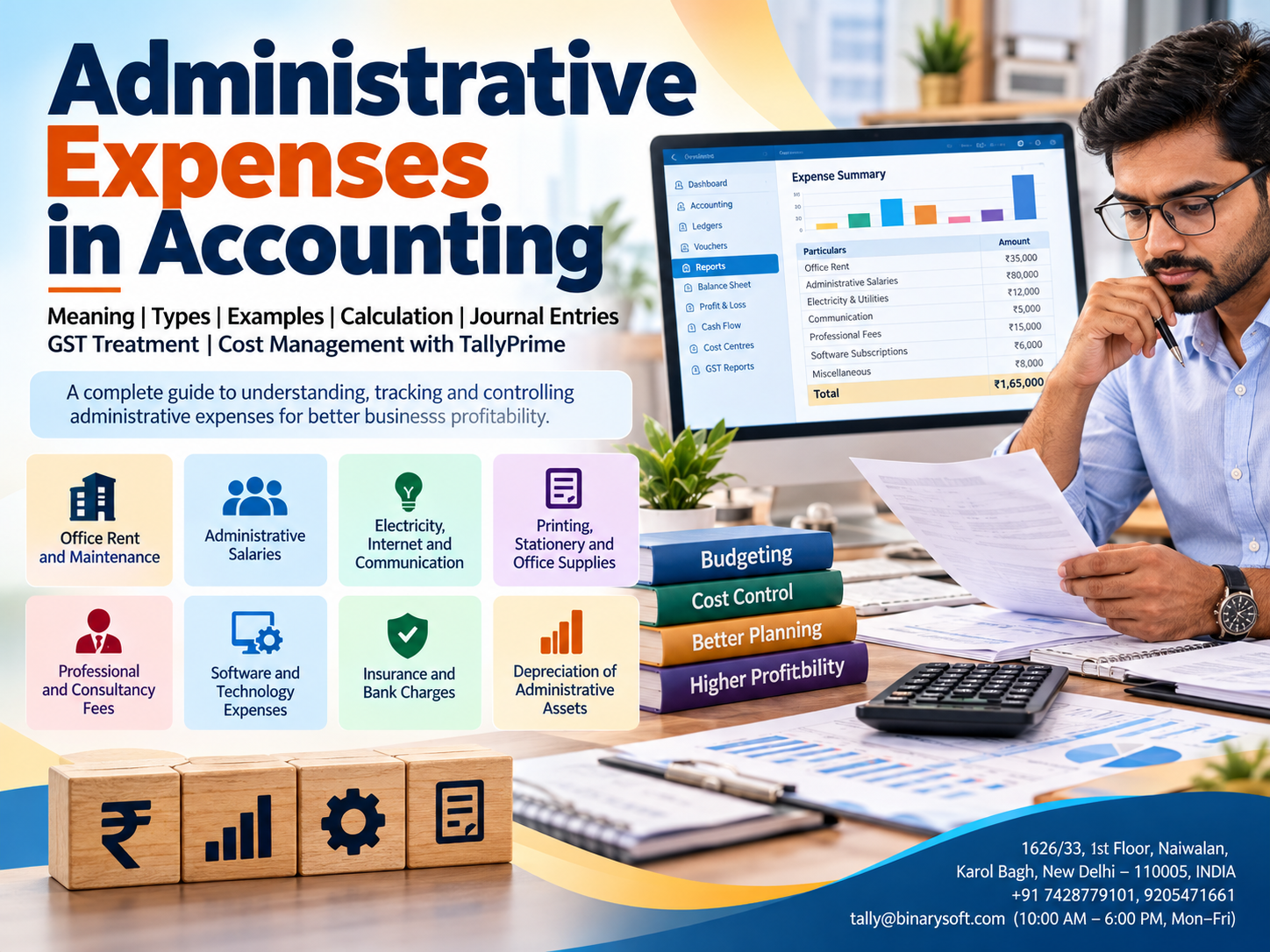
In 2026, Indian businesses are facing growing pressure to manage operating costs while maintaining profitability, compliance and financial transparency. Office rent, administrative salaries, electricity, internet subscriptions, professional fees and other routine expenses may appear small individually, but together they can significantly affect business earnings. For many retailers, wholesalers, manufacturers and service providers, the real challenge is not simply generating more revenue. It is understanding where money goes after sales are recorded. Without proper expense classification and regular financial monitoring, businesses may overlook unnecessary spending, experience cash flow difficulties and make decisions using incomplete financial information. Modern accounting systems such as TallyPrime help businesses record administrative expenses, maintain supporting vouchers, monitor departmental costs and generate financial reports. By understanding administrative expenses and adopting structured expense management, business owners can reduce financial uncertainty, improve budgeting and protect long-term profitability.
1. What Are Administrative Expenses?
Administrative expenses are the costs incurred by a business to manage, coordinate and support its general operations. These expenses are necessary for running the organization but are not directly associated with manufacturing products, purchasing goods for resale or delivering a particular service.
Administrative expenses are generally classified as indirect expenses because they support the organization rather than a specific unit of production.
For example, a wholesale trading business may incur expenses for office rent, accounting staff salaries, stationery, administrative software, internet connectivity and legal consultation.
Although these expenses do not directly generate sales, they help the business operate efficiently.
Common examples of administrative expenses
-
Salaries of administrative and office employees
-
Office rent and maintenance
-
Electricity and utility expenses for administrative premises
-
Telephone and internet charges
-
Printing, stationery and office supplies
-
Legal, accounting and professional fees
-
Office equipment depreciation
-
Administrative software subscriptions
-
Insurance relating to office operations
-
General office repairs and maintenance
-
Bank charges associated with general administration
-
Staff training for administrative functions
The exact classification depends on the nature of the business and the purpose of the expenditure.
For example, electricity consumed in a manufacturing plant may form part of production overheads, while electricity consumed in the corporate office is normally an administrative expense.
2. Why Administrative Expenses Matter for Business Profitability
Administrative expenses are unavoidable in most organizations. However, uncontrolled administrative spending can gradually reduce profitability.
Consider a trading business generating monthly sales of ₹20,00,000.
Its administrative expenses may include:
|
Expense category
|
Monthly amount
|
|---|
|
Office rent
|
₹35,000
|
|
Administrative salaries
|
₹80,000
|
|
Electricity and utilities
|
₹12,000
|
|
Internet and communication
|
₹5,000
|
|
Office stationery
|
₹4,000
|
|
Professional fees
|
₹15,000
|
|
Software subscriptions
|
₹6,000
|
|
Miscellaneous administration
|
₹8,000
|
|
Total administrative expenses
|
₹1,65,000
|
The business spends ₹1,65,000 every month on administration alone.
Its annual administrative expenditure would be:
₹1,65,000 × 12 = ₹19,80,000
If the business reduces avoidable administrative spending by 10%, it could save ₹1,98,000 annually, assuming operating requirements remain unchanged.
This demonstrates why accurate expense recording, monthly comparisons and budgeting are important for financial management.
3. Major Types of Administrative Expenses
3.1 Administrative employee salaries
Salaries paid to office managers, accountants, human resources employees, receptionists and other general administrative staff are common administrative expenses.
Businesses should distinguish these salaries from wages directly attributable to manufacturing, installation or service delivery.
3.2 Office rent and maintenance
Rent paid for corporate offices, administrative branches and management facilities is generally included in administrative expenses.
Related expenses may include office cleaning, security, routine maintenance and repairs.
3.3 Utilities and communication
Electricity, water, telephone, internet and communication expenses support daily office activities.
A business operating multiple branches should consider tracking these expenses separately to identify unusual increases.
3.4 Professional and consultancy fees
Payments made to chartered accountants, legal consultants, company secretaries and other professional advisers for general business administration may be classified as administrative expenses.
The accounting treatment should reflect the nature and purpose of each service.
3.5 Office supplies and stationery
Expenses for printing paper, files, pens, printer consumables and other routine office supplies are generally administrative costs.
However, significant purchases of equipment or long-lived assets may require capitalization rather than immediate expense recognition.
3.6 Depreciation of administrative assets
Office computers, furniture, printers and other capital assets may generate depreciation expenses over their useful lives.
Depreciation reflects the allocation of the depreciable amount of an asset across the periods benefiting from its use.
3.7 Administrative software and technology
Accounting applications, document management systems, office productivity subscriptions and certain cloud services may form part of administrative overheads.
Their accounting classification depends on whether the expenditure is recurring, prepaid or capital in nature.
4. Administrative Expenses vs Selling Expenses vs Production Expenses
Understanding the difference between expense categories is essential for preparing meaningful financial statements.
|
Particulars
|
Administrative
|
Selling
|
Production
|
|---|
|
Main purpose
|
General business management
|
Sales generation
|
Manufacturing or production
|
|
Examples
|
Office rent, accountant salary
|
Advertising, sales commission
|
Factory wages, factory power
|
|
Relationship with output
|
Usually indirect
|
Related to selling activity
|
Direct or indirect production cost
|
|
Financial classification
|
Operating overhead
|
Selling and distribution expense
|
Production or manufacturing cost
|
For example, the salary of an accountant working in the head office is generally administrative expenditure.
The salary of a salesperson is usually a selling expense.
Wages paid to factory workers directly involved in manufacturing are generally direct labour costs.
Proper classification improves cost analysis and supports more accurate financial reporting.
5. How to Calculate Administrative Expenses
Administrative expenses can be calculated by adding all relevant general management and office-related expenses for a particular accounting period.
Formula:
\[ \text{Administrative Expenses}=\sum \text{Eligible Administrative Costs} \]
Suppose a business records the following expenses:
-
Administrative salaries: ₹90,000
-
Office rent: ₹40,000
-
Electricity: ₹10,000
-
Professional fees: ₹20,000
-
Communication: ₹5,000
-
Office maintenance: ₹8,000
Total administrative expenses:
₹90,000 + ₹40,000 + ₹10,000 + ₹20,000 + ₹5,000 + ₹8,000
Total = ₹1,73,000
Administrative expense ratio
Businesses can also calculate administrative expenses as a percentage of revenue.
\[ \text{Administrative Expense Ratio}=\frac{\text{Administrative Expenses}}{\text{Revenue}}\times100 \]
If monthly revenue is ₹25,00,000:
\[ \frac{1,73,000}{25,00,000}\times100=6.92\% \]
The administrative expense ratio is 6.92%.
This ratio helps businesses compare spending across accounting periods. However, a lower ratio is not automatically better if essential administrative controls or service quality are being compromised.
6. Accounting Treatment of Administrative Expenses
Administrative expenses are generally recognized in the accounting period in which they are incurred, subject to the applicable accounting framework and recognition principles.
Under accrual accounting, an expense may need to be recognized even when payment has not yet been made.
For example, if office rent for March remains unpaid at the financial year-end, the business should normally recognize the relevant rent expense and corresponding liability in March.
Journal entry for administrative expenses paid immediately
Suppose a company pays ₹15,000 for office maintenance through its bank account.
|
Particulars
|
Debit
|
Credit
|
|---|
|
Office Maintenance Expenses A/c Dr.
|
₹15,000
|
|
|
To Bank A/c
|
|
₹15,000
|
Narration: Being office maintenance expenses paid through bank.
Journal entry for outstanding administrative expenses
Suppose administrative salaries of ₹50,000 are payable at the end of the month.
|
Particulars
|
Debit
|
Credit
|
|---|
|
Administrative Salaries A/c Dr.
|
₹50,000
|
|
|
To Salaries Payable A/c
|
|
₹50,000
|
When salaries are subsequently paid:
|
Particulars
|
Debit
|
Credit
|
|---|
|
Salaries Payable A/c Dr.
|
₹50,000
|
|
|
To Bank A/c
|
|
₹50,000
|
These entries help maintain accurate expense recognition and outstanding liability records.
7. How Administrative Expenses Appear in Financial Statements
Administrative expenses generally appear within operating expenses in the Statement of Profit and Loss, although the presentation and disclosure requirements depend on the applicable accounting framework.
For businesses preparing financial statements under Schedule III of the Companies Act, 2013, administrative expenses may be included within relevant expense classifications, such as other expenses, with appropriate disclosures.
A simplified example illustrates their impact.
|
Particulars
|
Amount
|
|---|
|
Revenue from operations
|
₹50,00,000
|
|
Cost of goods sold
|
₹35,00,000
|
|
Gross profit
|
₹15,00,000
|
|
Administrative expenses
|
₹4,00,000
|
|
Selling expenses
|
₹2,00,000
|
|
Other operating expenses
|
₹1,00,000
|
|
Operating profit
|
₹8,00,000
|
This example excludes finance costs, other income and taxes.
Administrative expenditure directly affects operating profitability. Therefore, business owners should review these costs regularly rather than waiting until the financial year ends.
8. How TallyPrime Helps Manage Administrative Expenses
TallyPrime provides accounting, voucher entry, ledger management, cost centre allocation and reporting features that businesses can use to monitor administrative expenditure.
Instead of maintaining separate spreadsheets for every expense category, organizations can maintain structured accounting records within their company data.
8.1 Create separate administrative expense ledgers
Businesses can create individual ledgers for:
These ledgers are generally grouped under Indirect Expenses, where appropriate.
To create an expense ledger in TallyPrime:
-
Open the relevant company in TallyPrime.
-
Navigate to the ledger creation screen through the Chart of Accounts or Create menu.
-
Enter the expense ledger name.
-
Select the appropriate group, such as Indirect Expenses.
-
Configure applicable statutory details.
-
Save the ledger.
Separate ledgers help businesses identify the categories contributing most to overall expenditure.
8.2 Record administrative expenses through vouchers
TallyPrime supports different accounting voucher types for recording transactions.
Payment Voucher: Used for expenses paid through cash or bank, such as office maintenance, rent or utility payments.
Journal Voucher: Used for appropriate adjustments, provisions, accruals and depreciation entries.
Purchase Voucher: May be used for eligible supplier invoices for goods or services, including applicable tax details.
For example, when office internet charges are paid, the accountant can record the transaction using the appropriate expense ledger and bank account.
This helps maintain an organized accounting trail.
8.3 Track expenses department-wise
A business may operate several departments, including accounts, human resources, administration and management.
Using cost centres, where configured, businesses can allocate relevant expenses to departments or other responsibility units.
For example:
|
Department
|
Administrative expenses
|
|---|
|
Accounts
|
₹45,000
|
|
Human Resources
|
₹25,000
|
|
General Administration
|
₹60,000
|
|
Management Office
|
₹30,000
|
|
Total
|
₹1,60,000
|
Cost centre reporting helps management understand which departments incur expenses and investigate significant variations.
8.4 Review the Profit and Loss Account
The Profit and Loss Account in TallyPrime helps business owners review income and expenditure.
By drilling down into indirect expense groups and individual ledgers, accountants can examine expense balances and underlying transactions.
This is useful for identifying unexpected increases in rent, communication expenses, professional fees and other administrative costs.
8.5 Maintain supporting transaction details
Administrative expenses should be supported by appropriate documentation.
Depending on the transaction and the business process, this may include supplier invoices, payment references, narration, purchase orders or other records.
Maintaining complete accounting information improves internal reviews and supports statutory compliance.
8.6 Export reports for management analysis
Businesses can export relevant TallyPrime reports for further analysis.
For example, monthly expense data can be reviewed in spreadsheets to prepare budget comparisons, trend reports and management presentations.
The exact export options and available reporting features depend on the TallyPrime release and configuration.
9. GST and Tax Considerations for Administrative Expenses
Administrative expenses may involve GST, TDS or other tax considerations depending on the transaction.
GST on administrative purchases
Suppose a business receives an eligible professional services invoice:
|
Particulars
|
Amount
|
|---|
|
Professional fees
|
₹20,000
|
|
CGST at 9%
|
₹1,800
|
|
SGST at 9%
|
₹1,800
|
|
Total invoice value
|
₹23,600
|
Where the recipient is eligible for input tax credit and the required conditions are satisfied, the GST component may be accounted for separately rather than treated as part of the expense.
Where input tax credit is unavailable, the non-recoverable tax may form part of the relevant expense or asset cost, depending on the transaction.
TallyPrime can help record GST-related transactions and maintain tax ledgers when correctly configured.
TDS on administrative payments
Certain administrative payments may attract tax deduction at source under applicable provisions of the Income-tax Act.
Examples may include professional fees, rent and certain contractual payments.
Applicability depends on factors such as the nature of payment, payer category, statutory thresholds and prevailing law.
Businesses should configure the relevant TDS ledgers and tax details correctly and verify the applicable provisions before processing deductions.
10. A Story of Financial Pressure: When Small Expenses Became a Big Problem
Rajesh operated a wholesale electrical goods business in Delhi.
For several years, he believed that strong sales automatically meant healthy profitability. His shop received regular orders, employees worked efficiently and customer relationships were stable.
However, one financial year brought an unexpected challenge.
Despite increasing sales, his bank balance continued to decline.
He started worrying about supplier payments, employee salaries and upcoming business commitments.
One evening, after the shop had closed, Rajesh sat with his accountant and reviewed the financial records.
They discovered that office expenses had increased gradually over several months.
Unused software subscriptions were still being paid. Communication expenses had risen. Several administrative purchases had been recorded without meaningful categorization.
The business was earning revenue, but unnecessary expenditure was reducing the money available for operations.
Rajesh decided to change his approach.
He introduced separate expense ledgers, reviewed monthly administrative costs and started comparing actual spending against planned budgets.
Using TallyPrime reports, his accountant could identify expense categories more easily and provide regular financial summaries.
Over time, the business gained better visibility into its operating costs.
For Rajesh, the most important improvement was not simply saving money.
It was the relief of understanding his financial position before making another major business decision.
This is an illustrative fictional story representing common challenges faced by small and medium-sized businesses.
11. Case Study 1: Administrative Cost Management in a Wholesale Trading Business
Business background
A hypothetical wholesale trading company in Karol Bagh, New Delhi, operates with 18 employees and handles regular purchases and sales.
Its administrative costs include office salaries, rent, communication, stationery and professional services.
The challenge
The business maintained most administrative expenses under a single general expense ledger.
As a result, management could not easily determine which expenses were increasing.
The monthly administrative expenditure averaged ₹2,40,000.
The solution using TallyPrime
The company introduced a structured expense classification system.
Separate ledgers were created for major administrative expense categories.
Cost centres were configured for the accounts and administration departments.
The accountant also began reviewing monthly Profit and Loss reports and individual expense ledgers.
Illustrative outcome
After reviewing recurring payments and eliminating unnecessary expenditure, the business prepared the following comparison:
|
Particulars
|
Before review
|
After review
|
|---|
|
Monthly administrative expenses
|
₹2,40,000
|
₹2,10,000
|
|
Monthly savings
|
—
|
₹30,000
|
|
Annualized savings
|
—
|
₹3,60,000
|
The example represents a 12.5% reduction in administrative expenses.
The savings resulted from management decisions and expenditure controls, while TallyPrime helped provide the accounting visibility needed for the review.
Key lesson: Accurate expense classification can help businesses identify spending patterns and make more informed cost-control decisions.
12. Case Study 2: Expense Visibility Across Multiple Office Locations
Business background
Consider a hypothetical professional services company operating offices in Delhi, Gurugram and Noida.
The company incurs administrative expenditure on employee salaries, office rent, utilities, subscriptions and professional services.
The challenge
Management struggled to compare administrative costs across its locations.
Expenses were recorded, but the absence of consistent department and location classifications made comparative reporting difficult.
Some recurring subscriptions were duplicated across offices.
The solution using TallyPrime
The business introduced standardized administrative expense ledgers.
Location-wise cost centres were configured where appropriate.
Accountants began recording expenses with the correct ledger and allocation details.
Management also established a monthly review of administrative expenses and recurring commitments.
Illustrative outcome
The company prepared the following monthly comparison:
|
Office
|
Earlier expenses
|
Revised expenses
|
|---|
|
Delhi
|
₹1,20,000
|
₹1,10,000
|
|
Gurugram
|
₹1,00,000
|
₹90,000
|
|
Noida
|
₹80,000
|
₹75,000
|
|
Total
|
₹3,00,000
|
₹2,75,000
|
The company identified potential monthly savings of ₹25,000, equivalent to ₹3,00,000 annually.
Management also gained a clearer understanding of location-wise administrative spending.
Key lesson: Consistent accounting classifications and cost centre reporting can improve expenditure visibility across departments and locations.
Both case studies are illustrative scenarios, not verified customer results.
13. Practical Strategies to Reduce Administrative Expenses
Reducing administrative expenses should not mean compromising employee productivity, statutory compliance or essential business operations.
Instead, organizations should focus on improving efficiency.
Prepare monthly administrative budgets
Establish realistic budgets for major expense categories based on historical expenditure and anticipated operational requirements.
Compare actual expenditure against the budget regularly.
Identify unnecessary recurring expenses
Review software subscriptions, internet plans, maintenance contracts and other recurring commitments.
Cancel or consolidate services that no longer provide sufficient business value.
Improve purchase approvals
Establish approval procedures for administrative purchases.
For example, businesses may require authorization before purchasing new office equipment or engaging additional professional services.
Use digital accounting records
Structured digital accounting reduces dependence on scattered manual registers and makes transaction reviews more convenient.
Monitor cost trends
Compare administrative expenditure across months and quarters.
A sudden increase in office maintenance or professional fees may require investigation.
Review vendor arrangements
Businesses can periodically compare service providers and negotiate commercial terms without compromising reliability.
Introduce expense accountability
Assign responsibility for major administrative budgets to appropriate employees or department managers.
This encourages financial discipline and supports informed purchasing decisions.
14. Common Mistakes Businesses Make While Recording Administrative Expenses
One common mistake is combining unrelated expenses under a single miscellaneous ledger.
Although this may simplify initial data entry, it reduces the usefulness of financial reports.
Another mistake is treating capital expenditure as an ordinary administrative expense.
For example, purchasing a new office computer may require recognition as a fixed asset rather than immediate charging of the entire purchase amount to the Profit and Loss Account.
Businesses may also overlook outstanding expenses at the financial year-end.
Failing to recognize unpaid liabilities can distort the financial results of the relevant period.
Incorrect GST or TDS treatment is another area of concern.
Finally, some organizations record expenses accurately but rarely review them.
Expense recording becomes more valuable when management uses the information to support budgeting and financial decisions.
15. Best Practices for Administrative Expense Management with TallyPrime
Businesses seeking better financial control can implement a structured monthly process.
At the beginning of the accounting period, review the expense ledger structure and confirm that employees understand the correct classifications.
During the month, record administrative transactions promptly using suitable vouchers.
Allocate expenses to cost centres where departmental or location-wise reporting is required.
At month-end, review the indirect expense balances, inspect unusual transactions and reconcile relevant accounts.
Compare actual expenditure against budgets maintained in the organization's budgeting process.
Investigate significant differences and document corrective actions.
Finally, prepare a concise management report covering total administrative expenses, major cost categories, significant changes and recommended improvements.
TallyPrime can support this process through ledger-based accounting, voucher records and financial reporting. More advanced budgeting or analytical requirements may involve additional configuration or external reporting tools.
16. How Administrative Expense Control Supports Long-Term Business Growth
Administrative expense management is not only about reducing costs.
It also improves financial planning and business resilience.
When management understands its recurring expenditure, it becomes easier to estimate working capital requirements, assess profitability and evaluate expansion plans.
For example, a business considering a new branch should estimate additional rent, administrative salaries, communication expenses and office operating costs before committing to the investment.
Similarly, a growing organization can use historical administrative expense information to assess whether overheads are increasing faster than revenue.
Good expense management also supports more reliable financial statements, improved internal accountability and better communication between business owners and accountants.
Most importantly, it allows businesses to make decisions based on organized financial information rather than assumptions.
Conclusion
Administrative expenses are an essential part of running a business, but they require careful classification, monitoring and financial control.
Office rent, administrative salaries, professional fees, utilities, communication expenses and other overheads can significantly affect profitability when they are not reviewed regularly.
Understanding the meaning, types, calculation and accounting treatment of administrative expenses helps businesses prepare more reliable financial statements and make informed operating decisions.
TallyPrime supports administrative expense management through structured ledgers, accounting vouchers, cost centre allocation and financial reporting.
By combining accurate accounting with realistic budgets, regular reviews and responsible spending practices, businesses can improve financial visibility and support sustainable growth.
The objective is not to eliminate necessary administrative expenditure. It is to ensure that every expense contributes appropriately to efficient business operations.
Powered by Binarysoft Technologies Authorized Tally Partner
Location: 1626/33, 1st Floor, Naiwalan, Karol Bagh, New Delhi – 110005, INDIA
Contact us: +91 7428779101, 9205471661
Email us: tally@binarysoft.com
Business Hours: 10:00 AM – 6:00 PM, Monday to Friday
Frequently Asked Questions
Can businesses claim GST input tax credit on administrative expenses?
Input tax credit may be available on eligible business expenses, provided the conditions under GST law are satisfied and the credit is not restricted or blocked.
Why is administrative expense management important for small businesses?
It helps small businesses understand operating costs, protect profitability, plan cash flow and make better financial decisions.
How frequently should administrative expenses be reviewed?
Monthly reviews are generally useful for identifying spending changes early. Businesses may also conduct quarterly and annual assessments for budgeting and strategic planning.
Can TallyPrime track administrative expenses department-wise?
Yes. TallyPrime supports cost centre accounting, which can help businesses allocate and analyze expenses by department, location or responsibility unit.
Are administrative expenses direct or indirect expenses?
Administrative expenses are generally indirect expenses because they support overall business operations rather than a specific product or service.
CA. Priya Tanvi specializes in accounting compliance, GST advisory, and business reporting for small and growing enterprises. She works with business owners to improve record-keeping and financial clarity. Her articles focus on practical compliance solutions and operational discipline.