Call CA Tally HelpDesk
+91 9205471661,
7428779101
Introduction: Why Choosing the Right Accounting Method Matters in 2026
In 2026, Indian businesses are facing increasing pressure to maintain accurate financial records, manage delayed customer payments, monitor expenses and make faster financial decisions. For retailers, wholesalers, distributors and service providers, one accounting decision can significantly influence how business performance appears in financial reports: choosing between cash accounting and accrual accounting. A business may record strong sales but struggle to pay suppliers because customers have not settled their invoices. Another business may have sufficient cash in its bank account while carrying substantial unpaid expenses. Understanding the difference between these two accounting methods helps business owners interpret profitability, liquidity and outstanding obligations correctly. With accounting software such as TallyPrime, businesses can maintain systematic transaction records, monitor receivables and payables, reconcile bank transactions and generate meaningful financial reports. Choosing an appropriate accounting method is not merely a bookkeeping decision; it is an important step toward stronger financial control and sustainable business growth.
A Business Owner's Story: When Strong Sales Failed to Pay the Bills
Rajesh operated a wholesale electrical goods business in Delhi. His business had grown steadily, and several retailers regularly purchased products on credit.
One evening, while preparing payments for suppliers, Rajesh discovered that his bank balance was insufficient to settle several urgent bills.
He was surprised because his monthly sales report showed revenue exceeding ₹18 lakh.
His accountant explained that a significant portion of those sales remained unpaid.
Rajesh had been treating sales performance and cash availability as though they represented the same thing.
His business had earned revenue, but the money had not yet reached the bank.
Meanwhile, employee salaries, warehouse rent and supplier payments were becoming due.
The situation created considerable stress. Rajesh worried about disappointing suppliers who had trusted his business for years.
After reviewing his accounting processes, he began monitoring outstanding receivables, payment due dates and cash flow separately from reported profits.
Using TallyPrime, his accounting team organized customer invoices, maintained bill-wise outstanding details and regularly reviewed financial statements.
Over time, Rajesh gained a clearer understanding of the difference between earning revenue and receiving money.
The lesson was simple: A profitable business can still experience a cash shortage when collections and payments are not properly managed.
This is an illustrative business story created to explain the accounting concepts.
1. What Is Cash Accounting?
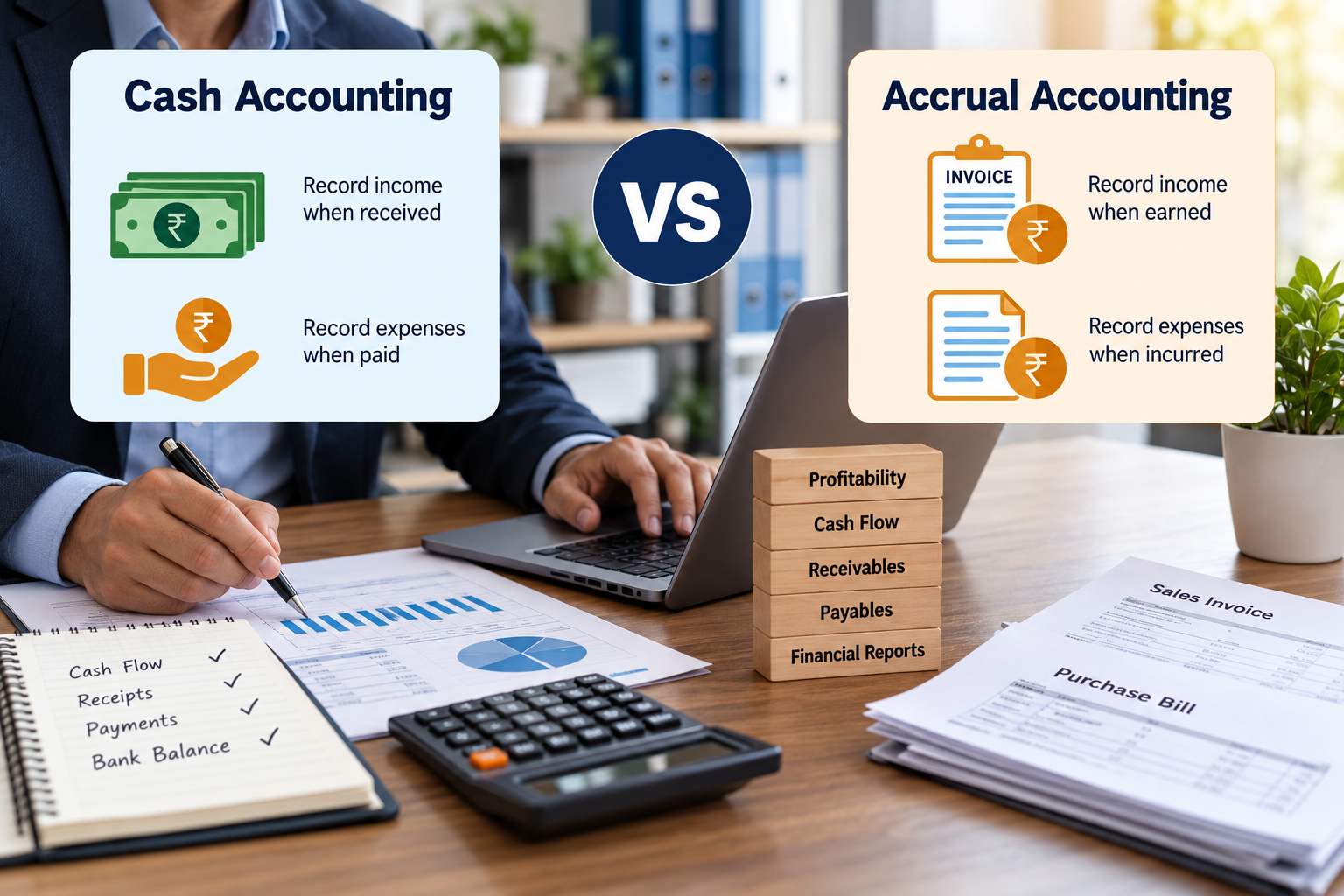
Cash accounting, also called cash basis accounting, is a method of recording financial transactions when money is actually received or paid.
Under this method, revenue is recognized when payment is received from customers, while expenses are recognized when payments are made.
The accounting records therefore focus on actual cash movements rather than the dates on which sales or expenses arise.
Example of Cash Accounting
Suppose a retailer sells products worth ₹50,000 on 10 June but receives payment on 5 July.
Under cash accounting:
-
No revenue is recognized on 10 June merely because the credit sale occurred.
-
Revenue of ₹50,000 is recognized on 5 July when payment is received.
-
If the business pays ₹12,000 for rent in July, the rent expense is recognized when paid.
This method can be straightforward for small businesses with simple transactions and limited credit arrangements.
Advantages of Cash Accounting
Simple recordkeeping: Transactions are generally recognized when money changes hands, making the method easier to understand.
Clear cash visibility: The method helps owners understand cash receipts and payments.
Lower accounting complexity: Businesses with few credit transactions may require fewer period-end adjustments.
Suitable for certain small operations: Some businesses operating primarily on immediate payments may find the approach convenient.
Limitations of Cash Accounting
Cash accounting does not always provide an accurate picture of financial performance for a particular period.
A business may complete substantial work in March but receive payment in April. Under cash accounting, the revenue appears in April.
Similarly, expenses relating to March may appear in another month if they are paid later.
This can distort comparisons between accounting periods.
Cash accounting also provides limited visibility into unpaid customer invoices and outstanding supplier obligations unless these are tracked separately.
2. What Is Accrual Accounting?
Accrual accounting is a method in which income and expenses are recognized when they are earned or incurred, regardless of when the related cash is received or paid.
It provides a broader view of financial performance by recognizing economic activities in the periods to which they relate.
For example, if a business sells goods on credit, revenue is generally recorded when the relevant revenue recognition conditions are satisfied, even if the customer pays later.
Similarly, expenses are recognized when incurred rather than waiting for payment.
Example of Accrual Accounting
A distributor supplies goods worth ₹1,20,000 to a retailer on 20 August. The retailer agrees to pay after 30 days.
Under accrual accounting:
-
Sales revenue of ₹1,20,000 is recognized in August.
-
The amount becomes a trade receivable.
-
When the customer pays in September, the receivable is settled.
-
The September collection does not create another ₹1,20,000 of revenue.
This prevents the same transaction from being counted as income twice.
Advantages of Accrual Accounting
Better profitability measurement: Income and related expenses are recognized in appropriate accounting periods.
Outstanding payment visibility: Businesses can track customer receivables and supplier payables.
Improved financial planning: Owners can evaluate financial commitments beyond current bank balances.
More meaningful financial statements: Profit and Loss Statements and Balance Sheets can reflect a broader range of business activities.
Useful for credit-based operations: Wholesalers, distributors and service businesses can monitor income earned but not yet collected.
Limitations of Accrual Accounting
Accrual accounting requires more detailed bookkeeping, regular reconciliation and appropriate accounting adjustments.
A business may report profit while having insufficient cash to meet immediate obligations.
Accrued income, prepaid expenses, outstanding liabilities and depreciation may require additional entries.
Businesses therefore need disciplined accounting practices and proper internal controls.
3. Cash Accounting vs Accrual Accounting: Major Differences
|
Basis of comparison
|
Cash accounting
|
Accrual accounting
|
|---|
|
Revenue recognition
|
When cash is received
|
When revenue is earned
|
|
Expense recognition
|
When cash is paid
|
When expense is incurred
|
|
Credit sales
|
Recognized when collected
|
Recognized when earned
|
|
Outstanding expenses
|
Generally not recognized until paid
|
Recognized as liabilities when incurred
|
|
Complexity
|
Relatively simple
|
More detailed
|
|
Profit measurement
|
Can fluctuate with payment timing
|
Better reflects period performance
|
|
Receivables and payables
|
Require separate tracking
|
Integral to the accounting records
|
|
Best suited for
|
Certain simple, cash-oriented operations
|
Credit-based and growing businesses
|
|
Cash flow analysis
|
Closely follows cash movements
|
Requires separate cash flow monitoring
|
Neither method eliminates the need to monitor cash flow.
The most appropriate method depends on the nature of the business, financial reporting requirements and applicable accounting and tax regulations.
4. Practical Example: How Both Methods Affect Business Profit
Consider a trading business with the following transactions during April.
|
Particulars
|
Amount
|
|---|
|
Sales made during April
|
₹5,00,000
|
|
Cash received from April sales
|
₹3,00,000
|
|
Expenses incurred during April
|
₹2,20,000
|
|
Expenses paid during April
|
₹1,50,000
|
For simplicity, assume all revenue is earned in April, all expenses relate to April, there are no opening balances or other transactions, and GST is excluded.
Cash-basis profit
₹1,50,000
₹3,00,000 received − ₹1,50,000 paid
Accrual-basis profit
₹2,80,000
₹5,00,000 earned − ₹2,20,000 incurred
Profit comparison for April
Illustrative figures in Indian rupees
₹0₹75K₹150K₹225K₹300KCash basisAccrual basis
The difference of ₹1,30,000 arises from transaction timing.
Under accrual accounting, the business also has ₹2,00,000 of outstanding receivables and ₹70,000 of unpaid expenses, based on the assumptions above.
The example demonstrates why profitability and available cash should be reviewed independently.
5. Why Accounting Methods Matter for Indian Businesses
Indian businesses operate in an environment involving GST compliance, income tax reporting, statutory records, supplier credit and customer payment terms.
The accounting method influences the presentation of income and expenses, but it does not independently determine every statutory obligation.
For example, GST liability and input tax credit are governed by applicable GST provisions rather than simply by whether a business uses cash or accrual accounting.
Similarly, businesses must follow the accounting method and reporting requirements applicable to their circumstances.
Under Section 145 of the Income-tax Act, 1961, income chargeable under the specified heads is generally computed using the cash or mercantile system regularly employed, subject to applicable provisions and notified standards.
Companies and other entities may be required to follow accrual-based accounting under relevant financial reporting rules.
Therefore, businesses should consult their chartered accountant before selecting or changing an accounting method.
6. How TallyPrime Helps Manage Cash and Accrual Accounting
TallyPrime supports structured accounting through ledgers, vouchers, bill-wise tracking and financial reporting.
Its accounting features are especially useful for businesses that need to distinguish between income earned, payments collected and liabilities outstanding.
Maintaining Sales and Purchase Records
Businesses can record sales and purchases using appropriate vouchers.
Credit sales can be reflected in customer ledger balances, while credit purchases can be recorded against supplier accounts.
This helps maintain records of business transactions independently of settlement dates.
Managing Receivables and Payables
TallyPrime provides bill-wise accounting and outstanding reports that help businesses monitor unpaid invoices.
A wholesaler can identify customers whose payments are overdue, while a retailer can review amounts payable to suppliers.
Generating Profit and Loss Statements
TallyPrime helps businesses review revenue, direct costs and indirect expenses.
When transactions and adjustments are recorded appropriately, these reports support accrual-based financial analysis.
Reviewing Cash and Bank Balances
Cash Book, Bank Book and related reports help users monitor actual cash movements.
This is particularly important because accrual profits do not necessarily equal available funds.
Recording Outstanding Expenses
Businesses can record unpaid expenses using suitable journal entries and expense ledgers.
For example, an unpaid electricity expense relating to March may be recorded as:
|
Account
|
Debit
|
Credit
|
|---|
|
Electricity Expense A/c
|
₹8,000
|
—
|
|
Outstanding Electricity A/c
|
—
|
₹8,000
|
When the expense is subsequently paid, the liability can be settled through a payment entry.
Monitoring Business Performance
TallyPrime provides accounting reports that can help owners examine sales, purchases, expenses, outstanding balances and financial position.
Report availability and specific workflows can vary by product release, configuration and enabled features.
Importantly, recording cash receipts and payments in TallyPrime is not the same as automatically converting an accrual-based set of books into cash-basis financial statements. Businesses requiring formal cash-basis reporting should use an appropriately designed accounting process.
7. Step-by-Step: Managing Credit Transactions in TallyPrime
Businesses using accrual accounting should establish a consistent process for recording invoices, tracking settlements and reviewing outstanding amounts.
Step 1: Create Customer and Supplier Ledgers
Open TallyPrime and select the relevant company.
Navigate to the ledger creation option and create separate accounts for customers and suppliers.
Assign customer ledgers to Sundry Debtors and supplier ledgers to Sundry Creditors, as appropriate.
Maintain relevant information such as GSTIN, address, credit period and opening balances.
Step 2: Record Credit Sales
Open the Sales Voucher using F8.
Select the customer ledger, enter invoice details, choose the relevant products or services and record applicable taxes.
Where bill-wise accounting is enabled, allocate the transaction against a new bill reference.
The sales transaction can then be reflected in the customer's outstanding balance.
Step 3: Record Customer Receipts
When payment is received, open the Receipt Voucher using F6.
Select the bank or cash account, choose the customer ledger and allocate the receipt against the relevant outstanding invoice.
This helps reduce the outstanding receivable without recording the same sale again.
Step 4: Record Supplier Payments
Use the Payment Voucher through F5 to record payments to suppliers.
Allocate payments against the appropriate outstanding purchase bills.
Step 5: Review Financial Reports
Regularly examine:
-
Profit and Loss Statement
-
Balance Sheet
-
Cash Book and Bank Book
-
Bills Receivable
-
Bills Payable
-
Ageing of Outstanding Receivables
-
Cash Flow and Funds Flow reports, where applicable
Reviewing these reports together helps management understand profitability, liquidity and future payment commitments.
8. Case Study 1: Wholesale Distributor Improves Credit Collection
Illustrative case study: A Delhi wholesale distributor improves payment tracking and financial visibility.
A wholesale electrical distributor in Delhi supplied products to more than 60 retailers.
Most customers purchased goods on credit, with payment terms ranging from 15 to 45 days.
The business maintained sales invoices but lacked a reliable system for reviewing overdue collections.
As a result, management frequently confused monthly sales revenue with available cash.
The Challenge
The distributor reported approximately ₹24 lakh in monthly sales, but customer collections were inconsistent.
Supplier payments became difficult because cash was tied up in unpaid invoices.
The Solution
The accounting team introduced structured accrual-based accounting supported by TallyPrime.
Customer invoices were recorded with bill references, payment terms were reviewed and receipts were allocated against outstanding invoices.
The owner began examining ageing reports and cash balances every week.
Illustrative Results
Over three months, the company achieved the following operational improvements in this hypothetical scenario:
|
Performance indicator
|
Before
|
After
|
|---|
|
Average collection period
|
52 days
|
36 days
|
|
Overdue customer balances
|
₹8.5 lakh
|
₹5.2 lakh
|
|
Outstanding review frequency
|
Monthly
|
Weekly
|
The business gained better control over credit sales and improved its ability to plan supplier payments.
Key takeaway: Accrual accounting supported accurate sales recognition, while TallyPrime's outstanding reports helped management focus on collecting the money already earned.
9. Case Study 2: Service Business Gains Better Profit Visibility
Illustrative case study: A professional services business uses accrual accounting to understand monthly profitability.
A small consultancy in Gurugram provided accounting and business support services to corporate clients.
Clients were generally billed at the end of each month, but payments often arrived 30 to 60 days later.
Initially, management evaluated monthly performance primarily through bank receipts.
The Challenge
During one month, the company completed substantial client work but received limited payments.
The owner assumed the business was performing poorly.
The following month, several overdue payments arrived together, creating the impression of unusually strong profitability.
However, the actual service delivery had remained relatively consistent.
The Solution
The company introduced accrual-based revenue recognition and began recording expenses in the periods to which they related.
TallyPrime was used to maintain customer ledgers, sales invoices, expense accounts and outstanding balances.
Management also reviewed bank balances separately to understand immediate liquidity.
Illustrative Results
The business was able to distinguish between monthly revenue, outstanding customer payments and available cash.
This improved budgeting, employee salary planning and client collection follow-ups.
Key takeaway: Accrual accounting provided a clearer picture of operating performance, while cash flow monitoring helped the company meet its financial obligations.
10. Which Accounting Method Is Better for Retailers, Wholesalers and Distributors?
Different business models have different financial reporting needs.
|
Business type
|
Important consideration
|
|---|
|
Small cash-oriented retailer
|
Cash basis may be simpler where legally permitted
|
|
Wholesale trader
|
Accrual accounting is useful for credit sales and purchases
|
|
Distributor
|
Accrual accounting supports receivable and payable tracking
|
|
Service provider
|
Accrual accounting helps align revenue and related expenses
|
|
Manufacturing business
|
Accrual accounting supports inventory, production costs and liabilities
|
|
Growing enterprise
|
Accrual accounting generally provides more comprehensive reporting
|
For businesses dealing with substantial inventory, supplier credit, customer advances or delayed payments, accrual accounting is generally more informative.
However, accounting policies must follow applicable legal and financial reporting requirements.
11. Common Accounting Mistakes Businesses Should Avoid
One frequent mistake is assuming that reported profit represents money available for immediate spending.
Another is recording a customer payment as fresh revenue even though the related invoice has already been recognized as income.
Businesses should also avoid ignoring outstanding supplier expenses, failing to reconcile bank transactions and recording payments against incorrect invoice references.
Inconsistent accounting practices can create misleading reports.
TallyPrime can support better accuracy through organized voucher entry, ledger management and reconciliation, but the quality of financial statements ultimately depends on correct accounting treatment and regular review.
12. Best Practices for Effective Financial Management
Businesses can strengthen accounting processes by maintaining accurate customer and supplier records, recording transactions promptly and reviewing financial statements at regular intervals.
Receivable ageing reports should be examined to identify overdue customers.
Supplier payment schedules should be prepared in advance to reduce unexpected cash shortages.
Management should also compare operating profits with actual cash generated from business activities.
Monthly bank reconciliation, periodic expense adjustments and appropriate year-end entries can improve reporting reliability.
For growing businesses, a qualified accountant should review whether existing accounting policies remain suitable.
13. Why Profitability and Cash Flow Must Be Managed Together
A business can report substantial profit and still face liquidity problems.
This commonly happens when sales are made on credit, inventory purchases require immediate payments or customers delay settlements.
Consider a business that earns ₹4 lakh in accounting profit but has ₹7 lakh tied up in unpaid customer invoices.
The profit figure indicates operating performance, but it does not establish whether the business can pay its upcoming bills.
Accrual accounting helps measure economic performance, while cash flow analysis helps assess the availability and movement of funds.
Together, they provide a more balanced foundation for business decisions.
TallyPrime supports this approach by allowing businesses to examine financial statements alongside cash, bank and outstanding reports.
Conclusion
Cash accounting and accrual accounting are two important approaches to recording business transactions.
Cash accounting focuses on actual receipts and payments, making it relatively simple for certain small operations.
Accrual accounting recognizes income and expenses when they are earned or incurred, providing a more comprehensive understanding of business performance.
For retailers, wholesalers, distributors and service businesses, understanding this difference can improve financial planning, credit management and profitability analysis.
TallyPrime helps businesses maintain systematic accounting records, track outstanding invoices, record financial transactions and generate reports that support informed decisions.
Ultimately, effective financial management requires more than choosing an accounting method. It requires accurate records, regular monitoring and a clear understanding of both profitability and cash availability.
Powered by Binarysoft Technologies
Authorized Tally Partner
Location: 1626/33, 1st Floor, Naiwalan, Karol Bagh, New Delhi – 110005, INDIA
Contact us: +91 7428779101, 9205471661
Email us: tally@binarysoft.com
Business Hours: 10:00 AM – 6:00 PM, Monday to Friday
Website: tallyatcloud.com
Frequently Asked Questions
Does accrual accounting show actual cash availability?
Does accrual accounting show actual cash availability?
Can TallyPrime be used for accrual accounting?
Yes. TallyPrime supports sales and purchase vouchers, journal entries, receivables, payables and financial statements that can be used to maintain accrual-based accounting records.
Can a business change from cash accounting to accrual accounting?
A change may be possible, subject to applicable laws and reporting requirements. It should be carefully planned with professional advice to ensure opening balances, outstanding transactions and comparative figures are handled correctly.
Does GST follow cash accounting or accrual accounting?
GST obligations are determined by applicable GST provisions, including time-of-supply rules and relevant conditions for input tax credit. They do not simply follow the business's selected accounting method.
CA. Darshit Malhotraa has hands-on experience in GST compliance, accounting reviews, and MSME consulting. He regularly works with businesses transitioning from manual systems to digital accounting platforms. His content emphasizes real-world problem solving and operational efficiency.