Call CA Tally HelpDesk
+91 9205471661,
7428779101
What Changed in 2026? Why Traders Should Start GSTR-9 Preparation Early
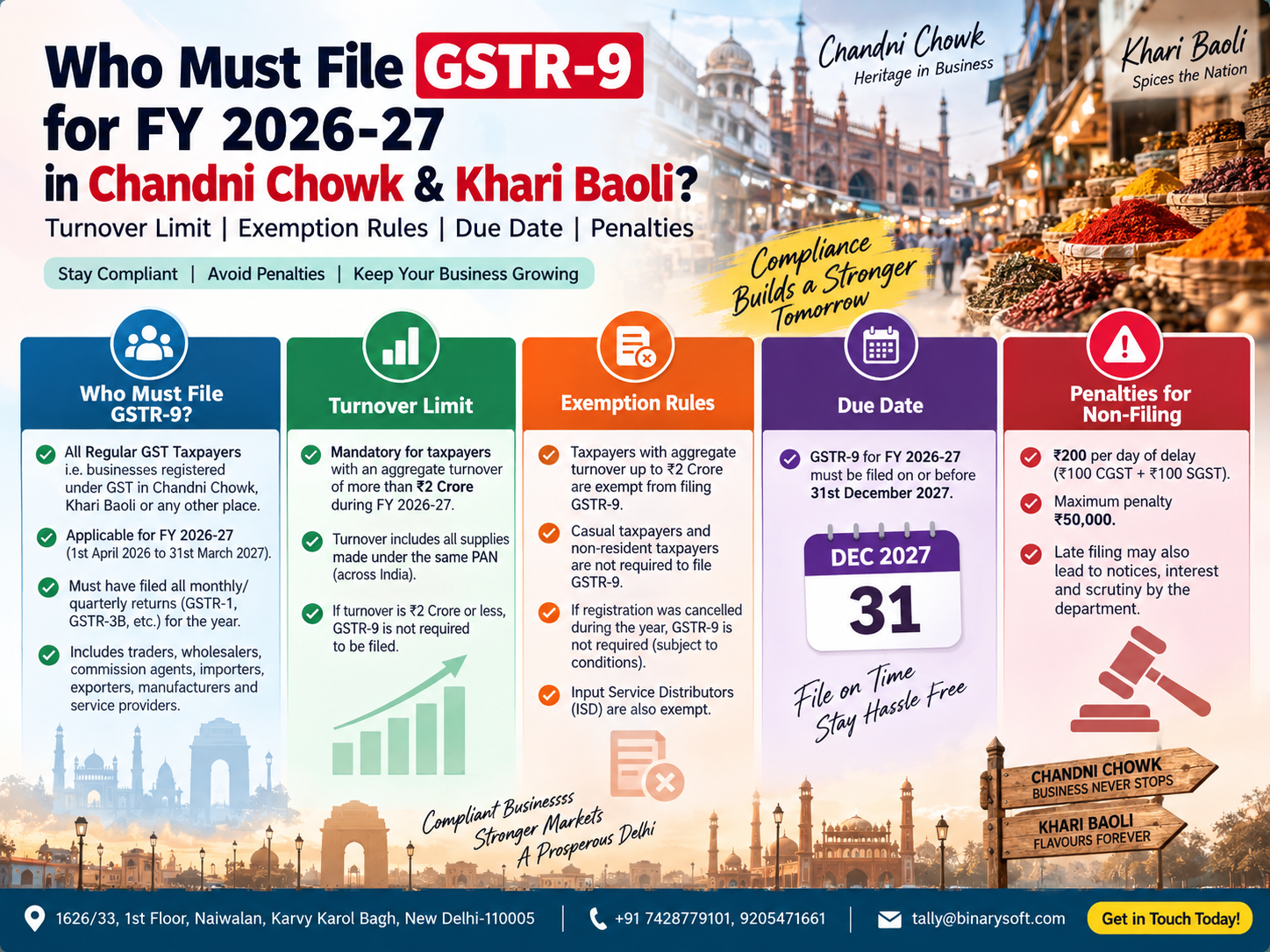
In 2026, GST annual-return compliance has become more structured, and businesses in Chandni Chowk and Khari Baoli should not wait until year-end to discover differences between their books, GSTR-1, GSTR-3B and input tax credit records. One important change is that the annual-return exemption for registered persons with aggregate turnover up to ₹2 crore now applies from FY 2024–25 onwards, rather than requiring a fresh exemption every year. This means the same threshold currently extends to FY 2026–27. Businesses above ₹2 crore generally need to prepare for GSTR-9, while those exceeding ₹5 crore also need the self-certified GSTR-9C reconciliation statement. The normal deadline for FY 2026–27 is 31 December 2027, unless extended. For high-volume Delhi traders, early reconciliation can mean fewer last-minute mismatches, better ITC control and lower exposure to late fees or compliance disputes.
Why GSTR-9 Matters for Chandni Chowk and Khari Baoli Businesses
Chandni Chowk and Khari Baoli are among Delhi's busiest traditional commercial markets.
Businesses operating in these areas may deal with:
Wholesale trading
Retail trading
Spices and dry fruits
Food commodities
Textiles
Garments
Electrical goods
Hardware
Jewellery
General merchandise
Packaging products
Import and distribution
FMCG products
Many businesses generate hundreds or thousands of sales and purchase invoices during a financial year.
Monthly or quarterly GST returns may be filed regularly, but GSTR-9 brings the entire financial year's GST information together.
For a high-volume business, that makes annual reconciliation extremely important.
What Is GSTR-9?
GSTR-9 is the annual return under GST for applicable regular registered taxpayers.
It consolidates information relating to the entire financial year, including areas such as:
Outward supplies
Taxable sales
Exempt supplies
Tax paid
Input tax credit
ITC reversals
Previous-year transactions reported later
HSN-wise information
Other annual GST disclosures
The GST Portal's GSTR-9 manual describes it as an annual return for regular taxpayers, including applicable SEZ units and developers, containing annual purchase, sale, ITC, refund and demand information.
FY 2026–27 Means Which Period?
Financial Year 2026–27 covers:
1 April 2026 to 31 March 2027.
This distinction is important because some businesses mistakenly assume GSTR-9 for FY 2026–27 will be due in December 2026.
That is incorrect.
The financial year itself does not end until 31 March 2027.
Under Rule 80, the normal annual-return deadline is 31 December following the end of the financial year. Therefore, the normal GSTR-9 due date for FY 2026–27 is:
31 December 2027.
This can change if the Government officially extends the deadline.
GSTR-9 Turnover Limit for FY 2026–27
This is the most important question for many businesses.
Under Notification No. 15/2025-Central Tax dated 17 September 2025, registered persons whose aggregate turnover in a financial year is up to ₹2 crore are exempted from filing the annual return for FY 2024–25 onwards.
Because the notification uses the words “2024-25 onwards,” the relief is not limited only to FY 2024–25.
It currently extends to FY 2026–27 as well.
Therefore, under the present rules:
Aggregate turnover up to ₹2 crore: GSTR-9 exempt.
Aggregate turnover above ₹2 crore: GSTR-9 generally mandatory for applicable regular taxpayers.
Aggregate turnover above ₹5 crore: GSTR-9 plus GSTR-9C generally required.
Quick Turnover Applicability Table
For FY 2026–27, the current position can be summarised as follows:
Turnover up to ₹2 crore: GSTR-9 exempt.
More than ₹2 crore and up to ₹5 crore: GSTR-9 required.
Exactly ₹5 crore: GSTR-9 required, but GSTR-9C threshold is not crossed.
More than ₹5 crore: GSTR-9 and self-certified GSTR-9C required.
The ₹5 crore GSTR-9C threshold is provided under Rule 80(3), which applies where aggregate turnover during the financial year exceeds ₹5 crore.
What Does Aggregate Turnover Mean?
Businesses should be careful when calculating the ₹2 crore and ₹5 crore thresholds.
Aggregate turnover is not simply the turnover of one shop, branch or GSTIN.
GST law generally looks at aggregate turnover across persons having the same PAN on an all-India basis, subject to the statutory definition.
This can create important consequences for businesses with more than one registration.
For example, suppose a proprietor has:
Delhi GSTIN turnover: ₹1.70 crore
Haryana GSTIN turnover: ₹80 lakh
Total PAN-level aggregate turnover: ₹2.50 crore
Looking only at the Delhi registration might suggest that turnover is below ₹2 crore.
But aggregate turnover may cross the threshold when the PAN-level turnover is considered.
Businesses with multiple GST registrations should therefore review their position carefully.
GSTR-9 Is Filed GSTIN-Wise
Although aggregate turnover is relevant for determining applicability, GSTR-9 is filed for each applicable GST registration.
A business operating under multiple GSTINs may therefore need separate annual returns for the registrations concerned.
This distinction between PAN-level turnover and GSTIN-level filing frequently causes confusion.
An Emotional Story: One Mismatch Discovered Too Late
Imagine a wholesale trader operating in Old Delhi.
For years, the business had grown steadily.
The owner rarely worried about GST because the accountant filed GSTR-1 and GSTR-3B every month.
Sales were growing.
Customers were paying.
Stock kept moving.
Everything appeared normal.
Then annual-return preparation began.
The accounts team downloaded the yearly figures and found that sales appearing in the books did not fully match the outward supplies reported through GST returns.
At first, the difference looked small.
Then the accountant found another discrepancy.
A credit note had been recorded in the books but treated differently in the GST data.
Some ITC required additional checking.
Several HSN classifications also needed reconciliation.
The owner asked a simple question:
“Why are we finding this now?”
Nobody had a good answer.
The problem had not been created in December.
It had accumulated quietly throughout the year.
The team spent several late evenings going through invoices, ledgers and GST reports.
The owner realised that annual compliance should not begin when the return becomes due.
After that year, the business introduced quarterly GST reconciliation.
Every three months, sales, tax liability and ITC were checked against returns.
The next annual closing was completely different.
There was still work to do, but there was no panic.
For a business processing thousands of transactions, the real value of reconciliation is not merely compliance.
It is knowing problems exist while there is still time to understand them.
Why Chandni Chowk Traders Need Early GSTR-9 Preparation
Chandni Chowk businesses often work in a high-volume environment.
A trader may manage:
Large product catalogues
Hundreds of customers
Multiple suppliers
Cash and credit transactions
Returns
Discounts
Credit notes
Interstate sales
Local sales
Even a small percentage of mismatched transactions can create a substantial annual difference.
Early reconciliation helps prevent that.
Why Khari Baoli Businesses Need Strong GST Reconciliation
Khari Baoli wholesalers dealing with spices, dry fruits, grains, food commodities and related goods may process significant volumes throughout the year.
Common complexities can include:
Different HSN codes
Different GST rates
Packing differences
Purchase returns
Sales returns
Discount adjustments
Interstate movement
Supplier ITC differences
Maintaining accurate accounting data throughout the year makes annual-return preparation easier.
Who Generally Must File GSTR-9?
Under section 44 and Rule 80, applicable regular registered persons generally fall within the annual-return framework, subject to exemptions.
For FY 2026–27, a regular registered person whose aggregate turnover exceeds ₹2 crore should generally prepare to file GSTR-9 unless specifically excluded or otherwise exempt.
Who Is Excluded from GSTR-9?
Certain categories are specifically outside the regular GSTR-9 requirement.
These include:
Input Service Distributors
Persons required to deduct tax under section 51
Persons required to collect tax under section 52
Casual taxable persons
Non-resident taxable persons
Section 44 also contains specific treatment concerning Government departments or local authorities whose books are subject to specified audit arrangements.
Businesses should check their exact registration category rather than applying only the turnover test.
What About Composition Dealers?
Composition taxpayers should not confuse GSTR-9 with their applicable annual-return requirements.
Rule 80 provides separately for persons paying tax under section 10.
Therefore, a composition taxpayer should review the applicable composition-return framework rather than assuming normal GSTR-9 treatment applies.
What About QRMP Taxpayers?
A taxpayer filing GSTR-1 and GSTR-3B quarterly under the QRMP mechanism does not automatically become exempt from GSTR-9.
QRMP changes the periodic return frequency.
It does not by itself remove annual-return applicability.
If the taxpayer is a regular registered person and the applicable turnover threshold is crossed, GSTR-9 requirements should still be reviewed.
GSTR-9C Turnover Limit for FY 2026–27
Where aggregate turnover exceeds ₹5 crore during the financial year, Rule 80(3) requires the applicable registered person to furnish a self-certified reconciliation statement in Form GSTR-9C along with the annual return.
This means:
₹5 crore exactly: GSTR-9C not triggered by the “exceeds ₹5 crore” wording.
₹5.01 crore: threshold crossed, subject to exact turnover calculation.
Is GSTR-9C Still CA-Certified?
The present GSTR-9C framework is based on self-certification.
The earlier statutory GST audit and professional certification model was changed.
CBIC Circular 246/03/2025 explains that from 1 August 2021 onward, taxpayers above the prescribed threshold furnish a self-certified reconciliation statement in GSTR-9C.
However, businesses may still choose to obtain professional assistance for preparation and reconciliation.
GSTR-9 Due Date for FY 2026–27
Under Rule 80, annual returns are ordinarily due on:
31 December following the end of the relevant financial year.
Therefore:
FY 2026–27 ends: 31 March 2027
Normal annual-return due date: 31 December 2027
This date should not be confused with 31 December 2026, which falls during FY 2026–27 itself.
Can the Due Date Be Extended?
Yes.
The Government may provide extensions or other relief where legally notified.
Businesses should therefore verify the official GST Portal and CBIC notifications closer to the filing period.
However, companies should plan based on the statutory due date rather than assuming an extension will be granted.
Why Waiting Until December 2027 Is Risky
GSTR-9 is essentially the final annual reconciliation of several streams of information.
Waiting until December means trying to reconcile twelve months of transactions in one exercise.
Businesses should ideally perform reconciliations:
Monthly
or
Quarterly.
This makes year-end preparation much easier.
GSTR-1 vs Books Reconciliation
The first important check is between turnover recorded in accounting books and turnover reported through GSTR-1.
Differences may arise because of:
Missing invoices
Duplicate invoices
Incorrect amendments
Credit notes
Wrong taxable values
Wrong GSTIN
Wrong reporting period
These differences should be identified before annual filing.
GSTR-3B vs Books Reconciliation
Next, compare tax liability recorded in the books with liability discharged through GSTR-3B.
Key areas include:
Taxable turnover
Output GST
Reverse charge
ITC
Tax payments
Adjustments
A mismatch does not automatically mean there is an error, but it should be explainable.
GSTR-1 vs GSTR-3B Reconciliation
Another important check is whether outward supplies reported in GSTR-1 reconcile with liability reported in GSTR-3B.
Businesses should investigate differences rather than simply carrying them into the annual return.
Input Tax Credit Reconciliation
ITC is often one of the most complex parts of annual-return preparation.
Businesses should review:
ITC in books
ITC claimed in GSTR-3B
Supplier-reported information
GSTR-2B
Reversals
Ineligible credit
Blocked credit
Reverse-charge credit
Capital goods ITC where applicable
The GST Portal has progressively increased annual-return system-generated and auto-populated information, making clean underlying records increasingly important.
Supplier GST Compliance Matters
A business may maintain perfect internal purchase records but still face ITC reconciliation issues if suppliers do not report transactions properly.
Businesses should periodically review vendor compliance and mismatches.
This is especially important for high-value purchases.
Credit Notes and Debit Notes
Credit notes frequently create annual-return differences.
They may relate to:
Sales returns
Rate reductions
Discount adjustments
Quantity differences
Commercial settlements
Every credit note should be correctly reflected in both accounting records and GST reporting.
Sales Returns
Market-based businesses frequently deal with returns.
If sales returns are entered into the accounting system but GST treatment is incomplete, turnover reconciliation may fail.
Returns should therefore be reviewed throughout the year.
Purchase Returns
Purchase returns can also affect:
Supplier balances
Inventory
ITC
Purchase value
They should be recorded and reconciled carefully.
HSN-Wise Reporting
GSTR-9 contains HSN-related annual reporting requirements.
The GST Portal manual notes turnover-linked HSN digit requirements and provides functionality for entering HSN-wise outward supply summaries.
Businesses should therefore maintain clean product masters containing:
HSN code
Description
Tax rate
Unit
Product category
Waiting until annual filing to classify thousands of products can create unnecessary work.
Correct GST Rate Mapping
Incorrect rate mapping is another common problem.
Businesses may deal with products taxable at different rates.
If an item master carries an incorrect rate, the error can repeat across hundreds of invoices.
Periodic product-master reviews help reduce this risk.
Exempt, Nil-Rated and Non-GST Supplies
These categories should not automatically be treated as interchangeable.
Businesses dealing with multiple product types should correctly classify transactions.
Annual reporting requires accurate categorisation.
Interstate and Intrastate Sales
Businesses in Chandni Chowk and Khari Baoli often sell across India.
The accounts team should distinguish between:
Intrastate sales
Interstate sales
B2B supplies
B2C supplies
Exports where applicable
Other relevant supply categories
Incorrect place-of-supply treatment can affect tax classification.
B2B Customer GSTIN Accuracy
Incorrect customer GSTINs create reconciliation problems for both supplier and buyer.
Businesses should validate customer GST information when creating masters.
Do not wait until the annual return to correct basic customer data.
Turnover in Books vs GST Turnover
Accounting turnover and GST-reported turnover may differ in certain circumstances.
Every difference should have a clear reconciliation explanation.
Management should not simply force one figure to equal another without understanding the reason.
Financial Statements vs GSTR-9C
For businesses above ₹5 crore, GSTR-9C requires reconciliation with the financial statements.
This is why accurate final accounts are critical.
Potential differences may arise from:
Multiple GST registrations
Unbilled revenue
Credit notes
Branch transfers
Accounting adjustments
Exempt income
Other reconciliation items
Each significant difference should be documented.
One PAN, Multiple GSTINs
This deserves special attention.
Suppose a company has registrations in Delhi, Haryana and Uttar Pradesh.
Financial statements may reflect company-wide figures.
GSTR-9C reconciliation may require appropriate allocation to the relevant GST registration.
The business should maintain location-wise records throughout the year.
Can GSTR-9 Be Revised?
Once GSTR-9 is filed, the GST Portal manual states that changes cannot be made to the filed annual return.
This makes pre-filing review extremely important.
Businesses should not treat GSTR-9 like a draft that can easily be corrected later.
Pre-Filing Checklist
Before filing GSTR-9, review:
GSTR-1 filed for all applicable periods
GSTR-3B filed for all applicable periods
Books finalised
Sales reconciled
Purchases reconciled
ITC reconciled
Credit notes reviewed
Debit notes reviewed
Tax liability checked
HSN information reviewed
Previous-year adjustments checked
GSTR-9C applicability checked
Late fee checked
Outstanding GST Returns
Businesses should ensure applicable periodic returns have been filed.
The GST Portal's GSTR-9 instructions state that relevant GSTR-1 and GSTR-3B returns need to be filed before annual-return filing.
Therefore, unresolved monthly or quarterly compliance can delay annual filing.
What Happens If GSTR-9 Is Filed Late?
Late filing can attract late fees under section 47, subject to applicable relief notifications.
For FY 2022–23 onwards, Notification No. 07/2023-Central Tax rationalised the late-fee structure for certain turnover classes.
Current GSTR-9 Late Fee: Turnover Up to ₹5 Crore
For registered persons with aggregate turnover up to ₹5 crore, the Central Tax late-fee amount after the waiver mechanism is ₹25 per day, subject to a maximum of 0.02% of turnover in the State or Union territory.
With the corresponding State GST component, this generally translates to:
₹50 per day total
subject to an overall combined ceiling of approximately:
0.04% of turnover in the State or Union territory.
Late Fee: More Than ₹5 Crore and Up to ₹20 Crore
For the next turnover slab, the Central Tax amount is ₹50 per day with the prescribed cap.
With the corresponding SGST component, the combined amount generally becomes:
₹100 per day
with the combined prescribed cap based on turnover in the State or Union territory.
Businesses Above ₹20 Crore
Businesses exceeding the turnover slab covered by the reduced late-fee notification fall back on the statutory section 47 framework.
This can result in a higher daily late fee.
Therefore, larger businesses have a strong incentive to complete annual-return reconciliation early.
GSTR-9C Delay Can Also Matter
Where GSTR-9C is required, filing only GSTR-9 does not necessarily complete the annual-return requirement.
CBIC Circular No. 246/03/2025 clarifies that where GSTR-9C is applicable, the annual return is treated as complete only when the required GSTR-9 and GSTR-9C have both been furnished. Late fee can therefore continue until the complete annual return is filed.
Example: GSTR-9 Filed, GSTR-9C Delayed
Suppose a business is required to furnish both forms.
GSTR-9 is filed on time.
GSTR-9C is filed several days later, after the due date.
The business should not assume that there can be no annual-return late-fee implication simply because GSTR-9 itself was filed before the deadline.
The CBIC circular specifically addresses this situation.
Is There a Penalty Apart from Late Fee?
GST compliance failures can potentially create consequences beyond routine late fees depending on the exact nature of the default.
For example, incorrect tax reporting, short payment, wrong ITC or other violations may involve separate statutory provisions.
Therefore, “late fee” and “penalty” should not automatically be treated as the same thing.
The exact consequences depend on the facts.
Short-Paid Tax Discovered During Reconciliation
Annual reconciliation may reveal tax that was not paid correctly earlier.
Businesses should not hide the difference simply to make GSTR-9 match previously filed returns.
The issue should be reviewed with a GST professional and corrected through the legally appropriate mechanism.
Excess ITC Identified During Annual Review
Another common issue is excess or ineligible ITC.
Possible causes include:
Duplicate claims
Blocked credit
Missing reversals
Incorrect supplier mapping
Incorrect accounting entries
These should be identified before annual filing.
GSTR-9 Is Not Just a Copy of GSTR-1 and GSTR-3B
Some businesses assume the annual return simply adds monthly returns together.
In practice, good GSTR-9 preparation requires reconciliation.
The annual return should make sense when compared with:
Books
GSTR-1
GSTR-3B
ITC records
Relevant GST statements
Financial accounts
Why Inventory Records Matter
For traders in Chandni Chowk and Khari Baoli, inventory and GST are closely connected.
Purchases and sales affect:
Stock
Profit
Turnover
GST
ITC
If stock records are weak, annual reconciliation becomes more difficult.
Integrated accounting and inventory records can reduce this problem.
TallyPrime for GST Reconciliation
TallyPrime can help businesses maintain:
GST sales
GST purchases
Ledgers
Inventory
Tax classifications
Customer and supplier information
Reports
Accounting records
Clean accounting data can make GST reconciliation significantly easier.
The software itself does not replace professional compliance review, but properly maintained data provides a stronger foundation.
Daily Discipline Creates Easier Annual Compliance
Annual-return problems usually start with daily transaction errors.
For example:
Wrong GSTIN entered today.
Wrong HSN selected tomorrow.
Purchase credit note forgotten next week.
One invoice missed next month.
By year-end, these become hundreds of reconciliation items.
The best GSTR-9 strategy begins with accurate daily accounting.
Monthly GST Review
A monthly GST review can include:
Sales vs GSTR-1
Tax liability vs GSTR-3B
ITC vs books
Supplier mismatches
Credit notes
Debit notes
Cash and credit ledger review
This keeps differences manageable.
Quarterly Reconciliation
Businesses that cannot perform detailed reconciliation monthly should at least consider quarterly reviews.
Quarterly reconciliation means only three months of transactions must be investigated at one time.
That is far easier than twelve months.
Year-End Closing Process
At financial year-end, businesses should freeze and review GST-related data systematically.
The process can include:
Finalising sales
Finalising purchases
Checking stock
Reviewing credit notes
Reviewing ITC
Matching GST returns
Reviewing tax liability
Checking HSN information
Finalising accounts
This prepares the business for annual filing.
Why Business Owners Should Review GSTR-9
GST compliance should not remain entirely invisible to the owner.
Management should at least understand:
Annual turnover
Tax liability
ITC claimed
Major reconciliation differences
Outstanding compliance
Potential additional liability
The owner does not need to prepare the return personally.
But management should understand what is being filed.
Questions to Ask Your Accountant
Before approving GSTR-9, ask:
Does turnover match the books?
Are GSTR-1 and GSTR-3B reconciled?
Has ITC been checked?
Are there unresolved differences?
Is GSTR-9C applicable?
Are there additional tax liabilities?
Is any late fee payable?
Have all material discrepancies been explained?
These questions improve governance.
Chandni Chowk Wholesale Businesses Above ₹2 Crore
A wholesaler whose aggregate turnover exceeds ₹2 crore should plan for annual-return compliance.
The preparation should not begin in December 2027.
Sales and ITC reconciliation should begin during FY 2026–27 itself.
Khari Baoli Businesses Above ₹5 Crore
Businesses exceeding ₹5 crore should plan for both:
GSTR-9
and
GSTR-9C.
Because GSTR-9C reconciles GST information with financial statements, accounts finalisation becomes particularly important.
Example 1: Turnover ₹1.80 Crore
Suppose a Chandni Chowk trader has aggregate turnover of ₹1.80 crore during FY 2026–27.
Under the current exemption applicable from FY 2024–25 onwards, the registered person is within the up-to-₹2-crore GSTR-9 exemption, assuming no special circumstance changes the position.
Example 2: Turnover ₹3.50 Crore
Suppose a Khari Baoli wholesale business records aggregate turnover of ₹3.50 crore.
The ₹2 crore exemption threshold is crossed.
GSTR-9 generally becomes applicable.
However, the ₹5 crore GSTR-9C threshold is not crossed.
Example 3: Turnover ₹5 Crore Exactly
Suppose aggregate turnover is exactly ₹5 crore.
GSTR-9 is required because turnover exceeds ₹2 crore.
However, Rule 80(3) applies where aggregate turnover “exceeds” ₹5 crore.
Therefore, exactly ₹5 crore does not by itself cross the GSTR-9C threshold.
Example 4: Turnover ₹8 Crore
Suppose a Chandni Chowk wholesaler has ₹8 crore aggregate turnover.
GSTR-9 is required.
GSTR-9C is also required because aggregate turnover exceeds ₹5 crore.
Example 5: Multiple State Registrations
Suppose a business has:
Delhi turnover: ₹1.60 crore
Uttar Pradesh turnover: ₹1 crore
Total aggregate turnover: ₹2.60 crore.
The business should not simply rely on the Delhi GSTIN turnover when considering the annual-return threshold.
PAN-level aggregate turnover must be considered according to GST law.
Common GSTR-9 Mistakes
Businesses frequently make mistakes such as:
Checking only one GSTIN's turnover
Confusing ₹2 crore and ₹5 crore thresholds
Assuming GSTR-9C is still CA-certified
Waiting until December to reconcile
Ignoring credit notes
Incorrect HSN mapping
Mismatch between books and GSTR-1
Mismatch between GSTR-1 and GSTR-3B
Incorrect ITC reconciliation
Assuming filed GSTR-9 can be revised
Each of these can create unnecessary difficulties.
Do Not Confuse GSTR-9 with GSTR-9C
GSTR-9 is the annual GST return.
GSTR-9C is the self-certified reconciliation statement for taxpayers crossing the applicable ₹5 crore threshold.
A business above ₹5 crore may need both.
Do Not Confuse GSTR-9 with GSTR-4
Composition taxpayers operate under a different annual return framework.
Normal taxpayers and composition taxpayers should not use the same compliance checklist.
GSTR-9 Filing Should Begin with Clean Books
Software cannot reconcile inaccurate accounting automatically.
Before annual filing, make sure:
Customer masters are correct.
Supplier masters are correct.
GSTINs are accurate.
HSNs are accurate.
GST rates are accurate.
Sales and purchase entries are complete.
Returns are recorded.
Credit notes are recorded.
This greatly reduces reconciliation workload.
Maintain Supporting Documents
Businesses should maintain supporting records such as:
Tax invoices
Purchase invoices
Credit notes
Debit notes
E-way bill information where applicable
Bank records
Stock information
Supplier statements
Customer statements
These may be useful when investigating annual differences.
Create a GST Closing Calendar
A useful internal annual process might look like:
April–June: first-quarter reconciliation.
July–September: second-quarter reconciliation.
October–December: third-quarter reconciliation.
January–March: fourth-quarter reconciliation.
April onward: finalise books and annual figures.
Before due date: final GSTR-9/GSTR-9C review.
This makes compliance more predictable.
Why Good Accounting Software Matters
For a high-volume trader, manually combining twelve months of GST information can become extremely difficult.
Integrated accounting software provides a central transaction database.
That improves:
Sales reconciliation
Purchase reconciliation
GST reporting
Inventory reporting
Customer balances
Supplier balances
Financial statements
Good data does not eliminate compliance work.
It makes compliance manageable.
GSTR-9 Readiness for 2026–27
Businesses should consider themselves GSTR-9 ready when:
Periodic returns are filed.
Books are updated.
Turnover reconciles.
ITC is reviewed.
Credit notes are reconciled.
Tax liabilities are understood.
HSN information is clean.
GSTR-9C applicability is known.
Supporting documents are available.
If these conditions are met, annual filing becomes significantly easier.
Powered by Binarysoft Technologies
Binarysoft Technologies
Authorized Tally Partner
Location: 1626/33, 1st Floor, Naiwalan, Karol Bagh, New Delhi – 110005, INDIA
Contact us: +91 7428779101, 9205471661
Email us: tally@binarysoft.com
Business Hours: 10:00 AM – 6:00 PM, Mon–Fri
Businesses in Chandni Chowk, Khari Baoli and other commercial areas can contact Binarysoft Technologies for Tally, GST accounting, inventory management, reconciliation and related business software requirements.
Conclusion
For traders, wholesalers and other GST-registered businesses in Chandni Chowk and Khari Baoli, GSTR-9 compliance for FY 2026–27 should begin long before the annual-return filing window arrives.
Under the current rules, Notification No. 15/2025-Central Tax exempts registered persons with aggregate turnover up to ₹2 crore from annual-return filing from FY 2024–25 onwards. This relief therefore currently extends to FY 2026–27.
Businesses with aggregate turnover above ₹2 crore generally need to prepare GSTR-9, subject to the statutory exclusions.
Where aggregate turnover exceeds ₹5 crore, the taxpayer generally also needs to furnish a self-certified GSTR-9C reconciliation statement.
The normal due date for FY 2026–27 is 31 December 2027, not 31 December 2026, because FY 2026–27 ends on 31 March 2027.
Late filing can attract daily late fees. Where GSTR-9C is required, filing only GSTR-9 may not complete the annual-return obligation; CBIC has clarified that late fee can continue until the complete annual return is furnished.
But GSTR-9 should not be viewed only as a deadline.
It is an annual test of the quality of the business's GST records.
If sales, purchases, ITC, credit notes and tax payments have been reconciled regularly, annual filing becomes manageable.
If these items have been ignored for twelve months, December can become stressful.
For busy businesses in Chandni Chowk and Khari Baoli, the most effective strategy is therefore simple:
Maintain accurate books.
Reconcile GST regularly.
Know your turnover threshold.
Review GSTR-9C applicability.
Correct mismatches early.
Prepare before the deadline.
Strong GST compliance is not created on the day the annual return is filed.
It is created throughout the financial year.
CA. Praneet Bansaal is a Chartered Accountant with experience in taxation, accounting controls, and financial process reviews. He has advised businesses on aligning inventory movement with accounting and GST requirements. His content focuses on compliance, accuracy, and long-term sustainability.