Call CA Tally HelpDesk
+91 9205471661,
7428779101
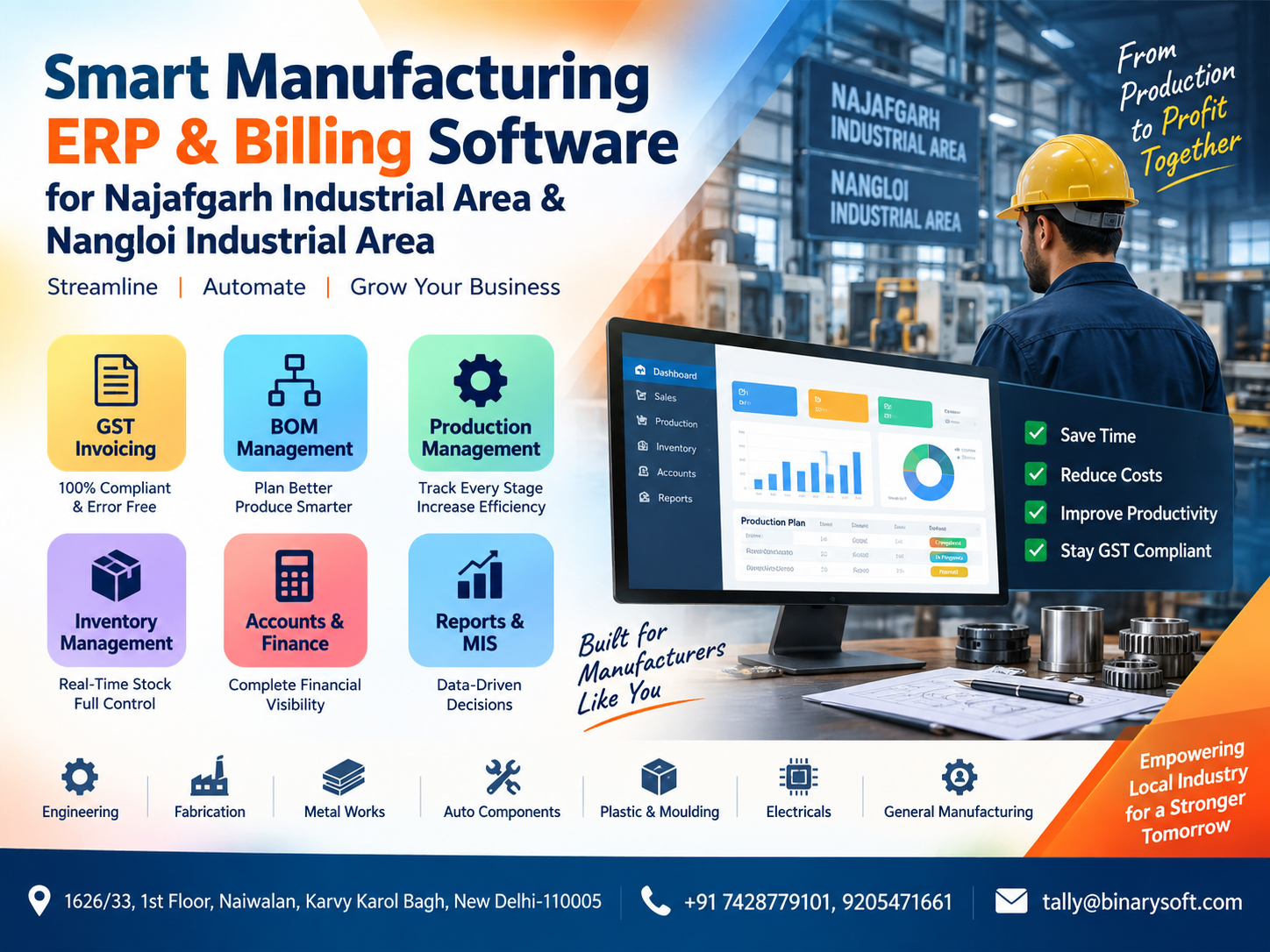
Manufacturing Businesses in 2026 Need More Than Basic Billing
In 2026, manufacturers operating in Najafgarh Industrial Area and Nangloi Industrial Area are facing stronger pressure to control material costs, maintain accurate stock, manage production schedules, generate GST-compliant invoices and understand profitability without waiting for month-end reports. In recent months, rising input costs, tighter customer delivery expectations and increasingly complex product structures have made manual registers and disconnected spreadsheets harder to manage. A smart manufacturing ERP and billing system can connect raw materials, BOM, production, finished goods, sales, purchases, GST and accounts in one structured workflow. This gives business owners faster visibility into what is being produced, what material is consumed, which orders are pending, how much stock is available and where money is blocked. For manufacturers planning growth in West Delhi, better software is no longer only about automation—it is about reducing leakage, improving control and making faster business decisions.
Why Manufacturing Businesses in Najafgarh and Nangloi Need Integrated Software
Manufacturing is not a simple buy-and-sell business.
A trader purchases finished goods and sells them.
A manufacturer purchases raw materials, transforms them through one or more production processes, consumes labour and overheads, creates finished goods and then sells those products.
That difference creates complexity.
A growing manufacturing business may need to manage:
Raw materials
Semi-finished goods
Finished goods
Bill of Materials
Production orders
Job work
Material consumption
Wastage
By-products
Purchase orders
Sales orders
GST invoices
Stock transfers
Multiple godowns
Customer outstanding
Supplier outstanding
Production costs
Profitability
Accounting
If each process is maintained separately, management may struggle to understand what is actually happening inside the factory.
Smart manufacturing ERP software brings these activities together.
Manufacturing ERP Software for Najafgarh Industrial Area
Najafgarh and surrounding areas support a wide variety of manufacturing, fabrication, assembly, packaging and industrial businesses.
Companies may manufacture products such as:
Electrical components
Metal products
Furniture
Packaging materials
Plastic goods
Auto components
Engineering products
Garments
Consumer products
Machinery parts
Fabricated items
Industrial supplies
Food products
Printing materials
Even when two factories manufacture completely different products, many management challenges remain the same.
Owners need to know:
What material is available?
What material is required for upcoming production?
How much has been consumed?
How much finished stock is ready?
What is pending for dispatch?
Which customer has not paid?
What is the actual production cost?
Without integrated records, these questions may require several employees and multiple spreadsheets to answer.
Smart Manufacturing Software for Nangloi Industrial Area
Manufacturers in Nangloi Industrial Area often operate in highly competitive markets where delivery speed and pricing matter.
If a customer places a large order, management needs to decide quickly whether the business can fulfil it.
That requires visibility into:
Available raw material
Existing production commitments
Machine or process capacity
Finished goods stock
Purchase lead times
Pending sales orders
Current receivables
When data is fragmented, decision-making becomes slower.
A properly configured ERP and accounting system can provide organised information so that management can respond with greater confidence.
GST Billing for Manufacturing Businesses
Manufacturing businesses must maintain accurate sales and purchase records.
GST billing software can help organise transaction details such as:
Customer name
Customer GSTIN
Supplier GSTIN
Invoice number
Invoice date
HSN/SAC information
Taxable value
Applicable GST rate
CGST
SGST
IGST
Discounts
Freight or other charges
Credit notes
Debit notes
Sales returns
Purchase returns
The advantage is not only faster invoicing.
When billing is integrated with accounts and inventory, a single transaction can contribute to multiple business records.
This reduces repeated data entry.
Why Basic Billing Software Is Often Not Enough for Manufacturers
Many small factories begin with simple billing software.
That may work when production volume is low.
As the business grows, limitations become visible.
The billing system may tell you how much was sold, but not:
How much raw material was consumed
Which BOM was used
How much wastage occurred
What production is pending
Which finished goods are available
What the cost per unit is
How much stock is blocked in work-in-progress
This is why manufacturing businesses eventually need systems designed around production processes rather than only invoicing.
BOM Management: The Foundation of Manufacturing Control
Bill of Materials, commonly called BOM, defines the components or raw materials required to produce a finished product.
For example, suppose a company manufactures 100 finished units.
The BOM may specify that production requires:
200 units of Raw Material A
50 units of Raw Material B
100 packaging boxes
100 labels
Certain accessories
The BOM creates a standard structure for production.
Without a BOM, employees may estimate consumption manually.
That creates inconsistencies.
A proper BOM setup helps management understand the expected material requirement for each finished product.
Multi-Level BOM for Complex Manufacturing
Some products require more than one production stage.
For example:
Raw materials are first converted into Component A.
Component A is then assembled with Component B.
The combined product is processed again to create the final finished item.
This type of production may require multi-level BOM structures.
A suitable ERP system can help manufacturers organise multi-stage production more systematically.
This is particularly valuable for engineering, machinery, furniture, electrical, assembly and fabrication businesses.
Production Management Software
Production management is one of the most important areas for a manufacturer.
The system should help record what is produced and what material is consumed.
A simplified production flow can look like this:
Customer order received
Production requirement identified
Raw material availability checked
Production planned
Material issued
Manufacturing completed
Finished goods received
Wastage recorded
Inventory updated
Product dispatched
Invoice generated
When these steps are properly recorded, management gets a clearer picture of factory operations.
An Emotional Story: The Order That Almost Broke the Factory
Consider a family-run manufacturing unit in West Delhi.
The owner had spent nearly fifteen years building the business.
He knew most customers personally.
He knew his workers by name.
For years, production was managed through experience, handwritten sheets and a few Excel files.
Then the company received its largest order ever.
Everyone was excited.
The order could open the door to a much bigger customer relationship.
Production began immediately.
A week later, one critical raw material unexpectedly ran out.
The purchase team believed sufficient stock was available.
The store register showed a different number.
Production records had not been updated after an earlier batch.
The factory floor stopped.
The customer started calling.
Workers waited.
The owner spent the evening calling suppliers and arranging urgent material at a higher price.
The order was eventually completed, but the profit almost disappeared.
More painful than the extra cost was the fear that the customer might never return.
The owner realised something important.
The factory had not failed because people were not working hard.
It failed because information was not moving as fast as production.
After implementing a more structured production, BOM and inventory system, the business gained something it had been missing for years: visibility.
Now, before accepting a large order, the team could review material requirements and stock availability rather than relying only on memory.
For a manufacturer, that visibility can be the difference between growth and chaos.
Raw Material Inventory Management
Raw materials are the starting point of manufacturing.
If raw material is unavailable, production can stop.
If too much material is purchased, working capital gets blocked.
Manufacturing inventory software can help maintain information such as:
Opening stock
Purchases
Material issues
Production consumption
Returns
Adjustments
Closing stock
Minimum stock levels
Location-wise quantities
Management can use this information to plan purchases more effectively.
Finished Goods Inventory
Finished goods also require careful monitoring.
Too much finished inventory can block capital.
Too little can result in delayed customer deliveries.
A manufacturing ERP system can help businesses understand:
Finished quantity available
Finished goods produced
Goods dispatched
Pending stock
Location-wise stock
Product-wise balances
This helps production and sales teams coordinate more effectively.
Work-in-Progress Management
Many factories have material that is neither raw material nor finished goods.
It is work-in-progress.
This may include:
Partially assembled products
Semi-finished components
Material under processing
Items sent for job work
Products waiting for the next manufacturing stage
Without proper WIP tracking, valuable inventory may become invisible.
A structured system can provide better control over these intermediate stages.
Material Requirement Planning
Production planning should ideally begin before material runs out.
Material requirement planning helps management understand how much material may be needed based on planned production.
For example:
A company receives an order for 1,000 units.
The BOM specifies the material required for each unit.
The system can help determine total expected material requirements.
The team can then compare those requirements with available stock.
The shortage can be identified before production starts.
This allows procurement to act earlier.
Prevent Production Delays
Production delays can happen because of many reasons:
Raw material shortages
Machine breakdown
Labour shortage
Late supplier delivery
Incorrect production planning
Quality problems
Missing components
Software cannot eliminate every operational problem.
However, better information can help identify potential shortages before they become emergencies.
Track Material Consumption
Material consumption is a major cost for manufacturers.
If actual consumption is consistently higher than expected BOM consumption, management should investigate.
Possible causes include:
Wastage
Poor quality material
Incorrect process
Theft or leakage
Wrong BOM standards
Machine inefficiency
Unrecorded rework
Comparing expected and actual consumption can reveal operational problems that are otherwise difficult to notice.
Wastage Management
Every manufacturing process has some level of wastage.
The important question is whether wastage is normal or excessive.
Software can help businesses record wastage during production.
Management can then analyse:
Product-wise wastage
Batch-wise wastage
Period-wise wastage
Material-wise wastage
Reducing even a small percentage of wastage can have a meaningful impact when production volumes are large.
By-Product and Scrap Management
Some manufacturing processes produce scrap or by-products.
These materials may have resale value.
If scrap is not properly recorded, businesses may lose both inventory and revenue visibility.
ERP systems can help maintain separate records for scrap and by-products.
This makes disposal, sale and accounting more systematic.
Job Work Management
Many manufacturers outsource certain processes.
For example:
Cutting
Polishing
Painting
Printing
Machining
Heat treatment
Packaging
Assembly
Embroidery
Fabrication
Material may be sent to an outside party and later returned after processing.
Job work management helps businesses track:
Material sent
Quantity received back
Pending material
Processing charges
Job worker details
Without proper records, material can remain outside the factory longer than expected and become difficult to reconcile.
Purchase Management
Manufacturing depends heavily on suppliers.
A delay from one supplier can affect an entire production schedule.
Purchase management software can help organise:
Purchase orders
Supplier quotations
Purchase invoices
Material receipts
Supplier outstanding
Purchase returns
Product rates
Supplier-wise purchases
Businesses can also analyse which suppliers provide consistent pricing and delivery performance.
Sales Order Management
Sales orders can serve as the starting point for production planning.
A sales order may contain:
Customer
Product
Quantity
Rate
Delivery date
Special requirements
Shipping information
Once orders are recorded systematically, management can identify upcoming production commitments.
This helps connect sales and production.
Purchase Order to Material Receipt
A more structured purchasing process can follow:
Material requirement identified
Purchase order created
Supplier confirms order
Material received
Quantity checked
Quality checked
Purchase transaction recorded
Inventory updated
Supplier account updated
This reduces dependency on informal communication.
Production Order Management
Production orders can help manufacturers define what needs to be produced and in what quantity.
This can improve coordination between office staff, stores and the factory floor.
The production order becomes a reference point for material requirements and finished output.
Batch-Wise Manufacturing
Some manufacturing businesses need batch-based production.
This can be relevant for:
Food products
Chemicals
Cosmetics
Pharmaceutical-related products
Packaged goods
Paint
Lubricants
Specialised industrial products
Batch tracking can help businesses maintain better traceability.
Serial Number Tracking
Manufacturers of machinery, electronics or durable products may need serial number tracking.
This can be useful for:
Warranty
Service
Installation
Customer support
Product traceability
The exact capability depends on the software configuration and business requirement.
Multiple Godown Management
Manufacturers often maintain separate storage locations.
Examples include:
Raw material store
Production floor
Finished goods warehouse
Dispatch warehouse
Scrap yard
Secondary godown
Godown-wise inventory helps identify where stock is physically located.
This is especially useful for factories with large premises or multiple locations.
Stock Transfer Management
Material may move between:
Warehouse and factory
One godown and another
Production stage and finished store
Job worker and factory
Each movement should be recorded.
Without stock transfer records, location-wise quantities quickly become unreliable.
Manufacturing Cost Calculation
Manufacturers need to understand the cost of production.
This may include:
Raw materials
Labour
Power
Machine cost
Job work
Packaging
Freight
Factory overhead
Administrative overhead
If management does not know the real cost, pricing decisions can be dangerous.
A product may appear profitable based on raw material cost alone while becoming unprofitable after other expenses are considered.
Product-Wise Profitability
Turnover is not the same as profit.
Some products may have high sales but low margins.
Others may generate less revenue but higher contribution.
Product-wise analysis can help management understand which products deserve greater focus.
Customer-Wise Profitability
The biggest customer is not always the most profitable customer.
Some customers may demand:
Heavy discounts
Long credit periods
Special packaging
Frequent returns
Urgent deliveries
Management should evaluate not only sales volume but also commercial impact.
Outstanding Receivables
Manufacturers often sell on credit.
A business can be profitable on paper and still face cash shortages because money is stuck with customers.
Customer outstanding reports can help management review:
Total receivables
Customer-wise balances
Overdue invoices
Invoice age
Collection priorities
This supports stronger cash-flow management.
Supplier Payables
Supplier payments also need careful planning.
A business needs to know:
Who must be paid?
How much is due?
When is payment due?
Which purchases remain unpaid?
Supplier outstanding reports help plan working capital more effectively.
Cash Flow Visibility
Manufacturing businesses often have significant money tied up in:
Raw material
WIP
Finished goods
Customer credit
This makes cash-flow visibility essential.
ERP and accounting reports can help management understand where funds are being utilised.
Integrated Accounts
Manufacturing software should ideally connect operational data with accounting.
Sales affect customer accounts.
Purchases affect supplier accounts.
Expenses affect profitability.
Inventory has financial value.
When these are integrated, management receives a more complete view of the business.
GST and Accounts in One Workflow
If GST billing and accounting are maintained separately, employees may need to enter the same data multiple times.
Integrated software reduces duplication.
It also helps maintain structured records for GST-related processes and financial reporting.
Management Information System Reports
Owners do not need raw data.
They need useful information.
MIS reports can help answer questions such as:
How much did we sell today?
How much did we produce?
What material was consumed?
What is our current inventory value?
Which orders are pending?
Which customers owe us money?
Which suppliers need payment?
Which products are most profitable?
Where is wastage increasing?
This turns the ERP system into a management tool rather than only a transaction-entry system.
Daily Production Reports
Daily production reporting can help management monitor:
Planned production
Actual production
Material consumption
Wastage
Pending production
Finished goods output
This provides visibility into factory performance.
Production Efficiency Analysis
If a factory normally produces 500 units per day but output falls to 350 units, management should know quickly.
Production reports can help identify changes in performance.
The reason may require further investigation, but early visibility allows action sooner.
Reduce Manual Registers
Many manufacturing units still maintain separate registers for:
Material issue
Production
Finished goods
Dispatch
Scrap
Job work
This creates duplicate work.
It also increases the risk of mismatched records.
Digital workflows can reduce dependence on manual registers while keeping information more searchable.
Reduce Spreadsheet Dependency
Spreadsheets can be useful for analysis, but problems arise when dozens of spreadsheets become the company's primary ERP system.
Common issues include:
Multiple versions
Accidental formula changes
Delayed updates
No real-time integration
Duplicate data entry
Poor traceability
An ERP system provides more structured transaction management.
Role-Based Access
Not every employee needs access to every business record.
Businesses may want different access levels for:
Billing staff
Purchase team
Store team
Production team
Accounts staff
Management
Role-based access can help maintain better control.
Multi-User Manufacturing Software
As the factory grows, multiple departments may need to work simultaneously.
A multi-user setup can allow different teams to enter and review information according to their responsibilities.
This helps avoid dependence on a single computer or employee.
Data Backup
Manufacturing ERP data contains critical business information.
Businesses should maintain a regular backup process.
The backup plan should answer:
How often is data backed up?
Where is it stored?
Who is responsible?
Can it be restored?
Is there an offsite or secondary copy?
Good backup practices protect business continuity.
Why TallyPrime Can Be Considered for Manufacturing
TallyPrime is widely used for accounting, GST, inventory and business management.
Depending on configuration and requirements, manufacturers may use TallyPrime for areas such as:
GST billing
Sales and purchases
Inventory
BOM
Manufacturing journals
Godown management
Batch information
Receivables
Payables
Financial accounting
Reports
For more specialised manufacturing workflows, businesses may also require customisation, integration or additional solutions depending on process complexity.
Tally Manufacturing Features
For suitable business processes, Tally can help organise manufacturing-related transactions using structured inventory and production entries.
A proper implementation should consider:
Stock groups
Stock items
Units
Godowns
BOM
Raw materials
Finished goods
Manufacturing journals
Cost centres
Customer and supplier ledgers
Good configuration is essential.
Why ERP Configuration Matters
Buying software without planning often leads to disappointment.
Before implementation, the business should document:
Products
Raw materials
BOM
Production stages
Warehouses
Job workers
Customers
Suppliers
Tax structure
Reporting requirements
User roles
The system should then be configured around actual business processes.
Avoid Overcomplicated ERP Implementation
Manufacturers sometimes believe a successful ERP implementation requires hundreds of features.
That is not always true.
A better approach is to focus first on the most important operational areas.
These may include:
Billing
Purchases
Inventory
BOM
Production
Outstanding
Accounting
Once these processes are stable, additional controls can be introduced.
Staff Training
Employees need practical training.
Training should be based on daily work rather than only software menus.
For example:
Store staff should learn inventory transactions.
Billing staff should learn invoices and returns.
Production staff should understand manufacturing entries.
Accounts staff should understand ledgers and reports.
Management should understand MIS.
This improves adoption.
ERP Implementation for Small Manufacturers
Small manufacturers often assume ERP is only for large factories.
That is not necessarily true.
A smaller business may benefit even more because the owner often manages many roles personally.
Better software can reduce the time spent checking registers and reconciling information.
ERP for Growing Manufacturing Companies
Growth increases complexity.
A business may start with:
One factory
One warehouse
A small customer base
Later it may have:
Multiple locations
More machines
More products
More employees
More customers
Higher credit exposure
A scalable system helps manage this transition.
Industrial Businesses That Can Benefit
Smart manufacturing ERP can be useful for:
Engineering companies
Fabricators
Furniture manufacturers
Packaging manufacturers
Electrical manufacturers
Plastic manufacturers
Garment manufacturers
Auto component suppliers
Food manufacturers
Printing businesses
Assembly units
Machinery manufacturers
Consumer goods manufacturers
Metal processing businesses
The configuration will vary by industry.
Signs Your Manufacturing Business Needs ERP
Your current system may need an upgrade if:
Production stops because material shortages are discovered late.
Raw material stock frequently differs from records.
BOM is maintained manually.
Production cost is difficult to calculate.
Sales, production and accounts use separate data.
Customer outstanding is unclear.
WIP cannot be tracked easily.
Management depends heavily on one employee.
Reports take hours or days to prepare.
Business growth is creating more confusion instead of more control.
Smart ERP for Better Factory Decisions
The biggest benefit of manufacturing ERP is not faster data entry.
It is better decision-making.
Management can make informed decisions about:
Purchasing
Production
Pricing
Credit
Inventory
Customer priorities
Supplier payments
Future investment
Better decisions compound over time.
Manufacturing ERP for 2026 and Beyond
Manufacturing businesses are becoming increasingly data-driven.
Customers want faster delivery.
Competition puts pressure on margins.
Working capital must be carefully managed.
Businesses that know their real-time operational position are better prepared to respond.
ERP software provides the information foundation for that control.
Why Local Support Matters
Manufacturing software is rarely a one-time purchase.
Businesses may need support for:
Configuration
New users
Reports
GST-related changes
BOM updates
Inventory structure
Data migration
Customisation
Training
Working with an experienced implementation partner can make the system more practical for daily operations.
Binarysoft Technologies – Manufacturing Software Support
Binarysoft Technologies provides Tally solutions and business software support for manufacturers and other businesses.
The implementation approach should begin by understanding the customer's actual workflow.
This may include:
Raw material purchase
Material storage
Production process
BOM structure
Finished goods
Dispatch
Billing
Outstanding management
Accounting
Once the workflow is clear, the software can be configured more effectively.
Manufacturing Software Support for Najafgarh Industrial Area
Businesses operating in Najafgarh Industrial Area can use integrated manufacturing software to improve control over production, inventory and accounts.
The right setup can help reduce dependence on disconnected processes and improve management visibility.
Manufacturing ERP Support for Nangloi Industrial Area
Manufacturers in Nangloi Industrial Area can also benefit from structured GST billing, BOM, production and inventory workflows.
As business volume increases, digital control becomes more important.
Powered by Binarysoft Technologies
Binarysoft Technologies
Authorized Tally Partner
Location: 1626/33, 1st Floor, Naiwalan, Karol Bagh, New Delhi – 110005, INDIA
Contact us: +91 7428779101, 9205471661
Email us: tally@binarysoft.com
Business Hours: 10:00 AM – 6:00 PM, Mon–Fri
Manufacturing businesses in Najafgarh Industrial Area, Nangloi Industrial Area and other parts of Delhi can contact Binarysoft Technologies for Tally, GST billing, inventory, BOM, manufacturing accounting and related business software requirements.
Conclusion
Manufacturers in Najafgarh Industrial Area and Nangloi Industrial Area are operating in an environment where production speed alone is no longer enough.
A successful manufacturing business must know what it has, what it needs, what it is producing, what it costs and when it will be paid.
Manual registers and disconnected spreadsheets may work in the early stages of a factory, but they become harder to control as the number of products, suppliers, customers and production transactions increases.
Smart manufacturing ERP and billing software can connect GST invoicing, BOM, raw materials, production, finished goods, inventory, customer outstanding, supplier payments and accounting into a more organised workflow.
The result can be better material planning, fewer stock surprises, stronger production visibility and more reliable management reporting.
For growing manufacturers, software should not be seen only as an accounting expense.
It is part of the operational infrastructure of the business.
The goal is not simply to digitise old registers.
The goal is to create a system where management can make faster decisions using accurate information.
For businesses planning expansion in Najafgarh, Nangloi or other industrial areas of Delhi, the right ERP setup can provide the foundation needed for better control, stronger profitability and sustainable growth.
Frequently Asked Questions
What is manufacturing ERP software?
Manufacturing ERP software connects business processes such as purchasing, raw material inventory, BOM, production, finished goods, sales, GST billing, receivables, payables and accounting in one structured system.
Is manufacturing ERP useful for small factories?
Yes. Small factories can benefit from better stock control, production visibility and accounting even when their operations are not highly complex.
CA. Arinav Chakraborty advises businesses on taxation, accounting systems, and financial planning. His professional interests include digital transformation, compliance management, and improving business efficiency through technology.