Call CA Tally HelpDesk
+91 9205471661,
7428779101
What Changed in 2026: Wholesale Businesses Need Faster, More Connected Operations
In 2026, wholesale businesses in busy Delhi trading hubs such as Karol Bagh Market and Rajouri Garden Market are facing a different kind of pressure. Customers expect faster billing, retailers want accurate stock availability, GST records need to remain organised, and business owners cannot afford to discover inventory shortages only after an order arrives. At the same time, handling hundreds or thousands of products through manual registers, spreadsheets and disconnected billing systems can create costly gaps between sales, purchases, stock and accounts.
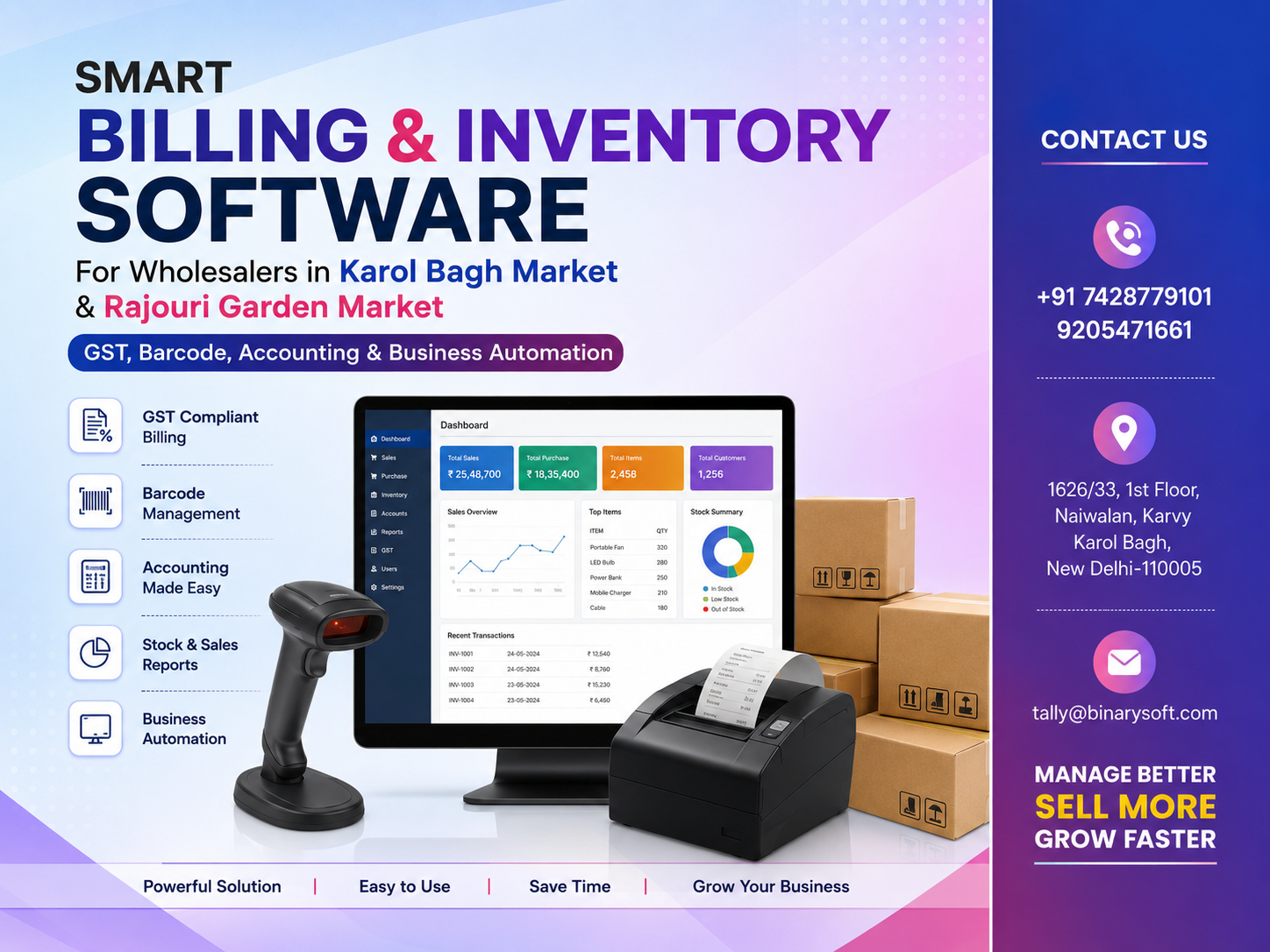
This is why smart billing and inventory software is becoming increasingly important for wholesalers. A connected system can bring GST billing, barcode management, inventory tracking, accounting, receivables, purchase management and business reporting together. The benefit is practical: fewer repetitive entries, better visibility over stock and outstanding payments, faster invoicing and more reliable information for everyday business decisions.
Why Wholesalers in Karol Bagh and Rajouri Garden Need Smarter Business Management
Wholesale businesses operate differently from ordinary retail shops.
A wholesaler may process large quantities of goods, maintain multiple product categories, negotiate different rates for different customers, manage credit transactions, receive stock from several suppliers and dispatch multiple orders throughout the day.
In markets such as Karol Bagh and Rajouri Garden, speed can directly affect customer satisfaction.
A retailer contacting a wholesaler generally wants quick answers:
Is the required item available?
What is today's rate?
How many units are available?
Can the goods be dispatched immediately?
What was the customer's previous purchase price?
How much payment is outstanding?
When information is distributed between notebooks, spreadsheets, employees and different applications, answering these questions becomes difficult.
Smart billing and inventory software creates a central business information system where transactions can update related records in a structured manner.
Instead of viewing billing, inventory and accounting as three separate activities, wholesalers can manage them as parts of the same business process.
A Karol Bagh Wholesaler's Story: When Sales Increased but Control Started Disappearing
Consider the example of a fictional wholesale trader operating near Karol Bagh.
For years, his business had grown through relationships.
Retail customers called him directly. His employees knew popular products almost from memory. Purchase information was maintained in spreadsheets, invoices were generated separately, and outstanding payments were tracked through accounts records and regular phone calls.
The system appeared manageable.
Then the business grew.
More products were added. More retailers started placing orders through phone calls and messaging applications. Some customers wanted GST invoices immediately, while others asked for old invoice copies or updated account statements.
During a particularly busy week, a long-standing customer placed an urgent bulk order.
The employee taking the order believed that sufficient stock was available.
The invoice preparation began.
Only when warehouse staff started collecting the goods did they discover that the physical quantity was much lower than expected.
Part of the stock had already been committed to another order.
The wholesaler had to call his customer and explain that the complete quantity could not be supplied.
The customer did not argue.
He simply purchased the remaining requirement elsewhere.
That silence worried the business owner more than an angry complaint.
The incident was not caused by a lack of sales. It happened because sales had grown faster than the systems controlling the business.
He realised that the next stage of growth required more than additional employees. He needed better visibility.
After moving towards an integrated billing, inventory and accounting workflow, his priority changed from asking employees, "How much stock do we have?" to checking reliable business information before committing an order.
For wholesalers, that change can be significant.
Growth becomes easier to manage when business information grows with the business.
What Is Smart Billing and Inventory Software for Wholesalers?
Smart billing and inventory software is a business management system designed to connect important commercial activities such as:
GST invoicing
Sales management
Purchase management
Inventory tracking
Barcode management
Customer accounts
Supplier accounts
Receivables and payables
Accounting
Cash and bank transactions
Business reports
Tax-related records
Management information
Instead of repeatedly entering the same information into different systems, businesses can create a more integrated workflow.
For example, when a sales transaction is properly recorded, the system can reflect its impact on inventory, customer accounts, taxation and financial records according to the configured process.
This provides management with a more consistent view of business activity.
1. Faster GST Billing for High-Volume Wholesale Operations
Billing speed matters when several customers are waiting simultaneously.
A wholesale billing system should help businesses create invoices quickly while maintaining accurate transaction details.
Depending on the software and business configuration, invoices may include:
Customer information
GSTIN
Invoice number
Invoice date
Product description
HSN/SAC information where applicable
Quantity
Rate
Discount
Taxable value
GST details
Total invoice value
Payment information
Transport or dispatch details where required
Properly configured GST billing reduces repetitive calculations and helps maintain consistent invoice records.
For wholesalers processing a large number of transactions, even a small improvement in invoice preparation time can make daily operations smoother.
2. Real-Time or Near Real-Time Inventory Visibility
Inventory is one of the biggest investments for many wholesale businesses.
Too little inventory can result in missed sales.
Too much inventory can block working capital.
The objective is therefore not simply to maintain more stock. It is to maintain the right stock with better visibility.
Inventory software can help wholesalers track:
Opening stock
Purchases
Sales
Sales returns
Purchase returns
Stock transfers
Current stock balances
Item-wise movement
Category-wise stock
Location-wise inventory where configured
Slow-moving products
Fast-moving products
Reorder requirements
Negative stock situations
Stock valuation
With timely transaction entry and proper controls, owners can get a much clearer understanding of what is actually happening inside their inventory.
3. Barcode-Based Billing and Stock Management
Barcode technology can make product identification significantly faster.
Instead of manually searching for every product during billing or stock handling, businesses can scan a barcode to identify an item where the software and barcode setup support the workflow.
Barcode systems can be useful for wholesalers handling large numbers of SKUs.
Potential benefits include:
Faster item identification
Reduced manual product selection
More efficient billing
Better stock counting
Improved warehouse handling
Fewer mistakes caused by similar product names
Easier product labelling
More organised dispatch operations
The exact barcode workflow should be selected according to the nature of the products and business.
For some wholesalers, manufacturer barcodes may already exist.
Others may need to generate and print their own internal barcode labels.
4. Better Management of Multiple Products and SKUs
A wholesale business may deal with hundreds or thousands of items.
Managing these items only by product name can quickly become confusing.
A structured inventory system can classify products using relevant attributes such as:
Item group
Category
Brand
SKU
Unit
Size
Model
Variant
Batch
Location
Tax classification
This makes searching, reporting and analysing inventory easier.
When products are organised properly at the master-data level, the quality of business reports also improves.
5. Batch and Expiry Management Where Required
Certain businesses need more detailed inventory control.
Wholesalers dealing in products with batches or expiry dates may require batch-wise tracking.
Depending on the software and configuration, businesses can maintain information such as:
Batch number
Manufacturing date
Expiry date
Purchase rate
Selling rate
Available batch quantity
This is especially useful where product shelf life or batch identification is commercially important.
6. Purchase Management and Supplier Control
Inventory management starts with purchasing.
A smart system should help wholesalers understand not only what they sold but also what they purchased, from whom and at what cost.
Purchase records can help track:
Supplier invoices
Purchase quantities
Purchase rates
GST details
Discounts
Additional expenses
Outstanding supplier balances
Purchase returns
Item-wise purchase history
Supplier-wise purchase history
This information becomes useful during supplier negotiations.
Instead of depending entirely on memory, wholesalers can review previous transactions before finalising the next purchase.
7. Customer-Wise Pricing and Discount Management
Wholesale pricing is rarely simple.
Different customers may receive different prices depending on:
Order quantity
Relationship history
Product category
Payment terms
Seasonal schemes
Market conditions
Negotiated rates
A properly configured billing system can help maintain more consistent pricing practices.
Businesses can also review previous sales transactions to understand the rates offered to a particular customer.
This reduces dependence on individual employees remembering every negotiated price.
8. Credit Sales and Outstanding Payment Management
Credit is common in wholesale trade.
But uncontrolled credit can create serious cash-flow problems.
A business may report strong sales and still struggle to pay suppliers because customer payments remain outstanding.
Accounting software can help wholesalers monitor:
Customer outstanding amounts
Invoice-wise receivables
Bill-wise ageing
Due dates
Overdue invoices
Payment receipts
Credit notes
Debit notes
Customer ledger balances
This makes collection planning more systematic.
Management can identify customers whose payments are becoming overdue instead of discovering the problem months later.
9. Receivables Ageing Can Improve Collection Discipline
An ageing report divides outstanding invoices according to how long they have remained unpaid.
For example, a business might analyse outstanding receivables across periods such as:
0–30 days
31–60 days
61–90 days
Above 90 days
The exact ageing periods can vary.
The purpose is simple.
Not every outstanding invoice carries the same risk.
A payment delayed by a few days may require a normal reminder.
An invoice outstanding for several months may require immediate management attention.
Ageing reports help wholesalers prioritise collection efforts.
10. Supplier Payables and Better Cash-Flow Planning
Wholesalers also need to know what they owe.
Supplier payment obligations can become difficult to manage when purchases are frequent and suppliers offer different credit periods.
A connected accounting system can help monitor:
Supplier balances
Bill-wise payable amounts
Due dates
Overdue payments
Advance payments
Purchase returns
Debit notes
This information helps businesses plan cash requirements more effectively.
It also supports stronger supplier relationships because payment commitments can be managed with greater visibility.
11. Accounting Integrated with Billing and Inventory
One of the biggest advantages of integrated business software is reducing unnecessary duplication between operational and accounting records.
Billing, inventory and accounts are closely connected.
A sale affects:
Revenue
Customer balance or payment
Inventory
Tax records
Profitability
Similarly, a purchase affects:
Inventory
Supplier liability or payment
Input tax records
Cost
When these activities are maintained in disconnected systems, reconciliation becomes an additional task.
An integrated system can reduce this gap by maintaining connected records according to the configured accounting workflow.
12. GST Data Management
GST compliance requires organised transaction records.
Software can help businesses maintain GST-related information systematically, but software alone does not guarantee compliance.
Correct GST treatment depends on accurate data, configuration and applicable legal requirements.
Businesses should therefore regularly review:
GSTIN details
Tax rates
HSN/SAC classifications where applicable
Place-of-supply information
Invoice records
Credit notes
Debit notes
Purchase transactions
Sales transactions
Reconciliation information
Tax-related reports
Complex tax matters should be reviewed with a qualified tax professional.
13. Sales Return and Purchase Return Management
Returns are part of wholesale operations.
A customer may return damaged goods, incorrect items or unsold products depending on commercial terms.
Similarly, wholesalers may need to return goods to suppliers.
These transactions should be recorded properly.
Return management helps maintain accurate:
Inventory
Customer balances
Supplier balances
Tax records
Sales figures
Purchase figures
Profitability analysis
Ignoring or informally handling returns can gradually create differences between physical stock and system stock.
14. Warehouse and Godown Management
Many wholesalers maintain inventory at more than one physical location.
For example:
Main shop
Godown
Warehouse
Secondary storage area
Dispatch location
Location-wise inventory tracking can help management determine exactly where goods are available.
This is particularly useful when a customer requires urgent delivery.
Instead of simply knowing that 100 units exist somewhere in the business, the owner needs to know which location actually has those 100 units.
15. Stock Transfers Between Locations
When inventory moves from one godown or warehouse to another, the movement should be recorded systematically.
Otherwise, total inventory may appear correct while location-wise inventory becomes inaccurate.
A stock transfer process provides better visibility into:
Source location
Destination location
Product
Quantity
Transfer date
Available quantity after transfer
This becomes increasingly important as a wholesale operation expands.
16. Reorder-Level Management
Stock-outs can cost wholesalers valuable customers.
If a retailer repeatedly hears "out of stock," they may start purchasing from another supplier.
Reorder-level monitoring can help identify products approaching minimum stock thresholds.
Management can then plan purchases before critical inventory runs out.
However, reorder levels should not be set randomly.
Businesses should consider:
Historical sales
Supplier lead time
Seasonal demand
Minimum order quantity
Available working capital
Storage capacity
Market conditions
The objective is to balance product availability with inventory investment.
17. Identify Fast-Moving and Slow-Moving Products
Not all inventory performs equally.
Some products sell almost every day.
Others remain in storage for months.
Software reports can help classify inventory according to movement.
Fast-moving products may require:
Higher reorder frequency
Closer stock monitoring
Better supplier coordination
Slow-moving products may require:
Reduced future purchasing
Promotional pricing
Alternative sales strategies
Management review
This analysis helps wholesalers invest working capital more intelligently.
18. Reduce Dead Stock
Dead stock is inventory that remains unsold for a prolonged period and has limited commercial movement.
It occupies storage space and blocks money that could otherwise be used for faster-moving products.
Regular inventory analysis can help management identify potential dead stock earlier.
Businesses can then decide whether to:
Reduce prices
Bundle products
Offer schemes
Return goods to suppliers where commercially possible
Move products between locations
Stop further purchasing
Early identification provides more options than discovering dead inventory after it has lost most of its market value.
19. Business Reports for Better Decisions
A modern wholesaler needs more than invoices.
Management needs information.
Useful reports may include:
Daily sales
Monthly sales
Product-wise sales
Customer-wise sales
Category-wise sales
Purchase analysis
Stock summary
Stock movement
Stock ageing
Outstanding receivables
Outstanding payables
Cash position
Bank position
Profit and loss
Balance sheet
Cash flow
Inventory valuation
The availability of specific reports depends on the software and configuration.
The important point is that management should be able to convert transaction data into actionable business information.
20. Understand Which Customers Drive Revenue
Customer-wise sales reports can reveal important patterns.
A wholesaler may discover that a relatively small group of customers contributes a large portion of total sales.
This information can help management strengthen important customer relationships while also monitoring concentration risk.
Businesses can analyse:
Customer sales value
Purchase frequency
Outstanding amount
Average order size
Product preference
Payment behaviour
Profitability where supported
This creates a more informed approach to customer management.
21. Product-Wise Profitability
High sales do not always mean high profit.
One product may generate strong revenue but offer a very small margin.
Another may sell less frequently but contribute significantly more profit.
Product-wise profitability analysis helps owners look beyond turnover.
This can influence:
Purchase decisions
Pricing
Discount policies
Sales priorities
Stock investment
Supplier negotiations
Wholesalers should focus not only on how much they sell but also on what those sales contribute to the business.
22. Automation Reduces Repetitive Work
Business automation does not necessarily mean removing people from business processes.
For wholesalers, its more practical purpose is to reduce repetitive manual work and make information easier to access.
Depending on the chosen solution, automation may help with:
Invoice calculations
Inventory updates
Accounting entries
Outstanding reports
Tax calculations
Barcode identification
Management reporting
Data analysis
This allows employees to spend more time on customers, purchasing, collections and business development.
23. User-Level Access and Better Internal Control
As businesses grow, multiple employees may use the same system.
Not every employee should necessarily have access to every financial or administrative function.
Role-based access can help businesses define who can:
Create transactions
Modify transactions
View reports
Access sensitive financial information
Manage masters
Perform administrative functions
The exact security capabilities depend on the selected software.
Proper access control reduces unnecessary exposure of business information and supports stronger internal processes.
24. Data Backup Should Be a Business Priority
Business data is an important operational asset.
Losing years of transaction information due to hardware failure, accidental deletion, malware or another incident can disrupt operations severely.
Wholesalers should establish a proper backup strategy.
This can include:
Regular backups
Multiple backup copies
Secure storage
Periodic restoration testing
Controlled access
Off-site or cloud-based backup where appropriate
The backup strategy should match the software environment and the business's risk requirements.
25. Why Karol Bagh Wholesalers Can Benefit from Integrated Software
Karol Bagh is a major commercial area with businesses operating across numerous trading categories.
For wholesalers handling frequent transactions, the ability to access billing, stock and accounting information quickly can improve daily control.
Instead of spending time reconciling different registers and spreadsheets, businesses can work towards maintaining a centralised transaction system.
The result can be faster access to business information and more structured decision-making.
26. Why Rajouri Garden Wholesalers Should Consider Business Automation
Rajouri Garden is another active commercial destination in Delhi.
Businesses serving retailers and other commercial customers must often manage a combination of stock availability, pricing, credit and rapid order fulfilment.
As transaction volumes increase, manual systems can become difficult to scale.
Business automation provides a foundation for handling higher volumes without allowing administrative work to increase at exactly the same rate.
27. TallyPrime for Billing, Inventory and Accounting
TallyPrime can support several important business functions, including accounting, invoicing, inventory management and GST-related business processes.
For wholesalers, a properly planned TallyPrime implementation can help connect day-to-day transactions with financial records.
Businesses should configure the software according to their actual workflow rather than simply installing it and immediately starting data entry.
Important implementation considerations may include:
Company configuration
Ledger structure
Stock groups
Stock items
Units of measurement
Godowns or locations
GST configuration
Customer and supplier masters
Voucher types
User permissions
Backup procedures
Reporting requirements
The right configuration can make a substantial difference to the usefulness of the system.
28. Barcode Integration with the Wholesale Billing Process
Businesses considering barcode billing should first study how goods move through their operation.
Questions to consider include:
Do products already carry manufacturer barcodes?
Does each product variant require a different barcode?
Will internal barcode labels be printed?
Where will scanners be installed?
Is barcode scanning required only for billing or also for stock operations?
How many billing counters are involved?
Is batch information required?
A well-designed barcode process should simplify operations rather than add unnecessary complexity.
29. Moving from Excel and Manual Registers to Integrated Software
Many businesses begin with spreadsheets because they are flexible and familiar.
The problem appears when the business becomes larger.
Different employees may maintain different files.
Data can become duplicated.
Older versions may continue circulating.
Inventory and accounts may no longer match.
Management reports require manual consolidation.
Migrating to integrated business software can provide a more structured foundation.
However, migration should be planned carefully.
Businesses should first clean and verify important master data, including:
Customers
Suppliers
Products
Opening stock
Outstanding receivables
Outstanding payables
Ledger balances
GST information
Incorrect opening information can reduce the reliability of future reports.
30. Questions to Ask Before Choosing Wholesale Billing Software
Before selecting a solution, wholesalers should evaluate their real operational requirements.
Important questions include:
How many invoices are generated every day?
How many products are maintained?
Is barcode billing required?
Are multiple warehouses involved?
Is batch tracking necessary?
How many users require system access?
Does the business primarily sell on cash or credit?
Are customer-specific prices required?
What GST-related reports are needed?
Is remote access important?
How will backups be managed?
What implementation and support services are available?
Software should be selected according to business requirements rather than simply the longest feature list.
31. Signs Your Wholesale Business Has Outgrown Its Current System
A business should consider upgrading its processes when employees regularly face problems such as:
Frequent differences between physical and recorded stock
Slow invoice generation
Difficulty finding old invoices
Unclear customer outstanding balances
Repeated manual data entry
Inventory shortages discovered too late
No visibility into slow-moving stock
Dependence on one employee for important information
Difficulty calculating actual profitability
Multiple spreadsheets containing conflicting information
Delayed accounting reconciliation
These are not merely software problems.
They are signals that business growth may be exceeding the capacity of the existing operating process.
32. Smart Software Is About Control, Not Just Computerisation
Purchasing software does not automatically transform a business.
Technology becomes valuable when the underlying process is designed correctly.
Wholesalers should establish clear procedures for:
Creating product masters
Recording purchases
Recording sales
Handling returns
Transferring inventory
Recording payments
Managing credit
Checking outstanding balances
Reviewing inventory
Backing up data
Reviewing reports
Software provides the platform.
Business discipline determines the quality of the results.
33. From Billing Counter to Business Intelligence
Traditional billing software primarily answered one question:
How do we generate an invoice?
Modern wholesale businesses need answers to much broader questions:
What is selling?
What is not selling?
What should we purchase?
Which customer owes us money?
Which supplier needs payment?
Where is our inventory?
Which products generate better margins?
How much working capital is tied up in stock?
What is our actual financial position?
This is where integrated billing, inventory and accounting systems become strategic business tools rather than simple invoice generators.
34. The Future of Wholesale Business Management in 2026 and Beyond
Wholesale trade is becoming increasingly information-driven.
Retail customers expect faster service.
Owners want immediate visibility.
Accounting needs to remain organised.
Inventory has to be controlled carefully.
Working capital needs continuous attention.
The businesses that benefit most from technology will not necessarily be those using the largest number of applications.
They will be those that maintain accurate data and create connected processes.
For wholesalers in Karol Bagh Market and Rajouri Garden Market, smart business software can become an important part of that transition.
The goal is not simply to make billing digital.
The goal is to connect the complete commercial cycle:
Purchase
Inventory
Order
Billing
Dispatch
Accounting
Payment collection
Reporting
Decision-making
When these functions work together, management gains a clearer view of the business.
Conclusion
Wholesale businesses in Karol Bagh Market and Rajouri Garden Market operate in an environment where speed, stock availability, pricing, customer relationships and working-capital management all matter.
As transaction volumes grow, depending heavily on manual registers, disconnected spreadsheets or isolated billing systems can make business control increasingly difficult.
Smart billing and inventory software can bring GST billing, barcode processes, inventory management, purchases, sales, customer receivables, supplier payables and accounting into a more integrated workflow.
For wholesalers, the biggest benefit is not simply faster invoice printing.
It is visibility.
Knowing what is available, what has sold, what needs to be purchased, who needs to pay, what the business owes and how the business is performing allows owners to make decisions using structured information rather than assumptions.
A carefully configured solution such as TallyPrime, combined with appropriate implementation, training, data management and business processes, can help wholesalers create a more organised foundation for sustainable growth.
Frequently Asked Questions
What is the best billing software for wholesalers in Karol Bagh?
The appropriate software depends on the wholesaler's size, product range, transaction volume, inventory complexity and reporting requirements. Businesses requiring integrated accounting, inventory, GST invoicing and business reporting can evaluate TallyPrime and other suitable solutions based on their workflow.
Can wholesale billing software manage GST invoices?
Yes. GST-enabled business software can assist with GST invoice preparation and maintaining tax-related transaction information when properly configured. Businesses should ensure their tax settings and transaction treatment comply with applicable requirements.
CA. Anand Tirpathi is a Chartered Accountant with experience in statutory compliance, internal controls, and accounting process optimization. He has advised multiple businesses on improving operational efficiency through structured accounting and inventory systems. His writing focuses on clarity, compliance, and risk reduction for MSMEs.