Call CA Tally HelpDesk
+91 9205471661,
7428779101
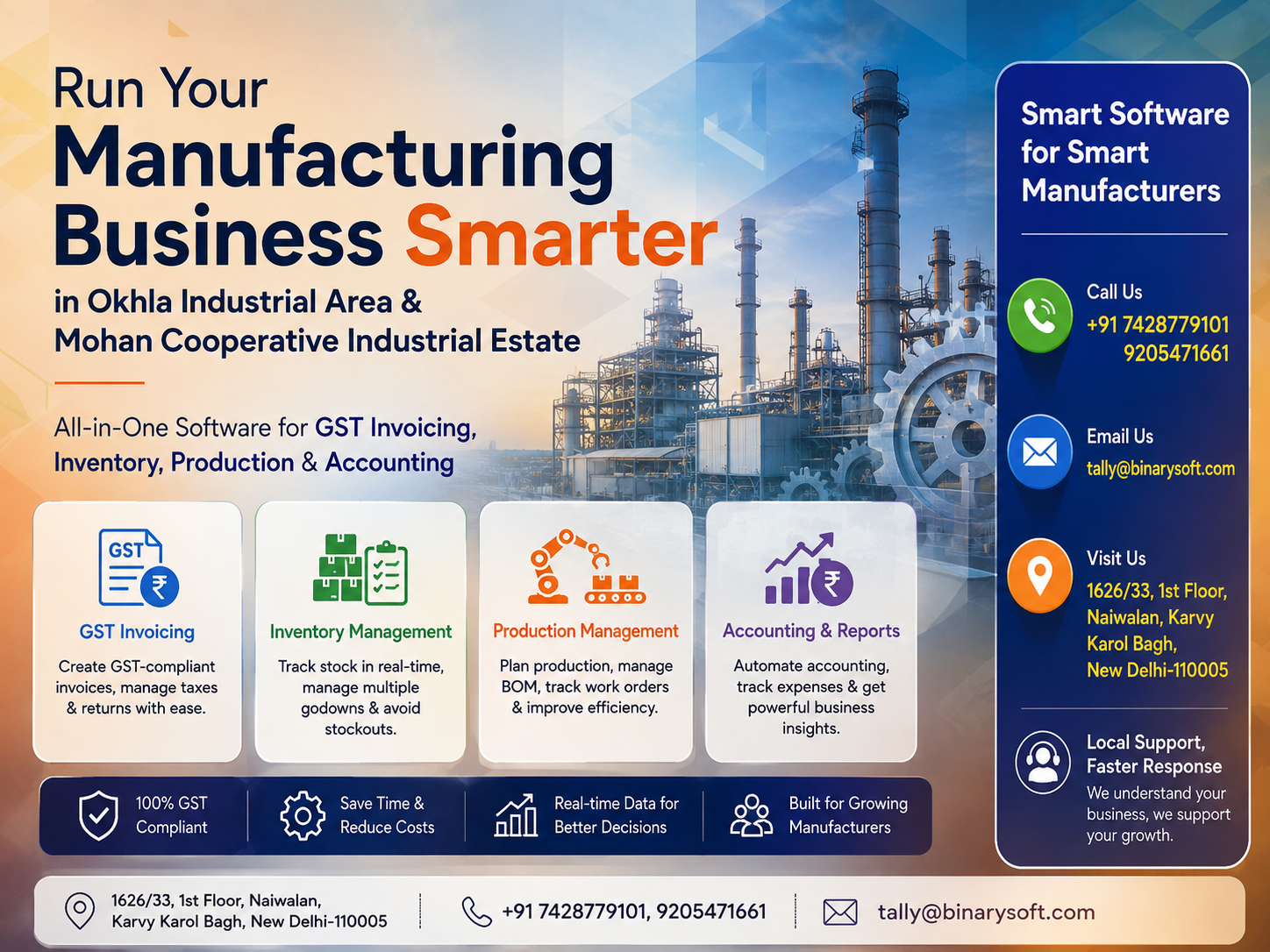
What Changed in 2026? Manufacturing Businesses Need Faster Control Over Every Rupee, Item and Production Order
In 2026, manufacturing businesses are operating under greater pressure to control costs, maintain accurate inventory, complete GST-ready invoicing, track production and understand profitability without waiting until the end of the month. For manufacturers operating in Okhla Industrial Area and Mohan Cooperative Industrial Estate, Delhi, disconnected spreadsheets, handwritten production registers and separate billing systems can quickly become a bottleneck. A delayed stock update can interrupt production, an incorrect material issue can distort costing, and incomplete accounting records can make business decisions harder. Modern manufacturing software brings GST invoicing, raw-material inventory, finished goods, Bill of Materials, production tracking, purchase management and accounting into one connected system. The benefit is practical: management gets clearer visibility of stock, production, receivables, costs and cash flow, helping teams reduce repetitive work, respond faster to customers and run a more controlled manufacturing operation.
Manufacturing in Delhi Is Becoming More Data-Driven
Manufacturing businesses are no longer competing only on the quality of their products.
Speed, cost control, inventory accuracy, delivery commitments, GST compliance, customer service and access to reliable business information have become equally important.
This is especially relevant for manufacturing units operating in major commercial and industrial locations such as Okhla Industrial Area and Mohan Cooperative Industrial Estate.
A manufacturer may deal with hundreds or thousands of transactions involving:
Raw materials
Components and spare parts
Semi-finished products
Finished goods
Packaging materials
Purchase orders
Sales orders
Job work
Production consumption
Wastage and scrap
Employee expenses
Transport charges
Supplier payments
Customer receivables
GST invoices
Credit notes and debit notes
Managing all these activities separately creates unnecessary complexity.
The objective of modern manufacturing software in 2026 is therefore not simply to create invoices.
It should help connect the entire business.
A Manufacturing Story: When a Busy Order Exposed the Real Cost of Manual Management
Consider the example of a growing manufacturing unit in Delhi.
The company had experienced employees, regular customers and increasing orders. Its owner believed the business was performing well because sales were rising steadily.
But there was a problem.
Inventory was maintained partly in spreadsheets and partly in physical registers. Production supervisors recorded material consumption separately. Billing was handled through another system, while accounting information was updated later.
One morning, an important customer placed a large repeat order and wanted urgent delivery.
The sales team confirmed that the goods could be supplied.
Production started preparing the order.
Then the team discovered that one essential raw material was below the required quantity.
The spreadsheet showed enough stock, but some material had already been consumed for another production batch and the consumption had not yet been updated.
The production schedule stopped.
The purchase department had to arrange urgent material. The supplier charged a higher rate for immediate delivery, transportation costs increased and workers waited for the material to arrive.
The order was eventually completed, but the margin was much lower than expected.
For the owner, the most frustrating part was not the additional expense. It was realizing that the information required to prevent the problem already existed somewhere inside the business—it simply was not connected.
That incident changed the way the company looked at software.
Instead of considering accounting software merely as a tool for the accounts department, management began looking at an integrated system covering purchasing, inventory, production, billing and accounting.
That is the shift many manufacturers need to consider in 2026.
Why Manufacturers in Okhla Industrial Area Need Integrated Business Software
Okhla Industrial Area is one of Delhi's established industrial and commercial hubs. Businesses operating in and around the area may deal with manufacturing, processing, assembly, distribution, trading and business-to-business supply.
As transaction volumes increase, manual coordination becomes difficult.
Imagine a manufacturer receiving several customer orders simultaneously.
The management needs answers to questions such as:
Do we have sufficient finished stock?
If not, how much needs to be manufactured?
Are the required raw materials available?
Which purchase orders are pending?
How much material will the production order consume?
What is the expected production cost?
Which customer payments are outstanding?
How much GST liability is reflected in the books?
Without connected information, different departments may provide different answers.
Integrated manufacturing and accounting software can create a common source of business information.
Why Businesses in Mohan Cooperative Industrial Estate Need Better Production Visibility
Mohan Cooperative Industrial Estate and its surrounding commercial belt accommodate businesses dealing with manufacturing, distribution, industrial products and related services.
For such businesses, the challenge is often not simply generating sales.
It is maintaining operational control as the company grows.
When a manufacturer handles more products, suppliers, customers and production orders, management needs better visibility.
Software can help monitor:
Raw-material availability
Finished-goods inventory
Production consumption
Material movement
Purchase requirements
Sales orders
Customer outstanding balances
Supplier dues
GST-related transactions
Cash and bank positions
Product-wise movement
Business profitability
Instead of waiting for multiple departments to prepare separate reports, authorized users can access relevant information directly from the system.
GST Invoicing Software for Manufacturing Businesses
GST invoicing is one of the most important requirements of a modern manufacturing operation.
A professional billing and accounting system can help businesses create invoices with relevant transaction information such as customer details, GSTIN, invoice number, invoice date, product description, quantity, rate, taxable value, applicable GST details and other required particulars according to the nature of the transaction.
The advantage of integrated GST invoicing is that the invoice does more than document a sale.
The transaction can simultaneously affect customer outstanding balances, sales accounts, taxes and inventory.
This reduces duplicate data entry.
Faster Invoice Generation
During busy business hours, repeatedly entering the same information wastes valuable time.
With properly configured masters, businesses can quickly select customers and products while preparing invoices.
This can improve billing speed while reducing repetitive manual entry.
Better Invoice Accuracy
Incorrect rates, quantities, tax treatment or customer details can create unnecessary reconciliation work.
Structured billing workflows help standardize invoicing across the organization.
Credit and Debit Notes
Manufacturing businesses may frequently deal with:
Sales returns
Purchase returns
Rate differences
Quantity differences
Damaged goods
Commercial adjustments
An integrated accounting system makes it easier to record these transactions while maintaining their accounting impact.
Inventory Management Software for Manufacturers
Inventory is often one of the largest working-capital investments in a manufacturing business.
Too little stock can interrupt production.
Too much stock can block cash.
Poor inventory records can create both problems simultaneously.
That is why inventory management should be treated as a core management function.
Raw Material Tracking
Manufacturers should know how much raw material is available before accepting production commitments.
A structured inventory system can help track material receipts, issues, consumption and closing quantities.
Finished Goods Tracking
Once manufacturing is completed, finished goods should be reflected accurately in inventory.
Sales teams can then check availability before promising dispatch.
Semi-Finished Goods
Some manufacturing processes involve multiple production stages.
Tracking work-in-progress or semi-finished products can provide better visibility into material movement and production status.
Multiple Godowns and Locations
Manufacturers may store inventory across:
Factories
Warehouses
Godowns
Retail counters
Dispatch locations
Different storage areas
Location-wise inventory tracking helps management understand where stock is physically available.
Bill of Materials: A Foundation for Better Production Control
A Bill of Materials, commonly called BOM, defines the materials or components required to manufacture a finished product.
For example, suppose Product A requires:
2 units of Component X
4 units of Component Y
1 unit of Component Z
Packaging material
A properly configured BOM gives the business a standard reference for expected material consumption.
This becomes extremely useful when production volumes increase.
Why BOM Matters
Without a standardized BOM, manufacturers may struggle to determine:
Expected material requirements
Actual versus expected consumption
Production planning requirements
Potential wastage
Finished-goods costing
Reorder requirements
A structured BOM therefore helps connect inventory with production.
Production Tracking Software in 2026
Manufacturing software should help businesses record the transformation of raw materials into finished goods.
Suppose a company plans to manufacture 1,000 units.
Before starting production, the system should help the team understand whether sufficient materials are available.
During or after production, actual material consumption can be recorded.
Finished goods can then be added to stock.
This creates a clearer production trail.
Production Planning
Better inventory visibility supports production planning.
Teams can identify material shortages before production starts instead of discovering them halfway through the process.
Material Consumption
Recording production consumption helps ensure that raw-material inventory reflects actual usage.
Finished Production
Once production is completed, finished goods can be recorded so sales and dispatch teams see updated stock.
Wastage and Scrap
Manufacturing rarely produces exactly the theoretical output every time.
There may be:
Material loss
Process wastage
Scrap
Rejected goods
Damaged components
Tracking these separately provides management with useful information for operational improvement.
Manufacturing Cost Control
A business can increase sales and still experience pressure on profitability if production costs are not controlled.
Manufacturing costs may include:
Raw materials
Components
Direct labour
Power
Machinery expenses
Packaging
Freight
Job work
Factory overhead
Repairs
Maintenance
Wastage
Administrative expenses
A connected accounting environment provides management with better information to evaluate these costs.
Why Product Costing Matters
Suppose a manufacturer sells an item for ₹1,000.
The selling price alone does not reveal whether the transaction is profitable.
Management needs to understand the cost associated with producing and supplying the item.
If raw-material costs rise but selling prices remain unchanged, margins may shrink without management noticing immediately.
Regular cost analysis helps businesses make better pricing and purchasing decisions.
Purchase Management for Manufacturing Companies
Purchasing has a direct impact on both production and profitability.
Manufacturers need the right material:
At the right quantity
At the right quality
At the right price
At the right time
Purchasing too early blocks working capital.
Purchasing too late can stop production.
Better inventory visibility can support more informed purchasing decisions.
Supplier Management
Businesses should be able to review supplier-related information such as:
Purchase transactions
Outstanding amounts
Material supplied
Pending payments
Purchase returns
Historical transactions
This information helps finance and purchase teams coordinate more effectively.
Sales Order and Dispatch Management
Customer satisfaction depends heavily on fulfilling commitments.
When an order arrives, the business needs to understand whether it can be supplied from existing inventory or requires additional production.
Integrated information helps sales, production and dispatch teams work from the same data.
A typical workflow may look like:
Customer order received → stock checked → production requirement identified → raw material checked → manufacturing completed → finished stock updated → invoice generated → goods dispatched → receivable recorded.
When these stages are disconnected, errors become more likely.
Accounting Software for Manufacturers
Accounting is the financial backbone of manufacturing operations.
A good accounting system should provide clear visibility into:
Sales
Purchases
Expenses
Receivables
Payables
Cash
Bank transactions
Taxes
Assets
Liabilities
Profitability
Management reports
The goal is not only to record transactions for compliance.
Accounting information should also support business decisions.
Accounts Receivable
Outstanding customer payments directly affect cash flow.
Management should regularly review:
Who owes money?
How much is outstanding?
How long has it been pending?
Which invoices require follow-up?
This can improve collection discipline.
Accounts Payable
Supplier payments also need careful management.
The business should understand upcoming obligations so that working capital can be planned effectively.
Cash Flow Is Just as Important as Profit
A manufacturer can show accounting profit and still face cash-flow pressure.
Why?
Because money may be locked in:
Customer receivables
Excess inventory
Slow-moving products
Raw materials
Work in progress
Advance payments
At the same time, the company must continue paying suppliers, employees, rent, utilities, transporters and other operating expenses.
Connected accounting and inventory information gives management a clearer picture of where money is tied up.
Stock Ageing and Slow-Moving Inventory
Not every item in a warehouse is equally valuable.
Some inventory moves every week.
Some remains untouched for months.
Slow-moving inventory consumes warehouse space and blocks working capital.
Manufacturers should periodically identify:
Non-moving stock
Slow-moving stock
Excess stock
Obsolete materials
Old finished goods
This allows management to take corrective action.
Batch-Wise and Item-Wise Tracking
Depending on the manufacturing sector, businesses may need more detailed stock tracking.
Batch-wise inventory can be useful where products are manufactured or purchased in identifiable lots.
Item-wise analysis can help management understand:
Fast-moving items
Slow-moving items
Sales quantities
Purchase quantities
Stock availability
Product performance
Better product-level visibility leads to better planning.
Multiple Units of Measurement
Manufacturers often purchase and sell goods in different units.
For example, materials may be handled in:
Kilograms
Grams
Litres
Metres
Pieces
Boxes
Cartons
Sets
Bundles
Dozens
A properly configured inventory system should reflect the units relevant to the business.
Barcode Integration for Faster Stock Handling
For suitable manufacturing and warehouse environments, barcode-based workflows can improve operational efficiency.
Barcodes can help with:
Product identification
Stock handling
Billing
Warehouse operations
Finished-goods identification
Dispatch processes
The exact barcode workflow should be designed according to the manufacturer's products and operational requirements.
Better Reporting for Business Owners
One of the biggest advantages of digitizing manufacturing operations is improved reporting.
A business owner should not need to manually combine multiple spreadsheets every time a decision has to be made.
Useful management reports may include:
Sales reports
Purchase reports
Stock summaries
Outstanding receivables
Outstanding payables
Cash and bank reports
Product movement
Godown-wise inventory
Production consumption
Finished-goods quantities
Expense reports
Profit and loss information
Balance sheet information
GST-related reports
When data is recorded consistently, reports become more useful for decision-making.
How Manufacturing Software Helps Different Teams
Manufacturing software is not only for accountants.
Business Owners
Owners gain better visibility into financial and operational performance.
Accounts Team
The accounts department can manage invoices, purchases, expenses, payments, receipts, taxes and financial reports in a structured environment.
Production Team
Production teams can work with material requirements, consumption and output information.
Purchase Team
Purchasing teams gain better stock visibility before placing orders.
Sales Team
Sales teams can check relevant stock and customer information before confirming commitments.
Warehouse Team
Warehouse staff can maintain more systematic stock movement records.
Management
Management can use consolidated information for faster decisions.
Why Excel Alone Can Become Difficult as Manufacturing Grows
Spreadsheets remain useful for many business tasks.
The problem occurs when critical operational processes depend on several separate spreadsheets maintained by different people.
One file may contain inventory.
Another contains production.
Another contains outstanding customer balances.
Another tracks purchases.
Another tracks GST calculations.
When these files are not synchronized, the business may experience:
Duplicate entries
Old information
Formula errors
Version confusion
Missing transactions
Delayed reporting
Difficult reconciliation
Limited access control
Integrated software reduces dependence on disconnected records.
Automation Reduces Repetitive Work
Business automation does not necessarily mean replacing employees.
It means reducing repetitive manual processes so employees can focus on more valuable work.
For example, when a sales transaction is recorded correctly, the same information may support inventory, accounting, receivables and reporting.
This is much more efficient than entering the transaction separately into multiple systems.
TallyPrime for Manufacturing Businesses
TallyPrime can support a range of accounting, inventory and business-management requirements for manufacturers when it is properly configured according to the company's workflow.
Depending on requirements and configuration, businesses can use relevant capabilities for areas such as:
Accounting
GST-related transactions
Sales and purchase management
Inventory management
Godowns
Stock items and groups
Units of measurement
Bill of Materials
Manufacturing-related inventory entries
Receivables and payables
Banking-related accounting
Cost tracking
Business reports
The most important consideration is implementation.
Software should be configured around the actual business workflow rather than forcing employees to follow an unnecessarily complicated process.
Why Proper Software Implementation Matters
Buying software is only the beginning.
A successful manufacturing software implementation requires understanding the company's existing operations.
Before configuration, businesses should identify:
What products are manufactured?
What raw materials are used?
How is the BOM structured?
How many warehouses exist?
How is production currently recorded?
How are purchase requirements generated?
How are sales orders processed?
How is wastage handled?
What reports does management require?
Who should have access to which information?
How will existing data be migrated?
Which GST and accounting processes need to be incorporated?
The answers help determine the appropriate configuration.
User Roles and Data Security
As businesses grow, not every employee should have unrestricted access to financial and operational information.
Organizations may need role-based access according to responsibilities.
For example:
Sales employees may require sales-related access.
Warehouse employees may require inventory-related functions.
Accounts employees may require accounting and GST information.
Management may require broader reporting access.
Appropriate controls can improve data governance while keeping workflows practical.
Data Backup Is Essential
Business data is valuable.
Invoices, customer balances, supplier transactions, stock records and accounting information represent years of operational history.
Manufacturers should maintain an appropriate backup process.
Depending on the company's setup, backup policies may include multiple copies, defined backup frequencies and secure storage arrangements.
A backup is useful only when it can be successfully restored, so recovery procedures should also be considered.
Moving From Reactive Management to Proactive Management
Many manufacturing businesses operate reactively.
They discover a raw-material shortage after production stops.
They discover an overdue payment when cash becomes tight.
They discover excess inventory when the warehouse is already full.
They discover shrinking margins after reviewing old financial information.
Connected software helps management become more proactive.
Instead of asking, "What went wrong?"
The company can increasingly ask:
"What is likely to require attention next?"
That is a major benefit of better business information.
Key Benefits of Manufacturing Software in 2026
For manufacturers in Okhla Industrial Area and Mohan Cooperative Industrial Estate, a properly implemented business-management system can help deliver:
Faster GST invoicing
Better inventory visibility
More structured production records
Raw-material tracking
Finished-goods tracking
BOM management
Better purchasing decisions
Reduced duplicate data entry
Improved receivable monitoring
Better supplier payment planning
Stronger cost visibility
More useful business reports
Improved coordination between departments
Better control over business information
Faster management decisions
Choosing Manufacturing Software for Your Business
Every manufacturing business is different.
Before choosing software, evaluate the actual operational requirements rather than selecting a system purely on the basis of the number of features advertised.
Consider:
Business size
Number of users
Number of stock items
Manufacturing process
BOM complexity
Warehouse locations
Production volume
GST requirements
Accounting requirements
Reporting needs
User permissions
Backup requirements
Current software
Future growth
Support requirements
The right solution should solve current problems while remaining practical as the business expands.
Manufacturing Business Software in Okhla Industrial Area
Businesses searching for manufacturing software in Okhla Industrial Area should consider an integrated approach covering accounting and operations.
Common requirements can include GST invoicing, accounting, inventory management, raw-material control, BOM, production records, finished goods, purchase management, sales management, receivables, payables and reporting.
The objective should be to create better visibility across the entire business.
Manufacturing Software in Mohan Cooperative Industrial Estate
Manufacturers operating in Mohan Cooperative Industrial Estate can similarly benefit from moving away from fragmented processes.
A connected system can help link sales, purchasing, inventory, production and accounting.
This can be particularly valuable for growing manufacturers where owners can no longer personally supervise every transaction.
The system becomes a structured source of information for management.
Why 2026 Is a Good Time to Review Your Existing System
Business software should evolve with the company.
A system that was sufficient when the company processed 20 invoices per day may not be appropriate when it processes 200.
Similarly, a spreadsheet that worked with 50 inventory items may become difficult to control with thousands of stock items and multiple warehouses.
Manufacturers should periodically review whether their current system provides timely answers to essential questions.
Can you see accurate inventory?
Can you identify material shortages?
Can you track outstanding customer payments?
Can you understand supplier liabilities?
Can you review production consumption?
Can you identify slow-moving stock?
Can you obtain financial reports without manually combining multiple files?
Can management access useful information quickly?
If several answers are "no," it may be time to review the current process.
Binarysoft Technologies – Tally Solutions for Manufacturing Businesses
Binarysoft Technologies provides Tally-related solutions and support for businesses looking to improve accounting, inventory, billing and related business processes.
Manufacturing businesses can discuss their requirements before implementation so that the software configuration is aligned with practical operational needs.
Whether your business operates from Okhla Industrial Area, Mohan Cooperative Industrial Estate or another industrial location, the focus should be on creating a system that makes everyday business management simpler, faster and more controlled.
Powered by Binarysoft Technologies
Authorized Tally Partner
Location: 1626/33, 1st Floor, Naiwalan, Karol Bagh, New Delhi – 110005, INDIA
Contact us: +91 7428779101, 9205471661
Email us: tally@binarysoft.com
Business Hours: 10:00 AM – 6:00 PM, Monday–Friday
Conclusion
Manufacturing success in 2026 increasingly depends on how quickly a business can convert everyday transactions into reliable information.
For manufacturers in Okhla Industrial Area and Mohan Cooperative Industrial Estate, disconnected billing, inventory, production and accounting processes can make growth unnecessarily difficult.
Integrated manufacturing software can help connect GST invoicing, raw-material inventory, Bill of Materials, production consumption, finished goods, purchasing, sales, receivables, payables and accounting within a more structured workflow.
The biggest benefit is not simply faster billing.
It is better control.
When management can see what is available in stock, what is being consumed, what needs to be purchased, what customers owe, what suppliers must be paid and how the business is performing financially, decisions can be made with greater confidence.
For growing manufacturers, the right combination of software, configuration, processes and support can turn business data into a practical management advantage.
Frequently Asked Questions
What is manufacturing accounting software?
Manufacturing accounting software combines financial accounting with business processes relevant to manufacturers, such as purchases, sales, inventory, raw materials, finished goods, production-related entries and cost tracking.
Can manufacturing software create GST invoices?
Yes. Suitable accounting and billing software can be configured to create GST-related sales invoices according to the nature of the business and transaction.
Can TallyPrime be used by manufacturing businesses?
Yes. TallyPrime can support accounting, inventory, sales, purchases and various manufacturing-related inventory requirements when appropriately configured for the business.
What is a Bill of Materials?
A Bill of Materials or BOM is a structured list of raw materials and components required to manufacture a particular finished product.
CA. Shivesh Khandelwaal is a practicing Chartered Accountant experienced in accounting automation, compliance management, and audit support. He has worked with trading and distribution businesses to improve inventory visibility and financial reporting. His articles focus on real-world applicability.