Call CA Tally HelpDesk
+91 9205471661,
7428779101
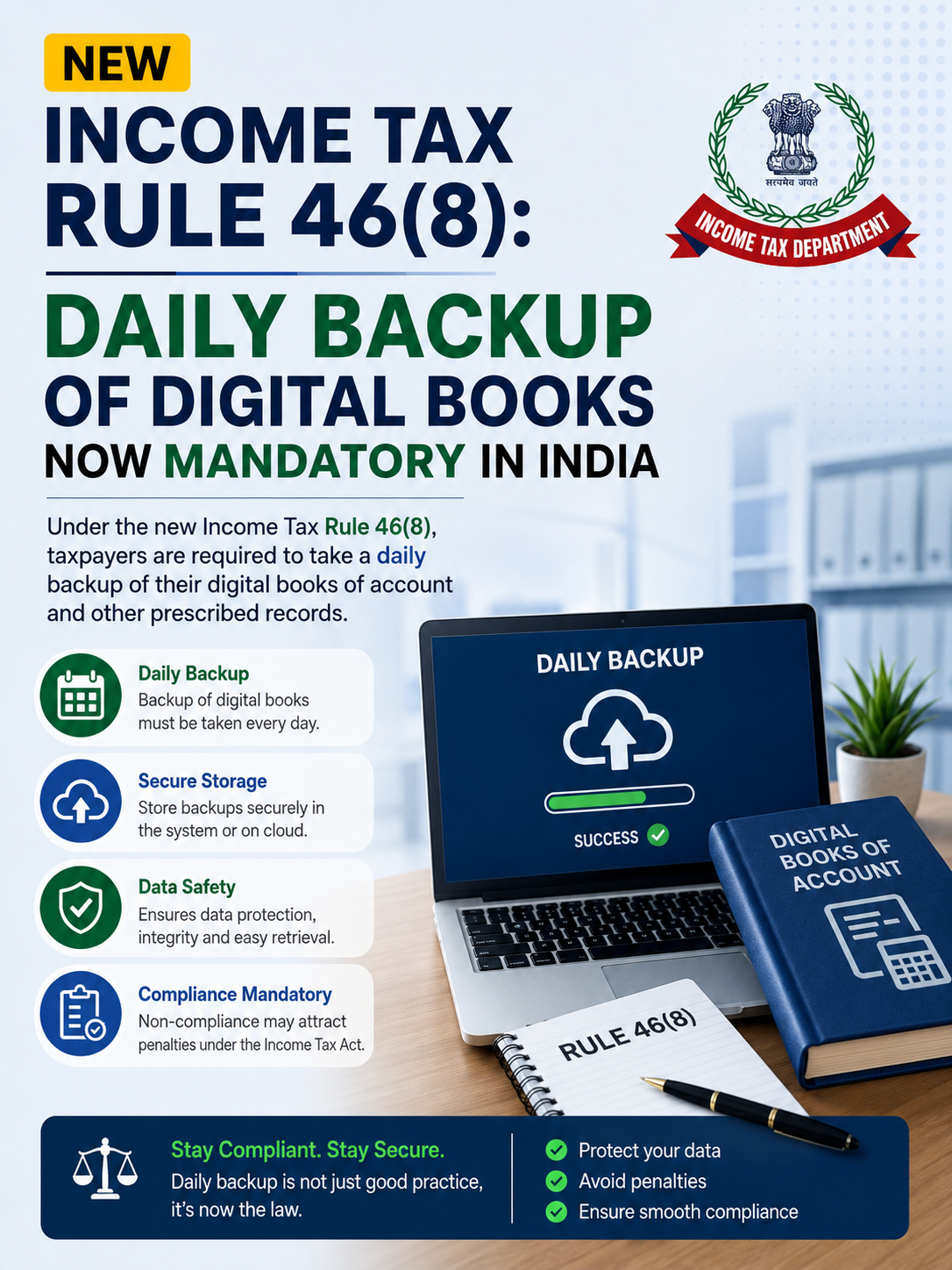
India’s tax and compliance ecosystem is changing rapidly, and businesses are now moving toward stricter digital record management. A major compliance update has emerged through Income Tax Rule 46(8), which introduces a significant requirement related to digital bookkeeping and record preservation. As businesses increasingly rely on accounting software, cloud systems, ERP platforms, and digital records, authorities are emphasizing secure and accessible data maintenance practices.
For companies, professionals, startups, traders, and enterprises maintaining books electronically, this update carries practical importance. Missing data, system failures, accidental deletion, cyberattacks, or poor backup practices can create serious compliance risks. Under the updated requirement, maintaining proper digital backups is no longer simply a best practice—it is becoming a critical compliance responsibility. Businesses using accounting systems should understand what this rule means, who may be affected, and what steps should be taken to avoid future legal and operational complications.
Understanding Income Tax Rule 46(8)
Rule 46(8) focuses on businesses and entities maintaining books of accounts in digital or electronic form. As accounting practices shift from paper-based records to software-driven systems, tax authorities increasingly expect records to remain secure, retrievable, and properly preserved.
Digital accounting records may include:
- Sales invoices
- Purchase entries
- Ledgers
- Journals
- Payment vouchers
- GST records
- Bank statements
- Inventory reports
- Audit files
- Financial statements
- Payroll data
- ERP records
- Electronic supporting documents
The primary objective is to ensure that electronic records remain available and verifiable whenever required during assessment, audit, scrutiny, or investigation proceedings.
Businesses often focus heavily on creating records but pay less attention to maintaining secure backup systems. When data loss occurs due to server crashes or accidental deletion, restoring complete records becomes difficult. This rule addresses that gap.
Why Daily Backup Requirements Are Becoming Important
Modern businesses operate almost entirely on digital systems. A small accounting error or sudden data loss can affect operations significantly.
Imagine a wholesale trader maintaining all records on a desktop system. One day, a hardware failure damages the hard drive. Years of invoices, ledger entries, and customer data disappear instantly.
Without proper backups, consequences may include:
- Delay in tax filings
- Audit complications
- Inability to produce records
- Financial reporting disruptions
- Compliance notices
- Increased legal risk
Data loss today is not only a technology problem—it can become a regulatory issue.
Daily backups help organizations reduce these risks.
The Growing Digital Transformation of Indian Businesses
Over the past few years, India has witnessed rapid digitization across sectors.
Businesses now commonly use:
- Cloud accounting software
- GST compliance tools
- ERP platforms
- Online banking integration
- Digital payment systems
- Inventory management software
- E-invoicing systems
- Automated accounting tools
Government initiatives and compliance systems have accelerated this transition.
Examples include:
- GST digitization
- E-invoicing
- Electronic audits
- Online tax filings
- Real-time reporting systems
As digital dependency increases, preserving records becomes equally important.
Who May Be Affected by Rule 46(8)?
The requirement could impact a wide range of entities maintaining electronic books of accounts:
Small businesses
Retail shops and local businesses increasingly use billing and accounting software.
Medium enterprises
Companies with inventory, payroll, and GST systems maintain large volumes of electronic records.
Chartered accountants and consultants
Professional firms handling client books digitally may also need structured backup systems.
Manufacturers
Manufacturing companies generate extensive accounting and inventory data daily.
Service companies
Consultancies and agencies often rely entirely on cloud-based records.
Startups
Most startups maintain digital books from the beginning.
Multi-location businesses
Organizations operating branches in different cities rely heavily on centralized digital systems.
The requirement is not limited to large corporations alone.
Common Risks Businesses Face Without Proper Backup Systems
Many organizations assume that having data on a computer automatically means it is safe.
That assumption often proves costly.
Common risks include:
Hardware failure
Storage devices eventually fail.
Ransomware attacks
Cybercriminals increasingly target business data.
Human error
Employees may accidentally delete files.
Software corruption
Applications sometimes damage data unexpectedly.
Natural disasters
Fire, flood, and other incidents can destroy physical systems.
Theft
Laptops and servers may be lost or stolen.
Daily backups create an additional safety layer.
What Businesses Should Do Immediately
Organizations should begin evaluating their current record management systems.
Key steps include:
Review current accounting setup
Identify where records are stored:
- Desktop systems
- Local servers
- Cloud systems
- External devices
Verify backup frequency
Many businesses back up weekly or monthly.
Daily backup systems offer stronger protection.
Check backup accessibility
Backups are useful only if restoration is possible.
Test recovery periodically.
Maintain multiple copies
Avoid storing backup data in only one location.
Examples:
- Local storage
- External drives
- Cloud storage
- Secondary servers
Define responsibility
Assign backup monitoring to specific personnel.
Importance of Cloud-Based Backup Systems
Cloud technology is becoming increasingly popular because of flexibility and accessibility.
Benefits include:
Automatic backups
No manual effort required.
Remote access
Data can be retrieved from multiple locations.
Reduced hardware dependency
Less reliance on local infrastructure.
Better security
Cloud providers often use advanced protection systems.
Disaster recovery support
Recovery becomes easier during emergencies.
However, businesses should also verify data security standards and provider reliability.
Role of Accounting Software in Backup Compliance
Modern accounting software increasingly provides built-in backup facilities.
Features may include:
- Scheduled backups
- Cloud synchronization
- Multi-user security
- Data restoration tools
- Audit tracking
- Automatic storage management
Businesses should review whether their existing systems support automated daily backup functionality.
This is particularly important for organizations handling large transaction volumes.
Practical Example
Suppose a distribution company processes:
- 400 invoices daily
- Inventory movements
- Banking entries
- GST data
- Payroll records
If system failure occurs and three days of data disappear, reconstruction can consume weeks.
The company may struggle during:
- GST reconciliation
- Tax audits
- Customer disputes
- Financial reporting
Daily backup systems dramatically reduce such risks.
Compliance Is No Longer Only About Tax Filing
Traditionally, businesses associated compliance primarily with:
- Filing returns
- Paying taxes
- Maintaining books
Today, compliance expectations are broader.
Authorities increasingly focus on:
- Data integrity
- Digital transparency
- Record accessibility
- Audit readiness
Businesses that treat record preservation seriously are likely to face fewer operational disruptions.
Building a Backup Policy
Organizations should create a formal backup policy covering:
Backup schedule
Specify timing and frequency.
Storage locations
Define where records will be stored.
Data retention period
Determine preservation timelines.
Security measures
Protect sensitive information.
Recovery testing
Verify backup usability periodically.
Accountability
Assign responsibilities clearly.
A documented process improves consistency.
Future of Digital Compliance in India
India’s compliance ecosystem continues evolving rapidly.
Businesses should expect greater emphasis on:
- Digital audits
- AI-driven verification
- electronic reporting
- cloud-based compliance
- automated tax systems
- secure record preservation
Future regulations may increasingly require organizations to maintain structured digital environments.
Organizations that prepare early may adapt more smoothly.
Conclusion
Income Tax Rule 46(8) highlights an important shift in India’s evolving digital compliance landscape. Maintaining books electronically brings convenience, automation, and efficiency, but it also creates responsibility. Businesses cannot rely solely on systems functioning perfectly every day.
Daily backup practices can protect organizations from operational disruptions, accidental data loss, cyber threats, and compliance risks. Whether a company is small or large, preserving accounting records securely should now become an essential part of routine business operations.
The focus is no longer simply on maintaining records—it is also about ensuring that records remain safe, accessible, and ready whenever required.
Frequently Asked Questions
Is this relevant only for large companies?
No. Businesses of various sizes maintaining electronic books may be affected.
Why is daily backup important?
Daily backup minimizes risk arising from data loss, cyberattacks, and technical failures.
Can cloud storage help?
Yes. Cloud-based systems often support automatic and secure backup functionality.
What records should be backed up?
Accounting records, invoices, ledgers, inventory data, tax records, and supporting documents should all be considered.
CA. Praneet Bansaal is a Chartered Accountant with experience in taxation, accounting controls, and financial process reviews. He has advised businesses on aligning inventory movement with accounting and GST requirements. His content focuses on compliance, accuracy, and long-term sustainability.