Call CA Tally HelpDesk
+91 9205471661,
7428779101
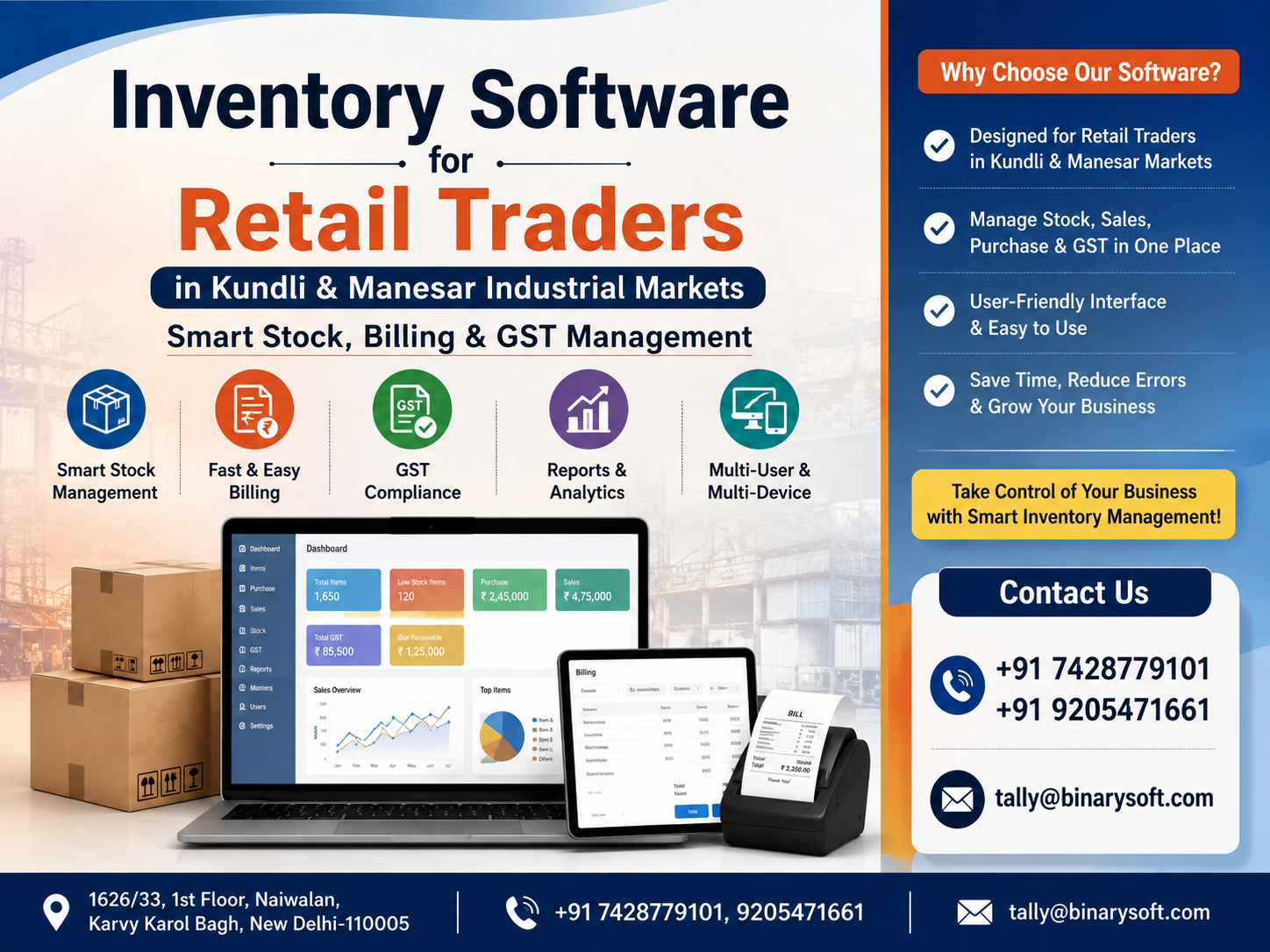
Retail Inventory Management Is Changing Fast in 2026
In 2026, retail traders operating in Kundli and Manesar industrial markets are dealing with a business environment where faster billing, tighter inventory control, accurate GST records, and instant access to financial information have become essential. Customers expect quicker service, businesses are handling more SKUs and suppliers, and even a small stock mismatch can lead to delayed orders, blocked working capital, or lost sales. At the same time, maintaining separate spreadsheets for purchases, sales, inventory, outstanding payments, and GST can make everyday operations unnecessarily complicated. This is why many growing traders are moving towards integrated inventory and accounting software such as TallyPrime. With billing, stock tracking, accounting, GST management, receivables, payables, and business reports connected in one system, retailers can reduce repetitive work and gain better visibility over their business. For traders in Kundli and Manesar, smarter inventory management can mean fewer stock surprises, faster decisions, and more controlled growth.
Why Inventory Software Matters for Retail Traders in Kundli and Manesar
Kundli and Manesar are important commercial and industrial locations in the Delhi-NCR and Haryana business ecosystem. Traders operating around industrial estates, manufacturing units, warehouses, retail markets, and distribution networks often deal with large product ranges and frequent movement of goods.
A retailer may purchase goods from several suppliers, maintain multiple product categories, sell to both regular and walk-in customers, offer different prices or discounts, and manage credit transactions.
When the number of daily transactions grows, maintaining these activities manually becomes difficult.
Modern inventory software can bring sales, purchases, stock, GST, accounting, and business reporting together. Instead of waiting until the end of the week or month to understand the position of the business, traders can access updated information whenever required.
Common Inventory Challenges Faced by Retail Businesses
Retail traders often experience inventory problems not because sales are poor, but because information is scattered.
For example, the physical stock available in a warehouse may differ from the quantity recorded in a spreadsheet. A salesperson may promise an item to a customer without knowing that the last few units have already been sold. Another product may remain in storage for months while new quantities continue to be purchased.
Typical challenges include:
- Difficulty knowing the actual available stock
- Over-purchasing slow-moving products
- Running out of fast-selling products
- Maintaining separate billing and stock records
- Tracking customer outstanding amounts
- Managing supplier payments
- Monitoring multiple godowns or storage locations
- Preparing GST-related transaction records
- Finding old invoices quickly
- Identifying profitable and slow-moving product categories
- Managing returns and stock adjustments
- Tracking purchase and sales transactions accurately
An integrated inventory management system can help reduce these problems by maintaining connected records.
A Kundli Trader's Story: The Order That Almost Went Away
Consider the example of a growing electrical and industrial supplies trader operating near Kundli.
For years, the business had relied on notebooks, spreadsheets, and the owner's memory. The system worked when the shop was small. The owner knew most customers personally and could almost remember where every important product was stored.
Then the business expanded.
More suppliers were added. The number of stock items increased. Orders started arriving through phone calls and WhatsApp along with counter sales.
One afternoon, an important customer urgently needed several units of an industrial component. The spreadsheet showed sufficient stock, so the trader confirmed the order.
But when the warehouse staff checked the shelves, the required quantity wasn't there.
Some units had already been sold, but the spreadsheet had not been updated.
The customer was frustrated and began contacting another supplier.
For the owner, the painful part wasn't simply losing an order. It was realizing that the business had grown beyond the system being used to manage it.
After moving towards integrated billing and inventory management, every properly recorded purchase and sale began contributing to updated stock information. The owner could check inventory before committing to an order.
The biggest change wasn't just faster billing.
It was confidence.
Instead of wondering, "Do we have enough stock?" the business could make decisions using its records.
That is the practical value of inventory software for a growing retail trader.
Smart Stock Management with TallyPrime
TallyPrime can help businesses maintain inventory information alongside their accounting and billing processes.
Traders can create stock items according to their product range and organize them into appropriate stock groups and categories.
For example, an industrial retail business might maintain products under categories such as:
Electrical Components
Industrial Hardware
Safety Equipment
Tools and Accessories
Packaging Material
Machine Components
Consumables
Spare Parts
A structured inventory system makes it easier to review available stock and analyze product movement.
Real-Time Visibility of Stock
One of the biggest benefits of computerized inventory management is improved stock visibility.
When sales and purchases are entered correctly, inventory records can reflect the movement of goods through the business.
A trader can review questions such as:
What products are currently available?
Which items are running low?
Which products have accumulated excess stock?
How much stock is available at a particular location?
Which items are moving faster than others?
This information can support better purchasing decisions.
Instead of ordering products only because a supplier calls with an offer, traders can examine their current inventory position before committing working capital.
Better Billing for Busy Retail Counters
Billing speed matters in retail.
Customers do not want to wait while staff search through registers, manually calculate totals, or repeatedly verify tax details.
With a properly configured billing and accounting system, businesses can maintain item details, quantities, rates, taxes, customer information, and transaction records in a more organized manner.
This is particularly useful for businesses handling a high volume of invoices.
Efficient billing also improves the customer experience. Faster transaction processing can reduce queues and allow staff to focus more on customers rather than repetitive calculations.
GST Management Alongside Business Transactions
GST compliance is closely connected with sales, purchases, invoices, and accounting records.
When businesses maintain separate systems for billing, inventory, and accounting, reconciliation can become more complicated.
TallyPrime allows businesses to maintain GST-related transaction information within their accounting workflow when it is configured and used correctly.
This can help traders maintain structured records for:
Sales
Purchases
Taxable transactions
GST invoices
Input tax-related information
Output tax-related information
Returns and adjustments
GST reports
The benefit is not simply compliance. Better transaction records can also reduce the time spent searching for information when accountants or business owners need to review a transaction.
Purchase Management and Supplier Control
Inventory management starts before products reach the shelves.
Retailers need visibility over what they are purchasing, from whom, at what rate, and how much they owe suppliers.
Purchase records can help traders analyze supplier transactions and understand the relationship between purchasing and inventory.
This becomes particularly important for businesses in industrial markets where the same product may be available from multiple suppliers at different prices.
Better records can help management compare purchasing patterns and make informed procurement decisions.
Customer Receivables and Credit Sales
Many retail and industrial traders do not operate entirely on cash or immediate digital payments.
Regular customers may receive goods on credit.
As the customer base expands, outstanding balances can become difficult to track manually.
Accounting software can help maintain customer ledgers and transaction histories so businesses can review receivables systematically.
This helps answer important questions:
Which customers have outstanding balances?
How much is currently receivable?
Which invoices remain unpaid?
How old are the outstanding transactions?
Better receivables visibility can support healthier cash-flow management.
Managing Multiple Godowns and Storage Locations
Retail businesses in Kundli and Manesar may maintain a shop, warehouse, back-office storage area, or multiple stock locations.
Without location-wise inventory tracking, employees may know that a product exists somewhere but not know exactly where it is available.
Godown or location-based inventory management can help businesses organize stock according to where goods are stored.
For example:
Main Shop
Kundli Warehouse
Manesar Warehouse
Secondary Godown
Returns Stock
This can make internal stock management more systematic.
Avoiding Over-Stocking
More stock does not always mean more profit.
Inventory occupies working capital.
If a trader purchases ₹5 lakh worth of products that remain unsold for months, that money cannot easily be used for other business requirements.
Excess inventory can also create storage costs, damage risks, obsolescence, and discounting pressure.
Inventory reports can help businesses identify products that are accumulating and review their purchasing strategy.
Reducing Stock-Out Situations
The opposite problem is equally serious.
Imagine that a particular component sells consistently every week. If the trader notices the shortage only when a customer places an order, the sale may be lost.
Good inventory visibility allows businesses to review stock levels regularly and plan replenishment more effectively.
For retailers competing in busy markets, product availability can directly affect customer loyalty.
A buyer who repeatedly hears "out of stock" may eventually shift to another supplier.
Stock Valuation and Financial Visibility
Inventory represents money invested in goods.
Therefore, understanding stock value is important for financial management.
A business owner should ideally be able to understand not only the quantity of products available but also their financial impact.
When inventory and accounting records work together, management gets a more complete picture of business operations.
This can support discussions with accountants, management teams, partners, and financial advisers.
Sales Analysis for Better Business Decisions
Retail software should do more than create invoices.
The information generated through daily transactions can help businesses understand sales patterns.
Management can review sales by product, customer, period, or other available reporting dimensions depending on the system configuration.
This can reveal valuable patterns.
For example, a trader may discover that a product with a high sales quantity provides a relatively small margin, while another product with fewer transactions contributes significantly to profitability.
Such information can influence purchasing, pricing, promotions, and inventory planning.
Faster Access to Business Reports
One major problem with manual records is that preparing a report itself becomes a project.
The owner may ask:
"How much did we sell this month?"
Staff members then begin collecting spreadsheets and checking registers.
With properly maintained digital records, many business reports can be accessed much faster.
This enables business owners to spend less time collecting data and more time interpreting it.
Better Control Over Retail Operations
As businesses expand, owners cannot personally supervise every transaction.
A structured software environment creates greater operational discipline.
Sales need to be entered.
Purchases need to be recorded.
Stock movements need to be documented.
Payments and receipts need to be accounted for.
When processes become systematic, the business becomes less dependent on one person's memory.
This is particularly important for family businesses and growing retail enterprises preparing to expand into additional locations.
Why Kundli Retail Traders Need Scalable Inventory Management
Kundli's proximity to Delhi and surrounding industrial areas makes it a strategic location for traders, manufacturers, distributors, and logistics-driven businesses.
A retailer serving industrial customers may begin with a few hundred products but gradually expand to thousands of stock items.
The software selected today should therefore support the business as transaction volumes increase.
Moving away from disconnected spreadsheets can create a stronger foundation for future expansion.
Why Manesar Businesses Need Integrated Billing and Stock Control
Manesar is home to a significant industrial and commercial ecosystem.
Businesses supplying manufacturers, offices, workshops, factories, contractors, and other enterprises may need to process frequent orders while maintaining accurate inventory information.
For these traders, billing cannot remain separate from stock management.
Every sale affects inventory.
Every purchase affects inventory.
Every return can affect inventory.
And every credit transaction affects accounts.
An integrated system connects these activities and provides a clearer operational picture.
Inventory Software vs Spreadsheet-Based Management
Spreadsheets remain useful for many business activities, but they can become difficult to control when several employees repeatedly update stock, sales, purchases, and customer information.
Manual spreadsheet processes may involve:
Multiple versions of the same file
Accidental deletion of formulas
Delayed stock updates
Duplicate entries
Difficulty tracking historical transactions
Manual GST calculations
Limited integration with accounting
A dedicated business management system can create a more structured transaction workflow.
How TallyPrime Can Support Retail Traders
Depending on configuration and business requirements, TallyPrime can support important areas such as:
Sales invoicing
Purchase recording
Inventory management
Stock groups and stock items
Godown management
Accounting
Receivables and payables
GST-related transaction management
Cash and bank transactions
Business reports
Financial statements
Inventory reports
The objective is to bring important business information into a connected environment rather than maintaining unrelated records across multiple systems.
A Practical Daily Workflow
A retail trader can follow a structured workflow.
When goods arrive from a supplier, the relevant purchase transaction is recorded.
Inventory information is updated according to the transaction.
When products are sold, the sales invoice is created and the stock movement is recorded.
If the sale is on credit, the customer account reflects the transaction.
When payment is received, the receipt can be recorded.
At the end of the day, management can review sales, cash, bank transactions, stock, receivables, and other relevant reports.
This creates a continuous flow of business information.
How Smart Inventory Management Supports Cash Flow
Cash flow and inventory are closely connected.
Purchasing too much inventory can block cash.
Purchasing too little can reduce sales.
Poor receivables management can further increase pressure on working capital.
By reviewing stock, purchases, sales, receivables, and payables together, business owners can make more balanced decisions.
For example, instead of purchasing 100 additional units simply because the supplier offers a discount, the owner can first examine existing stock and recent sales patterns.
That is a much more informed approach to purchasing.
Preparing Your Business for Growth
A growing business needs processes that can scale.
Retailers planning to add more products, customers, employees, warehouses, or sales volume should consider whether their current management system can handle that growth.
The right time to improve inventory processes is often before the existing system becomes unmanageable.
Digital inventory and accounting management can provide a stronger operational foundation for expansion.
Choosing Inventory Software for Your Retail Business
Before implementing inventory software, retail traders should consider their actual operational requirements.
Important factors include:
Number of stock items
Daily transaction volume
Number of users
GST requirements
Number of stock locations
Credit sales volume
Supplier network
Reporting requirements
Accounting requirements
Future business expansion
Instead of selecting software only on the basis of price, traders should evaluate how well it fits their everyday business workflow.
Implementation and Training Are Equally Important
Purchasing software alone does not solve inventory problems.
Proper implementation matters.
Stock items should be created logically. Opening quantities should be verified. Customer and supplier ledgers should be structured correctly. GST settings should reflect applicable business requirements.
Employees also need appropriate training.
If staff continue maintaining unofficial spreadsheets while only partially using the main software, inventory differences may continue.
A successful implementation therefore requires both the right technology and disciplined usage.
Powered by Binarysoft Technologies
Binarysoft Technologies provides Tally-related solutions and support for businesses looking to improve accounting, inventory, billing, and GST management.
As an Authorized Tally Partner, Binarysoft Technologies can assist businesses in understanding suitable Tally solutions based on their operational requirements.
Retail traders in Kundli, Manesar, Delhi-NCR, Haryana, and other business locations can discuss requirements relating to Tally licensing, implementation, inventory management, billing, GST configuration, and business process support.
Binarysoft Technologies
Authorized Tally Partner
Location:
1626/33, 1st Floor, Naiwalan, Karol Bagh,
New Delhi – 110005, INDIA
Contact us:
+91 7428779101
+91 9205471661
Email:
tally@binarysoft.com
Business Hours:
10:00 AM – 6:00 PM, Monday to Friday
Conclusion
Retail businesses in Kundli and Manesar are operating in an environment where speed, inventory visibility, GST-ready records, and financial control are increasingly important.
As the number of products, suppliers, customers, invoices, and credit transactions grows, manual inventory management can become a serious operational limitation.
A properly implemented inventory and accounting solution such as TallyPrime can help connect billing, purchases, stock movement, accounting, receivables, payables, GST-related records, and business reporting.
For retailers, the real advantage is not simply replacing a register or spreadsheet with software. It is gaining clearer visibility into what is happening inside the business.
Knowing what is available, what is selling, what needs replenishment, what customers owe, what suppliers need to be paid, and how the business is performing can lead to faster and better-informed decisions.
For retail traders in Kundli and Manesar industrial markets looking to build more organized and scalable operations in 2026, integrated inventory management can be an important step towards smarter business control.
Frequently Asked Questions
What is the best inventory software for retail traders in Kundli?
The right inventory software depends on the size and requirements of the business. Retailers requiring integrated accounting, inventory, billing, GST-related transaction management, receivables, payables, and reporting can consider TallyPrime based on their operational needs.
Can TallyPrime manage stock and billing together?
Yes. TallyPrime supports inventory and accounting-related business processes, allowing sales and purchase transactions to be connected with inventory records when the system is configured appropriately.
CA. Pankaj Bhadoria brings practical experience in GST, accounting, and business process consulting. He works closely with MSMEs to resolve compliance challenges and improve operational transparency. His articles aim to simplify complex regulations for everyday business use.