Call CA Tally HelpDesk
+91 9205471661,
7428779101
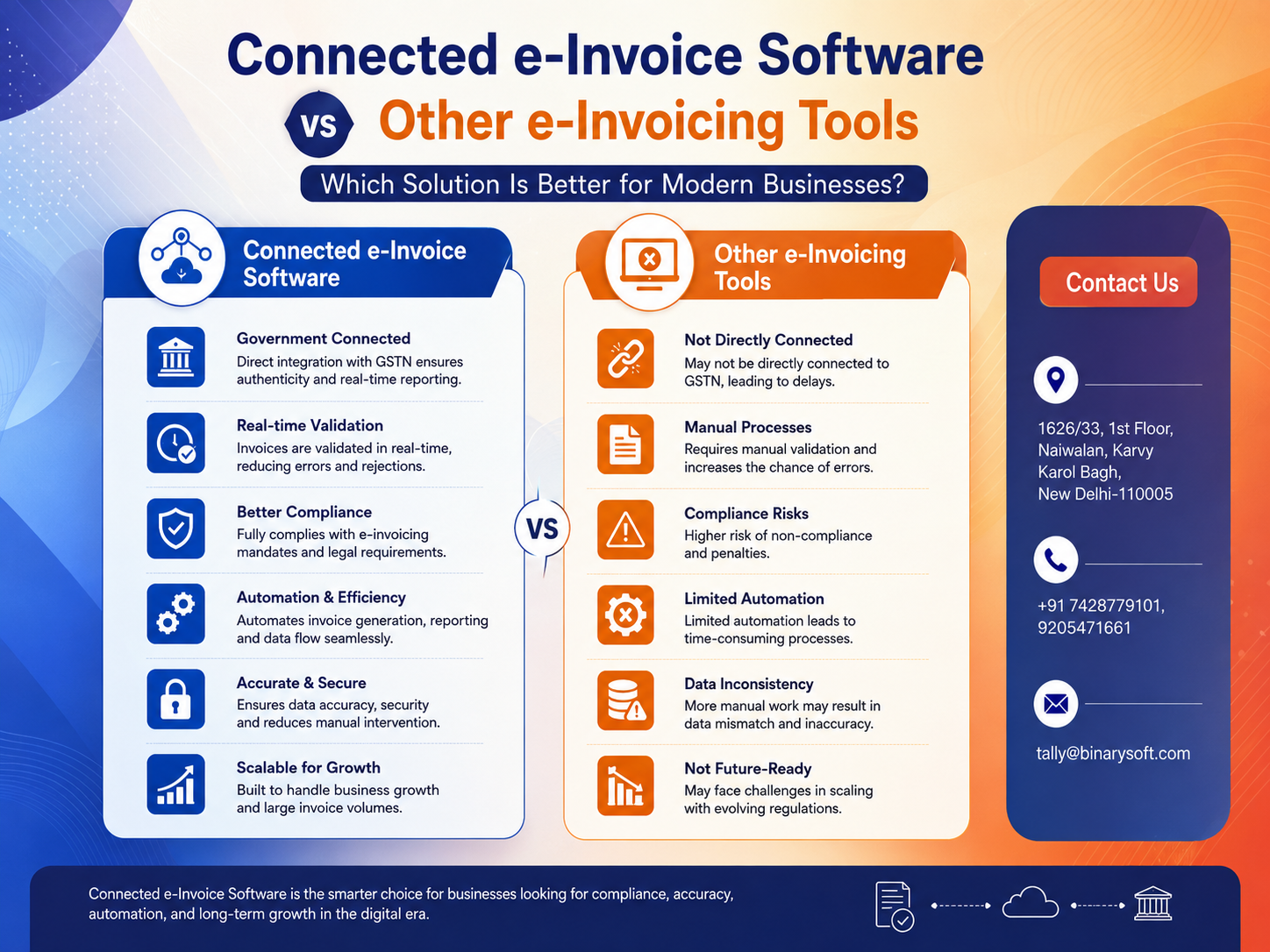
The way Indian businesses handle invoicing has changed dramatically over the last few years. With GST compliance becoming increasingly digital and e-invoicing now mandatory for a growing number of businesses, companies can no longer rely on manual billing processes or disconnected software. In 2026, businesses are expected to generate invoices faster, maintain accurate records, and comply with evolving GST regulations—all while keeping operational costs under control. This shift has encouraged many organizations to move away from standalone e-invoicing utilities and adopt connected e-invoice software that integrates billing, accounting, inventory, and GST compliance into a single platform.
Consider the story of a wholesale distributor who once managed invoices through spreadsheets and a separate e-invoicing portal. Every invoice required manual uploads, downloading IRNs, updating accounting records, and reconciling GST data. During peak business seasons, small errors resulted in delayed shipments and unnecessary compliance concerns. After switching to an integrated connected e-invoice solution, invoice generation became nearly effortless, accounting entries were created automatically, inventory updated in real time, and GST reports remained accurate without repetitive work. The business not only saved hours every week but also improved customer satisfaction by delivering invoices instantly.
As businesses continue embracing automation, the question arises:
Should you choose Connected e-Invoice Software or continue using standalone e-Invoicing tools?
Let's understand the differences in detail.
Understanding e-Invoicing in India
Under the GST framework, eligible businesses must generate invoices that are authenticated through the Invoice Registration Portal (IRP). Once invoice details are submitted, the system generates:
- Invoice Reference Number (IRN)
- Digitally signed QR Code
- Authenticated invoice details
The authenticated invoice becomes legally valid for applicable B2B transactions.
Businesses generally follow one of two approaches:
- Connected e-Invoice Software
- Standalone e-Invoicing Utilities
Although both methods ultimately generate valid e-invoices, the workflow, efficiency, automation, and scalability differ significantly.
What Is Connected e-Invoice Software?
Connected e-Invoice Software integrates directly with the Invoice Registration Portal while also connecting with your accounting, inventory, taxation, and business management system.
Instead of generating invoices in one application and uploading them elsewhere, the software performs every step within a single workflow.
Typically, it allows users to:
- Create invoice
- Validate invoice
- Generate IRN
- Fetch QR Code
- Update accounting entries
- Update inventory
- Prepare GST reports
- Generate e-Way Bill where applicable
—all from one interface with minimal manual effort.
What Are Standalone e-Invoicing Tools?
Standalone tools are designed only for generating e-invoices.
These may include:
- Offline utilities
- JSON generators
- Excel-based upload tools
- Government portal uploads
- Third-party invoice converters
In this approach, users often:
- Prepare invoices separately
- Export data
- Upload JSON manually
- Download IRN
- Update accounting manually
- Maintain inventory separately
While functional for low invoice volumes, this process becomes increasingly time-consuming as business grows.
Connected e-Invoice Software vs Standalone Tools
1. Automation
Connected Software
Almost every step is automated.
Invoice creation automatically triggers:
- IRN generation
- QR Code generation
- Accounting entries
- GST records
- Inventory updates
Minimal human intervention is required.
Standalone Tools
Most activities require manual work.
Users often repeat the same data entry across multiple systems.
Winner: Connected Software
2. Speed of Invoice Processing
Modern businesses cannot afford invoice delays.
Connected software generates compliant invoices almost instantly because communication with the IRP happens automatically.
Standalone utilities require:
- Exporting data
- Uploading files
- Downloading responses
- Updating invoices manually
For organizations issuing hundreds of invoices daily, this difference is substantial.
3. Data Accuracy
Manual work increases the possibility of:
- Wrong GSTIN
- Incorrect invoice numbers
- Tax mismatches
- Duplicate entries
- Missing IRNs
Connected software eliminates repetitive data entry since information flows automatically across modules.
This significantly improves invoice accuracy.
4. GST Compliance
Compliance is one of the biggest advantages of integrated software.
Connected systems help businesses remain compliant by:
- Validating GST details
- Creating compliant invoices
- Maintaining audit trails
- Synchronizing GST reports
- Reducing reconciliation errors
Standalone tools usually require additional checking before filing returns.
5. Inventory Integration
Businesses dealing with products require inventory management.
Connected solutions automatically:
- Reduce stock
- Update warehouse balances
- Record batch information
- Track item movement
Standalone utilities generally do not offer inventory synchronization.
6. Accounting Integration
One of the biggest strengths of connected software is integrated accounting.
Once an invoice is generated:
- Sales ledger updates
- Customer balance updates
- GST liability updates
- Profit reports refresh automatically
Standalone e-invoicing software often requires accountants to post entries separately.
7. Business Scalability
As companies grow:
- Invoice volume increases
- Customers increase
- Branches expand
- Compliance requirements multiply
Connected software easily scales with growing business operations.
Standalone solutions become difficult to manage because manual work also increases proportionally.
8. Error Reduction
Errors are expensive.
Incorrect invoices may result in:
- Customer complaints
- Delayed payments
- GST mismatches
- Compliance notices
Connected software minimizes errors by validating invoice information before submission and automatically updating related business records.
9. Reporting and Business Insights
Connected software provides real-time dashboards for:
- Sales
- Outstanding receivables
- GST liability
- Inventory
- Profitability
- Customer reports
Standalone utilities usually focus only on invoice generation and offer limited reporting capabilities.
10. Cost Effectiveness
Many businesses assume standalone tools are cheaper.
However, the hidden costs include:
- Employee time
- Duplicate data entry
- Human errors
- Compliance corrections
- Multiple software subscriptions
Connected software often delivers better long-term value by reducing operational costs and improving productivity.
Which Businesses Benefit Most from Connected e-Invoice Software?
Connected solutions are ideal for:
- Manufacturers
- Wholesalers
- Distributors
- Retail chains
- Trading companies
- Service providers
- Multi-location businesses
- Growing SMEs
- Exporters
Businesses handling a large number of invoices gain the greatest benefits through automation and integrated workflows.
Situations Where Standalone Tools May Still Work
Standalone utilities may still be suitable for:
- Very small businesses
- Occasional invoice generation
- Businesses issuing only a handful of B2B invoices
- Temporary compliance requirements
However, as invoice volumes increase, these tools often become inefficient due to repetitive manual processes.
Why Connected Software Is Becoming the Preferred Choice
Modern businesses expect software to do more than generate invoices.
They want a solution that can:
- Simplify accounting
- Improve GST compliance
- Reduce manual work
- Automate business operations
- Improve decision-making
- Support future business growth
Connected e-Invoice Software meets these expectations by integrating invoicing with accounting, inventory, and statutory compliance in one ecosystem. This reduces complexity, improves operational efficiency, and enables businesses to focus more on growth than administrative tasks.
Best Practices for Choosing an e-Invoicing Solution
Before selecting any software, evaluate whether it offers:
- Seamless IRP integration
- Automatic IRN and QR code generation
- GST compliance updates
- Inventory management
- Accounting integration
- e-Way Bill support
- Real-time reports
- Secure data handling
- Scalability
- Reliable customer support
Choosing a solution with these capabilities helps reduce manual intervention and supports long-term business efficiency.
Conclusion
Choosing between Connected e-Invoice Software and standalone e-Invoicing tools ultimately depends on your business size, invoice volume, and operational needs. While standalone tools may suit businesses with minimal invoicing requirements, they often require repeated manual work and separate management of accounting, inventory, and GST compliance.
Connected e-Invoice Software, on the other hand, provides a unified business management experience by automating invoice generation, integrating with accounting and inventory, ensuring GST compliance, and minimizing errors. As businesses continue to embrace digital transformation in 2026, connected solutions are increasingly becoming the preferred choice for organizations seeking higher productivity, improved compliance, and scalable operations.
Frequently Asked Questions
What is Connected e-Invoice Software?
It is an integrated solution that generates GST-compliant e-invoices while automatically connecting invoicing with accounting, inventory, and compliance processes.
How is Connected e-Invoice Software different from standalone e-Invoicing tools?
Connected software automates the complete invoicing workflow and integrates with business operations, whereas standalone tools mainly focus on generating e-invoices and often require manual data transfers.
CA. Atharv Nambiar provides advisory services in accounting, audit, and taxation. He shares practical guidance on financial reporting, business controls, and technology adoption for modern organizations.