Call CA Tally HelpDesk
+91 9205471661,
7428779101
Manufacturing Businesses Are Changing Fast in 2026
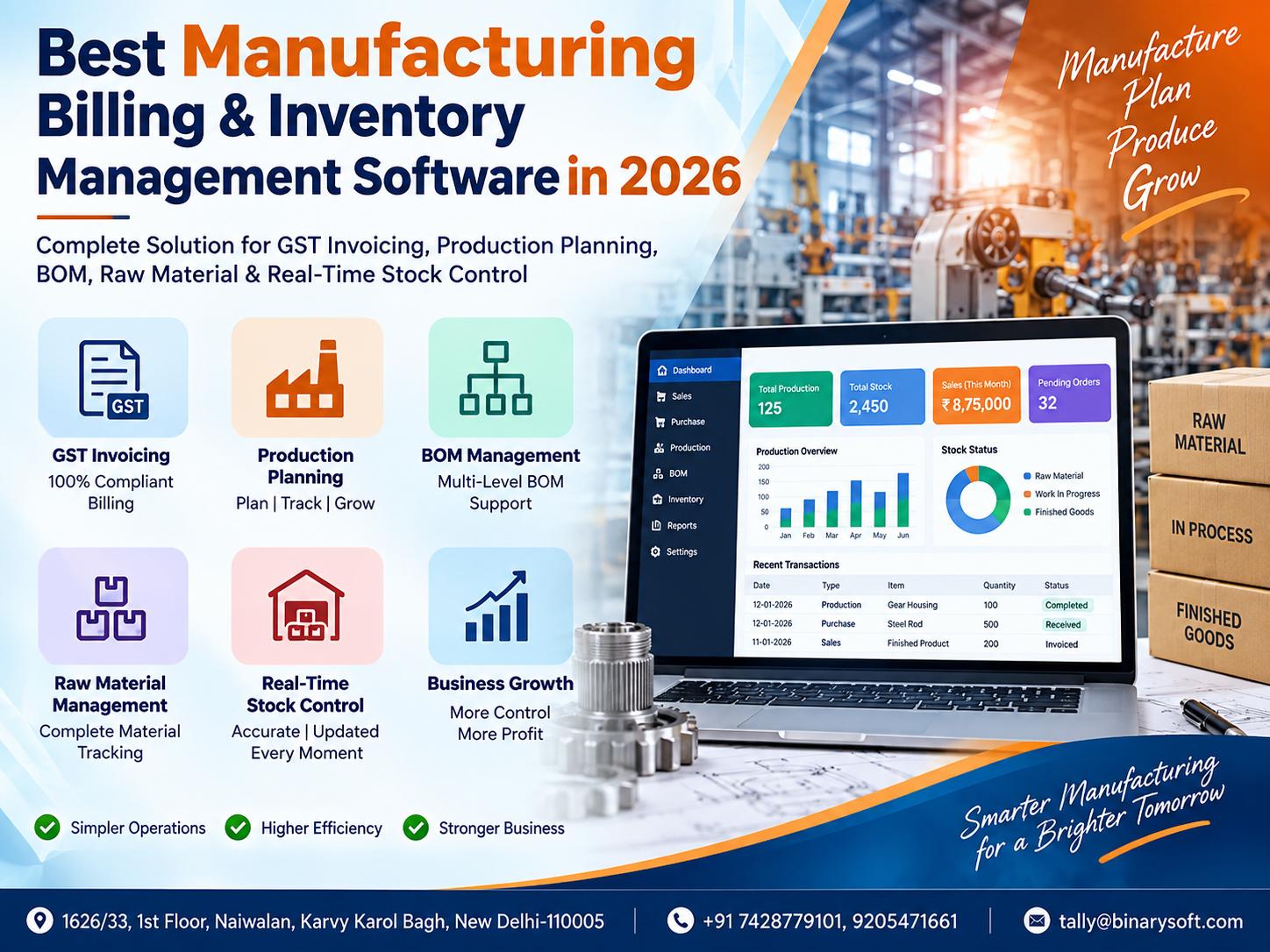
In 2026, manufacturing businesses are under growing pressure to produce faster, control costs, maintain accurate inventory and complete GST-compliant billing without depending on disconnected spreadsheets and manual registers. What has changed in recent months is the increasing need for real-time visibility across raw materials, production, finished goods, sales, purchases and accounts. A small stock error can delay an entire production cycle, while an incorrect invoice or outdated inventory figure can affect cash flow and customer commitments. This is why manufacturers are increasingly looking for integrated manufacturing billing and inventory management software. The right solution connects GST invoicing, production planning, Bill of Materials (BOM), raw-material consumption, finished-goods tracking and accounting in one workflow. Instead of discovering shortages after production stops, businesses can identify requirements earlier, reduce wastage, improve planning and make faster decisions using reliable business data.
Why Manufacturing Businesses Need More Than Basic Billing Software
Manufacturing is fundamentally different from ordinary trading.
A trader generally purchases finished products, stores them and sells them. A manufacturer, however, purchases raw materials and converts them into finished products through one or more production processes.
This means manufacturers need to answer questions such as:
How much raw material is currently available?
How much material is required for the next production order?
Which raw materials are being consumed faster than expected?
What is the standard Bill of Materials for each finished product?
How many units are currently under production?
How many finished units are ready for dispatch?
What is the cost of manufacturing each unit?
Are there unexpected production losses or wastage?
What stock needs to be reordered?
Which finished products are generating the highest sales?
Are GST invoices being generated correctly?
When billing, inventory, production and accounting are maintained separately, getting reliable answers to these questions becomes difficult.
A modern manufacturing billing and inventory management solution helps connect these operations.
From Raw Material Purchase to Final Invoice: One Connected Workflow
An efficient manufacturing system should provide visibility across the complete operational cycle.
A typical workflow may look like:
Raw Material Purchase
→ Goods Receipt
→ Raw Material Inventory
→ Production Planning
→ Material Issue
→ Bill of Materials
→ Manufacturing / Production
→ Finished Goods Entry
→ Quality or Quantity Verification
→ Warehouse / Godown Stock
→ Sales Order
→ GST Invoice
→ Dispatch
→ Accounting
→ Outstanding Payment Tracking
→ Business Reports
When these activities are connected, information does not have to be entered repeatedly into different registers or spreadsheets.
This can reduce duplicate work and make stock and financial information more consistent.
GST Invoicing for Manufacturing Businesses
GST billing is an important part of manufacturing operations.
Manufacturers may handle local sales, interstate transactions, B2B supplies, B2C transactions, exports, job work and other types of taxable supplies depending on their business model.
Manufacturing billing software should make it easier to maintain information such as:
GSTIN
Customer details
HSN/SAC information
Taxable value
CGST
SGST
IGST
Discounts
Freight and additional charges
Invoice numbers
Credit and debit notes
Sales returns
Purchase transactions
The goal is not simply to print an invoice.
The billing transaction should also update accounts and inventory wherever applicable.
For example, when 100 units of a finished product are sold, the finished-goods stock should reflect the movement without requiring someone to manually reduce the same quantity in another spreadsheet.
Production Planning: Know What You Need Before Production Starts
Production planning is one of the biggest challenges for growing manufacturing companies.
Suppose a business receives an order for 5,000 finished units.
Before accepting a delivery commitment, management may need to know whether sufficient raw material, components and packaging material are available.
If the business does not have reliable inventory information, employees may manually check warehouses or call different departments.
That takes time.
With structured inventory and production information, businesses can plan requirements more efficiently.
Production planning can help management understand:
Current finished-goods availability
Raw-material availability
Expected production quantity
Material requirements
Shortage quantities
Pending purchase requirements
Production schedules
Expected completion
Finished-goods requirements
This improves coordination between sales, stores, purchasing, production and accounts.
Bill of Materials (BOM): The Foundation of Manufacturing Inventory
A Bill of Materials, commonly called BOM, defines the materials and quantities normally required to manufacture a finished product.
For example, imagine a manufacturer producing 1 unit of Product A.
Its BOM might include:
2 units of Component X
4 units of Component Y
1.5 kg of Raw Material Z
1 unit of Packaging Material P
Once the BOM is properly defined, the business has a structured reference for material requirements.
For 100 units of Product A, the expected requirement can then be calculated from the defined quantities.
This becomes particularly valuable when a manufacturer produces dozens or hundreds of different products.
Why BOM Management Matters
Without a controlled BOM structure, material consumption can become difficult to monitor.
Employees may rely on handwritten notes, memory or old spreadsheets.
This can create inconsistencies between planned and actual consumption.
Proper BOM management can help businesses:
Standardize production recipes or component structures
Estimate material requirements
Monitor consumption
Identify excessive usage
Control production costs
Improve purchasing decisions
Reduce unnecessary stock
Compare expected versus actual consumption
For manufacturers working with multiple components, BOM management can become a central part of inventory control.
Raw Material Management: Avoid Production Delays
Imagine having a large customer order ready for production, workers available and machines scheduled—but production cannot begin because one small component is unavailable.
This is a common manufacturing problem.
The missing item may represent only a small percentage of the product's overall cost, but without it, the entire production schedule can be disrupted.
Real-time raw-material management helps businesses understand what is available before production begins.
Businesses can monitor:
Opening stock
Purchases
Material issued to production
Material returned
Consumption
Wastage
Closing stock
Reorder requirements
Godown-wise availability
Batch-wise availability where relevant
Accurate raw-material information allows purchasing teams to plan procurement before shortages become urgent.
A Manufacturer's Story: The Order That Almost Missed Its Deadline
A growing manufacturer had received one of its most important orders of the year.
The customer wanted a large quantity delivered within a tight deadline. The sales team confirmed the order because the spreadsheet showed enough raw material in stock.
Production began confidently.
Two days later, the production supervisor discovered something worrying.
The physical quantity of a critical component was significantly lower than the spreadsheet quantity.
Some previous consumption entries had never been updated.
Production slowed. The purchasing team urgently contacted suppliers. The customer kept asking whether the dispatch date would be met.
For the owner, the problem was not simply a missing component. Years of effort had gone into earning that customer's trust, and one delayed order could damage the relationship.
Afterwards, the business moved toward an integrated inventory and production workflow.
The biggest improvement was visibility.
Instead of asking, “How much material do we think we have?” the team could work from updated inventory records and plan production accordingly.
That confidence can be as valuable as the software itself.
Real-Time Stock Control for Better Decision-Making
Inventory is money sitting inside a business.
Too little inventory can stop production.
Too much inventory can block working capital.
Manufacturers therefore need a balance between availability and investment.
A good inventory management system can help track:
Raw materials
Semi-finished goods
Finished goods
Consumables
Packaging material
Spare parts
Rejected material
Returned material
Location-wise stock
Batch-wise stock where required
Management can then review inventory more systematically instead of waiting for month-end physical reports.
Multi-Godown and Warehouse Inventory Management
Manufacturers may maintain inventory across several locations.
For example:
Factory Store
Raw Material Warehouse
Production Floor
Finished Goods Warehouse
Dispatch Area
Branch Warehouse
Job Worker Location
Without location-wise inventory tracking, the company may know that 500 units exist somewhere in the organization but still struggle to identify exactly where those units are available.
Godown-wise inventory management helps maintain clearer visibility of stock location.
It can also support internal stock transfers and improve warehouse planning.
Production Consumption and Finished Goods Tracking
Manufacturing inventory should ideally reflect the transformation of raw material into finished goods.
For example, when a production transaction is recorded, the system may need to account for:
Raw materials consumed
Components consumed
Finished quantity produced
By-products
Scrap
Wastage
Production variance
The exact workflow depends on the manufacturing process and software configuration.
The key objective is to create traceability between input materials and output quantities.
Reduce Inventory Leakage and Unexplained Stock Differences
Inventory differences can arise from many sources:
Incorrect entries
Unrecorded material issues
Wrong units of measurement
Production wastage
Damaged stock
Material returns not entered
Duplicate entries
Incorrect purchase quantities
Manual adjustments
When these problems accumulate, the stock shown in the system can become very different from physical stock.
Structured manufacturing inventory processes can make it easier to identify unusual differences and investigate them earlier.
Purchase Management for Manufacturing
Manufacturing purchasing should be driven by actual requirements wherever possible.
Purchasing too early increases inventory carrying costs.
Purchasing too late creates production shortages.
A connected system can help purchasing teams review:
Current stock
Pending production requirements
Purchase orders
Pending receipts
Supplier information
Reorder levels
Historical consumption
Material requirements
Outstanding supplier payments
This helps shift procurement from emergency purchasing toward planned purchasing.
Sales Order and Dispatch Management
The manufacturing process does not end when production is completed.
Finished goods must eventually reach the customer.
Sales and dispatch workflows may involve:
Customer quotation
Sales order
Order confirmation
Finished stock verification
Production requirement
Packing
GST invoice
E-Invoice where applicable
E-Way Bill where applicable
Dispatch documentation
Transport details
Outstanding tracking
Connecting sales orders with inventory can help sales teams avoid promising quantities that are not actually available.
E-Invoice and E-Way Bill Integration
Eligible businesses may also need to handle electronic compliance requirements such as E-Invoicing and E-Way Bills under applicable GST rules.
Instead of repeatedly entering invoice information into separate systems, compatible accounting and billing solutions can simplify the workflow.
Businesses should configure these features according to their current statutory applicability and verify compliance requirements with their tax professionals.
This is particularly useful for manufacturers processing a large number of dispatches.
Manufacturing Accounting in the Same Business System
Manufacturing is not only about quantities.
Management also needs financial visibility.
A connected accounting system can help businesses monitor:
Sales
Purchases
Expenses
Receivables
Payables
Cash
Bank balances
Tax liabilities
Profitability
Outstanding invoices
Customer balances
Supplier balances
When accounting and inventory are connected, management can evaluate operations from both quantity and financial perspectives.
Track Customer Outstanding Payments
Sales growth does not automatically mean healthy cash flow.
A manufacturer may record strong sales while a large amount remains unpaid by customers.
Outstanding management helps businesses review:
Customer-wise balances
Invoice-wise outstanding
Overdue payments
Credit periods
Receivable ageing
Payment history
Regular monitoring of receivables can improve collection planning and working-capital control.
Supplier Payables and Purchase Control
Manufacturers also need to know how much they owe suppliers and when payments are due.
Proper payable tracking can help businesses plan:
Supplier payments
Cash-flow requirements
Purchase commitments
Credit periods
Overdue bills
Vendor balances
This becomes particularly important when several raw-material suppliers operate on different credit terms.
Manufacturing Cost Control
Understanding manufacturing cost is essential for pricing and profitability.
Manufacturing cost may include:
Raw materials
Components
Packaging
Direct labour
Power
Machine costs
Freight
Job work
Production overhead
Factory expenses
Wastage
Other indirect expenses
A structured accounting and manufacturing system gives management better data for evaluating these costs.
Why Excel Alone Becomes Difficult as Manufacturing Grows
Spreadsheets are useful and flexible.
However, as transaction volumes grow, a manufacturer may end up maintaining separate sheets for purchases, sales, raw materials, production, finished goods, outstanding payments and GST calculations.
The difficulty is not necessarily Excel itself.
The challenge is maintaining one reliable version of business information across multiple people and processes.
Common problems include:
Duplicate data entry
Formula errors
Accidental deletion
Outdated files
Multiple file versions
Delayed updates
Limited audit trail
Difficulty connecting production with accounting
An integrated business system can reduce dependence on disconnected records.
Reports Manufacturers Should Monitor
Good software should not merely store transactions. It should convert transactions into useful information.
Important reports may include:
Stock Summary
Raw Material Stock
Finished Goods Stock
Godown-wise Stock
Purchase Register
Sales Register
Outstanding Receivables
Outstanding Payables
Production Reports
Material Consumption
BOM Analysis
Stock Movement
Item-wise Sales
Customer-wise Sales
Supplier-wise Purchases
Profit & Loss
Balance Sheet
Cash Flow
GST-related reports
Management should choose reports based on the actual needs of the business.
Manufacturing Software for Small Businesses
Small manufacturers sometimes assume that production and inventory systems are only necessary for large factories.
In reality, smaller businesses may benefit significantly because a small team often handles many responsibilities simultaneously.
The owner may personally monitor purchasing, production, sales, collections and accounts.
Centralized information can reduce the time spent calling employees or checking multiple registers for routine updates.
Manufacturing Software for Growing MSMEs
As an MSME expands, complexity increases quickly.
More customers create more orders.
More products create more BOMs.
More warehouses create more stock movements.
More employees create more data-entry points.
More suppliers create more purchase transactions.
At this stage, processes that worked when the company was smaller may no longer be efficient.
A structured manufacturing billing and inventory solution can help create standardized processes that are easier to scale.
How Manufacturing Software Can Improve Department Coordination
One of the biggest advantages of connected business information is improved coordination.
Sales Team
Can review finished-stock information and customer outstanding balances.
Purchase Team
Can understand material requirements and pending purchases.
Stores Team
Can monitor receipts, issues and available quantities.
Production Team
Can plan production based on BOM and material availability.
Accounts Team
Can maintain billing, purchases, payments and statutory information.
Management
Can review overall business performance through consolidated reports.
When departments work from consistent information, fewer decisions depend on phone calls and manual reconciliation.
Choosing Manufacturing Billing & Inventory Software in 2026
Before selecting software, manufacturers should first understand their own workflow.
Important questions include:
Does the business manufacture or only trade products?
How many raw materials are involved?
How many finished products are manufactured?
Is BOM required?
Are multiple production stages involved?
How many warehouses or godowns exist?
Is batch tracking required?
Are GST invoices required?
Does the business require E-Invoice functionality?
Does it require E-Way Bill support?
How many users need access?
Is remote access required?
What accounting reports are needed?
What production reports are required?
Does management require customized reports?
A software solution should be evaluated against these actual requirements rather than selected only because it has a long feature list.
Why TallyPrime Can Be Considered for Manufacturing and Accounting
For businesses already familiar with Tally Solutions products, TallyPrime can form part of an integrated accounting, inventory and manufacturing workflow.
Depending on business requirements and configuration, organizations can use TallyPrime for areas such as accounting, inventory management, GST-related transactions, stock groups and items, godowns, manufacturing journals and BOM-based workflows.
The appropriate setup depends on the manufacturer's production process, number of locations, reporting requirements and desired level of automation.
A proper implementation is important because simply installing software does not automatically create an efficient manufacturing system.
The masters, stock structure, BOM, godowns, voucher processes, user workflow and reports need to match how the business actually operates.
Implementation Matters as Much as Software Selection
Two companies can use the same software and receive very different results.
Why?
Because implementation matters.
Before implementation, businesses should identify:
Product categories
Raw-material categories
Finished-goods structure
Units of measurement
BOM structure
Godown structure
Opening stock
Customer masters
Supplier masters
GST configuration
Production workflow
Employee responsibilities
Reporting requirements
Approval requirements
A structured setup makes day-to-day usage easier and helps produce more reliable reports.
Data Accuracy Is the Foundation
Even the most capable software cannot generate reliable reports from inaccurate data.
Businesses should therefore establish processes for:
Timely purchase entry
Accurate material receipt
Proper production consumption
Finished-goods entry
Sales invoice recording
Stock transfers
Sales and purchase returns
Wastage
Payment receipts
Supplier payments
Regular reconciliation
Software improves control when employees follow consistent operating procedures.
Benefits of Integrated Manufacturing Billing & Inventory Management
When implemented correctly, an integrated system can help manufacturers achieve:
Better raw-material visibility
Faster GST billing
Improved stock accuracy
Structured BOM management
Better production planning
Reduced duplicate data entry
Improved warehouse visibility
Better purchasing decisions
Faster customer order processing
Improved receivable tracking
Better supplier payment planning
Stronger financial visibility
More reliable management reporting
The biggest benefit is having connected information for everyday decision-making.
Moving From Reactive Manufacturing to Planned Manufacturing
A reactive manufacturer frequently responds to emergencies.
Material is purchased only after it runs out.
Production is scheduled only after customers start calling.
Stock discrepancies are discovered during dispatch.
Payments are followed up only when cash becomes tight.
Reports are prepared only when management urgently requests them.
A more structured manufacturer works differently.
Material requirements are reviewed before production.
Inventory levels are monitored regularly.
Production is linked with demand.
Receivables are tracked systematically.
Management reviews reports before problems become emergencies.
This shift from reactive to planned operations is one of the strongest reasons to improve manufacturing information systems.
Prepare Your Manufacturing Business for Growth in 2026
Growth creates opportunity, but it also creates operational pressure.
A business processing 20 invoices per day may be able to handle several manual activities.
When that becomes 100 or 500 invoices, the same process may become a bottleneck.
Similarly, a factory manufacturing five products can manually track BOM information more easily than a company producing hundreds of SKUs.
Businesses should therefore build processes that can support future growth.
Manufacturing billing and inventory software is not simply a replacement for paper registers.
It can become the information backbone connecting production, inventory, sales, purchasing and accounting.
Powered by Binarysoft Technologies
Binarysoft Technologies provides Tally-related software, implementation and business support solutions for organizations looking to improve accounting, billing, inventory and operational processes.
As an Authorized Tally Partner, Binarysoft Technologies can assist businesses in evaluating their requirements and implementing appropriate Tally-based solutions for accounting and inventory management.
Powered by Binarysoft Technologies
Authorized Tally Partner
Location: 1626/33, 1st Floor, Naiwalan, Karol Bagh, New Delhi – 110005, INDIA
Contact us: +91 7428779101, 9205471661
Email us: tally@binarysoft.com
Working Hours: 10:00 AM – 6:00 PM, Mon–Fri
Conclusion
Manufacturing businesses in 2026 need more than a tool for generating invoices. They need reliable information connecting raw-material purchases, inventory, production, BOM, finished goods, sales, GST billing, accounting and outstanding payments.
An integrated manufacturing billing and inventory management system can help businesses reduce manual work, improve stock visibility, plan production more effectively and make better decisions using current operational data.
The objective should not be software adoption for its own sake. The objective is to create a controlled manufacturing workflow in which management knows what material is available, what is required, what is being produced, what has been sold, what payments are pending and where attention is needed.
For manufacturers planning to scale in 2026 and beyond, improving billing, inventory, production and accounting processes can create a stronger foundation for sustainable growth.
Frequently Asked Questions
What is manufacturing billing and inventory management software?
Manufacturing billing and inventory management software helps businesses manage activities such as raw-material purchases, stock, production, finished goods, sales invoices, GST transactions and accounting through connected processes.
Which software is best for manufacturing billing in 2026?
The best choice depends on the manufacturer's size, products, production process, number of users, inventory complexity, GST requirements and reporting needs. Businesses should compare software against their actual workflow rather than choosing solely on popularity.
CA. Mayankh Singhaal is a Chartered Accountant experienced in accounting systems, statutory audits, and compliance advisory. He has worked with businesses across different sectors to improve reporting accuracy and inventory tracking. His writing focuses on structured growth and compliance-ready operations.