Call CA Tally HelpDesk
+91 9205471661,
7428779101
Introduction: Why Increasing Sales Does Not Always Mean Increasing Profit
Every business owner dreams of growing sales, attracting new customers and expanding operations. However, increasing revenue does not automatically guarantee higher profits.
Many businesses experience rising turnover while their profit margins gradually decline. Uncontrolled expenses, inefficient resource utilisation, unexpected operational costs and poor financial planning can silently consume earnings.
Imagine a manufacturing business generating ₹50 lakh in monthly sales but struggling to understand why its profits remain low. Raw material costs may have increased, production wastage may be excessive, or administrative expenses may be higher than expected.
Without accurate cost analysis, identifying the real problem becomes difficult.
This is where cost control and cost analysis with Tally Prime can make a meaningful difference.
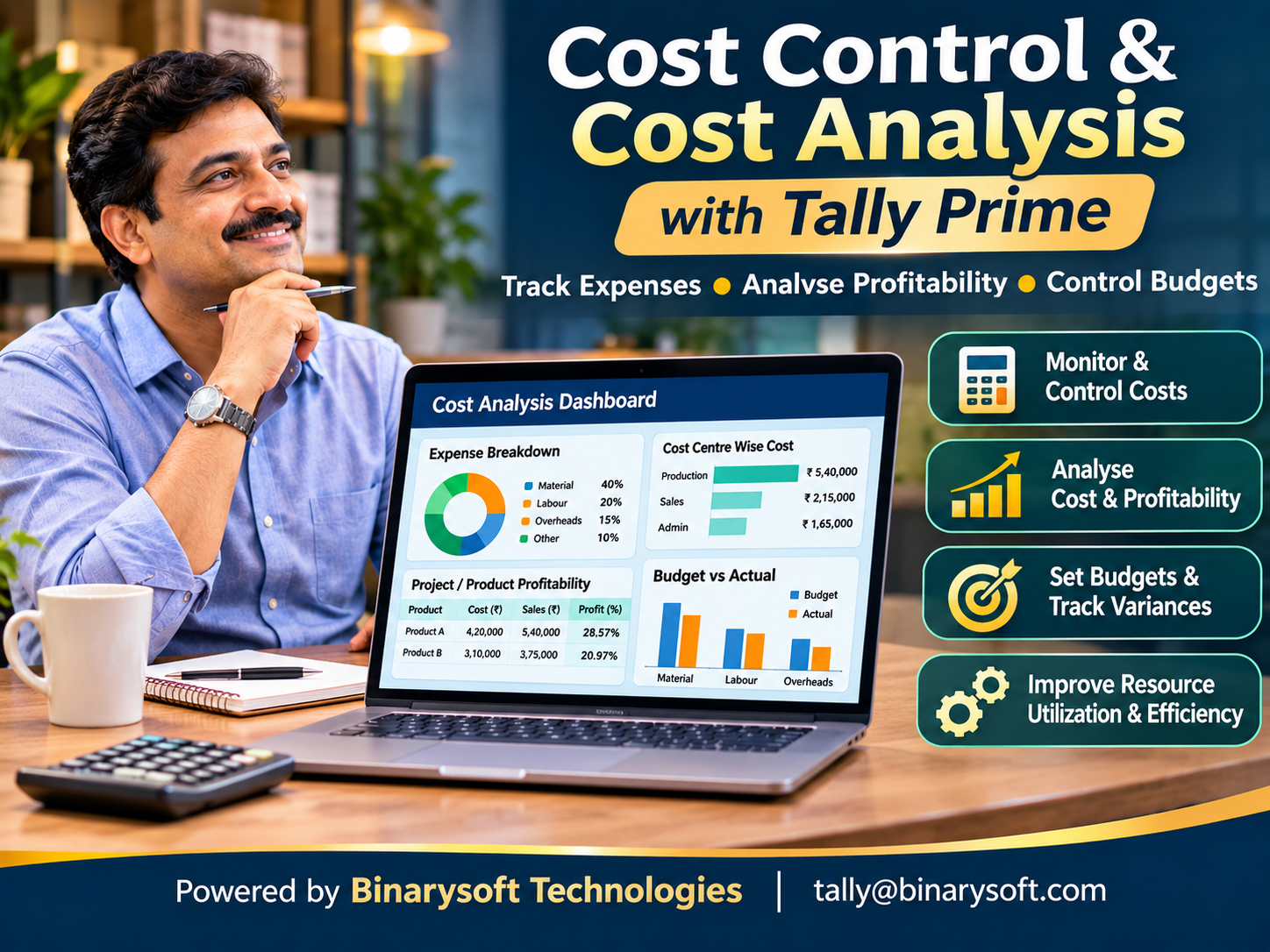
Tally Prime provides accounting and reporting capabilities that help businesses monitor expenses, allocate costs to departments, evaluate budgets and analyse financial performance.
Whether you operate a manufacturing unit, wholesale business, retail store, construction company or professional consultancy, understanding where money is spent is essential for sustainable growth.
Effective cost management is not simply about reducing expenditure. It is about ensuring every rupee contributes value to the business.
1. What Is Cost Control and Cost Analysis?
Cost control and cost analysis are two closely related financial management activities.
Cost control involves monitoring and managing business expenditure to prevent unnecessary spending and maintain financial discipline.
Cost analysis involves examining expenses to understand how they affect products, departments, projects and overall profitability.
For example, a furniture manufacturer may spend money on wood, labour, electricity, transportation, packaging and administration.
Cost analysis identifies how much each activity contributes to total production expenses.
Cost control then helps management identify opportunities to reduce wastage, negotiate better purchasing arrangements or improve operational efficiency.
The objective is to maintain product quality and business performance while controlling unnecessary expenditure.
2. Why Cost Management Is Essential for Indian MSMEs
Small and medium businesses frequently operate with limited financial resources and competitive profit margins.
Even minor increases in expenses can significantly affect profitability.
Effective cost management helps businesses improve financial visibility, establish realistic budgets, identify inefficient departments and make informed pricing decisions.
For example, a wholesaler may discover that transportation expenses are increasing faster than sales.
A manufacturer may identify excessive material consumption in a particular production department.
A service provider may realise that certain client projects consume more employee hours than originally estimated.
Without structured accounting information, these problems can remain unnoticed.
Tally Prime helps businesses organise financial transactions and analyse costs through appropriate accounting classifications and management reports.
3. Understanding Cost Centres in Tally Prime
A cost centre is a department, project, employee, branch or business activity for which expenses and income can be tracked separately.
Cost centre accounting is particularly useful when businesses want to understand where money is being spent.
For example, a manufacturing company may create cost centres for Production, Sales, Administration and Maintenance.
When recording an eligible expense, the amount can be allocated to the appropriate cost centre.
Consider the following illustrative monthly expenses:
|
Department
|
Monthly Expense
|
|---|
|
Production
|
₹4,50,000
|
|
Sales
|
₹1,80,000
|
|
Administration
|
₹1,20,000
|
|
Maintenance
|
₹75,000
|
|
Total
|
₹8,25,000
|
This classification helps management compare departmental expenses and identify areas requiring attention.
Tally Prime supports cost centre creation, transaction allocation and cost centre reporting, enabling more detailed financial analysis.
4. Cost Categories for Multiple Business Dimensions
Some businesses require more than one method of analysing expenses.
For example, management may want to evaluate spending by department and by project.
Tally Prime supports cost categories that allow businesses to maintain separate dimensions of cost centre analysis.
A construction company could create one category for departments and another for projects.
Department cost centres might include Engineering, Procurement and Administration.
Project cost centres might include Residential Project A, Commercial Project B and Renovation Project C.
This arrangement helps management understand expenditure across different business activities.
Properly configured cost categories make financial reporting more meaningful, especially for organisations handling several projects simultaneously.
5. Budget Management and Expense Control
A budget establishes the expected financial performance of a business during a particular period.
It may define planned expenditure, revenue or departmental financial targets.
Tally Prime supports budgets and controls that help businesses compare planned figures against actual accounting results.
Consider a company's monthly budget:
|
Expense Category
|
Budget
|
Actual
|
Variance
|
|---|
|
Raw materials
|
₹5,00,000
|
₹5,60,000
|
₹60,000 over
|
|
Salaries
|
₹2,50,000
|
₹2,45,000
|
₹5,000 under
|
|
Electricity
|
₹80,000
|
₹95,000
|
₹15,000 over
|
|
Transportation
|
₹1,20,000
|
₹1,10,000
|
₹10,000 under
|
The report highlights areas where actual spending exceeds the approved budget.
Management can investigate whether the difference resulted from higher production, price increases, wastage or inefficient operations.
Budget variance analysis becomes especially valuable when performed regularly rather than only at the end of the financial year.
6. How Tally Prime Helps Analyse Business Expenses
Expense analysis helps business owners understand the structure of their operating costs.
Tally Prime records financial transactions through accounting ledgers and provides reports that can be examined according to relevant classifications.
Businesses can monitor direct expenses such as raw materials, wages and production-related costs.
They can also analyse indirect expenses such as office rent, administration, marketing, insurance and utilities.
For example, if transportation expenses increase by 25% while sales increase by only 8%, management may need to investigate delivery routes, fuel consumption or logistics contracts.
Similarly, an increase in administrative expenditure without corresponding business growth may indicate inefficient resource utilisation.
Consistent expense classification is essential because incorrectly recorded transactions can distort management reports.
7. Project-Wise Cost and Profitability Analysis
Businesses managing multiple projects often struggle to determine which assignments are profitable.
A construction contractor may handle several projects simultaneously, each involving different materials, labour requirements and subcontractor expenses.
Tally Prime cost centres can help allocate relevant income and expenses to individual projects.
For example:
|
Particulars
|
Project A
|
Project B
|
|---|
|
Revenue
|
₹15,00,000
|
₹12,00,000
|
|
Direct costs
|
₹9,50,000
|
₹8,80,000
|
|
Allocated overheads
|
₹2,00,000
|
₹1,50,000
|
|
Project contribution after allocations
|
₹3,50,000
|
₹1,70,000
|
Although both projects generate revenue, Project A delivers a stronger contribution.
Such analysis helps management improve quotations, estimate future project costs and evaluate operational performance.
Accurate results depend on consistent allocation of direct expenses and reasonable treatment of shared overheads.
8. Product Cost Analysis and Pricing Decisions
Pricing products without understanding their actual cost can create serious profitability problems.
Manufacturers must consider raw materials, labour, production overheads, packaging and other relevant expenses.
Suppose a business manufactures 1,000 units of a product.
|
Cost Component
|
Total Cost
|
|---|
|
Raw materials
|
₹2,00,000
|
|
Direct labour
|
₹80,000
|
|
Factory overheads
|
₹70,000
|
|
Packaging
|
₹30,000
|
|
Total production cost
|
₹3,80,000
|
The estimated production cost per unit is ₹380.
If the product sells for ₹500, the difference of ₹120 per unit must still cover any additional selling, administrative and financing costs before arriving at final profit.
Tally Prime inventory and accounting information can support product costing analysis, while cost centre allocations can provide additional expense visibility.
Businesses requiring highly specialised manufacturing costing may need supplementary calculations or suitable customisation.
9. An Emotional Story: When a Family Business Nearly Lost Its Future
For twenty years, Amit had operated a small garment manufacturing business in Delhi.
His father had started the business with just four sewing machines and a determination to provide a better future for his family.
Over time, Amit expanded operations, hired employees and began supplying garments to several retailers.
Sales increased steadily.
Yet something was wrong.
Despite receiving larger orders, the business bank balance continued shrinking.
One evening, Amit's accountant explained that production costs had increased significantly.
Fabric wastage was rising, overtime expenses were poorly monitored, and certain customer orders were generating very little profit.
Amit sat silently in his office, looking at an old photograph of his father standing beside the first sewing machine.
He remembered his father's words: “A successful business is built by respecting every rupee.”
That night, Amit decided to change how he managed the company.
He reorganised expense accounting, introduced departmental cost centres and began reviewing monthly budgets using Tally Prime.
His team started analysing material consumption, labour expenses and production-related overheads.
Instead of accepting every large order, Amit began evaluating expected profitability before confirming prices.
Over the following months, management gained clearer visibility into operational spending.
The business became more disciplined, and Amit felt more confident about its future.
The lesson was simple: business growth should be measured not only by sales but also by the value retained after expenses.
This fictional story illustrates the emotional and financial importance of responsible cost management.
10. Case Study 1: Manufacturing Company Improves Cost Efficiency
Business: Illustrative furniture manufacturing unit in Bawana, Delhi.
Challenge: The company experienced increasing raw material costs and declining profit margins despite stable sales.
Management had limited visibility into departmental expenses and production overheads.
The company introduced cost centre accounting in Tally Prime to classify production, maintenance and administrative expenditure.
It also established monthly expense budgets and reviewed actual spending against approved targets.
Illustrative results after six months
|
Performance Indicator
|
Before
|
After
|
|---|
|
Monthly operating costs
|
₹12 lakh
|
₹10.8 lakh
|
|
Material wastage
|
8%
|
5%
|
|
Operating profit margin
|
12%
|
16%
|
|
Cost review frequency
|
Quarterly
|
Monthly
|
The hypothetical reduction in operating costs was ₹1.2 lakh per month.
Management achieved better visibility into expenditure and identified opportunities to reduce unnecessary material consumption.
Key lesson: Accurate cost allocation and regular budget reviews can help manufacturers improve operational efficiency without compromising product quality.
11. Case Study 2: Service Company Tracks Project Profitability
Business: Illustrative IT consultancy in New Delhi.
Challenge: The company handled several client projects but could not accurately identify the profitability of individual assignments.
Employee salaries, travel expenses and administrative costs were recorded without consistent project allocation.
The company introduced project-wise cost centres and began allocating relevant expenses to individual assignments.
Management reviewed project revenue, direct costs and shared overhead allocations every month.
Illustrative results
|
Performance Indicator
|
Before
|
After
|
|---|
|
Average project margin
|
18%
|
25%
|
|
Untracked project expenses
|
₹2 lakh
|
₹40,000
|
|
Project profitability reviews
|
Irregular
|
Monthly
|
|
Cost allocation accuracy
|
Limited
|
Improved
|
The hypothetical results demonstrate how structured project accounting can improve decision-making.
Management could identify projects requiring revised quotations, better resource planning or improved expense controls.
Key lesson: Project-wise financial visibility helps service businesses protect margins and make better commercial decisions.
12. How to Configure Cost Control in Tally Prime
Businesses can begin implementing cost management through a structured accounting process.
-
Enable cost centre functionality: Open the company features and enable cost centres where required.
-
Create cost centres: Define departments, branches, projects or other reporting units.
-
Create cost categories: Configure additional analysis dimensions when the business needs them.
-
Allocate expenses: Record transactions against the appropriate ledgers and cost centres.
-
Configure budgets: Establish budgets for relevant ledgers, groups or cost centres.
-
Review cost reports: Examine cost centre summaries, breakups and relevant financial statements.
-
Compare budget and actual figures: Identify significant variances and investigate their causes.
-
Improve financial controls: Update budgets, purchasing procedures and cost allocation practices based on findings.
The precise menu labels may vary by software release and enabled company features.
For quick navigation, use Alt+G (Go To) and search for relevant reports such as Cost Centre Summary, Cost Centre Break-up or Budgets.
13. Cost Control for Different Business Industries
Tally Prime cost management capabilities can support businesses across several industries.
Manufacturing: Analyse raw materials, production expenses, labour costs, maintenance and departmental overheads.
Wholesale and distribution: Monitor transportation, warehousing, packaging, sales administration and branch expenditure.
Retail: Compare store-wise operating expenses, employee costs, rent and promotional expenditure.
Construction: Track project-related purchases, labour, subcontractor expenses and site administration.
Professional services: Analyse client projects, departmental costs, travel expenses and administrative overheads.
Educational institutions: Monitor programme expenses, departmental expenditure and operational budgets.
The most effective reporting structure depends on how the business operates and which financial decisions management needs to make.
14. Benefits of Cost Control and Cost Analysis with Tally Prime
Implementing structured cost management provides several practical advantages.
Improved profitability
Identifying unnecessary expenditure and inefficient activities helps protect operating margins.
Better financial planning
Budget comparisons allow management to anticipate spending pressures and allocate resources responsibly.
Departmental accountability
Cost centres make departmental expenditure more visible, encouraging managers to monitor their financial responsibilities.
Better pricing decisions
Understanding product and project costs supports more realistic quotations and selling prices.
Efficient resource utilisation
Expense analysis can reveal excessive material consumption, avoidable overtime and unnecessary operating costs.
Faster management reporting
Integrated accounting records reduce dependence on disconnected spreadsheets and repetitive manual calculations.
Stronger business decisions
Reliable cost information helps management evaluate expansion plans, investments and operational improvements.
15. Common Cost Management Mistakes Businesses Should Avoid
One common mistake is focusing exclusively on sales while ignoring the cost of generating those sales.
Another is recording expenses under broad accounting headings without sufficient detail for meaningful analysis.
Businesses may also prepare budgets at the beginning of the year but fail to compare them with actual results.
Incorrect allocation of shared expenses can create misleading project profitability figures.
Similarly, reducing expenditure without considering product quality, employee productivity or customer satisfaction can damage long-term performance.
Successful cost control requires a balance between financial discipline and operational effectiveness.
Businesses should establish consistent accounting procedures, review reports regularly and investigate unusual changes before taking corrective action.
16. How Binarysoft Technologies Can Help
Effective cost management depends on appropriate software configuration and reliable accounting practices.
Binarysoft Technologies assists businesses with Tally Prime implementation, accounting configuration, cost centre setup, budgeting workflows and financial reporting.
Businesses can receive guidance on organising departmental expenses, establishing project-wise accounting structures and using relevant reports for management decisions.
The objective is to help business owners gain clearer financial visibility and improve operational efficiency.
Conclusion
Cost control and cost analysis are essential for businesses seeking sustainable profitability and long-term financial stability.
Increasing sales alone cannot guarantee success when expenses remain uncontrolled.
Tally Prime provides practical accounting tools for monitoring expenditure, allocating costs, managing budgets and evaluating departmental or project performance.
Through cost centres, cost categories, budget comparisons and financial reports, businesses can better understand where money is being spent and identify opportunities for improvement.
For Indian MSMEs, manufacturers, wholesalers, retailers and service providers, accurate cost information can support better pricing, resource planning and financial decisions.
The most successful businesses do not simply earn more revenue. They understand their costs, eliminate unnecessary spending and protect the value of every rupee earned.
Powered by Binarysoft Technologies
Authorized Tally Partner
Location: 1626/33, 1st Floor, Naiwalan, Karol Bagh, New Delhi – 110005, INDIA
Contact us: +91 7428779101, 9205471661
Email us: tally@binarysoft.com
Business Hours: 10:00 AM – 6:00 PM, Monday–Friday
Frequently Asked Questions
Is Tally Prime suitable for manufacturing cost analysis?
Yes. Its accounting, inventory and cost centre capabilities support manufacturing expense analysis. Advanced costing requirements may need additional configuration or calculations.
Can Tally Prime help reduce business expenses?
Tally Prime helps identify expenditure patterns and budget variances. Actual cost reductions depend on management decisions and operational improvements.
How frequently should businesses review cost reports?
Monthly reviews are useful for many businesses, while organisations with high transaction volumes may benefit from weekly monitoring.
Does Tally Prime automatically calculate every product's full cost?
Not necessarily. Inventory valuation and accounting reports provide useful information, but complete product costing may require additional expense allocations and calculations.
CA. Ishaan Bagaria works closely with traders and service enterprises on accounting systems, GST compliance, and reporting processes. His focus is on improving record accuracy and simplifying day-to-day financial management.