Call CA Tally HelpDesk
+91 9205471661,
7428779101
Why Smart Inventory Management Is Essential for Business Growth
Every successful business depends on maintaining the right products, in the right quantities, at the right time. Whether you operate a retail store, wholesale distribution business, manufacturing company, automobile spare parts dealership, pharmaceutical business or e-commerce enterprise, inventory management directly influences profitability and customer satisfaction.
Many businesses face common challenges such as stock shortages, excess inventory, inaccurate stock records, delayed deliveries, expired products and difficulties tracking goods across multiple locations.
These problems often result in financial losses, dissatisfied customers and unnecessary operational expenses.
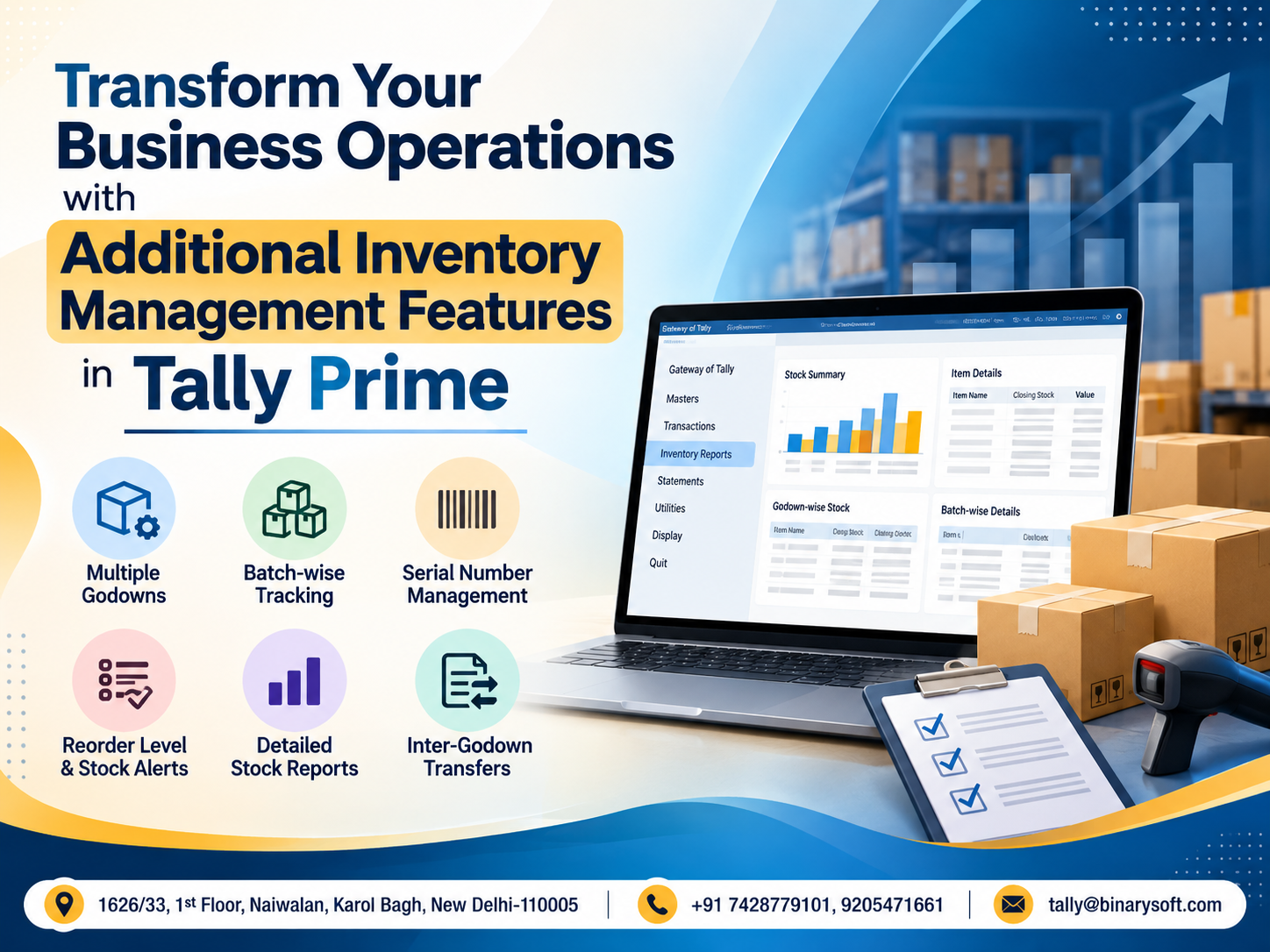
Tally Prime offers advanced inventory management features that help businesses maintain accurate stock records, monitor inventory movements, control purchasing decisions and improve overall operational efficiency.
Beyond basic stock accounting, Tally Prime provides additional capabilities such as batch-wise inventory tracking, multiple godown management, stock categories, reorder levels, price lists, manufacturing inventory management and detailed inventory reports.
By using these features effectively, businesses can transform traditional inventory operations into a more organised, transparent and data-driven process.
This article explains how Tally Prime inventory management features work, their practical benefits and how businesses can use them to achieve sustainable growth.
1. A Business Owner's Story: When Missing Inventory Nearly Destroyed Customer Trust
The Day a Small Inventory Mistake Became a Big Business Problem
Rohit Mehta had spent fifteen years building his automobile spare parts business in Delhi.
His shop started with a small collection of replacement parts. Through dedication, customer relationships and consistent service, he gradually expanded into wholesale distribution.
His business supplied spare parts to garages, repair workshops and automobile dealers across the city.
However, as his business grew, managing inventory became increasingly difficult.
His warehouse contained thousands of products, including filters, brake pads, bearings, batteries and engine components.
Stock information was maintained through spreadsheets and handwritten registers.
One morning, Rohit received an urgent order from a long-standing customer.
The customer needed 150 brake pads for a major repair contract.
Rohit's records showed that 200 units were available.
He confidently promised delivery the following morning.
But when his warehouse staff checked the shelves, they discovered that only 65 units were physically available.
Some products had been transferred to another location without proper recording. Others had already been sold, but the records were not updated.
The customer was disappointed.
For Rohit, the situation was more than a missed sale. It threatened a relationship he had spent years building.
That evening, he sat in his office looking at the warehouse records and realised that business growth without inventory control could eventually destroy everything he had worked for.
He decided to improve his inventory management system.
After implementing Tally Prime, Rohit's team organised stock items into categories, introduced godown-wise tracking, recorded inventory transfers and established regular stock verification procedures.
The business also configured reorder levels for frequently sold products.
Over time, the team gained better visibility into available stock and purchasing requirements.
Rohit no longer had to depend entirely on handwritten records or verbal warehouse updates.
He could review stock reports before committing to important customer orders.
The biggest transformation was not simply better accounting. It was the confidence to make promises to customers and fulfil them.
This illustrative story highlights how structured inventory management can protect customer relationships and business reputation.
2. Understanding Inventory Management in Tally Prime
Inventory management involves tracking products from procurement to storage, movement, sale and final delivery.
An effective inventory system should answer several important questions.
How much stock is currently available?
Which products are selling quickly?
Which products remain unsold?
Where are particular items stored?
When should additional stock be purchased?
What is the value of existing inventory?
Tally Prime helps businesses answer these questions through integrated inventory records and reporting capabilities.
Important Inventory Management Capabilities
Tally Prime supports:
-
Stock item creation and classification.
-
Stock groups and stock categories.
-
Multiple units of measurement.
-
Godown-wise inventory tracking.
-
Batch-wise inventory management.
-
Manufacturing and expiry-date tracking.
-
Stock transfers and adjustments.
-
Reorder-level monitoring.
-
Purchase and sales order processing.
-
Manufacturing inventory accounting.
-
Stock valuation and movement analysis.
-
Inventory-related GST invoicing.
These features help businesses maintain greater control over stock while connecting inventory transactions with financial accounting.
3. Organise Products Efficiently with Stock Groups and Categories
Businesses often deal with hundreds or thousands of different products.
Without proper classification, identifying specific items and analysing stock performance becomes difficult.
Tally Prime allows businesses to organise products using stock groups and stock categories.
Stock Groups
Stock groups help classify products based on their primary characteristics.
For example, an automobile spare parts dealer may create the following groups:
| Stock Group | Products |
|---|
| Engine Components |
Pistons, filters, gaskets |
| Brake Components |
Brake pads, brake discs |
| Electrical Parts |
Batteries, switches, wiring |
| Lubricants |
Engine oil, transmission oil |
| Accessories |
Covers, lights, cleaning products |
This classification makes stock reporting easier.
Stock Categories
Stock categories provide another method of classifying products independently of their primary groups.
For example, products can be categorised according to brand, size or product range.
A business may group brake pads under Brake Components while using stock categories to analyse products by manufacturer.
Business Benefits
Proper product classification helps businesses improve stock searches, analyse product groups, identify profitable categories and maintain consistent inventory records.
It also makes reporting more useful as product volumes increase.
4. Manage Inventory Across Multiple Godowns and Warehouses
Businesses operating multiple warehouses, retail outlets or storage locations often struggle to maintain accurate location-wise inventory information.
Tally Prime provides godown management features to track stock across different locations.
How Multiple Godown Management Works
Businesses can create separate godowns for individual warehouses, branches, storage sections or inventory stages.
For example, a distributor may maintain:
Main Warehouse – Delhi: Central inventory storage.
Branch Warehouse – Noida: Products allocated for regional customers.
Retail Outlet – Gurugram: Stock available for direct sales.
Damaged Goods Location: Products awaiting inspection or disposal.
When inventory moves between locations, the business can record transfers using Stock Journal vouchers.
Godown-Wise Stock Reports
Tally Prime provides reports that help users review quantities and values associated with individual storage locations.
Businesses can identify where products are available before processing orders.
Practical Advantages
Multiple godown management can reduce stock confusion, improve transfer accountability and support better distribution planning.
It is particularly useful for wholesalers, manufacturers, retail chains and businesses with multiple branches.
5. Improve Product Traceability with Batch-Wise Inventory Management
Batch-wise inventory management is especially valuable for businesses handling products with different manufacturing dates, expiry dates or purchase costs.
Industries such as pharmaceuticals, food distribution, cosmetics and chemicals frequently require batch-level tracking.
How Batch Tracking Works
Tally Prime allows businesses to maintain stock under different batches.
For example, a pharmaceutical distributor may receive the same medicine in separate batches.
| Batch Number | Quantity | Manufacturing Date | Expiry Date |
|---|
| MED101 |
500 |
January 2026 |
December 2027 |
| MED102 |
750 |
March 2026 |
February 2028 |
| MED103 |
400 |
June 2026 |
May 2028 |
By maintaining these details, businesses can review stock according to its batch information.
Managing Expiry Dates
Businesses can monitor products approaching expiry and prioritise appropriate stock movement.
This can reduce losses caused by expired inventory.
Managing Product Returns
When a customer returns a defective product, batch information helps identify the original stock batch.
The business can investigate whether similar products require inspection.
Benefits of Batch Management
Batch-wise tracking improves traceability, supports quality-control procedures and helps businesses make informed inventory decisions.
It is particularly valuable when product safety and shelf life are important.
6. Prevent Stock Shortages with Reorder Levels
Running out of frequently sold products can lead to missed sales and disappointed customers.
On the other hand, purchasing excessive quantities can block working capital.
Tally Prime provides reorder-level functionality to help businesses monitor replenishment requirements.
What Is a Reorder Level?
A reorder level represents the stock quantity at which a business should consider placing a new purchase order.
For example, a distributor may maintain a reorder level of 100 units for a frequently sold product.
When available stock approaches that threshold, the business can review its replenishment requirements.
How Reorder Levels Help
Businesses can use reorder reports to identify items requiring attention.
This supports more organised purchasing decisions.
Avoiding Excess Inventory
Reorder levels should be determined using expected demand, supplier lead times, minimum order quantities and safety stock requirements.
They should also be reviewed periodically.
Important: Tally Prime provides reorder analysis, but fully automatic supplier ordering or predictive demand forecasting may require additional software or integration.
7. Manage Product Pricing with Multiple Price Levels
Businesses frequently sell products to different customer groups.
Retail customers, wholesalers, distributors and institutional buyers may receive different prices.
Maintaining separate pricing records manually can create billing errors.
Tally Prime supports price lists and multiple price levels.
Example of Multiple Pricing
| Customer Category | Product Price |
|---|
| Retail Customer |
₹1,200 |
| Wholesale Customer |
₹1,100 |
| Distributor |
₹1,050 |
| Institutional Buyer |
₹1,025 |
Businesses can configure appropriate price levels according to their commercial policies.
Advantages
Multiple price levels can improve billing consistency and reduce the need to enter prices manually for every transaction.
They also help businesses maintain structured pricing policies.
Before implementation, businesses should review how discounts, customer-specific agreements and applicable taxes will be handled.
8. Simplify Manufacturing Inventory with Bill of Materials
Manufacturing businesses require accurate information about raw materials, production quantities and finished goods.
Tally Prime provides inventory features that support manufacturing-related accounting.
Understanding Bill of Materials
A Bill of Materials, or BOM, identifies the components and quantities required to manufacture a finished product.
For example, a furniture manufacturer producing one wooden table may require:
| Raw Material | Required Quantity |
|---|
| Wooden Boards |
4 Units |
| Metal Fittings |
12 Units |
| Adhesive |
1 Unit |
| Protective Coating |
500 ml |
Businesses can define these components within the product's Bill of Materials.
Manufacturing Journal
Manufacturing Journal vouchers help record raw material consumption and finished goods production.
Businesses can also account for relevant by-products, co-products and scrap.
Production Cost Analysis
By recording material consumption and related expenses, manufacturers can better understand production costs.
This information supports selling-price decisions and profitability analysis.
Tally Prime's manufacturing inventory features are useful for furniture manufacturers, engineering workshops, food-processing units and other production businesses.
9. Track Stock Movement with Inventory Vouchers
Accurate inventory management requires every significant stock movement to be recorded.
Tally Prime provides different voucher types for inventory-related transactions.
Stock Journal
Stock Journal vouchers can record inventory transfers between godowns and certain stock adjustments.
They are also useful for recording material consumption and production-related movements.
Physical Stock Voucher
Physical Stock vouchers help businesses record quantities identified during stock verification.
This supports reconciliation between physical inventory and accounting records.
Purchase and Sales Vouchers
Purchase and sales vouchers record inventory transactions associated with buying and selling products.
Delivery and Receipt Notes
Where configured, delivery and receipt notes help businesses record the movement of goods separately from the related invoices.
This can be useful when goods are delivered or received before final billing.
Maintaining accurate inventory vouchers creates a stronger foundation for reliable stock reports and financial records.
10. Improve Inventory Decisions with Advanced Stock Reports
Inventory reports help businesses understand how products move through their operations.
Tally Prime provides several reports for analysing inventory performance.
Stock Summary
Stock Summary displays information about opening stock, inward movements, outward movements and closing balances.
Businesses can use it to understand available quantities and stock values.
Movement Analysis
Movement Analysis helps identify products with high or low movement during a selected period.
Fast-moving products may require more frequent replenishment.
Slow-moving products may require promotional activity or purchasing adjustments.
Stock Ageing Analysis
Stock ageing information helps businesses identify inventory that has remained unsold for extended periods.
For batch-managed products, relevant reports can also support expiry-related analysis.
Godown Summary
Godown Summary provides location-wise inventory information.
It helps businesses review stock availability across different warehouses.
Reorder Status
Reorder reports help identify products approaching their defined replenishment levels.
Together, these reports provide valuable information for purchasing, sales planning and inventory control.
11. Case Study One: How a Wholesale Distributor Improved Inventory Accuracy
Business Background
A medium-sized electrical goods distributor supplied products to retailers and contractors across Delhi NCR.
The business maintained approximately 3,500 stock items across two warehouses.
Challenges
The company frequently experienced stock mismatches.
Warehouse employees maintained separate records, while the accounts department updated inventory information later.
Management struggled to identify products available at each location.
Tally Prime Implementation
The business organised stock items into groups and categories.
Separate godowns were created for each warehouse.
Stock transfers were recorded using Stock Journal vouchers.
Reorder levels were configured for frequently sold electrical components.
Employees also introduced regular physical stock verification.
Illustrative Results
After implementation, stock reconciliation became more organised.
In this example, the business reduced its monthly stock-verification workload from approximately five working days to two.
Management gained clearer visibility into warehouse stock and replenishment requirements.
Customer orders could be checked against recorded stock availability more consistently.
Key Learning
Accurate stock classification, location tracking and regular verification can improve operational control.
This case study is illustrative. Actual results depend on implementation quality, transaction accuracy and business processes.
12. Case Study Two: Reducing Expiry-Related Losses in a Food Distribution Business
Business Background
A packaged-food distributor supplied grocery stores, restaurants and supermarkets.
The company handled products with different manufacturing and expiry dates.
Challenges
Employees struggled to identify older stock batches.
Some products remained in storage while newer batches were dispatched first.
This resulted in avoidable expiry-related losses.
Tally Prime Implementation
The business introduced batch-wise inventory management.
Manufacturing and expiry dates were maintained for applicable products.
Warehouse employees began reviewing batch reports before dispatching goods.
Management also introduced periodic checks for products approaching expiry.
Illustrative Results
The distributor improved visibility into batch-wise stock.
Older inventory could be identified more easily, allowing employees to prioritise suitable products for dispatch.
In this example, the business recorded a reduction in avoidable expiry-related losses over the following reporting periods.
Key Learning
Batch-wise tracking, combined with disciplined warehouse procedures, can improve product traceability and reduce inventory waste.
This case study is illustrative and does not represent verified customer performance.
13. How to Use Additional Inventory Management Features in Tally Prime
Businesses can implement inventory management features through a structured process.
Step 1: Enable Inventory Management
Open the company in Tally Prime and review the inventory settings through F11 Features.
Enable the relevant options according to business requirements.
Step 2: Create Stock Groups
Organise products into suitable groups such as electronics, machinery, spare parts or finished goods.
Step 3: Create Stock Items
Define individual products with appropriate names, units of measurement and other required details.
Step 4: Configure Godowns
Create separate locations for warehouses, branches or storage areas.
Step 5: Enable Batch Tracking
Where required, enable batch management and maintain manufacturing or expiry dates.
Step 6: Configure Reorder Levels
Set suitable reorder quantities for important stock items based on demand and supplier lead times.
Step 7: Configure Price Lists
Create price levels for relevant customer categories.
Step 8: Record Inventory Transactions
Use appropriate vouchers for purchases, sales, transfers, manufacturing and stock adjustments.
Step 9: Review Inventory Reports
Regularly examine Stock Summary, Movement Analysis, Godown Summary and Reorder Status.
Step 10: Verify Physical Inventory
Conduct periodic physical stock checks and investigate discrepancies before making adjustments.
A successful implementation also requires employee training, consistent product naming and clearly defined stock-handling procedures.
14. How Tally Prime Helps Improve Business Profitability
Inventory management has a direct impact on business finances.
Excess inventory blocks money that could otherwise support business expansion.
Insufficient stock can result in lost sales.
Inaccurate stock information may lead to unnecessary purchases and delivery delays.
Tally Prime helps businesses improve inventory visibility and financial decision-making.
Better Working Capital Management
Businesses can identify slow-moving products and review purchasing requirements.
Improved Customer Satisfaction
More accurate inventory records help employees provide dependable information about product availability.
Reduced Operational Waste
Batch tracking and stock ageing analysis can help identify inventory requiring attention.
Better Purchasing Decisions
Reorder reports and movement analysis support more informed procurement planning.
Improved Financial Reporting
Integrating inventory records with accounting information can provide clearer visibility into stock values and business performance.
These improvements can contribute to stronger financial control and sustainable profitability.
15. Why Choose Binarysoft Technologies for Tally Prime Inventory Management?
Implementing inventory management software requires an understanding of business operations, accounting processes and reporting requirements.
Binarysoft Technologies, an Authorized Tally Partner, helps businesses explore Tally Prime solutions suited to their operational needs.
Businesses can seek assistance with inventory configuration, product classification, godown management, batch tracking and accounting-related requirements.
Organisations planning to access Tally Prime through a cloud-hosted environment can also discuss suitable hosting options.
The objective is to create a practical accounting and inventory management setup that supports business growth.
Whether your business operates a single retail outlet or multiple warehouses, properly configured inventory features can improve operational visibility.
16. Conclusion: Build a More Efficient and Profitable Business with Tally Prime
Inventory is one of the most valuable assets for businesses involved in trading, manufacturing and distribution.
However, maintaining large quantities of stock does not guarantee profitability.
Success depends on knowing what products are available, where they are stored, how quickly they sell and when they need replenishment.
Tally Prime provides additional inventory management features that help businesses improve stock accuracy, reduce operational confusion and make better purchasing decisions.
From multiple godown management and batch tracking to reorder levels, price lists, manufacturing accounting and inventory analysis, these capabilities support more organised business operations.
Businesses that combine accurate software records with disciplined inventory procedures can improve efficiency, customer satisfaction and financial control.
For organisations looking to modernise their inventory management processes, Tally Prime offers a practical foundation for better decision-making and long-term growth.
Transform Your Inventory Management with Binarysoft Technologies
Powered by Binarysoft Technologies
Authorized Tally Partner
Location:
1626/33, 1st Floor, Naiwalan, Karol Bagh, New Delhi – 110005, INDIA
Contact Us:
+91 7428779101, 9205471661
Email Us:
tally@binarysoft.com
Business Hours:
10:00 AM – 6:00 PM, Monday to Friday
Contact Binarysoft Technologies to discuss Tally Prime inventory management, configuration, implementation and cloud-hosting requirements.
Frequently Asked Questions
What are the additional inventory management features in Tally Prime?
Tally Prime provides features such as multiple godown management, batch tracking, reorder levels, stock categories, price lists, manufacturing inventory accounting and advanced inventory reports.
Can Tally Prime manage inventory across multiple warehouses?
Yes. Tally Prime allows businesses to create multiple godowns and track inventory movements between locations.
How does batch-wise inventory management work in Tally Prime?
Batch-wise inventory management allows businesses to maintain products under separate batches and track quantities, manufacturing dates and expiry dates where applicable.
Can Tally Prime help prevent stock shortages?
Yes. Businesses can configure reorder levels and review reorder reports to identify products that may require replenishment.
CA. Vihaan Taparia focuses on GST compliance, ledger reconciliation, and accounting process management. He helps trading and service businesses establish structured workflows for accurate reporting and efficient record maintenance.