Call CA Tally HelpDesk
+91 9205471661,
7428779101
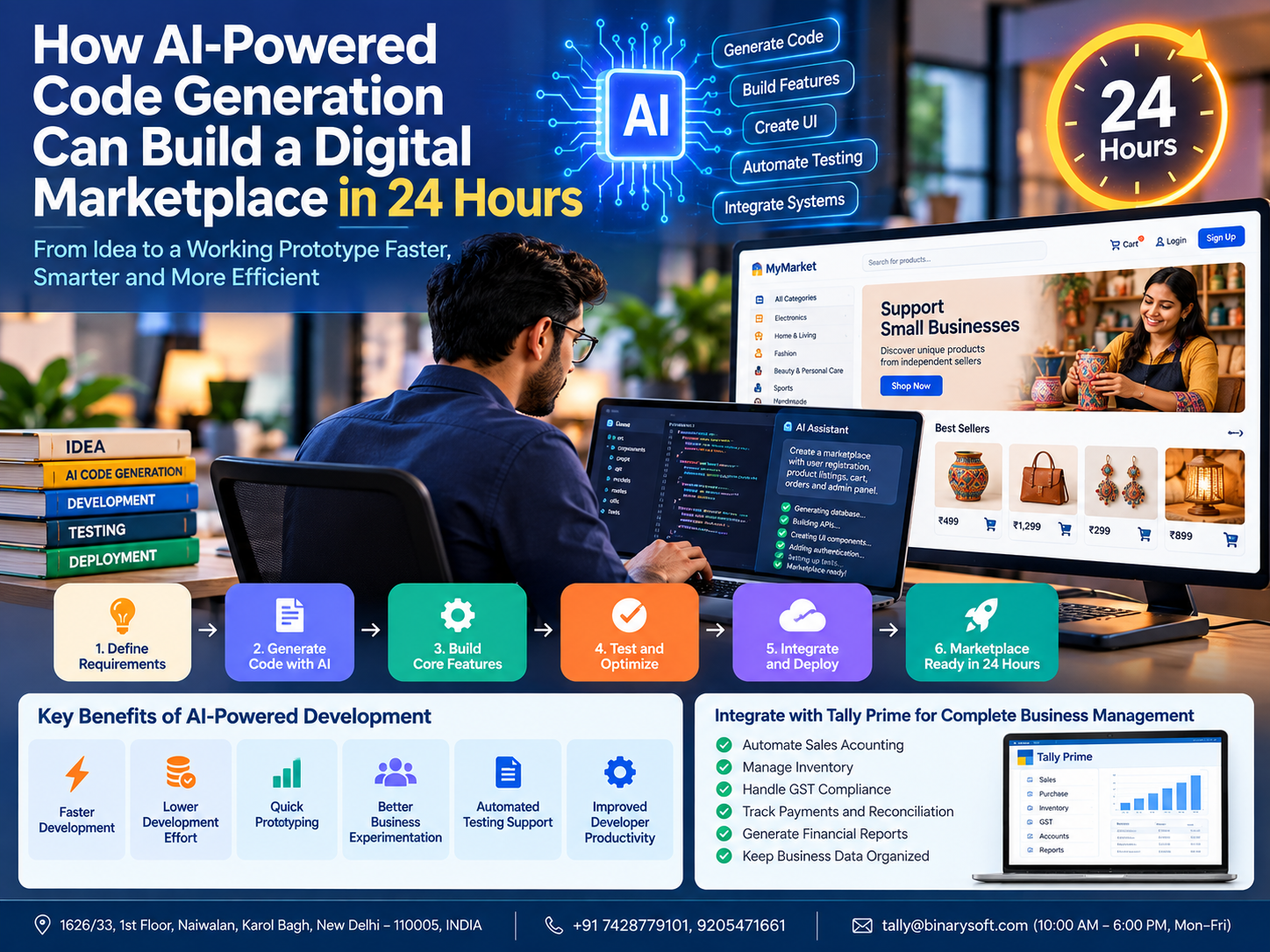
Introduction: A New Era of Software Development Has Arrived
Imagine creating a sophisticated digital marketplace in just 24 hours instead of spending several weeks developing its basic functionality.
A marketplace where customers can browse products, sellers can manage listings, administrators can monitor transactions, and businesses can process orders through a secure digital environment.
Until recently, building such a platform typically required substantial planning, programming, testing and integration work.
Today, artificial intelligence is changing how software applications are developed.
AI-powered code generation allows developers to convert structured business requirements into software components, database designs, application interfaces, APIs and automated tests much faster than traditional manual development.
For startups, software companies and established businesses, this represents an opportunity to experiment with digital ideas, accelerate product development and reduce repetitive programming work.
However, developing an application quickly is only one part of the challenge. Building a reliable marketplace also requires security, financial accuracy, scalability and effective integration with existing business systems.
This is where modern accounting solutions such as Tally Prime can contribute.
By connecting an appropriately designed marketplace with accounting, inventory and GST workflows, businesses can create a more organized digital operating environment.
This guide explores how AI-assisted development works, how a marketplace prototype can be built within 24 hours, the role of automated testing and how Tally Prime can support the financial operations behind an online marketplace.
A Business Story: When a Small Entrepreneur's Big Dream Finally Became Possible
For several years, Rohit had dreamed of building an online marketplace for independent handicraft sellers across India.
His vision was simple.
He wanted artisans from smaller towns to sell handmade products directly to customers without depending entirely on large distributors.
Rohit had personally witnessed the struggles of small manufacturers.
Many talented artisans produced beautiful products but lacked the technology, marketing resources and financial knowledge required to reach online customers.
His mother had spent years creating handmade decorative products.
Despite her dedication, she often struggled to find buyers willing to pay a fair price.
Rohit wanted to build something that could help people like her.
However, every software development quotation seemed beyond his budget.
A professional marketplace required customer registration, seller dashboards, product listings, payment processing, order management and administrative controls.
The estimated development period stretched across several months.
Rohit almost abandoned his idea.
Then he discovered AI-assisted software development.
Working with an experienced developer, he created a structured description of the marketplace, its users and its essential workflows.
AI coding tools helped generate application components, database structures and initial automated tests.
Within a day, the team had a working prototype that demonstrated product listings, seller registration and basic purchasing workflows.
It was not yet ready for unrestricted public transactions.
Security reviews, payment integration, testing and deployment preparation still required additional work.
But for the first time, Rohit could see his idea functioning on a screen.
He called his mother and showed her a sample product listing.
She smiled and asked whether other artisans would soon be able to display their products there.
For Rohit, that moment meant more than faster software development.
It represented the possibility of turning a long-held dream into a real business.
The lesson: artificial intelligence cannot replace determination, business understanding or human creativity, but it can help transform promising ideas into working prototypes much faster.
This is an illustrative story created to explain the human impact of AI-assisted software development.
What Is AI-Powered Code Generation?
AI-powered code generation is the process of using artificial intelligence systems to assist with creating, reviewing, explaining, modifying and testing software code.
Modern AI coding tools can interpret natural-language instructions and produce programming components in different languages and frameworks.
For example, a developer may provide the following requirement:
"Create a marketplace where customers can register, sellers can upload products, administrators can approve listings and customers can place orders."
An AI coding assistant may help generate:
-
Database tables and relationships
-
User registration components
-
Authentication workflows
-
Product management interfaces
-
Shopping cart functionality
-
Order processing logic
-
API endpoints
-
Automated test cases
-
Technical documentation
The generated output must still be reviewed, tested and refined by qualified developers.
AI-assisted development works best when clear requirements, sound software architecture and human oversight are combined.
Why Is AI Code Generation Becoming Important?
Traditional software development often involves considerable repetitive work.
Developers must create database models, application routes, validation rules, user interfaces and test cases.
Many of these tasks follow recognizable patterns.
AI can accelerate their initial implementation, allowing developers to spend more time on complex business rules, security, architecture and user experience.
For businesses, potential benefits include faster prototyping, shorter feedback cycles, reduced repetitive work and more opportunities to experiment with digital products.
Can AI Really Build a Marketplace in 24 Hours?
AI can help an experienced development team create a substantial marketplace prototype within 24 hours when the project has clearly defined requirements and a manageable scope.
However, a working prototype is not necessarily equivalent to a fully tested, secure and production-ready marketplace.
Actual delivery time depends on several factors:
-
Complexity of business requirements
-
Number of user roles
-
Payment gateway requirements
-
Integration with existing applications
-
Security and compliance obligations
-
Expected transaction volumes
-
Testing and deployment requirements
A simple marketplace prototype may be created rapidly.
A production platform handling real customer payments, sensitive information and high transaction volumes generally requires additional validation.
The most useful approach is to treat the 24-hour development period as an opportunity to build and evaluate a functional foundation.
Step-by-Step Guide to Building an AI-Powered Marketplace in 24 Hours
Phase 1: Requirements and Architecture — Hours 0 to 6
The first stage focuses on understanding the business idea and defining its technical structure.
Before generating code, developers should identify the platform's main users and responsibilities.
A marketplace commonly includes three roles.
Customers: Browse products, manage carts, place orders and view purchase history.
Sellers: Upload products, update prices, manage inventory and review sales.
Administrators: Manage users, approve listings, monitor transactions and oversee platform operations.
The development team must also define important business rules.
For example, a seller should not be able to modify another seller's products.
Similarly, a customer should not be able to access administrative functions.
AI tools can assist with preparing requirements, suggesting database relationships and generating an initial application structure.
Database Design
A basic marketplace database may include:
| Database Table | Purpose |
|---|
| Users |
Customer and seller accounts |
| Products |
Product descriptions and prices |
| Categories |
Product classification |
| Orders |
Customer purchase information |
| Order Items |
Products included in orders |
| Payments |
Payment references and status |
| Inventory |
Product availability |
| Audit Logs |
Important system activities |
The database design should consider data integrity, future expansion and access restrictions.
Architecture Planning
A marketplace commonly requires a frontend application, backend services, database and integration layer.
AI may assist with generating these components using suitable development technologies.
However, experienced developers should approve architectural decisions before implementation.
Phase 2: Core Marketplace Development — Hours 6 to 12
The second stage focuses on creating the essential user experience.
Customer Registration
Customers should be able to register, authenticate and manage their profiles.
Security controls must protect passwords and account information.
Product Catalogue
The marketplace should display product names, descriptions, prices, categories and availability.
Search and filtering features help customers find relevant products.
Shopping Cart
Customers should be able to add products, update quantities and review their orders before checkout.
Seller Dashboard
Sellers require tools to manage product listings, prices and stock information.
Order Management
The application should record orders and maintain clear status information.
AI coding assistants can accelerate the development of these standard components.
Nevertheless, developers must review generated logic to prevent incorrect calculations, unauthorized access and data inconsistencies.
Phase 3: Advanced Features and Automated Testing — Hours 12 to 18
Once core functionality is available, the development team can implement additional business features.
Administrative Dashboard
Administrators may require visibility into registered users, product listings, orders and operational activity.
Product Approval Workflow
Marketplaces can introduce approval procedures before seller products become publicly available.
GST Calculation
For Indian businesses, the platform may need to calculate applicable GST based on product classification, transaction details and relevant tax rules.
The correct tax treatment should be validated by qualified accounting or tax professionals.
Payment Integration
A marketplace may integrate with a payment gateway to support digital transactions.
Payment processing requires secure handling of transaction references, confirmations, refunds and failed payments.
Automated Testing
AI tools can generate tests for common workflows and unusual scenarios.
Examples include:
-
Registration with invalid information
-
Duplicate account creation
-
Unauthorized product modification
-
Incorrect product prices
-
Failed payment transactions
-
Invalid discount calculations
-
Orders exceeding available inventory
Testing helps identify defects before customers encounter them.
Phase 4: Integration, Optimization and Review — Hours 18 to 24
The final development stage focuses on connecting components and preparing the prototype for evaluation.
Developers review application performance, error handling, data validation and user experience.
They may also generate technical documentation and conduct automated regression tests.
Important activities include checking mobile responsiveness, validating database transactions, reviewing application logs and examining access permissions.
At the end of this phase, the team may have a working marketplace prototype.
Before production deployment, additional activities may still be necessary, including penetration testing, payment gateway certification, backup configuration, infrastructure monitoring and user acceptance testing.
The objective is to achieve rapid development without compromising essential business controls.
How AI-Powered Testing Improves Software Quality
Testing is one of the most valuable applications of AI in software development.
Traditional testing can require considerable manual effort, particularly when applications contain numerous user roles and transaction workflows.
AI-assisted tools can help developers create test scenarios alongside application code.
1. Unit Testing
Unit tests examine individual functions or components.
For example, a marketplace may require tests to confirm that a product's total price is calculated correctly.
2. Integration Testing
Integration tests verify communication between application components.
A typical example involves confirming that an order is saved correctly after a payment gateway reports a successful transaction.
3. End-to-End Testing
End-to-end testing evaluates complete user workflows.
A test may simulate a customer registering, selecting products, placing an order and receiving confirmation.
4. Security Testing
AI can assist developers in identifying potentially unsafe patterns and generating security-related tests.
However, automated code generation cannot guarantee application security.
Professional security reviews remain necessary.
5. Regression Testing
Regression testing checks whether newly introduced changes affect previously working features.
AI-assisted test generation can help maintain broader test coverage as an application evolves.
Major Benefits of AI-Powered Code Generation
Faster Software Development
AI reduces the time required to create repetitive application components.
This allows development teams to demonstrate working ideas earlier.
Reduced Development Effort
Automating routine programming activities can reduce manual effort.
Actual cost savings depend on project complexity, tool costs, developer expertise and rework requirements.
Faster Business Experimentation
Entrepreneurs can test digital concepts before committing substantial resources to full-scale development.
Improved Documentation
AI can help generate API descriptions, technical explanations and development notes.
Better Testing Support
Developers can use AI to suggest additional test cases and identify overlooked scenarios.
Increased Developer Productivity
AI coding assistants can help developers understand unfamiliar code, troubleshoot errors and evaluate implementation alternatives.
Greater Focus on Business Requirements
By reducing repetitive coding work, development teams can spend more time understanding customer needs and improving application usability.
How Tally Prime Can Support an AI-Developed Marketplace
Creating an online marketplace is only one part of operating a successful digital business.
Businesses must also manage accounting, GST, inventory, supplier payments and financial reporting.
Tally Prime can support these requirements through its accounting and business management capabilities.
Importantly, AI-generated marketplace applications do not automatically connect with Tally Prime.
Integration requires appropriate technical development, compatible interfaces, testing and security controls.
1. Sales Accounting
Marketplace transactions generate financial information that businesses must record accurately.
A suitable integration can transfer validated sales information into Tally Prime through supported data exchange mechanisms.
This can reduce repetitive manual entry.
2. GST Accounting
Indian marketplaces may need to handle GST-related information, including taxable values, applicable rates and transaction classifications.
Tally Prime supports GST accounting and reporting.
Businesses should ensure that marketplace data is mapped correctly and that tax treatment reflects applicable requirements.
3. Inventory Management
Businesses selling physical products must monitor stock availability.
Where supported by a properly designed integration, marketplace inventory information can be coordinated with stock records maintained in Tally Prime.
This may help reduce inconsistencies between online product availability and accounting inventory records.
4. Purchase and Supplier Management
Marketplace businesses often purchase goods from suppliers or maintain relationships with multiple vendors.
Tally Prime supports purchase accounting, supplier ledgers and outstanding payable reports.
These capabilities can help businesses manage supplier obligations.
5. Payment Reconciliation
Online marketplaces may receive payments through different digital channels.
Payment gateway settlements can involve transaction charges, refunds and settlement delays.
Businesses can use Tally Prime to record appropriate accounting entries and reconcile financial information.
Automated reconciliation requires suitable integration and validation.
6. Financial Reporting
Tally Prime provides financial reports that help businesses review profitability, receivables, payables and cash flow.
Management can use these reports alongside marketplace analytics to understand business performance.
7. Customization and Integration
Developers can explore supported Tally Prime customization and integration technologies, including TDL and relevant data exchange interfaces.
The appropriate approach depends on the installed version, integration requirements and technical environment.
8. Tally Prime on Cloud
Cloud-hosted access can help authorized accounting teams manage financial information from different locations.
Businesses should choose appropriate hosting arrangements and implement suitable access controls, backup procedures and security practices.
Case Study 1: AI Helps a Retail Startup Launch a Marketplace Prototype Faster
Business: Illustrative fashion accessories startup
Location: Bengaluru, Karnataka
Challenge: Limited development budget and a tight product demonstration deadline
A small startup wanted to create an online marketplace connecting independent accessories manufacturers with customers.
The founders had a clear business concept but limited technical resources.
Traditional development estimates made it difficult to demonstrate the platform quickly.
Solution
The startup worked with a software developer who used AI-assisted coding tools to create the initial application structure.
The team defined customer registration, product listings, seller dashboards and basic order workflows.
AI helped generate database models, interface components and automated tests.
Within approximately 24 hours, the team had a functional prototype suitable for internal demonstrations.
Additional development was required before accepting real customer payments.
Illustrative Results
The startup gained several advantages:
-
Faster product demonstrations
-
Earlier feedback from potential sellers
-
Reduced repetitive coding work
-
Improved clarity about business requirements
-
Better prioritization of future development
The company subsequently planned accounting and inventory integration with Tally Prime.
Key Lesson: AI-assisted development can help startups validate business ideas quickly, while production readiness still requires careful engineering.
This case study is hypothetical and does not represent verified customer results.
Case Study 2: Wholesale Distributor Modernizes Its Digital Ordering System
Business: Illustrative electrical equipment distributor
Location: New Delhi
Challenge: Manual ordering, inconsistent stock information and delayed accounting updates
A wholesale distributor supplied electrical products to retailers and contractors.
Customers placed orders through telephone calls and messaging applications.
Employees manually transferred order details into accounting records.
As transaction volumes increased, mistakes became more frequent.
The business wanted a digital ordering platform but was concerned about development time and cost.
Solution
A development team used AI coding assistance to create a business-to-business ordering portal prototype.
The platform included customer accounts, product catalogues, order requests and administrative review functions.
The team then designed a controlled integration process for transferring approved transactions into the accounting system.
Tally Prime remained the primary accounting environment for purchase records, sales entries, inventory and financial reporting.
Illustrative Results
After additional development, testing and implementation, the business experienced:
-
More organized customer order information
-
Reduced repetitive data entry
-
Improved visibility into order status
-
Better coordination between sales and accounting teams
-
More consistent financial recordkeeping
Key Lesson: AI-assisted application development can complement established accounting systems rather than replacing them.
This case study is illustrative.
Challenges and Risks of AI-Generated Software
Although AI-powered development offers significant advantages, businesses must understand its limitations.
Incorrect Business Logic
AI may generate code that appears correct but fails to implement specific business requirements.
Security Vulnerabilities
Generated applications may contain weaknesses involving authentication, authorization, file uploads or data validation.
Incomplete Testing
AI-generated tests may overlook important scenarios or repeat incorrect assumptions from the application code.
Integration Complexity
Connecting a new marketplace with existing accounting, payment and customer management systems may require substantial additional engineering.
Data Privacy Concerns
Organizations must carefully evaluate how coding tools handle source code, credentials and confidential business information.
Long-Term Maintenance
Rapidly generated applications still require documentation, monitoring, updates and ongoing maintenance.
Regulatory Requirements
Marketplaces must consider applicable taxation, consumer protection, privacy and payment-related obligations.
These challenges reinforce the importance of human supervision throughout the development process.
Best Practices for Successful AI-Assisted Software Development
Businesses should begin with clearly documented requirements.
The development team must define user roles, workflows, data structures and acceptance criteria before generating code.
AI-generated components should be reviewed by experienced developers.
Security should be incorporated into application architecture rather than treated as a final-stage activity.
Automated tests should be supplemented with manual reviews and realistic business scenarios.
Sensitive information should be protected when using external AI services.
Integrations with accounting software and payment gateways should be tested carefully.
Organizations should also maintain version control, technical documentation and reliable deployment procedures.
Most importantly, development speed should never become a substitute for software quality.
AI-Powered Development vs Traditional Software Development
| Particulars | Traditional Development | AI-Assisted Development |
|---|
| Initial Code Creation |
Primarily manual |
AI-generated drafts with developer review |
| Development Speed |
Depends on team and scope |
Can accelerate repetitive tasks |
| Requirements |
Human analysis |
Human analysis supported by AI |
| Testing |
Manual and automated |
AI-assisted and conventional testing |
| Documentation |
Written by developers |
AI-generated drafts reviewed by developers |
| Security |
Requires dedicated controls |
Requires the same dedicated controls |
| Integration |
Custom engineering |
Custom engineering assisted by AI |
| Human Expertise |
Essential |
Essential |
AI-assisted development does not eliminate traditional engineering practices.
Instead, it changes how developers perform certain activities.
The greatest value comes from combining AI capabilities with professional software development knowledge.
The Future of AI-Powered Software Development
Artificial intelligence is expected to play an increasingly important role in application design, code generation, testing and maintenance.
Development teams may use AI to accelerate routine implementation, analyze errors and generate technical documentation.
Businesses may also become more capable of experimenting with specialized applications designed around their operational requirements.
However, successful software development will continue to depend on human understanding of customers, business processes, security and regulatory obligations.
For Indian businesses, opportunities include digital ordering portals, customer service applications, inventory dashboards, reporting systems and industry-specific marketplaces.
When these applications are integrated appropriately with accounting solutions such as Tally Prime, organizations can create more connected business workflows.
The future is not simply about producing more code.
It is about using technology to solve meaningful business problems faster and more reliably.
Conclusion: AI-Powered Code Generation Is Changing How Businesses Innovate
AI-powered code generation is transforming software development by helping teams move from business requirements to working applications more efficiently.
A digital marketplace prototype that once required considerable manual coding can now be developed much faster when experienced professionals combine structured requirements with AI-assisted tools.
However, a successful marketplace requires more than rapid code generation.
Security, testing, payment reliability, financial accuracy, scalability and long-term maintenance remain essential.
For businesses using Tally Prime, appropriately designed integrations can connect digital marketplace operations with accounting, GST, inventory and financial reporting workflows.
This creates opportunities to improve operational efficiency while maintaining reliable financial records.
The greatest promise of AI is not that every application can be completed in 24 hours. It is that more businesses can explore innovative ideas, test possibilities and build useful digital solutions with greater speed and confidence.
Transform Your Business with Tally Prime and Digital Integration
Improve your accounting, inventory management, GST reporting and business efficiency with professional Tally Prime assistance.
Powered by Binarysoft Technologies
Authorized Tally Partner
Location: 1626/33, 1st Floor, Naiwalan, Karol Bagh, New Delhi – 110005, INDIA
Contact Us: +91 7428779101, 9205471661
Email: tally@binarysoft.com
Business Hours: 10:00 AM – 6:00 PM, Monday to Friday
Frequently Asked Questions
Can AI replace professional software developers?
AI can automate or accelerate certain programming tasks, but experienced developers remain important for architecture, security, business logic, testing and maintenance.
Is AI-assisted development suitable for small businesses?
Yes. Small businesses can use AI-assisted development to explore prototypes and custom applications. Costs and technical requirements depend on the project.
What technologies are used to build digital marketplaces?
Common technologies include frontend frameworks, backend programming languages, relational databases, APIs, authentication services and payment gateway integrations.
Can Tally Prime manage marketplace GST transactions?
Tally Prime supports GST accounting and reporting. Marketplace-specific tax treatment and data integration must be configured according to applicable requirements.
CA. Anand Tirpathi is a Chartered Accountant with experience in statutory compliance, internal controls, and accounting process optimization. He has advised multiple businesses on improving operational efficiency through structured accounting and inventory systems. His writing focuses on clarity, compliance, and risk reduction for MSMEs.