Call CA Tally HelpDesk
+91 9205471661,
7428779101

Digital banking in Tally Prime helps businesses simplify banking-related accounting activities, improve reconciliation accuracy and strengthen financial visibility.
With features such as bank statement import, bank reconciliation, banking transaction management and cash flow reporting, Tally Prime enables businesses to organize their financial operations more effectively.
Supported connected banking capabilities can further simplify selected activities, depending on the bank, product release and configuration.
This comprehensive guide explores how businesses can use Tally Prime for digital banking, accurate reconciliation, efficient transaction management and improved cash flow control.
1. Understanding Digital Banking in Modern Business Accounting
Digital banking refers to the use of electronic banking systems to manage financial transactions, access account information and perform banking-related activities.
For businesses, digital banking includes receiving customer payments, transferring money to suppliers, monitoring account activity and maintaining transaction records.
However, digital banking becomes more valuable when banking information is connected with accounting processes.
An organization may conduct hundreds of bank transactions every month.
Without proper accounting integration, each transaction must be identified, categorized and reconciled manually.
This creates unnecessary administrative work.
Tally Prime helps businesses manage banking information alongside their financial records.
Important Digital Banking Activities
-
Recording customer receipts and supplier payments.
-
Importing supported bank statements.
-
Reconciling bank transactions with accounting vouchers.
-
Identifying unmatched banking entries.
-
Monitoring cash and bank balances.
-
Reviewing bank-related expenses.
-
Preparing financial and cash flow reports.
By organizing these activities within the accounting environment, businesses can improve financial accuracy and operational efficiency.
2. Common Banking Challenges Faced by Indian Businesses
Businesses frequently encounter banking-related difficulties that affect financial reporting and cash flow management.
Manual Bank Reconciliation
Accountants often compare bank statements with accounting ledgers transaction by transaction.
This process becomes difficult when businesses maintain multiple bank accounts.
Unidentified Customer Payments
Customers may transfer money through NEFT, RTGS, IMPS or UPI without providing complete invoice references.
Accountants must identify the correct customer before adjusting the payment.
Delayed Accounting Updates
When bank transactions are not recorded promptly, accounting reports may not reflect the latest financial position.
Duplicate or Missing Entries
Manual transaction recording can result in duplicate payments, missing receipts or incorrect ledger allocations.
Limited Cash Flow Visibility
Business owners may know their bank balance but remain unaware of upcoming supplier payments, customer receivables and other financial commitments.
Time-Consuming Month-End Closing
Unreconciled bank entries can delay financial statement preparation.
These challenges highlight the importance of structured digital banking and reconciliation processes.
3. How Tally Prime Supports Digital Banking Operations
Tally Prime provides banking-related accounting features that help businesses maintain accurate transaction records.
The software supports bank ledgers, payment vouchers, receipt vouchers, contra entries and reconciliation reports.
It also provides bank statement import and reconciliation capabilities for supported formats and configurations.
Centralized Banking Records
Businesses can create separate ledgers for their bank accounts.
Transactions recorded against these ledgers become part of the accounting system.
Bank Statement Import
Supported bank statements can be imported to assist with transaction matching and reconciliation.
Available formats and capabilities depend on the Tally Prime release and supported banking arrangements.
Transaction Matching
Reconciliation features help identify corresponding entries between accounting records and bank statements.
Financial Reporting
Banking transactions contribute to financial reports, including cash and bank books, the Balance Sheet and cash flow statements.
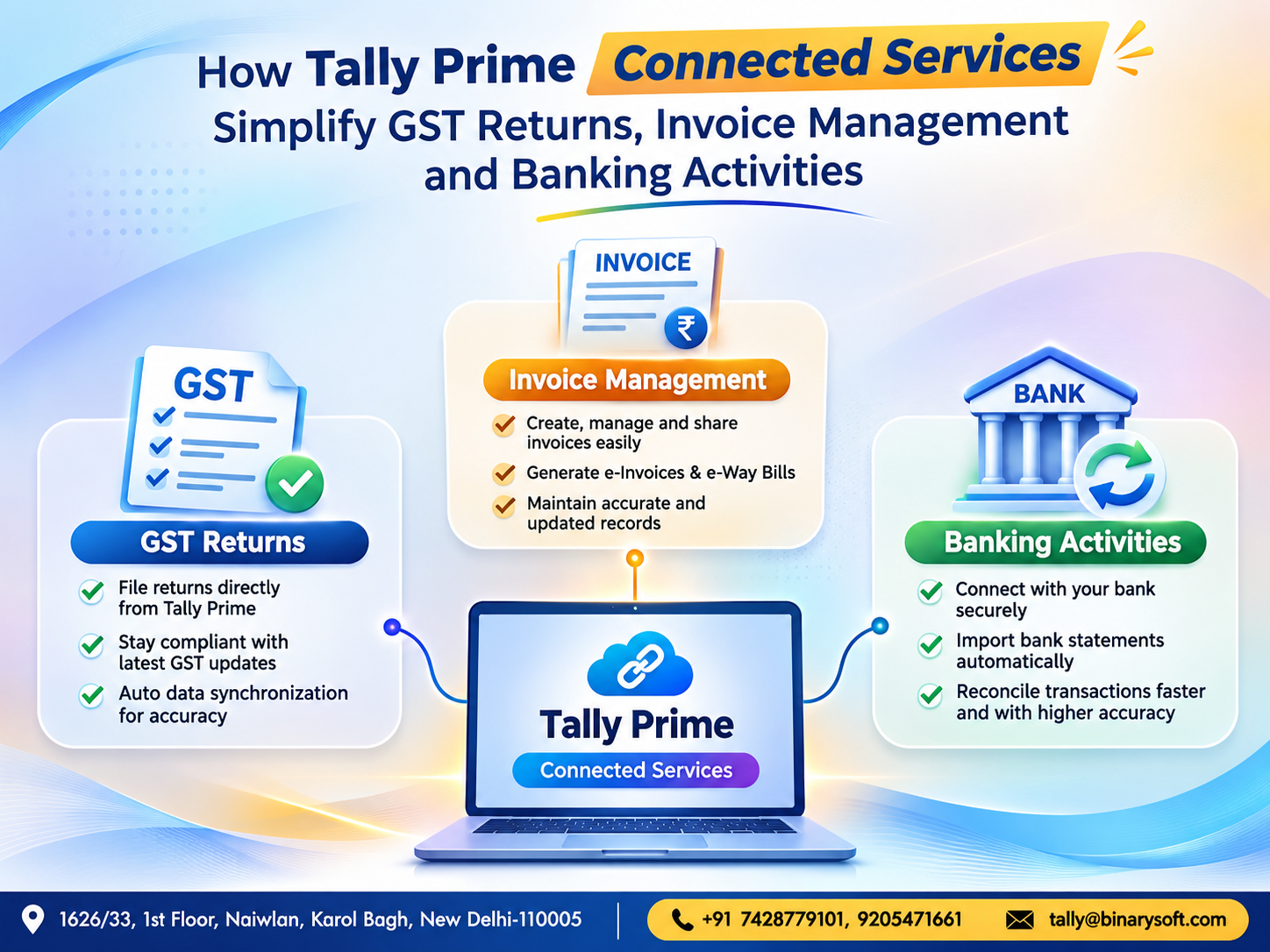
Connected Banking Capabilities
Certain supported banking arrangements may offer additional connected services.
Businesses should verify bank eligibility, activation requirements and available features before relying on these capabilities.
4. Efficient Bank Transaction Management in Tally Prime
Accurate banking records begin with properly recorded financial transactions.
Tally Prime supports different voucher types for managing business banking activities.
Payment Vouchers
Payment vouchers are used to record money paid by the business.
Common examples include supplier payments, rent, electricity bills, professional fees and other operating expenses.
The appropriate bank ledger is selected when recording the transaction.
Receipt Vouchers
Receipt vouchers record money received by the business.
These transactions may include customer payments, interest income, refunds and other receipts.
When bill-wise accounting is configured, receipts can be adjusted against relevant customer invoices.
Contra Vouchers
Contra vouchers are used for transfers involving cash and bank accounts, including transfers between the business's own bank accounts.
Journal Vouchers
Journal vouchers can be used for appropriate accounting adjustments that do not require ordinary receipt or payment vouchers.
Benefits of Proper Transaction Recording
Consistent voucher entry improves ledger accuracy, simplifies reconciliation and supports reliable financial reporting.
5. Bank Reconciliation in Tally Prime: Why It Matters
Bank reconciliation is the process of comparing transactions recorded in accounting books with transactions appearing in bank statements.
The objective is to identify differences and confirm that banking records are complete and accurate.
Common Reasons for Reconciliation Differences
Differences may arise because of:
-
Cheques issued but not yet cleared.
-
Customer payments not recorded in accounting books.
-
Bank charges or interest entries.
-
Incorrect transaction amounts.
-
Duplicate accounting entries.
-
Transactions recorded on different dates.
For example, a business may record a supplier payment of ₹45,000 on 28 September.
However, the bank may process the transaction on 1 October.
The difference in dates must be considered during reconciliation.
Advantages of Regular Bank Reconciliation
Regular reconciliation helps businesses identify missing transactions, investigate errors and maintain reliable financial information.
It also supports faster month-end accounting procedures.
6. How to Perform Bank Reconciliation in Tally Prime
Businesses can follow a structured reconciliation process.
Step 1: Create the Bank Ledger
Create the relevant bank account under the appropriate bank account group.
Enter the required bank information accurately.
Step 2: Record Banking Transactions
Use receipt, payment and contra vouchers to record transactions.
Ensure dates, amounts and ledger allocations are correct.
Step 3: Obtain the Bank Statement
Download the statement from the bank using a format supported by the installed Tally Prime release.
Step 4: Open the Banking Reconciliation Feature
Access the applicable bank reconciliation option from the banking or accounting reports available in the product.
Step 5: Import the Statement
Where supported, import the bank statement and review the displayed transactions.
Step 6: Match Transactions
Compare accounting entries with corresponding bank statement transactions.
Use available matching or reconciliation options.
Step 7: Investigate Differences
Review unmatched transactions carefully.
Check whether they represent missing entries, bank charges, timing differences or incorrect postings.
Step 8: Complete Reconciliation
Update reconciliation information after verifying the transactions.
Step 9: Review Outstanding Items
Examine transactions that remain unreconciled and investigate them before closing the accounting period.
Important: Bank statement import, automatic matching and reconciliation workflows may vary by Tally Prime release and bank support. Always verify transactions before confirming adjustments.
7. Automated Bank Reconciliation: Reducing Manual Accounting Work
Traditional reconciliation requires accountants to compare numerous transactions manually.
Automated or assisted reconciliation features can reduce this effort.
Tally Prime supports reconciliation workflows that help identify matching transactions from supported bank statements.
How Assisted Reconciliation Helps
When bank statement information is available, the accounting team can compare imported transactions with recorded vouchers.
Matching transactions can be identified more efficiently.
Unmatched entries can then be reviewed separately.
Practical Benefits
Reduced manual effort: Accountants spend less time comparing repetitive transactions.
Improved accuracy: Structured matching reduces the risk of overlooking entries.
Faster financial closing: Reconciliation can be completed more efficiently.
Better transaction visibility: Unmatched items become easier to identify.
Improved financial discipline: Regular reconciliation encourages timely accounting updates.
Automation does not eliminate the need for human verification.
Accountants should continue reviewing unusual transactions, incorrect allocations and unmatched entries.
8. Managing Customer Payments Through Digital Banking
Customer payment tracking is essential for maintaining healthy working capital.
Businesses may receive payments through bank transfers, UPI, cheques and other supported payment channels.
Tally Prime helps organize these receipts within customer accounting records.
Recording Customer Receipts
When a customer makes a payment, the accountant records the transaction through a receipt voucher.
The payment can be adjusted against the appropriate outstanding invoice.
Bill-Wise Accounting
Bill-wise accounting helps businesses identify unpaid, partially paid and settled invoices.
Customer Outstanding Reports
Receivables reports provide visibility into customer balances.
Businesses can identify overdue invoices and prioritize collection activities.
Matching Bank Credits
Bank reconciliation helps verify whether recorded customer receipts correspond to bank statement credits.
Improving Collection Efficiency
Businesses can use outstanding reports to plan customer follow-ups.
This improves payment discipline and helps reduce avoidable collection delays.
9. The Human Side of Business Banking: A Story of Financial Confidence
For fifteen years, Amit had operated a family-owned furniture manufacturing business in Delhi.
His workshop employed twelve people, including carpenters, polishers and delivery workers.
The business had a loyal customer base, but its financial operations were becoming increasingly difficult to manage.
Every month, Amit faced the same problem.
His bank statement showed numerous transactions, but his accounting records did not always match.
Some customers paid without mentioning invoice numbers.
Supplier payments were recorded late.
Bank charges were occasionally overlooked.
One Friday evening, Amit discovered that the bank balance was lower than expected.
Employee salaries were due the following morning.
He spent several anxious hours reviewing statements and contacting his accountant.
His wife noticed his worried expression.
Their young son had been waiting for him to attend a school function, but Amit remained occupied with financial records.
That evening became a turning point.
Amit decided to improve his business accounting processes.
He organized bank ledgers, customer accounts and payment records in Tally Prime.
His accountant began recording transactions consistently and reconciling bank statements every week.
Over time, unexplained differences became easier to investigate.
Customer payment tracking improved, and Amit gained better visibility into available funds and upcoming obligations.
The business still experienced ordinary financial challenges, but its records became more reliable.
A few months later, Amit attended another school event.
This time, he was sitting in the front row.
For him, improved banking management meant more than accurate accounting.
It meant reduced uncertainty, greater confidence and more time with his family.
This fictional story illustrates the emotional and operational benefits of disciplined banking and accounting practices.
10. Case Study 1: Trading Company Improves Bank Reconciliation Efficiency
Business Background
A wholesale trading company processed approximately 1,200 banking transactions every month.
Its customers made payments through multiple electronic payment channels.
The accounting team manually compared bank statements with customer and supplier ledgers.
Challenges
The company experienced delayed reconciliation, unidentified customer receipts and occasional duplicate accounting entries.
Month-end reconciliation required approximately 24 working hours.
Tally Prime Implementation
The company organized its bank ledgers and introduced a regular reconciliation schedule.
Supported bank statements were imported into Tally Prime.
The accounting team reviewed matching transactions and investigated unmatched entries separately.
Customer receipts were adjusted against the relevant invoices.
Illustrative Results
After three months, monthly reconciliation effort decreased from approximately 24 hours to 9 hours.
Unidentified customer payments were resolved more quickly.
Financial reports became available earlier during month-end closing.
Key Learning
Structured bank reconciliation and consistent transaction recording can reduce accounting effort and improve financial visibility.
This is an illustrative case study. Results are hypothetical and will vary according to transaction volume, software configuration and operational practices.
11. Case Study 2: Service Company Strengthens Cash Flow Management
Business Background
A growing consultancy firm provided professional services to corporate clients.
The business generated regular revenue but experienced inconsistent customer payment collections.
Challenges
Customer invoices were often paid after their due dates.
Management had difficulty identifying upcoming financial obligations.
The accounting team reviewed customer balances only at month-end.
Tally Prime Implementation
The company introduced bill-wise customer accounting and organized its banking records.
Customer receipts were adjusted against outstanding invoices.
Management began reviewing receivables, bank balances and cash flow reports weekly.
Illustrative Results
Over six months, the average customer collection period decreased from 48 days to 35 days.
The company also improved payment planning for salaries, rent and supplier expenses.
Management gained better visibility into short-term financial requirements.
Key Learning
Regular monitoring of receivables and banking transactions can help businesses improve working capital management.
This illustrative case study demonstrates potential benefits rather than verified customer outcomes.
12. Improving Cash Flow Management with Tally Prime
Cash flow management involves monitoring money entering and leaving a business.
Even profitable organizations can face financial difficulties when customer payments are delayed or expenses exceed available funds.
Tally Prime provides accounting reports that help businesses understand cash movement and financial commitments.
Monitor Cash and Bank Balances
Cash and bank books help businesses review recorded receipts, payments and balances.
Review Customer Receivables
Outstanding reports identify amounts expected from customers.
Track Supplier Payables
Payables reports help businesses monitor upcoming supplier obligations.
Analyze Cash Flow Statements
Cash flow reports provide information about recorded cash movements.
Improve Working Capital Planning
By reviewing receivables, payables and available balances together, businesses can make more informed financial decisions.
Practical Example
Consider a business with the following financial position:
Monthly customer collections: ₹15,00,000
Monthly supplier payments: ₹9,00,000
Monthly operating expenses: ₹4,00,000
Net monthly cash movement: ₹2,00,000
If customer collections decline by ₹3,00,000 while expenses remain unchanged, the business may experience a monthly cash shortfall of ₹1,00,000.
Regular cash flow monitoring helps management identify such risks earlier.
However, historical cash flow reports are not substitutes for forward-looking cash forecasts. Businesses should also consider expected collection dates, future expenses and committed payments.
13. Digital Banking Security and Financial Data Protection
Banking information is sensitive and requires appropriate security controls.
Businesses should protect financial records against unauthorized access, accidental modification and data loss.
User Access Permissions
Configure appropriate user permissions to restrict access to sensitive accounting functions.
Strong Authentication
Use secure credentials for banking portals and accounting environments.
Regular Data Backups
Maintain reliable backups and periodically verify that restoration procedures work.
Transaction Verification
Review beneficiary details, payment amounts and supporting documents before authorizing transfers.
Segregation of Responsibilities
Where practical, separate transaction preparation, payment authorization and reconciliation responsibilities.
Secure Remote Access
Businesses using cloud-hosted environments should implement suitable network security, access controls and monitoring.
Bank reconciliation confirms accounting consistency; it does not independently establish that every payment was authorized or free from fraud.
14. Tally Prime Cloud for Remote Banking and Accounting Management
Modern business owners frequently need access to financial information while travelling or working from different locations.
A properly configured Tally Prime Cloud environment can support remote access to accounting information.
Remote Financial Monitoring
Authorized users can review recorded bank balances, customer outstanding reports and financial statements.
Centralized Accounting
Teams can work with a common accounting environment according to their permissions and licensing.
Multi-Location Operations
Businesses operating across multiple locations can benefit from centralized access to accounting records.
Backup and Continuity
Appropriate hosting arrangements can support scheduled backups and disaster recovery planning.
Better Collaboration
Accountants and authorized managers can review financial information without relying entirely on locally stored files.
Cloud hosting does not automatically provide live banking connectivity.
Actual capabilities depend on the Tally Prime release, hosting infrastructure, supported banking services and configuration.
15. Best Practices for Efficient Digital Banking Operations
Businesses should adopt consistent procedures to maximize the benefits of digital banking.
Reconcile bank accounts regularly. High-volume businesses may benefit from daily reconciliation, while smaller organizations may use a weekly schedule.
Record transactions promptly. Delayed entries can create misleading financial reports.
Maintain accurate customer references. Proper bill-wise accounting simplifies receipt allocation.
Review unmatched transactions. Investigate unexplained bank credits, debits and reconciliation differences.
Monitor receivables frequently. Regular customer follow-ups help improve collection discipline.
Plan supplier payments. Review available funds and upcoming commitments before scheduling payments.
Protect banking credentials. Never share passwords, OTPs or banking authorization details through insecure channels.
Review financial reports. Use cash flow statements, bank books and outstanding reports to support financial planning.
Train accounting employees. Proper training improves transaction accuracy and reduces avoidable mistakes.
Verify software compatibility. Confirm supported bank statement formats and banking capabilities before implementing new workflows.
These practices help businesses build reliable banking and accounting processes.
16. Why Digital Banking and Accounting Integration Matter for Business Growth
As businesses expand, transaction volumes and financial responsibilities increase.
Manual banking processes become harder to manage.
Integrated banking and accounting workflows can support growth by improving transaction visibility and reducing repetitive administrative work.
Accurate bank records also support stronger financial decision-making.
Business owners can identify payment delays, monitor available funds and evaluate upcoming obligations more effectively.
For small and medium-sized businesses, these improvements can make financial operations more predictable.
Digital banking is therefore not simply about replacing paper-based transactions.
It is about creating a more organized financial management system that supports operational efficiency, accountability and sustainable growth.
Conclusion
Efficient banking management is essential for maintaining financial accuracy, operational stability and healthy business cash flow.
Manual reconciliation, delayed transaction recording and poor payment visibility can create unnecessary challenges for growing organizations.
Digital banking in Tally Prime helps businesses organize banking transactions, simplify reconciliation, monitor customer payments and improve financial reporting.
Through properly configured bank ledgers, receipt and payment vouchers, supported bank statement imports and cash flow reports, businesses can establish more reliable accounting processes.
Regular reconciliation and disciplined payment monitoring also help management identify financial risks earlier.
Whether you operate a trading company, manufacturing business, consultancy firm or service organization, Tally Prime can support better banking-related accounting and financial control.
The objective is not merely to record money received and paid.
It is to understand how money moves through the business and use that information to make better decisions.
With suitable implementation and professional guidance, organizations can improve accounting efficiency and build a stronger foundation for long-term growth.
Powered by Binarysoft Technologies
Authorized Tally Partner
Binarysoft Technologies helps businesses improve their accounting operations through Tally Prime implementation, configuration, banking-related accounting workflows, inventory management and suitable cloud-hosting solutions.
Our team can assist organizations in organizing bank ledgers, improving reconciliation procedures, managing customer payments and strengthening financial reporting processes.
Location:
1626/33, 1st Floor, Naiwalan, Karol Bagh, New Delhi – 110005, INDIA
Contact Us:
+91 7428779101, 9205471661
Email:
tally@binarysoft.com
Business Hours:
10:00 AM – 6:00 PM, Monday to Friday
Simplify your banking transactions, improve reconciliation accuracy and strengthen cash flow management with Tally Prime.
Frequently Asked Questions
What is digital banking in Tally Prime?
Digital banking in Tally Prime refers to banking-related accounting capabilities such as recording bank transactions, importing supported statements, reconciling entries and reviewing financial information. Certain connected banking services may also be available under supported arrangements.
Can Tally Prime automatically reconcile bank transactions?
Tally Prime provides reconciliation features that can assist with matching accounting entries against supported bank statements. Available automation depends on the software release, statement format and configuration.
How do I import a bank statement into Tally Prime?
Businesses can use the applicable bank statement import feature in a supported Tally Prime release. The statement must be in a compatible format, and imported transactions should be reviewed carefully.
Does Tally Prime support multiple bank accounts?
Yes. Businesses can create and maintain separate ledgers for multiple bank accounts.
CA. Advait Chitale advises businesses on taxation, audit, and financial controls. He is passionate about helping organizations adopt technology-driven accounting solutions that enhance productivity and ensure regulatory compliance.