Call CA Tally HelpDesk
+91 9205471661,
7428779101
Introduction: Why Connected Services in TallyPrime Are Becoming More Important in 2026
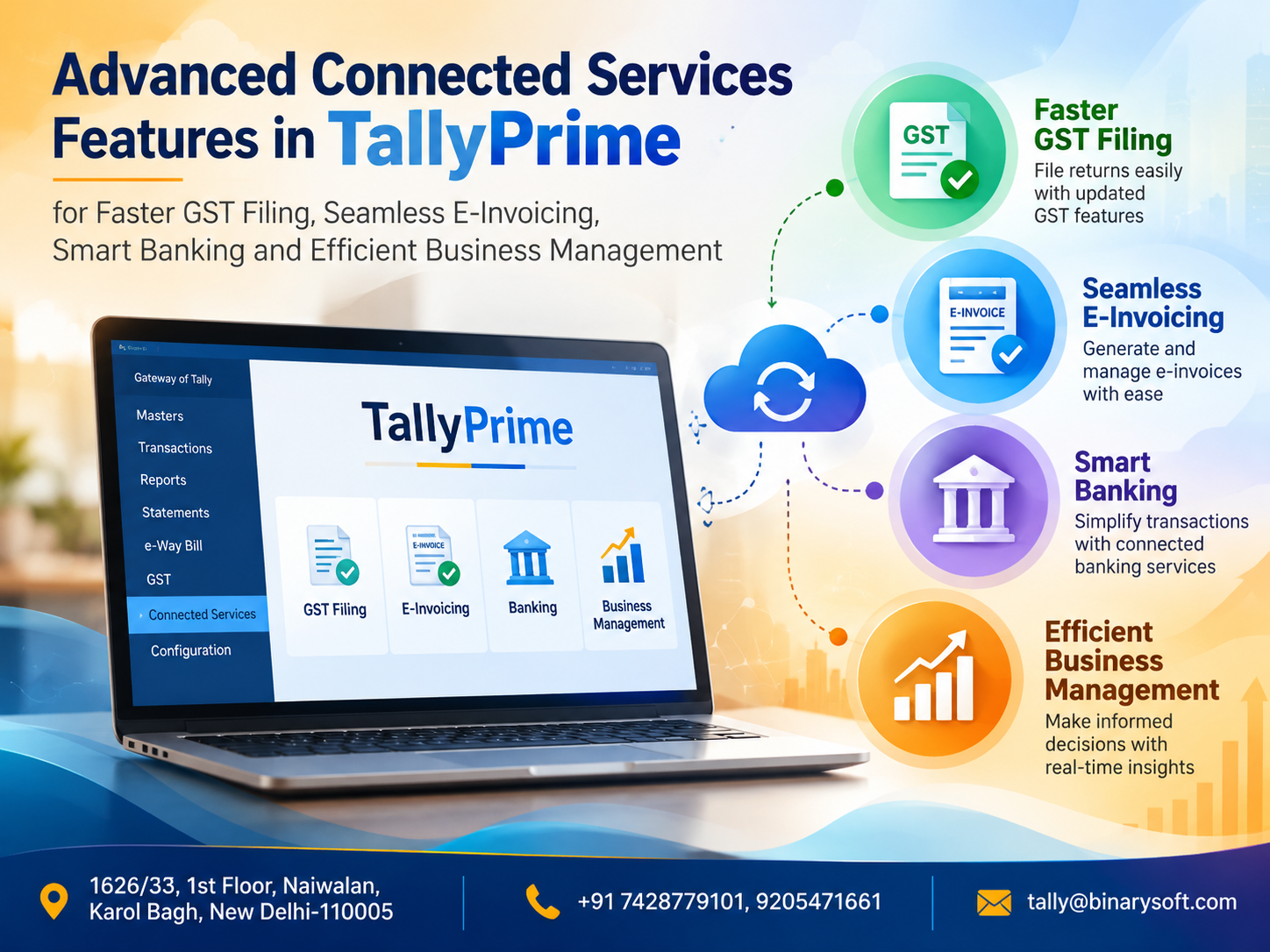
In 2026, Indian businesses are under growing pressure to manage GST compliance, generate e-invoices, reconcile bank transactions, and maintain accurate financial records without slowing daily operations. As digital tax reporting and electronic business transactions become increasingly important, repeatedly switching between accounting software, government portals, banking platforms, and spreadsheets can create unnecessary work and increase the risk of errors. Delayed GST reconciliation, incorrect invoice information, and incomplete banking records may affect cash flow, compliance, and customer relationships. TallyPrime's connected services help businesses bring several of these activities closer to their accounting workflows through supported GST portal connectivity, e-invoicing, e-way bill services, banking features, and digital document sharing. By using these capabilities effectively, retailers, wholesalers, manufacturers, distributors, and service providers can reduce repetitive data entry, improve transaction visibility, identify discrepancies earlier, and manage financial operations more efficiently while maintaining appropriate checks over compliance and business data.
What Are Connected Services in TallyPrime?
Connected services in TallyPrime refer to features that help businesses exchange information between their accounting system and supported external services.
Traditionally, businesses maintained accounting records in software but completed several related activities separately.
For example, an accountant might prepare GST reports in accounting software, open the GST portal to download return information, access another platform to generate e-invoices, and visit a banking website to compare transactions.
Although these activities are necessary, repeatedly transferring information between systems can consume time and introduce errors.
TallyPrime offers connected capabilities that can simplify selected workflows.
These include GST-related services, e-invoicing, e-way bill operations, supported banking services, and digital communication features.
The availability of individual services depends on the TallyPrime release, subscription, configuration, internet connectivity, supported providers, and applicable regulatory requirements.
Why Connected Services Matter for Businesses
Connected services can help organizations:
-
Reduce repeated manual data entry.
-
Improve coordination between accounting and compliance activities.
-
Access supported online services through accounting workflows.
-
Identify GST-related discrepancies.
-
Simplify eligible e-invoice generation.
-
Improve e-way bill processing.
-
Support bank reconciliation.
-
Share business documents digitally.
-
Maintain more organized financial information.
-
Reduce administrative workload.
The main advantage is not that every business process becomes completely automatic. It is that supported digital services can be accessed through more connected and efficient workflows.
A Business Story: How Digital Connectivity Helped a Distributor Regain Control of His Accounts
Consider the fictional story of Rakesh, who operates an electrical goods distribution business in Delhi.
His company supplies cables, switches, lighting equipment, and electrical accessories to retailers and contractors across Delhi NCR.
Over several years, his business expanded considerably.
Daily invoice volumes increased, customer accounts became more complex, and GST-related activities required greater attention.
However, the accounting process remained largely manual.
Rakesh's accounts team recorded transactions in accounting software but used separate websites and spreadsheets for many compliance activities.
Every month, the team spent considerable time checking invoices, downloading GST information, comparing purchase records, and reconciling bank statements.
During busy periods, these tasks often extended late into the evening.
The Problem That Changed Everything
One afternoon, Rakesh received a call from a major customer.
The customer was unable to locate the expected e-invoice information for a recent transaction.
At the same time, the accounts department discovered discrepancies between certain purchase records and GST portal information.
The accountant was already working on bank reconciliation and preparing records for an upcoming compliance deadline.
Several employees were searching through spreadsheets and downloaded files.
Rakesh became increasingly worried.
He had worked hard to build a successful business, but the growing administrative burden was affecting his employees and customer relationships.
The problem was not a lack of effort.
His team was spending too much time moving information between disconnected processes.
The Turning Point: Adopting Connected Accounting Workflows
Rakesh decided to review the connected services available in his TallyPrime setup.
With appropriate configuration, his team began using supported GST connectivity features, e-invoicing workflows, e-way bill capabilities, and bank reconciliation tools.
The accounts department also established a structured process for checking transaction exceptions before completing compliance activities.
Instead of relying entirely on repeated manual downloads and comparisons, employees could complete more tasks through supported connected workflows.
Over time, the business reduced unnecessary duplication and improved its accounting review process.
Employees could focus more attention on investigating actual discrepancies rather than repeatedly transferring information.
Rakesh also gained greater confidence in the reliability of his financial records.
The most meaningful change was not simply faster processing.
It was the reduction in daily uncertainty.
His team had more time to serve customers, review accounts, and plan business operations.
This illustrative story demonstrates how connected accounting services, combined with proper internal controls, can improve business efficiency and reduce administrative pressure.
1. Connected GST Services in TallyPrime
GST compliance is an important responsibility for registered businesses in India.
Businesses must maintain accurate transaction records, review applicable tax information, reconcile relevant purchase data, and submit returns within prescribed timelines.
TallyPrime provides connected GST capabilities in supported releases and configurations.
These services can help businesses work with GST-related information through their accounting environment.
Important Connected GST Capabilities
GST return data access: Supported connected workflows can help retrieve relevant information from the GST system.
Return preparation: Businesses can review accounting transactions and prepare applicable return information.
Reconciliation: Purchase-related information can be compared with relevant GST portal data.
Exception identification: Certain mismatches or incomplete transaction details can be identified for review.
Return-related status information: Supported services may provide information about connected GST activities.
Filing workflows: Eligible connected filing functions can help businesses complete supported return-related processes.
Benefits for Businesses
Connected GST services can reduce repeated portal navigation, improve the consistency of accounting reviews, and make it easier to investigate tax-related discrepancies.
However, businesses remain responsible for verifying return information and ensuring that filings comply with applicable GST requirements.
2. Faster GSTR-1 Preparation and Filing Workflows
GSTR-1 contains details of outward supplies reported by applicable registered taxpayers.
Preparing accurate GSTR-1 information requires businesses to review sales invoices, credit notes, debit notes, and other relevant transactions.
TallyPrime supports GSTR-1 preparation and connected workflows in applicable releases.
How Connected GSTR-1 Features Help
Businesses can use relevant features to:
-
Review sales transactions.
-
Identify missing or inconsistent GST information.
-
Examine applicable return sections.
-
Prepare eligible return data.
-
Use supported online upload or filing workflows.
-
Review transaction exceptions before submission.
Practical Example
A distributor generates 1,200 sales invoices during a month.
Manually checking every invoice across separate spreadsheets can be time-consuming.
With properly maintained TallyPrime records, the accounts team can review GST-related reports and identify exceptions requiring attention.
Supported connected services may then reduce additional manual steps in the return workflow.
This can improve efficiency without eliminating the need for verification.
3. GSTR-2A and GSTR-2B Reconciliation
Input Tax Credit management is a major concern for GST-registered businesses.
Businesses need to compare purchase records with relevant GST portal information to identify potential differences.
GSTR-2A and GSTR-2B provide different views of supplier-reported information.
TallyPrime offers GST reconciliation features, including connected data access in supported configurations.
Common Reconciliation Issues
-
Supplier invoices missing from portal data.
-
Incorrect GSTIN information.
-
Differences in taxable values.
-
Differences in GST amounts.
-
Invoice number mismatches.
-
Transactions recorded in different periods.
-
Credit note or debit note differences.
Example
|
Particulars
|
Purchase books
|
GSTR-2B
|
|---|
|
Eligible ITC under review
|
₹2,50,000
|
₹2,35,000
|
|
Difference
|
|
₹15,000
|
Illustrative example.
The ₹15,000 difference requires investigation.
It may result from supplier reporting delays, incorrect invoice details, timing differences, or other issues.
The amount appearing in GSTR-2B should not automatically be treated as the final eligible ITC without considering applicable GST rules and conditions.
Benefits of GST Reconciliation
-
Better visibility into purchase-related discrepancies.
-
Improved supplier follow-up.
-
More organized ITC review.
-
Reduced dependence on manual comparisons.
-
Earlier identification of potential compliance issues.
4. ITC at Risk Analysis and Supplier Compliance Visibility
Input Tax Credit discrepancies can affect working capital and GST compliance.
Connected GST features in applicable TallyPrime releases may help businesses identify purchase-related ITC differences and review information requiring attention.
Why ITC Monitoring Matters
A business may record a purchase invoice correctly in its books, but the relevant supplier-reported information may not appear as expected in GST records.
This can create uncertainty regarding ITC availability.
By reviewing reconciliation information, businesses can identify transactions that require supplier communication or additional verification.
Business Benefits
-
Better awareness of ITC-related discrepancies.
-
Improved supplier reconciliation.
-
More organized tax documentation.
-
Faster identification of missing purchase information.
-
Better information for GST compliance decisions.
ITC eligibility must always be determined under applicable GST law, not solely from a software-generated warning or classification.
5. E-Invoicing Services in TallyPrime
E-invoicing is an important part of India's GST compliance framework for businesses covered by the applicable requirements.
Under the e-invoicing system, eligible invoice information is reported to an Invoice Registration Portal.
The portal validates the submitted information and generates relevant registration details, including an Invoice Reference Number.
TallyPrime provides e-invoicing capabilities that can simplify supported workflows.
Important E-Invoicing Features
-
Preparation of eligible invoice information.
-
Supported submission workflows.
-
Generation or retrieval of relevant IRN details.
-
Handling of applicable e-invoice status information.
-
Support for required invoice output details.
-
Relevant cancellation workflows where supported.
How E-Invoicing Improves Efficiency
Businesses can reduce repeated entry of invoice information across separate systems.
When transactions are recorded correctly, supported connected workflows can help streamline the process of reporting eligible invoices.
Example
A manufacturing company generates 300 eligible B2B invoices during a reporting period.
Instead of manually transferring each invoice's information to a separate platform, the company may use supported TallyPrime e-invoicing workflows.
This can reduce repetitive work and improve consistency.
E-invoicing applicability, reporting timelines, cancellation conditions, and technical requirements should be verified against current GST rules.
6. E-Way Bill Generation and Management
E-way bills are required for certain movements of goods under applicable GST rules.
Businesses transporting goods must consider the nature of the transaction, consignment value, movement details, and applicable exemptions.
TallyPrime supports e-way bill-related workflows.
Important E-Way Bill Information
Relevant information may include:
Benefits of Connected E-Way Bill Services
-
Reduced repeated data entry.
-
Better coordination between invoicing and dispatch.
-
More organized transport documentation.
-
Improved consistency of transaction information.
-
Faster preparation of eligible e-way bill data.
Businesses should verify e-way bill requirements for each applicable movement and ensure transport information remains accurate.
7. Connected Banking Features in TallyPrime
Banking is an essential part of business accounting.
Businesses frequently need to review receipts, payments, bank charges, transfers, and outstanding instruments.
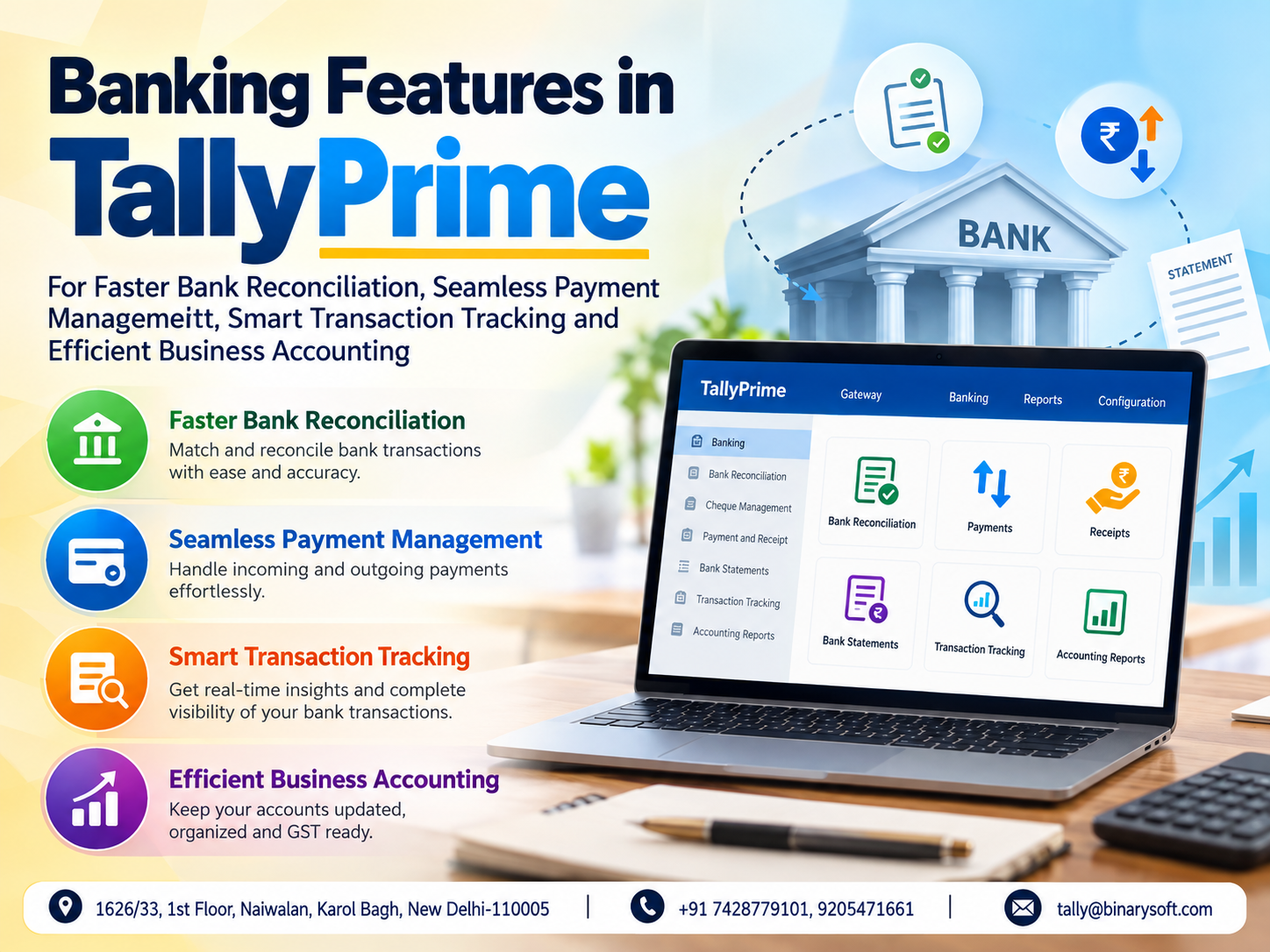
TallyPrime provides banking and reconciliation features, with connected banking services available for supported banks and configurations.
Common Banking Activities
-
Recording customer receipts.
-
Recording supplier payments.
-
Reviewing bank ledger transactions.
-
Importing supported bank statement data.
-
Reconciling bank transactions.
-
Identifying differences between bank and accounting records.
-
Reviewing relevant banking information.
Benefits of Connected Banking
Connected banking features can reduce manual transaction comparison and improve the efficiency of bank-related accounting activities.
However, available features vary by bank, product release, and service arrangement.
Businesses should not assume that every bank supports direct connectivity or that every payment can be initiated automatically.
8. Bank Reconciliation for Better Financial Accuracy
Bank reconciliation involves comparing transactions recorded in accounting books with transactions shown in bank statements.
Differences may arise because of uncleared cheques, missing entries, bank charges, interest, or timing differences.
TallyPrime supports bank reconciliation, including additional automation capabilities in applicable versions.
Example
|
Particulars
|
Amount
|
|---|
|
Bank ledger balance
|
₹8,50,000
|
|
Bank statement balance
|
₹8,35,000
|
|
Difference
|
₹15,000
|
The difference could result from an uncleared payment or another transaction requiring investigation.
Bank reconciliation helps identify the reason for the difference.
Business Advantages
-
Improved bank ledger accuracy.
-
Faster identification of missing transactions.
-
Reduced reconciliation workload.
-
Better cash and bank visibility.
-
More reliable financial reports.
-
Improved accounting controls.
9. Digital Invoice and Document Sharing
Businesses regularly share invoices, statements, receipts, and financial documents with customers, suppliers, and other stakeholders.
TallyPrime provides document-sharing features through supported communication services and configured output options.
Depending on the release and service availability, these may include email and WhatsApp-related capabilities.
Common Applications
-
Sharing sales invoices.
-
Sending relevant account statements.
-
Communicating transaction information.
-
Distributing business documents.
-
Reducing manual document handling.
Benefits
Digital document sharing can improve communication speed and reduce the time spent printing, scanning, and manually distributing documents.
Businesses should verify recipient details and use appropriate security practices before sharing financial information.
10. WhatsApp Integration for Business Communication
WhatsApp has become an important communication channel for many Indian businesses.
Supported TallyPrime releases offer WhatsApp-related document-sharing capabilities through applicable connected services.
Potential Business Uses
-
Sharing sales invoices with customers.
-
Sending relevant accounting documents.
-
Communicating transaction details.
-
Improving document delivery convenience.
Why WhatsApp Connectivity Matters
Many customers prefer receiving business documents through familiar digital channels.
Integrated sharing can reduce the need to export documents and manually attach them through separate applications.
However, WhatsApp-related features depend on service availability, subscription or usage requirements, and supported workflows.
Businesses should not assume that every communication, reminder, or customer interaction is automatically handled.
11. Connected Services and Customer Outstanding Management
Customer outstanding balances affect business cash flow.
When invoices remain unpaid, businesses may struggle to meet supplier obligations and daily expenses.
TallyPrime provides bill-wise receivables tracking and customer outstanding reports.
These accounting capabilities can be combined with appropriate digital communication workflows.
Practical Applications
-
Review unpaid invoices.
-
Identify overdue balances.
-
Prepare customer account statements.
-
Share relevant documents through supported channels.
-
Improve payment follow-up procedures.
Example
A distributor has 150 customers with outstanding balances.
Instead of manually preparing separate spreadsheets, the accounts team can use customer ledger and receivables information to review amounts due.
Relevant statements can then be shared through available document-sharing methods.
This supports more organized collection activities.
12. Remote Access and Connected Business Operations
Business owners and accounting professionals increasingly need access to financial information while working from different locations.
TallyPrime provides supported remote-access and connected capabilities, subject to configuration and service availability.
Common Business Requirements
A business owner may need to review financial reports while travelling.
An accountant may need to access authorized company information from another location.
A manager may need to examine outstanding balances before approving a transaction.
Supported remote-access services can help address selected requirements.
Important Considerations
Remote access is not identical to full cloud hosting.
Businesses requiring centralized cloud infrastructure, simultaneous remote users, or specialized hosting arrangements should evaluate the relevant deployment options.
Security, licensing, connectivity, and access controls must also be considered.
13. Multi-GSTIN Management with Connected GST Workflows
Businesses operating in multiple states may maintain more than one GST registration.
Managing these registrations can create additional accounting and compliance requirements.
TallyPrime supports multi-GSTIN capabilities in applicable releases.
Benefits
-
Better organization of registration-specific records.
-
Support for relevant GST transaction classification.
-
Improved reporting across registrations.
-
Reduced dependence on disconnected manual records.
-
More consistent accounting processes.
Businesses should verify that the selected release and configuration support their required multi-GSTIN and connected GST workflows.
14. GST Activity Logs and Transaction Status Monitoring
Connected services involve communication between accounting software and external systems.
When transactions are uploaded, downloaded, or processed through supported services, businesses may need to review their status.
Applicable TallyPrime releases provide status-tracking and activity information for certain connected GST operations.
Why Activity Tracking Matters
An accounting team may need to know whether a request was completed, rejected, or requires further attention.
Status information can help employees identify transactions requiring corrective action.
Benefits
-
Better visibility into connected activities.
-
Easier investigation of unsuccessful requests.
-
Reduced confusion about processing status.
-
Improved accountability.
-
More organized compliance workflows.
The exact activity logs, trackers, and notifications available depend on the release and connected service.
15. Connected Services and Financial Reporting
Financial reporting helps businesses understand profitability, cash flow, outstanding balances, and overall financial position.
TallyPrime provides reports such as:
-
Balance Sheet.
-
Profit & Loss Account.
-
Trial Balance.
-
Cash Flow.
-
Receivables.
-
Payables.
-
Ledger reports.
-
GST-related reports.
Connected services can complement these reports by supporting relevant data exchange and reconciliation activities.
However, financial statements remain dependent on accurate accounting entries and appropriate reporting policies.
16. How Connected Services Help Reduce Manual Work
One of the main advantages of connected accounting is the reduction of repetitive activities.
Traditional workflows often require employees to enter or transfer the same information across multiple systems.
Connected services can reduce some of these steps.
|
Business activity
|
Traditional approach
|
Connected TallyPrime approach
|
|---|
|
GST data review
|
Separate portal downloads and manual comparison
|
Supported connected GST data access and reconciliation
|
|
E-invoicing
|
Re-entering invoice details on another platform
|
Supported invoice reporting workflow
|
|
E-way bill preparation
|
Repeated transport and invoice data entry
|
Supported e-way bill workflow
|
|
Bank reconciliation
|
Manual comparison with bank statements
|
Statement import or connected reconciliation where available
|
|
Document sharing
|
Exporting and attaching files manually
|
Supported email or WhatsApp sharing
|
|
GST activity monitoring
|
Checking separate processing records
|
Relevant connected status information where available
|
The actual efficiency improvement depends on transaction volumes, configuration, and the availability of supported services.
17. Data Security in Connected Accounting Services
Connected accounting workflows involve business and financial information.
Protecting this information is essential.
Businesses should establish suitable security practices when enabling connected services.
Important Security Measures
User access control: Grant employees only the permissions required for their responsibilities.
Strong authentication: Protect credentials used for accounting and connected services.
Secure communication: Use supported and trusted connectivity methods.
Regular backups: Maintain reliable backups of accounting data.
Transaction verification: Review important connected transactions and exceptions.
Software updates: Keep the accounting environment updated and supported.
Staff awareness: Train employees to recognize suspicious messages and avoid sharing sensitive credentials.
Connected services can improve efficiency, but businesses must maintain responsibility for data security and internal controls.
18. Common Connected Services Problems and How to Address Them
Businesses may encounter issues when using online services.
These can arise from connectivity problems, incorrect configuration, service availability, or incomplete transaction information.
Internet Connectivity Problems
Connected workflows require suitable network access.
Businesses should check connectivity and service availability before retrying unsuccessful requests.
Incorrect GST Information
Invalid or inconsistent GSTIN, invoice, or tax details may prevent successful processing.
Review the relevant master and transaction information.
E-Invoice Validation Errors
Invoice registration may fail if required details are missing or inconsistent.
The accounts team should review the error information and correct the relevant transaction.
Bank Reconciliation Differences
Differences may result from timing issues, duplicate entries, or missing transactions.
Reconciliation should be completed using appropriate supporting records.
Unsupported Service Configuration
Some features may not be available for a particular bank, release, or subscription.
Businesses should verify compatibility before planning a connected workflow.
19. Practical Steps to Enable and Use Connected Services in TallyPrime
A structured implementation process can help businesses adopt connected services more effectively.
Step 1: Review the TallyPrime Release
Check the installed release and identify the connected services supported by that version.
Step 2: Verify Licensing and Service Requirements
Confirm that the relevant subscription, connected service, and account requirements are satisfied.
Step 3: Configure Company and GST Details
Maintain accurate company information, GST registrations, ledgers, and tax-related settings.
Step 4: Enable Applicable Connected Features
Configure the required GST, e-invoicing, e-way bill, banking, or communication capabilities according to the supported workflow.
Step 5: Review User Permissions
Ensure that only authorized employees can access sensitive connected activities.
Step 6: Test with Appropriate Transactions
Use suitable test or controlled business transactions to verify configuration before wider adoption.
Step 7: Train Accounting Staff
Explain the correct process for connected transactions, reconciliation, status checking, and exception handling.
Step 8: Establish Review Procedures
Require verification of important GST, banking, and financial information.
Step 9: Monitor Errors and Exceptions
Review unsuccessful requests and resolve discrepancies promptly.
Step 10: Maintain Regular Backups
Protect accounting records through a documented backup and recovery process.
Exact menu paths and configuration steps depend on the TallyPrime release and service being used.
20. Industry-Wise Benefits of TallyPrime Connected Services
Retail Businesses
Retailers can benefit from organized GST accounting, invoice sharing, banking reconciliation, and financial reporting.
Wholesale Traders
Wholesalers can use supported e-invoicing, e-way bill, GST reconciliation, and customer account workflows to manage higher transaction volumes.
Manufacturing Companies
Manufacturers can connect relevant invoicing and transport documentation processes with accounting records.
FMCG Distributors
Distributors can benefit from GST-related reporting, e-way bill workflows, invoice communication, and customer outstanding management.
Service Providers
Professional service businesses can use digital invoicing, GST accounting, document sharing, and financial reports.
E-Commerce Sellers
Online sellers can maintain accounting records and use applicable GST-related connected services, with additional integrations where marketplace-specific data exchange is required.
Multi-Location Businesses
Organizations with multiple branches or registrations can evaluate relevant multi-GSTIN, remote-access, and reporting capabilities.
21. Common Mistakes Businesses Should Avoid When Using Connected Services
Businesses should avoid assuming that connected features eliminate the need for accounting review.
Common mistakes include:
-
Using outdated or unsupported software releases.
-
Maintaining incorrect GST registration information.
-
Submitting transactions without reviewing tax details.
-
Ignoring GST reconciliation differences.
-
Assuming all purchase ITC is automatically eligible.
-
Failing to review e-invoice validation errors.
-
Using incorrect e-way bill transport information.
-
Ignoring bank reconciliation exceptions.
-
Sharing financial documents with incorrect recipients.
-
Granting excessive user permissions.
-
Failing to maintain backups.
-
Repeating failed requests without checking their status.
-
Assuming every bank supports connected banking.
-
Confusing remote access with cloud hosting.
-
Treating connected services as a substitute for professional compliance review.
Avoiding these mistakes can help businesses use connected capabilities more reliably.
22. Connected Services and Better Cash Flow Management
Connected services can support better cash flow management indirectly by improving the timeliness and organization of financial information.
For example, faster invoice processing may reduce administrative delays.
Improved bank reconciliation can help businesses maintain more reliable cash and bank records.
Organized customer statements can support payment follow-ups.
GST reconciliation can help businesses identify tax-related differences requiring attention.
Together, these improvements can strengthen financial visibility.
However, connected services do not guarantee faster customer payments or automatically improve cash flow.
Businesses still need effective credit policies, collection procedures, expense controls, and financial planning.
23. Why TallyPrime Connected Services Are Valuable for Small and Medium Enterprises
Small and medium enterprises often operate with limited accounting teams.
Employees may be responsible for billing, GST preparation, bank reconciliation, customer follow-ups, and financial reporting.
This creates pressure during busy periods and compliance deadlines.
TallyPrime connected services can help reduce the administrative burden associated with selected online activities.
Key Advantages for SMEs
-
More efficient GST-related workflows.
-
Reduced repetitive data transfer.
-
Better invoice processing.
-
Improved reconciliation support.
-
Faster digital document sharing.
-
More organized transaction records.
-
Better visibility into processing exceptions.
-
Improved accounting productivity.
-
More consistent financial information.
-
Greater operational flexibility.
These benefits are particularly valuable when businesses combine connected features with well-defined accounting procedures.
24. The Future of Connected Accounting and Digital Compliance in India
Digital accounting is becoming an increasingly important part of business operations in India.
Businesses are expected to maintain accurate financial records while responding to evolving compliance requirements and customer expectations.
Connected GST services, e-invoicing, digital document sharing, and supported banking integrations can help reduce unnecessary separation between accounting and related online activities.
In 2026, businesses should focus on selecting digital workflows that match their actual operational requirements.
A small retailer may prioritize GST billing and document sharing.
A wholesale distributor may place greater emphasis on e-way bills, receivables, and GST reconciliation.
A manufacturer may require more extensive invoicing, inventory, banking, and financial reporting processes.
The appropriate connected services strategy depends on business size, transaction volume, industry, and compliance obligations.
TallyPrime provides a foundation for many of these activities through its accounting and supported connected capabilities.
Businesses that invest in accurate records, staff training, secure access, and regular financial review are better positioned to benefit from digital accounting.
25. How Binarysoft Technologies Can Help Businesses Use TallyPrime Connected Services
Implementing connected services requires more than enabling a software feature.
Businesses need to understand which services are supported, how they interact with accounting records, and what controls are required.
Binarysoft Technologies, an Authorized Tally Partner, can assist businesses with TallyPrime-related requirements.
Areas of Assistance
-
TallyPrime installation and configuration.
-
GST accounting setup.
-
Connected GST workflow guidance.
-
E-invoicing-related configuration.
-
E-way bill workflow assistance.
-
Bank reconciliation support.
-
Invoice and document-sharing setup.
-
Customer and supplier ledger management.
-
Financial reporting configuration.
-
User training and accounting process improvement.
Businesses should confirm the availability and scope of any specific implementation or support service before proceeding.
Conclusion
Connected services are becoming an important part of efficient business accounting in 2026.
As GST compliance, digital invoicing, banking activities, and financial reporting requirements become more demanding, businesses need reliable ways to reduce repetitive work and maintain accurate records.
TallyPrime offers connected capabilities that can support GST-related workflows, e-invoicing, e-way bill processing, bank reconciliation, document sharing, and selected remote business activities.
When properly configured, these features can improve accounting productivity, reduce unnecessary manual data transfer, and make it easier to identify discrepancies.
However, connected services are most effective when combined with accurate accounting records, trained employees, secure access controls, and regular compliance reviews.
For retailers, wholesalers, manufacturers, distributors, and service providers, adopting appropriate connected accounting features can support better operational efficiency and more confident financial management.
TallyPrime connected services help businesses bring accounting, compliance, banking, and digital communication closer together, creating a more organized foundation for sustainable business growth.
Powered by Binarysoft Technologies
Authorized Tally Partner
Binarysoft Technologies provides TallyPrime-related solutions and assistance for businesses seeking improved GST accounting, e-invoicing, e-way bill management, connected banking, digital document sharing, and financial reporting.
Businesses looking to implement or improve TallyPrime connected services can contact Binarysoft Technologies for guidance on suitable configurations and accounting workflows.
Location: 1626/33, 1st Floor, Naiwalan, Karol Bagh, New Delhi – 110005, INDIA
Contact Us: +91 7428779101, 9205471661
Email Us: tally@binarysoft.com
Business Hours: 10:00 AM – 6:00 PM, Monday to Friday
CA. Mayankh Singhaal is a Chartered Accountant experienced in accounting systems, statutory audits, and compliance advisory. He has worked with businesses across different sectors to improve reporting accuracy and inventory tracking. His writing focuses on structured growth and compliance-ready operations.