Call CA Tally HelpDesk
+91 9205471661,
7428779101
ntroduction: Why Small Businesses Need Strong Support Systems in 2026
Starting a small business in India requires courage, financial commitment and determination. Growing that business into a stable, profitable enterprise requires something more: access to the right support systems.
In 2026, Indian entrepreneurs face increasing competition, changing customer expectations, digital transformation and complex financial responsibilities. Whether someone operates a retail store in Delhi, a manufacturing unit in Faridabad or a service business in Bengaluru, access to funding, professional guidance and reliable technology can influence long-term success.
Many entrepreneurs remain unaware of government schemes, financial assistance programs, training opportunities and digital tools that could help them overcome everyday business challenges.
The right resources can make a meaningful difference. Affordable financing can support expansion, professional guidance can reduce compliance mistakes, and accounting software can improve financial visibility.
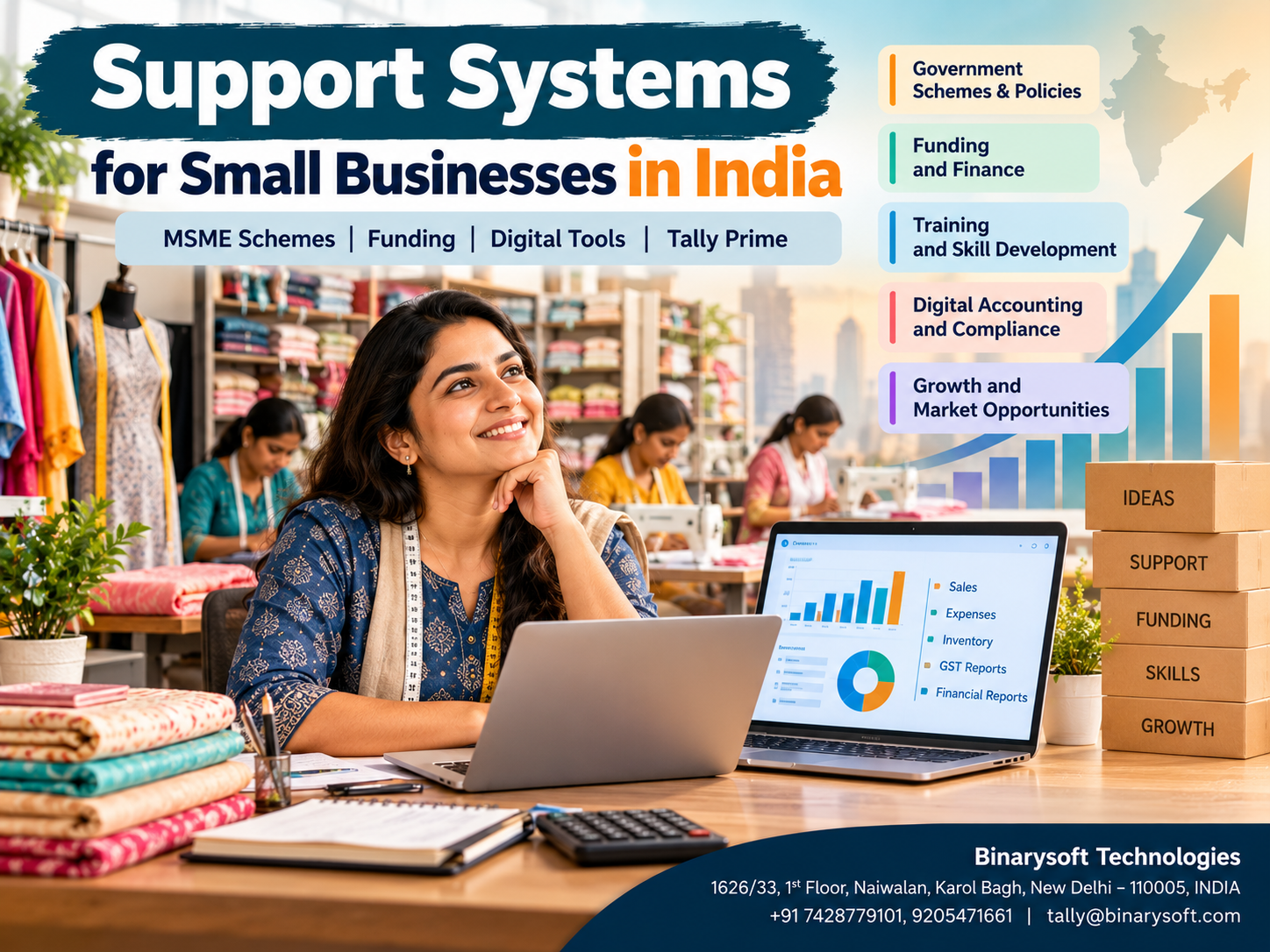
This guide explains the major support systems available to small businesses in India and demonstrates how Tally Prime can help entrepreneurs manage operations with greater confidence.
The Story of a Small Entrepreneur Who Refused to Give Up
When Sunita started her small garment manufacturing business in Delhi, she had just four sewing machines, three employees and a dream of providing a better future for her family.
During the first year, customer orders increased steadily. But success created new problems.
Suppliers demanded timely payments, customers requested credit, and raw material prices continued rising. Sunita struggled to calculate her actual profits because most transactions were recorded in notebooks.
One evening, after reviewing unpaid bills, she wondered whether closing the business would be the only practical option.
Her biggest fear was not losing money. It was disappointing the employees whose families depended on her business.
A local business adviser encouraged her to explore MSME registration, formal financing options and digital accounting.
She gradually organized her financial records, introduced inventory tracking and began reviewing customer outstanding payments.
With better information, she could negotiate payment terms, plan purchases and prepare more reliable financial statements for financing discussions.
Her business did not transform overnight. However, each improvement reduced uncertainty and helped her make more confident decisions.
This fictional story illustrates challenges commonly experienced by Indian small business owners.
The lesson is simple: entrepreneurs do not need to solve every business challenge alone. Appropriate support systems can help turn difficult situations into opportunities for sustainable growth.
1. Understanding Small Business Support Systems in India
A small business support system is a network of financial, institutional, technological and professional resources designed to help entrepreneurs establish, operate and expand their businesses.
These resources may include government departments, banks, industry associations, training institutions, business advisers and digital service providers.
The primary objectives are to improve access to finance, encourage entrepreneurship, strengthen productivity and support compliance.
For small businesses, effective support systems can provide:
-
Access to business loans and credit facilities
-
Guidance on registrations and government schemes
-
Entrepreneurship and skill development training
-
Digital accounting and inventory management
-
Marketing and market expansion opportunities
-
Technology adoption and productivity improvements
-
Legal, taxation and regulatory assistance
The most appropriate combination depends on the business's industry, size, location and development stage.
2. Government Support Through the MSME Ecosystem
The Ministry of Micro, Small and Medium Enterprises plays an important role in supporting Indian entrepreneurs.
Various initiatives focus on improving competitiveness, encouraging innovation, facilitating access to finance and strengthening business capabilities.
Udyam Registration
Udyam Registration provides formal MSME recognition to eligible enterprises.
Registration may help businesses access relevant government initiatives, procurement opportunities and MSME-related institutional support.
Classification depends on applicable investment and turnover thresholds.
Business owners should ensure that their registration details accurately reflect their operations and remain updated.
District Industries Centres
District Industries Centres, commonly known as DICs, provide local institutional assistance to entrepreneurs.
Depending on the state and district, services may include guidance on business establishment, available schemes, training and coordination with relevant departments.
MSME Development and Facilitation Institutions
These institutions support entrepreneurs through awareness programs, technical assistance, entrepreneurship development and information about government initiatives.
Small businesses should verify current program availability and eligibility before applying.
3. Financial Support and Business Funding Resources
Access to working capital remains one of the biggest challenges for small businesses.
Entrepreneurs often require funding to purchase machinery, maintain inventory, expand premises or meet operating expenses.
Pradhan Mantri MUDRA Yojana
The MUDRA framework supports eligible micro-enterprises through loans provided by participating lending institutions.
Loan categories include Shishu, Kishor, Tarun and Tarun Plus, subject to applicable limits and eligibility requirements.
Financing is not automatic. Lenders assess repayment capacity, business requirements and relevant documentation.
Credit Guarantee Fund Trust for Micro and Small Enterprises
CGTMSE supports eligible credit facilities extended by participating lenders through a credit guarantee framework.
It can improve access to formal credit for qualifying micro and small enterprises.
However, a guarantee does not mean that a loan is interest-free or automatically approved.
Prime Minister's Employment Generation Programme
PMEGP is a credit-linked subsidy program intended to support eligible new micro-enterprises.
Assistance depends on the project, applicant category, location and current scheme conditions.
How Tally Prime helps with financing
Banks and lenders commonly require reliable financial information.
Tally Prime helps businesses prepare Profit & Loss Accounts, Balance Sheets, sales reports, cash flow information and receivables statements.
These records can improve loan application readiness and support discussions with financial institutions.
4. Skill Development and Entrepreneurship Training
Many small businesses struggle not because their products are poor, but because owners lack access to management training.
Important areas include financial literacy, pricing, inventory control, digital marketing and customer relationship management.
Government-supported training programs, entrepreneurship development institutions, industry associations and private training providers can help bridge these gaps.
Business owners should prioritize practical training that addresses their immediate challenges.
For example, a retailer struggling with profitability may benefit more from inventory and pricing training than from an advanced marketing course.
Employees can also receive training in accounting procedures, billing, stock management and customer service.
5. Digital Transformation Support for Small Businesses
Digital tools have become essential for businesses seeking operational efficiency and better financial control.
Manual accounting systems may work during the earliest stages of a business, but increasing transaction volumes make them difficult to manage.
Digital transformation can help businesses automate repetitive activities, reduce errors and improve reporting.
Important digital resources include accounting software, payment systems, inventory applications, e-commerce platforms and customer management tools.
Benefits of digital accounting
Digital accounting helps entrepreneurs monitor transactions, prepare financial reports, track expenses and maintain organized records.
It can also improve collaboration between business owners and accountants.
Tally Prime supports these requirements through integrated accounting, invoicing, inventory and GST-related capabilities.
6. GST, Taxation and Compliance Support
Small businesses must understand the compliance requirements applicable to their operations.
These may include GST registration and returns, income-tax obligations, TDS, payroll-related compliance and industry-specific regulations.
Professional Chartered Accountants, tax advisers and compliance specialists can provide valuable assistance.
Businesses should maintain invoices, purchase records, bank statements, expense documents and supporting registers.
Accurate records make compliance reviews easier and reduce the risk of avoidable mistakes.
Role of Tally Prime
Tally Prime supports GST-enabled invoicing, tax classification, purchase and sales records, GST reports and reconciliation-related workflows.
These features can help businesses identify discrepancies and prepare information needed for statutory compliance.
The availability of particular functions depends on the installed software release and configuration.
7. Marketing and Market Expansion Resources
Access to new customers is essential for business growth.
Small enterprises can explore online marketplaces, trade fairs, business directories, digital advertising and industry exhibitions.
The Government e-Marketplace (GeM) can provide procurement opportunities to eligible sellers supplying government buyers.
Industry associations and export promotion organizations may also help businesses explore domestic and international markets.
Before expanding, entrepreneurs should evaluate demand, pricing, delivery capabilities and working capital requirements.
Tally Prime can support expansion by providing sales analysis, customer outstanding information and inventory reports.
8. Professional Networks and Business Associations
Business associations provide opportunities for entrepreneurs to exchange knowledge, understand industry developments and build commercial relationships.
Organizations such as chambers of commerce, local trade associations and sector-specific bodies may organize workshops, networking events and business development programs.
These networks can help entrepreneurs identify suppliers, discover markets and understand regulatory developments.
Professional relationships are particularly valuable for small businesses that cannot maintain large internal advisory teams.
9. Technology and Innovation Support
Technology adoption can improve productivity, product quality and competitiveness.
Small manufacturers may benefit from production planning systems, inventory monitoring, quality control tools and equipment upgrades.
Retailers may prioritize billing systems, digital payments and stock management.
Service providers may focus on project tracking, invoicing and customer relationship management.
Government and institutional technology-support initiatives may provide training, advisory assistance or access to specialized facilities, depending on program availability.
The most useful technology is not necessarily the most expensive. It is the solution that addresses a genuine business problem.
10. Case Study One: A Retail Distributor Improves Financial Control
Illustrative case study — fictional business and figures
A small electrical goods distributor in Karol Bagh managed sales through handwritten invoices and separate spreadsheets.
The business generated annual sales of approximately ₹75 lakh but frequently experienced cash shortages.
Customers delayed payments, and the owner lacked a reliable overview of outstanding balances.
After consulting an accounting professional, the business introduced structured bookkeeping and Tally Prime.
Customer ledgers, purchase records and inventory transactions were organized.
The owner began reviewing receivables every week and contacting customers before payment deadlines.
Over several months, the business reduced overdue receivables from an illustrative ₹12 lakh to ₹7 lakh.
The improvement did not represent additional profit, but it released working capital that had previously been tied up in customer balances.
Financial reports also made it easier to prepare documentation for discussions with a bank.
Key lesson: Strong accounting systems and professional support can help businesses improve liquidity without relying entirely on additional borrowing.
11. Case Study Two: A Small Manufacturer Uses Institutional Support to Expand
Illustrative case study — fictional business and figures
A small packaging manufacturer in Faridabad wanted to increase production capacity but lacked sufficient funds to purchase additional machinery.
The owner approached a local business support institution to understand MSME registration and financing options.
After reviewing available programs, the entrepreneur prepared a business expansion proposal and approached a participating financial institution.
The business used its accounting records to prepare sales summaries, expense statements and financial projections.
Following the lender's independent assessment, the manufacturer obtained a suitable credit facility.
The business purchased equipment, improved production scheduling and introduced better inventory monitoring.
Tally Prime helped the accounting team track raw material purchases, finished goods, expenses and customer payments.
Key lesson: Government information resources, formal finance and organized business records can work together to support sustainable expansion. Loan approval remains subject to lender requirements.
12. How Tally Prime Helps Small Businesses Use Support Resources Effectively
Tally Prime can become an important part of a small business's financial management system.
Its practical value comes from organizing information that entrepreneurs need for daily operations, professional consultations and financing decisions.
Accounting and financial statements
Businesses can maintain sales, purchases, receipts, payments and expenses in one accounting system.
Profit & Loss Accounts and Balance Sheets provide useful information for management reviews and financing discussions.
GST management
GST-enabled invoices, purchase records and tax reports help businesses organize compliance information and review transactions.
Inventory management
Stock groups, stock items, godowns and inventory reports help businesses monitor product availability and stock movement.
Receivables and payables
Bill-wise accounting and outstanding reports allow owners to monitor customer dues and supplier obligations.
Banking and reconciliation
Banking-related features help businesses record transactions, review balances and reconcile accounts, subject to supported functionality and configuration.
Multi-user and cloud-enabled working
Suitable Tally Prime configurations and professionally managed Tally on Cloud environments can help authorized users access business accounting data from different locations.
Cloud access should include appropriate security, backup and user-permission controls.
Business decision-making
Reliable financial information supports budgeting, pricing decisions, inventory planning and business expansion.
While Tally Prime does not guarantee government assistance or loan approval, it can help businesses maintain the documentation and financial visibility needed to pursue available opportunities.
13. How to Choose the Right Support System for Your Business
Not every government scheme, financial product or technology solution is suitable for every entrepreneur.
Business owners should begin by identifying their most important challenges.
A business facing a temporary cash shortage may need working capital planning. A manufacturer struggling with production efficiency may need technical training or equipment investment.
A retailer with inaccurate stock records may benefit most from inventory software and better operating procedures.
Before applying for assistance, review eligibility requirements, costs, documentation, repayment obligations and expected business benefits.
Seeking advice from qualified professionals can help entrepreneurs avoid unsuitable commitments.
14. Building a Sustainable Small Business Growth Strategy
Support resources deliver the greatest value when they form part of a long-term business strategy.
Entrepreneurs should establish realistic sales targets, monitor expenses, maintain adequate working capital and review financial performance regularly.
Business growth should be supported by reliable customer demand rather than borrowing alone.
Digital accounting can make this planning process more manageable.
Regular financial reviews help owners recognize problems early and make informed adjustments.
The combination of government support, professional guidance, employee skills and reliable technology creates a stronger foundation for sustainable business development.
Conclusion: The Right Support Can Turn Small Business Challenges into Growth Opportunities
Small businesses are vital contributors to India's economy, employment and entrepreneurship.
However, access to finance, professional knowledge, technology and market opportunities remains essential for their long-term success.
Government initiatives, MSME institutions, banking resources, training programs and industry associations can help entrepreneurs overcome important barriers.
Tally Prime complements these resources by supporting organized accounting, GST reporting, inventory management and financial analysis.
For entrepreneurs, the objective should not simply be to grow faster. It should be to build businesses that are financially disciplined, operationally efficient and prepared for future opportunities.
With appropriate support and reliable information, even a modest business can develop the confidence and capability to pursue larger ambitions.
Powered by Binarysoft Technologies
Authorized Tally Partner
Location: 1626/33, 1st Floor, Naiwalan, Karol Bagh, New Delhi – 110005, INDIA
Contact Us: +91 7428779101, 9205471661
Email: tally@binarysoft.com
Business Hours: 10:00 AM – 6:00 PM, Monday to Friday
Frequently Asked Questions
What are the main support systems available for small businesses in India?
Small businesses can access government MSME initiatives, banking and financing programs, entrepreneurship training, professional advisory services, business associations and digital technology solutions.
How can MSME registration benefit a small business?
Udyam Registration provides formal MSME recognition and may help eligible businesses access relevant government initiatives, procurement opportunities and institutional support.
Which government schemes help small businesses obtain financing?
Programs such as MUDRA, PMEGP and the CGTMSE credit guarantee framework can support eligible businesses through different financing mechanisms. Approval depends on the relevant scheme and lender requirements.
Can small businesses apply for government support without collateral?
Certain financing arrangements may offer collateral-free facilities to eligible applicants. Availability depends on the scheme, lender policies, loan structure and applicable conditions.
CA. Anand Tirpathi is a Chartered Accountant with experience in statutory compliance, internal controls, and accounting process optimization. He has advised multiple businesses on improving operational efficiency through structured accounting and inventory systems. His writing focuses on clarity, compliance, and risk reduction for MSMEs.