Call CA Tally HelpDesk
+91 9205471661,
7428779101

Introduction: Why Businesses Need Smarter Accounting and Inventory Management in 2026
In 2026, businesses across India are facing increasing pressure to maintain accurate financial records, manage inventory efficiently, comply with GST requirements, and make faster decisions in competitive markets. Traditional accounting methods, disconnected spreadsheets, and manual stock registers are becoming difficult to manage as transaction volumes increase and customers expect faster service. Even a small accounting mistake or inventory mismatch can affect profitability, cash flow, and customer satisfaction. This is why businesses are increasingly exploring integrated accounting solutions that connect daily transactions with inventory and financial reporting. Tally Prime helps organizations simplify bookkeeping, automate routine calculations, monitor stock movements, and generate meaningful financial reports from a centralized system. Whether a business operates a retail store, wholesale distribution network, manufacturing unit, or professional services company, Tally Prime provides practical tools to improve operational efficiency, reduce repetitive work, and support informed financial decisions while maintaining better control over business activities.
1. Understanding Business Efficiency in the Modern Accounting Environment
Business efficiency is not simply about completing transactions faster. It involves managing financial information accurately, controlling operational expenses, maintaining appropriate inventory levels, and ensuring that management has access to reliable business data.
Many organizations still depend on multiple spreadsheets, handwritten registers, and disconnected software applications. Although these methods may work for small transaction volumes, they often become difficult to maintain as businesses expand.
Common operational challenges include:
-
Delays in recording purchase and sales transactions.
-
Differences between physical stock and accounting records.
-
Difficulty tracking customer outstanding balances.
-
Repeated manual calculations during GST preparation.
-
Limited visibility into business profitability.
-
Delayed preparation of financial statements.
-
Difficulty coordinating accounting and inventory teams.
-
Increased risk of duplicate entries and data inconsistencies.
Tally Prime addresses many of these challenges by bringing accounting, inventory management, taxation, and business reporting into an integrated environment.
When transactions are recorded correctly, related financial and inventory information can be updated together, reducing the need for repeated data entry.
This integration helps businesses establish more consistent processes and make better use of available resources.
2. A Business Owner's Story: From Daily Accounting Stress to Better Financial Control
Consider the example of Rajesh, a fictional wholesale electrical goods distributor operating in Delhi.
Rajesh started his business with a small warehouse, three employees, and a limited product range. During the initial years, he maintained customer invoices in spreadsheets, tracked stock through handwritten registers, and relied on his accountant to prepare monthly financial reports.
As the business expanded, the number of products increased significantly. Orders started arriving from multiple retailers, suppliers demanded timely payments, and customers frequently requested immediate stock confirmation.
One afternoon, an important customer placed a large order for electrical accessories. Rajesh confidently accepted the order because his spreadsheet indicated sufficient stock.
However, when his warehouse team checked the shelves, several items were unavailable.
The customer became frustrated and cancelled part of the order.
Rajesh realized that the problem was not a lack of demand but the absence of reliable inventory information.
At the same time, his accountant was struggling to reconcile outstanding invoices, purchase records, and bank transactions.
The situation became emotionally exhausting. Rajesh spent evenings reviewing spreadsheets instead of spending time with his family or planning business expansion.
Eventually, he decided to implement Tally Prime with structured accounting and inventory processes.
After creating stock items, customer ledgers, supplier accounts, and appropriate voucher workflows, his team began recording sales, purchases, receipts, and payments within the same accounting environment.
Over time, the business experienced several operational improvements.
Stock information became easier to review, customer outstanding balances were available through reports, and financial summaries no longer required the same amount of manual consolidation.
Most importantly, Rajesh gained greater confidence in the information used to make purchasing and sales decisions.
The lesson from this illustrative story is simple: business growth becomes easier to manage when financial and inventory information is organized, timely, and dependable.
3. Automated Accounting in Tally Prime: Reducing Manual Work and Improving Accuracy
Automated accounting is one of the most valuable capabilities of modern business management software.
Instead of manually calculating and updating every accounting balance, businesses can use properly configured vouchers, ledgers, and accounting rules to maintain financial records more efficiently.
Simplified daily accounting transactions
Tally Prime supports different accounting voucher types for recording business activities.
These include:
-
Sales vouchers for customer invoices.
-
Purchase vouchers for supplier transactions.
-
Payment vouchers for outgoing payments.
-
Receipt vouchers for incoming payments.
-
Contra vouchers for cash and bank transfers.
-
Journal vouchers for accounting adjustments.
-
Debit notes and credit notes for applicable adjustments.
Each voucher helps maintain a structured record of the corresponding transaction.
For example, when a credit sales invoice is recorded using the appropriate configuration, Tally Prime can update the customer ledger, sales account, tax ledgers, and inventory records as applicable.
This reduces the need to maintain separate accounting entries for the same transaction.
Automated calculations
Depending on the configuration and transaction type, Tally Prime can assist with calculations relating to:
-
GST on sales and purchases.
-
Invoice totals and applicable discounts.
-
Ledger balances.
-
Inventory valuation.
-
Outstanding receivables and payables.
-
Cost allocations.
-
Interest calculations where configured.
These capabilities help reduce repetitive calculations while improving consistency.
However, automation does not eliminate the need for accurate master data, correct tax classifications, and periodic review.
Faster bookkeeping and financial closing
Businesses often spend considerable time preparing month-end reports.
With transactions recorded consistently throughout the month, accountants can access updated books without manually combining several independent files.
This helps reduce the time required for routine review and financial closing activities.
4. Real-Time Stock Management for Better Inventory Control
Inventory management plays a major role in profitability, especially for retailers, wholesalers, distributors, and manufacturing businesses.
Excess stock blocks working capital, while insufficient stock can result in missed sales opportunities.
Tally Prime provides integrated inventory management features that help businesses monitor stock quantities and movements based on recorded transactions.
Stock item creation and classification
Businesses can organize inventory using stock groups, stock categories, stock items, and units of measurement.
For example, an electronics distributor may maintain inventory under the following structure:
|
Stock group
|
Example stock items
|
|---|
|
Mobile Accessories
|
Chargers, USB Cables, Earphones
|
|
Computer Accessories
|
Keyboards, Mouse, Adapters
|
|
Electrical Products
|
Switches, Wires, LED Lights
|
|
Networking Equipment
|
Routers, Network Cables
|
|
Office Equipment
|
Printers, Scanners
|
This structured classification makes inventory reporting and item identification easier.
Monitoring stock availability
Tally Prime allows businesses to review stock quantities through inventory reports.
When sales, purchases, stock transfers, and adjustments are recorded correctly, the corresponding stock balances are updated in the system.
This helps businesses identify available quantities before accepting customer orders.
Stock information reflects recorded transactions; it is not a substitute for physical verification or automatic warehouse sensing.
Multiple godown and warehouse management
Businesses operating from several storage locations can use godown or location-based inventory tracking.
For example, a distributor may maintain stock at:
-
Main Warehouse, Karol Bagh.
-
Retail Outlet, Connaught Place.
-
Distribution Centre, Rohini.
-
Secondary Warehouse, Pitampura.
Tally Prime can help track inventory by location when the appropriate features and transaction processes are configured.
This supports better coordination between purchasing, warehouse operations, and sales teams.
Batch-wise inventory management
For businesses dealing with products that require batch tracking, Tally Prime supports batch-related inventory records.
This can be useful for industries such as pharmaceuticals, food distribution, cosmetics, and other businesses where batch identification matters.
Depending on the configuration, users can maintain batch details and expiry-related information.
Stock valuation and profitability
Inventory valuation affects financial reporting and business profitability.
Tally Prime supports inventory valuation methods and stock reports that help businesses understand the value of inventory held.
Accurate valuation requires consistent accounting policies and correct transaction recording.
5. Advanced Financial Reporting for Better Business Decisions
Financial reporting transforms accounting transactions into information that management can use.
A business may generate strong sales but still experience financial difficulties because of high expenses, slow collections, or excessive inventory investment.
Tally Prime provides financial reports that help management understand these conditions.
Profit and Loss Account
The Profit and Loss Account helps businesses analyze income, expenses, and operating results for a selected period.
Business owners can use it to review profitability and identify areas where costs may require attention.
Balance Sheet
The Balance Sheet provides an overview of assets, liabilities, and capital.
It helps management evaluate the financial position of the organization at a particular date.
Cash Flow Statement
Cash flow reporting helps businesses understand cash inflows and outflows.
This information is important because profitable businesses can still experience payment difficulties when customer collections are delayed.
Outstanding receivables and payables
Tally Prime provides reports that help businesses review amounts due from customers and payable to suppliers.
These reports support collection planning, supplier payment scheduling, and working capital management.
Ratio analysis
Financial ratios help business owners assess different aspects of financial performance.
Depending on the available information, ratio analysis can support evaluation of liquidity, profitability, and financial structure.
Comparative financial reporting
Period-based reports help management compare business performance over different periods.
For example, a business can compare current-month sales and expenses with earlier periods to identify changes that require investigation.
6. How Integrated Accounting and Inventory Management Work Together
One of the major advantages of Tally Prime is the connection between accounting and inventory information.
Consider a wholesale business selling 50 units of an electrical product.
When the sale is recorded using an appropriately configured inventory invoice, the system can reflect the transaction across relevant records.
Example: Integrated sales transaction workflow
Sales invoice recorded
50 units sold to a customer
Accounting records
Sales and customer ledger updated
Inventory records
Stock quantity reduced
Tax records
Applicable GST calculated
Financial reports
Balances reflect the transaction
This integrated approach reduces duplicate work and helps different departments operate using consistent information.
For example, the sales department can review stock balances, the accounting department can track receivables, and management can analyze revenue through related reports.
7. GST Accounting and Compliance Management with Tally Prime
GST compliance is an important responsibility for Indian businesses.
Incorrect tax classifications, incomplete invoice information, and differences between accounting records and GST data can create additional reconciliation work.
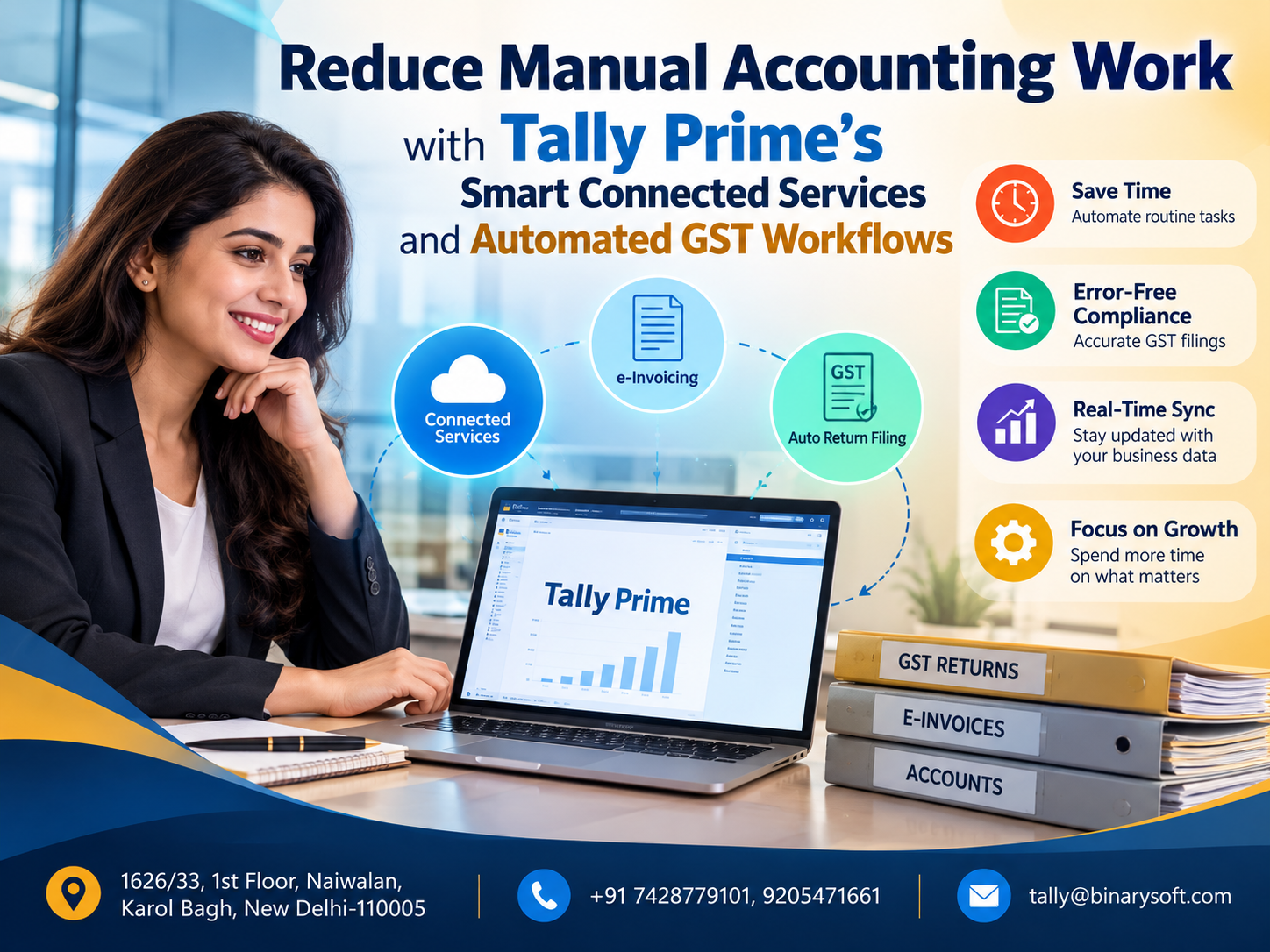
Tally Prime provides GST-related capabilities that support routine compliance processes.
GST-compliant invoicing
Businesses can configure GST details and prepare invoices with relevant tax information.
Depending on the transaction, this may include:
GST reporting
Tally Prime supports GST reports and workflows that help users prepare and review information relevant to returns such as GSTR-1 and GSTR-3B.
Available connected features and filing workflows depend on the installed release, configuration, and applicable services.
GST reconciliation
Reconciliation helps identify differences between books of accounts and GST-related information.
Businesses can review mismatches, investigate exceptions, and correct eligible records before completing their compliance processes.
E-invoicing and e-Way Bill support
For businesses subject to applicable requirements, Tally Prime provides support for e-invoicing and e-Way Bill workflows.
Eligibility, thresholds, and reporting obligations must be checked against current government rules.
Important: Tally Prime supports GST compliance, but it does not automatically guarantee that every return or invoice is legally correct. Businesses should review tax settings, transaction data, and statutory requirements.
8. Banking Operations and Payment Management
Banking is another essential component of business efficiency.
Organizations regularly process customer receipts, supplier payments, bank charges, transfers, and other financial transactions.
When banking information is maintained separately from accounting records, reconciliation can become time-consuming.
Tally Prime offers banking features that help businesses manage and review bank-related transactions.
Bank statement import
Supported bank statements can be imported through applicable banking workflows, reducing the need for repetitive manual entry.
The exact import and reconciliation options depend on the Tally Prime release and bank statement format.
Bank reconciliation
Bank reconciliation helps businesses compare recorded transactions with bank statement entries.
This process can reveal missing entries, timing differences, incorrect amounts, and transactions requiring investigation.
Payment tracking
Businesses can maintain payment vouchers and supplier balances to monitor outgoing payments.
This helps reduce the risk of overlooking important obligations.
Better cash management
When bank records, receivables, and payables are reviewed together, businesses can make more informed cash management decisions.
For example, a company can identify upcoming supplier payments and prioritize customer collections accordingly.
9. Improving Customer Relationship Management Through Accurate Financial Records
Customer satisfaction depends not only on product quality but also on reliable invoicing, accurate payment records, and timely order fulfillment.
Tally Prime helps businesses maintain structured customer accounts.
Customer ledger management
Each customer can have a separate ledger containing relevant transaction records.
This makes it easier to review invoice balances and payment history.
Outstanding payment tracking
Businesses can generate outstanding reports to identify customers with unpaid invoices.
When bill-wise tracking is used correctly, reports can help distinguish different invoices and their pending amounts.
Faster invoice preparation
Consistent item masters, customer ledgers, and tax configurations can simplify invoice preparation.
Better customer communication
Accurate financial information helps businesses respond confidently to customer queries about outstanding balances and transaction history.
This can reduce misunderstandings and strengthen professional relationships.
10. Supporting Manufacturing and Distribution Operations
Manufacturing and distribution businesses face additional challenges involving raw materials, finished goods, production costs, and inventory movements.
Tally Prime includes inventory-related features that can support these requirements.
Raw material tracking
Manufacturers can maintain separate stock items for raw materials and finished products.
This helps improve visibility into material availability.
Bill of Materials
Bill of Materials functionality can help define components required to manufacture a finished product.
For example, a furniture manufacturer may define the materials needed for a particular table.
Manufacturing transactions
Manufacturing-related inventory vouchers can be used to record production and material consumption according to the configured process.
Distribution management
Distributors can use inventory and accounting reports to monitor product movement, customer sales, and supplier purchases.
These capabilities help businesses manage operations more systematically.
11. Better Working Capital Management Through Financial Visibility
Working capital is essential for day-to-day operations.
A company may have significant inventory and strong sales but still struggle to pay suppliers because customer payments are delayed.
Tally Prime provides financial information that can help management identify such problems.
Consider the following illustrative business position:
|
Financial component
|
Amount
|
|---|
|
Inventory
|
₹12,00,000
|
|
Customer Receivables
|
₹8,00,000
|
|
Cash and Bank
|
₹3,00,000
|
|
Supplier Payables
|
₹9,00,000
|
|
Other Current Liabilities
|
₹2,00,000
|
Based on these simplified figures:
Total Current Assets = ₹23,00,000
Total Current Liabilities = ₹11,00,000
Net Working Capital = ₹12,00,000
Although the business has positive working capital, a large portion is tied up in inventory and customer receivables.
Management may therefore need to improve collections or reduce slow-moving inventory.
Tally Prime reports can provide the underlying accounting information needed for such analysis.
12. How Tally Prime Can Help Reduce Operational Costs
Operational costs often increase when employees repeatedly perform the same tasks or spend excessive time correcting errors.
Integrated accounting software can help reduce these inefficiencies.
Reduced duplicate data entry
When transactions are recorded through suitable workflows, the need to update several separate records may be reduced.
Improved reporting efficiency
Reports generated from recorded transactions reduce the amount of manual compilation required.
Better inventory planning
Stock reports help identify quantities and stock movement patterns, supporting more informed purchasing decisions.
Improved collection follow-up
Outstanding reports can help accounting teams identify overdue invoices.
Reduced reconciliation effort
Structured accounting records and available reconciliation tools help users investigate differences more efficiently.
Actual cost savings depend on transaction volume, staff training, configuration, and process discipline.
13. Role-Based Access and Business Data Security
Financial records contain sensitive business information.
Unauthorized changes, accidental deletion, and poor backup practices can create serious operational risks.
Tally Prime provides security-related capabilities that help businesses manage access to accounting data.
User access controls
Organizations can configure security settings and user permissions to control access to specific functions and information.
Controlled accounting operations
Appropriate permissions can help limit sensitive activities to authorized personnel.
Data backup practices
Regular backups are essential for business continuity.
Businesses should maintain a documented backup schedule and periodically verify that backup data can be restored.
Audit and transaction review
Where applicable and configured, audit-related features can help businesses review changes and maintain stronger internal controls.
Security also depends on the surrounding environment, including computer protection, network access, passwords, and backup storage.
14. Tally Prime for Different Types of Businesses
Tally Prime can support several industries, although requirements and configurations differ.
|
Business type
|
Key operational requirement
|
Relevant Tally Prime capability
|
|---|
|
Retail Stores
|
Fast billing and stock control
|
Sales invoicing and inventory reports
|
|
Wholesale Traders
|
Customer credit and bulk inventory
|
Outstanding and stock reports
|
|
Manufacturers
|
Raw materials and production records
|
BOM and manufacturing inventory workflows
|
|
Distributors
|
Product movement and warehouse control
|
Godown and inventory tracking
|
|
Professional Services
|
Income, expenses and receivables
|
Accounting and financial reporting
|
|
Electronics Businesses
|
Product-wise inventory and GST
|
Stock items and tax-enabled invoicing
|
|
Construction Businesses
|
Project-related expenses
|
Cost centres and accounting reports
|
|
Trading Companies
|
Purchases, sales and profitability
|
Integrated accounting and inventory
|
Businesses should assess their transaction volume, reporting needs, statutory obligations, and integration requirements before implementation.
15. Using Tally Prime Reports to Make Smarter Business Decisions
Financial reporting becomes more valuable when business owners use it regularly rather than only at year-end.
For example, management can review sales, expenses, outstanding invoices, and inventory reports to identify operational problems.
Illustrative Monthly Business Performance
Example figures for management analysis; not actual Tally Prime data.
Monthly Sales
₹18L
Expenses
₹14L
Illustrative Surplus
₹4L
0L5L10L15L20LMayJunJulAugSepOct
Figures in ₹ lakh; simplified example, excluding further accounting adjustments.
Suppose monthly sales increase from ₹12 lakh to ₹18 lakh over several months.
This growth appears positive, but management should also evaluate whether expenses, customer outstanding balances, and inventory investment are increasing.
An increase in sales does not necessarily mean that cash flow has improved.
By reviewing multiple financial and inventory reports together, businesses can identify whether growth is financially sustainable.
16. Steps to Implement Tally Prime Successfully
Implementing accounting software requires more than installing an application.
Businesses should plan their accounting structure and operational workflows carefully.
Step 1: Assess existing business processes
Review current accounting methods, inventory registers, invoicing procedures, and reporting requirements.
Identify activities that consume excessive time or frequently produce errors.
Step 2: Create the company and configure features
Set up the company with appropriate financial-year details, accounting options, inventory settings, and statutory information.
Step 3: Organize accounting masters
Create the necessary customer, supplier, bank, expense, income, and tax ledgers.
Step 4: Configure inventory masters
Set up stock groups, stock items, units, godowns, and other required inventory information.
Step 5: Verify opening balances
Ensure that ledger balances and opening stock information agree with the approved records.
Step 6: Configure GST requirements
Review GST registrations, tax classifications, HSN or SAC details, and applicable invoice settings.
Step 7: Train employees
Provide practical training for accounting staff, sales operators, warehouse personnel, and management users.
Step 8: Establish reporting and review procedures
Define how frequently stock, receivables, payables, bank balances, and financial statements should be reviewed.
Step 9: Maintain backups and access controls
Establish security responsibilities and a reliable backup process.
Step 10: Review implementation results
After implementation, evaluate whether transaction accuracy, reporting speed, and operational visibility have improved.
17. Common Mistakes Businesses Should Avoid When Using Tally Prime
Even advanced software cannot produce reliable results when business processes are poorly managed.
Several common mistakes can reduce the effectiveness of an accounting system.
Incorrect ledger classification: Creating ledgers under unsuitable groups can affect financial reporting.
Inaccurate stock masters: Duplicate stock items or inconsistent units can create inventory discrepancies.
Delayed transaction recording: Entering transactions several days after they occur reduces the usefulness of current reports.
Incorrect GST configuration: Wrong tax classifications can lead to incorrect invoice and return information.
Ignoring outstanding reports: Businesses may overlook overdue customer balances.
Insufficient employee training: Users may record transactions inconsistently or fail to use available features.
Poor backup practices: Data loss can disrupt business operations and financial reporting.
Regular reviews, staff training, and proper accounting procedures are essential for avoiding these problems.
18. The Importance of Automated Accounting for Business Growth in 2026
As businesses expand, accounting complexity often increases.
A growing organization may need to manage more customers, suppliers, stock items, employees, locations, and financial transactions.
Manual methods that worked during the early stages of business may become difficult to maintain.
Tally Prime can support growth by providing structured accounting and inventory processes.
Businesses can benefit from more consistent transaction recording, easier access to reports, and improved coordination between accounting and operations.
For example, a company expanding from one warehouse to multiple locations may need better visibility into inventory distribution.
Similarly, a wholesale trader handling hundreds of customer invoices may require stronger receivables tracking and faster reconciliation.
Integrated accounting software helps create a foundation for managing these requirements.
However, successful expansion also depends on management decisions, employee capabilities, internal controls, and customer service.
Technology supports business growth, but it cannot replace effective business planning.
19. Why Businesses Should Choose an Authorized Tally Partner
Choosing the right implementation and support partner can make a significant difference in how effectively a business uses accounting software.
An Authorized Tally Partner can assist organizations with understanding product options, implementation requirements, configuration, and available support services.
Binarysoft Technologies provides Tally-related assistance for businesses seeking to improve their accounting and inventory management processes.
Businesses may require support with:
-
Tally Prime license selection and purchasing.
-
Company creation and initial configuration.
-
Accounting and inventory setup.
-
GST configuration and workflow guidance.
-
Data migration planning.
-
User training and operational support.
-
Reporting requirements.
-
Multi-user setup and related technical requirements.
-
Product upgrades and troubleshooting.
Before choosing an implementation approach, businesses should discuss their transaction volume, number of users, inventory complexity, and reporting requirements.
This helps identify a suitable solution rather than adopting unnecessary features.
20. The Future of Business Accounting: Integrated Information and Faster Decisions
The role of accounting software continues to evolve.
Businesses increasingly expect accounting systems to provide timely information rather than merely store historical transactions.
Financial reporting, inventory management, taxation, banking, and operational controls are becoming more closely connected.
For Indian businesses, the priority is not simply adopting more technology. It is ensuring that the technology already being used produces reliable information.
Tally Prime provides an integrated foundation for recording business transactions and reviewing accounting and inventory information.
When supported by accurate data entry, suitable configuration, regular reconciliation, and trained employees, the software can help businesses improve their daily operations.
Over time, organizations can use this information to strengthen financial discipline, plan purchases, manage customer collections, and evaluate business performance.
The greatest benefit comes when accounting information becomes part of regular management decision-making.
Conclusion: Transform Business Efficiency with Tally Prime
Efficient business management requires accurate accounting, dependable inventory records, timely financial reporting, and effective control over daily operations.
Tally Prime brings these essential activities together through integrated accounting, stock management, GST-related functionality, banking tools, and financial reports.
By reducing repetitive work and improving access to business information, Tally Prime can help retailers, wholesalers, manufacturers, distributors, and service providers manage operations more effectively.
Automated calculations and structured voucher processes support accounting consistency, while inventory reports help businesses monitor stock movements and plan purchases.
Financial statements, outstanding reports, and cash flow information provide management with a clearer understanding of business performance.
However, successful implementation depends on correct configuration, disciplined transaction recording, employee training, and regular data review.
For businesses planning to modernize their accounting processes in 2026, Tally Prime offers a practical foundation for improving operational efficiency, strengthening financial visibility, and supporting sustainable business growth.
Powered by Binarysoft Technologies
Authorized Tally Partner
Location: 1626/33, 1st Floor, Naiwalan, Karol Bagh, New Delhi – 110005, INDIA
Contact Us: +91 7428779101, 9205471661
Email Us: tally@binarysoft.com
Business Hours: 10:00 AM – 6:00 PM, Monday to Friday
Binarysoft Technologies helps businesses explore Tally Prime solutions for accounting, GST management, inventory control, financial reporting, and business operations.
Frequently Asked Questions
What is Tally Prime, and how does it improve business efficiency?
Tally Prime is business management software designed to support accounting, inventory management, taxation, banking, and financial reporting. It improves efficiency by integrating business transactions and reducing repetitive accounting work.
Can Tally Prime automate accounting transactions?
Yes. Tally Prime supports automated calculations and accounting updates based on properly configured vouchers and masters. Users still need to enter or import accurate transaction information and review the results.
CA. Ronav Maheshwari works with small and mid-sized businesses on accounting processes, GST compliance, and financial reporting. His focus is on simplifying routine accounting workflows and helping business owners maintain accurate and audit-ready records.