Call CA Tally HelpDesk
+91 9205471661,
7428779101
What Changed in 2026: Inventory Is Now a Cash-Flow Decision, Not Just a Stock Count
In 2026, inventory management has become a direct test of how efficiently a business uses its money. Rising product variety, faster customer expectations, GST-linked transactions, multi-location operations and tighter working capital are putting pressure on companies that still depend on spreadsheets or delayed stock updates. A product may appear available in one record while the shelf is empty, or thousands of rupees may remain locked in slow-moving items that management notices only months later. Modern inventory management software changes this by connecting purchases, sales, stock quantities, locations, costs and financial information in a more structured system. Businesses can identify fast-moving products, monitor shortages, improve replenishment decisions and understand where their working capital is sitting. For SMEs, distributors, retailers, manufacturers and wholesalers, better inventory visibility can mean fewer lost orders, less excess stock and stronger control over everyday profitability.
What Is Inventory Management Software?
Inventory management software is a business system designed to help companies record, monitor and control the movement of goods.
It provides businesses with structured information about products coming into the organization, products being sold or consumed, quantities currently available and, depending on the software, where those goods are located.
A good inventory system can answer some of the most important questions in a trading or manufacturing business:
What products do we currently have?
How much stock is available?
Which items are selling quickly?
Which products have stopped moving?
What should we reorder?
Which warehouse contains a particular item?
How much money is invested in inventory?
Which items contribute most to sales?
Are recorded quantities matching physical stock?
Without reliable software, answering these questions may require checking several spreadsheets, registers, invoices and warehouse records.
Inventory software brings that information into a more structured environment.
Why Inventory Management Has Become Critical for Businesses
Inventory is often one of the largest investments made by a product-based business.
When a company purchases goods, cash effectively becomes inventory.
That money remains tied up until the products are sold and payment is collected.
This creates a simple but important relationship:
Poor inventory management can become poor cash-flow management.
Buying too much stock can block working capital.
Buying too little can cause lost sales.
Ordering the wrong products can leave shelves full while customers ask for products that are unavailable.
The objective is therefore not simply to keep more stock.
The objective is to keep the right stock, in the right quantity, at the right location and at the right time.
A Business Story: The Order That Changed How a Distributor Managed Stock
Amit operated a growing electrical goods distribution business.
His company supplied switches, cables, lighting products and electrical accessories to retailers and contractors.
For years, inventory was managed through spreadsheets.
Every morning, his warehouse employee updated quantities manually. Sales invoices were maintained separately, while purchase information was entered by the accountant.
The system seemed inexpensive and familiar.
Then one Friday afternoon, Amit received an unusually large order from an important contractor.
The customer needed several products urgently for a commercial project.
Amit checked the spreadsheet.
Everything appeared available.
He confidently confirmed the order.
The warehouse team began picking the goods.
Within twenty minutes, the phone rang.
One of the most important items wasn't available.
The spreadsheet showed 240 units.
The warehouse had only 38.
Several transactions from the previous week had not been updated correctly.
Amit called the customer and requested additional time.
The customer couldn't wait.
Most of the order went to another supplier.
The financial loss hurt, but the conversation with the customer hurt more.
"We ordered from you because we thought you could deliver."
That sentence stayed with Amit.
The following Monday, he stopped treating inventory management as an administrative task.
He began treating it as a business-control problem.
After introducing a more structured accounting and inventory system, purchases, sales and stock movements became easier to monitor together.
Amit's lesson was simple: inventory information has value only when management can trust it.
Why Spreadsheets Become Difficult as Inventory Grows
Excel and other spreadsheets can be useful during the early stages of a business.
A company with 20 products and a limited number of transactions may manage reasonably well with spreadsheets.
But imagine the same business two years later.
It now has 2,000 stock items.
There are multiple suppliers.
Customers purchase on different payment terms.
Some goods are stored in a warehouse while others remain at a retail outlet.
Purchases arrive every day.
Sales happen continuously.
Returns need to be recorded.
Stock gets transferred.
Prices change.
GST needs to be considered.
At this point, the spreadsheet is no longer simply a list.
It has become a manually maintained database.
That creates risks including duplicate entries, incorrect formulas, outdated quantities, multiple file versions, accidental deletion and delayed updates.
Inventory management software is designed to handle this information more systematically.
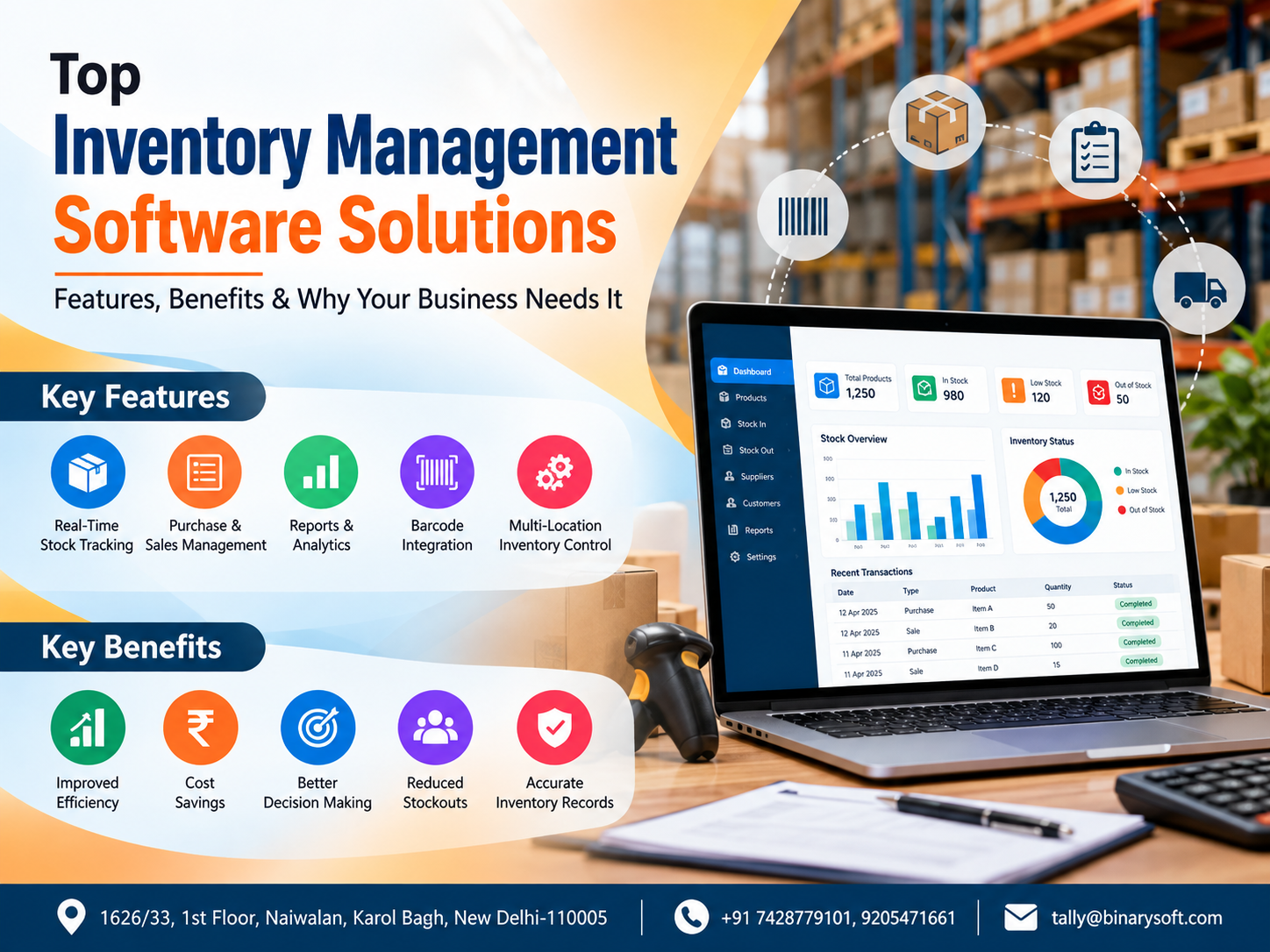
Essential Features of Inventory Management Software
The best inventory solution depends on the nature and size of the business. However, several capabilities are particularly valuable.
1. Real-Time Stock Visibility
Management should be able to understand the current inventory position without waiting for someone to prepare a separate report.
Stock visibility helps answer:
What is available?
What has been sold?
What has been purchased?
Which products are running low?
Which items are overstocked?
Faster access to this information improves operational decision-making.
2. Stock Item Management
Businesses may handle hundreds or thousands of products.
Software should allow products to be maintained systematically with appropriate names, groups, units and other relevant classifications.
A clean item structure improves reporting and reduces confusion.
3. Stock Grouping and Categorization
Products should be organized logically.
For example, an electronics distributor might classify inventory into:
Laptops
Desktops
Monitors
Networking equipment
Storage devices
Accessories
Components
Proper grouping makes large inventories easier to understand.
4. Multiple Units of Measurement
Different industries use different units.
Goods may be managed in pieces, kilograms, litres, boxes, metres, cartons or other units.
Inventory software should support the measurement requirements relevant to the business.
5. Purchase Management
Purchasing directly affects stock availability and cash flow.
Businesses should be able to record purchases accurately and understand how procurement affects inventory.
When purchasing and inventory information are connected, management gains a clearer picture of stock movement.
6. Sales Management
Sales reduce available stock.
When sales and inventory operate within the same system, businesses can maintain more accurate quantities and reduce repetitive data entry.
This is particularly valuable for businesses processing large transaction volumes.
7. Warehouse or Location-Wise Stock
Companies operating multiple warehouses, branches or storage locations need more than a company-wide quantity.
They need to know where the inventory is.
A product might have 500 units overall but only 10 units at the location where a customer needs it.
Location-wise inventory visibility supports better fulfilment and stock-transfer decisions.
8. Reorder Management
Running out of a high-demand product can mean lost revenue.
Inventory software can help businesses identify products that require replenishment based on configured processes, reports or reorder information.
The purchasing team can then make more informed decisions rather than relying entirely on memory.
9. Batch-Wise Inventory
Batch management can be important in industries dealing with products that need batch-level identification.
Examples can include pharmaceuticals, food products, chemicals and selected FMCG categories.
Depending on the software and configuration, batch tracking can provide greater control over inventory.
10. Expiry-Date Management
For businesses selling perishable or date-sensitive goods, expiry visibility is critical.
Without proper tracking, products may remain in storage until they become difficult or impossible to sell.
Better expiry management can help reduce wastage.
11. Inventory Valuation
Knowing the quantity of stock is only part of inventory management.
Management also needs to understand its value.
If a company has ₹50 lakh invested in inventory, that amount represents significant working capital.
Inventory valuation helps management understand the financial impact of stock.
12. Stock Ageing Analysis
Not all stock has equal business value.
A product that sells every week is different from a product that has remained untouched for a year.
Stock ageing can help identify slow-moving and potentially obsolete inventory.
This gives management an opportunity to take action through pricing, promotions, purchasing adjustments or other strategies.
Benefits of Inventory Management Software
Better Stock Accuracy
One of the biggest benefits is improved reliability of stock information.
When purchases, sales and inventory transactions are recorded consistently, businesses can maintain a clearer view of available quantities.
Fewer Stockouts
Imagine a customer is ready to place an order, but the required product is unavailable.
That is not merely an inventory problem.
It is lost revenue.
Better visibility helps companies recognize low-stock situations earlier and plan replenishment.
Reduced Overstocking
Businesses sometimes over-purchase because they lack confidence in their records.
This can lock substantial working capital into inventory.
Software provides better information for purchasing decisions, helping management avoid unnecessary accumulation.
Better Cash-Flow Management
Suppose a distributor has ₹1 crore invested in inventory.
If ₹20 lakh of that amount is sitting in products that barely sell, the company effectively has ₹20 lakh of working capital trapped in slow-moving goods.
Inventory reports can make these situations easier to identify.
Faster Order Fulfilment
Accurate stock information allows sales teams to make more reliable commitments to customers.
Instead of calling the warehouse repeatedly, the team can check available information through the appropriate system.
Improved Purchasing Decisions
Purchasing should ideally be driven by data.
Management can review stock levels and movement before placing supplier orders.
This helps answer an important question:
Are we buying because customers need the product, or because we have always ordered the same quantity?
Better Customer Experience
Customers expect businesses to know whether a product is available.
Repeatedly confirming orders and later cancelling them because inventory was incorrect damages trust.
Reliable stock information helps improve customer communication.
Inventory Management and Accounting Should Work Together
Inventory and finance are deeply connected.
Every purchase has a financial impact.
Every sale affects revenue and stock.
Unsold inventory represents working capital.
Damaged inventory may create financial losses.
Customer returns may affect both stock and accounting.
This is why many SMEs benefit from an integrated accounting and inventory environment rather than maintaining completely separate systems.
TallyPrime is one example of business software that combines accounting and inventory capabilities in a common environment.
TallyPrime for Inventory Management
TallyPrime can be considered by SMEs that want accounting and inventory management to work together.
For businesses already using or planning to use TallyPrime for accounting, maintaining inventory within the same business system can reduce the need to duplicate information across separate applications.
Depending on business requirements and configuration, organizations can structure stock items, groups, units, locations and inventory-related transactions while keeping financial records connected.
This can be particularly useful for traders, wholesalers, distributors, retailers and selected manufacturing businesses.
Inventory Software for Wholesalers
Wholesalers typically deal with:
Large product ranges
High transaction volumes
Multiple suppliers
Customer credit
Bulk purchases
Bulk sales
Warehouses
Variable margins
For them, stock visibility can directly affect profitability.
A wholesaler should be able to identify what is available, what is selling and what needs attention.
Inventory Software for Distributors
Distributors face an additional challenge: availability.
Retailers and dealers expect fast supply.
If a distributor repeatedly fails to provide popular products, customers may shift orders to competitors.
Inventory software helps distributors maintain stronger control over stock movement and purchasing.
Inventory Software for Retail Businesses
Retail businesses need fast and accurate stock information.
A retailer may sell hundreds of items every day.
Without integrated stock records, management may discover shortages only when a customer asks for a product.
Better inventory management provides earlier visibility.
Inventory Software for Manufacturing Businesses
Manufacturers have different inventory challenges.
They may need to monitor raw materials, components, work-related stock movements and finished goods.
The exact software requirements depend heavily on the production process.
Manufacturers should therefore evaluate inventory software based on their operational complexity rather than selecting it purely on price.
Inventory Software for FMCG Businesses
FMCG businesses often operate with high transaction volumes and relatively fast stock movement.
The ability to understand product availability, batches where applicable, stock movement and inventory value can be especially useful.
Fast-moving businesses need fast-moving information.
Inventory Management for Multiple Locations
As a business expands, stock may be distributed across several places.
For example:
Main warehouse: 1,000 units
Branch A: 250 units
Branch B: 80 units
Retail outlet: 40 units
Knowing that the company owns 1,370 units is not enough.
Management needs to know where those units are.
Location-wise inventory management becomes increasingly important as businesses expand geographically.
How Inventory Software Improves Working Capital
Working capital is one of the most important reasons to improve inventory management.
Consider two companies with identical annual sales.
Company A maintains ₹1 crore of average inventory.
Company B achieves similar sales with ₹70 lakh of average inventory because it manages purchasing and stock movement more efficiently.
Company B potentially has ₹30 lakh less capital tied up in stock.
This simplified example demonstrates why inventory optimization matters.
The goal isn't always to increase inventory.
Often, the goal is to make existing inventory work harder.
How to Choose the Best Inventory Management Software
Businesses should evaluate software based on operational requirements rather than advertising claims.
Important questions include:
How many products do we maintain?
How many transactions occur every day?
Do we maintain multiple warehouses?
Do we require batch tracking?
Do we manage expiry-sensitive products?
Do we need accounting integration?
Do we require GST-related accounting?
How many users need simultaneous access?
Do we need detailed stock reports?
Are we migrating from Excel or another system?
What implementation and support will we require?
The answers help define the right solution.
Why the Cheapest Inventory Software May Not Be the Cheapest Solution
Software price is easy to compare.
Operational cost is harder to see.
Suppose inexpensive software saves ₹10,000 at purchase but causes recurring manual work, duplicate entry or poor stock visibility.
The initial saving can quickly disappear.
Businesses should consider the total value of the solution:
Software capability
Implementation
Reliability
Accounting integration
Compliance requirements
Training
Support
Scalability
Reporting
Data management
The best solution is the one that improves business control at a sustainable cost.
Signs Your Business Has Outgrown Manual Inventory Management
There are several warning signs.
Staff regularly call the warehouse to confirm stock.
Spreadsheet quantities frequently differ from physical stock.
Customers order products that later turn out to be unavailable.
The business has excessive slow-moving inventory.
Management does not know the current inventory value.
Multiple employees maintain different versions of stock files.
Purchasing decisions depend heavily on memory.
Physical stock verification regularly produces major differences.
Reports take hours or days to prepare.
When these issues become frequent, the business should evaluate a structured inventory solution.
Inventory Management and GST
For Indian businesses, inventory transactions often exist alongside GST-related accounting requirements.
Purchases and sales may contain tax information that needs to be recorded accurately.
Maintaining accounting, inventory and applicable GST information in a connected environment can help reduce duplicate work and improve transaction consistency.
Businesses should ensure that their accounting practices and statutory treatment are configured according to current requirements and professional advice where necessary.
Data Accuracy Still Depends on People
Software does not automatically solve every inventory problem.
If users record incorrect quantities, skip transactions or create duplicate stock items, reports can still become inaccurate.
Successful inventory management requires both good software and good processes.
Businesses should establish clear procedures for:
Creating new stock items
Recording purchases
Recording sales
Processing returns
Recording stock transfers
Physical stock verification
Correcting discrepancies
Taking backups
Reviewing reports
Technology works best when supported by operational discipline.
Why Management Should Review Inventory Reports Regularly
Inventory reports should not be viewed only at year-end.
Management should periodically review:
Available quantities
Stock value
Fast-moving items
Slow-moving items
Potential shortages
Excess stock
Location-wise quantities
Purchase patterns
Sales movement
Unusual stock differences
Regular review allows problems to be identified while management still has time to act.
The Future of Inventory Management for SMEs
Inventory management is moving toward greater integration, visibility and data-driven decision-making.
SMEs increasingly expect their business systems to provide more than transaction entry.
They want answers.
What should we buy?
What is selling?
Where is our money blocked?
Which items require attention?
What do we have available right now?
This transition changes the role of inventory software.
It is no longer simply a digital stock register.
It is becoming part of the decision-making infrastructure of the business.
Why Your Business Needs Inventory Management Software
The strongest reason is not technology.
It is control.
Businesses need control over what they purchase, what they sell, what remains in stock and how much money is invested in those goods.
When inventory is poorly controlled, the consequences appear throughout the organization.
Cash gets blocked.
Orders get delayed.
Customers become dissatisfied.
Warehouses become overcrowded.
Purchasing becomes reactive.
Margins become harder to understand.
Reliable inventory information gives management a stronger foundation for making decisions.
Implementing Inventory Management Software Successfully
Before implementation, review the existing inventory structure.
Clean up duplicate product names.
Define stock groups.
Standardize units.
Review opening quantities.
Check warehouse locations.
Identify obsolete products.
Establish procedures for purchases, sales and returns.
Determine who is responsible for data entry.
Decide which reports management will review.
A clean implementation creates a stronger foundation for reliable inventory information.
How Binarysoft Technologies Can Help
Businesses considering TallyPrime for accounting and inventory management can work with Binarysoft Technologies for licensing and related Tally requirements.
As an Authorized Tally Partner, Binarysoft Technologies can help businesses evaluate requirements such as accounting, GST-related processes, inventory structure and software licensing.
The objective should be to create a system that reflects the actual business workflow rather than simply installing software.
For a small trader, that might mean straightforward accounting and inventory.
For a distributor, the focus may be stock movement, receivables and product availability.
For a growing enterprise, the requirement may include more users, locations and reporting.
The implementation should follow the business.
Conclusion
Inventory is money sitting on a shelf, in a warehouse, at a branch or moving through the supply chain.
That is why inventory management deserves the same attention as accounting and cash flow.
Modern inventory management software can help businesses improve stock visibility, reduce shortages, identify excess inventory, strengthen purchasing decisions and maintain better control over working capital.
For Indian SMEs, integrating inventory with accounting and GST-related processes can provide an additional advantage by reducing fragmented records and repetitive work.
TallyPrime can be a practical option for businesses that want accounting and inventory capabilities within a connected environment, while the appropriate configuration should always be based on the company's size, industry, locations, transaction volume and number of users.
The right inventory solution does more than tell you what is in stock.
It helps you understand where your money is, what customers are buying and what your business should do next.
Frequently Asked Questions
What is inventory management software?
Inventory management software helps businesses record, monitor and control products, stock quantities and inventory movements. Depending on the solution, it may also support purchasing, sales, warehouses, inventory valuation and related reports.
Why does a small business need inventory software?
Small businesses need accurate information about what they have, what they sell and what they need to purchase. Inventory software can reduce dependence on manually maintained spreadsheets and improve stock visibility.
CA. Tanishq Saraf works with traders and service businesses on GST compliance, ledger scrutiny, and accounting automation. His focus is on simplifying financial processes and improving the quality of business accounting records.