Call CA Tally HelpDesk
+91 9205471661,
7428779101
What Changed in 2026: Businesses Need More Than Billing and Bookkeeping
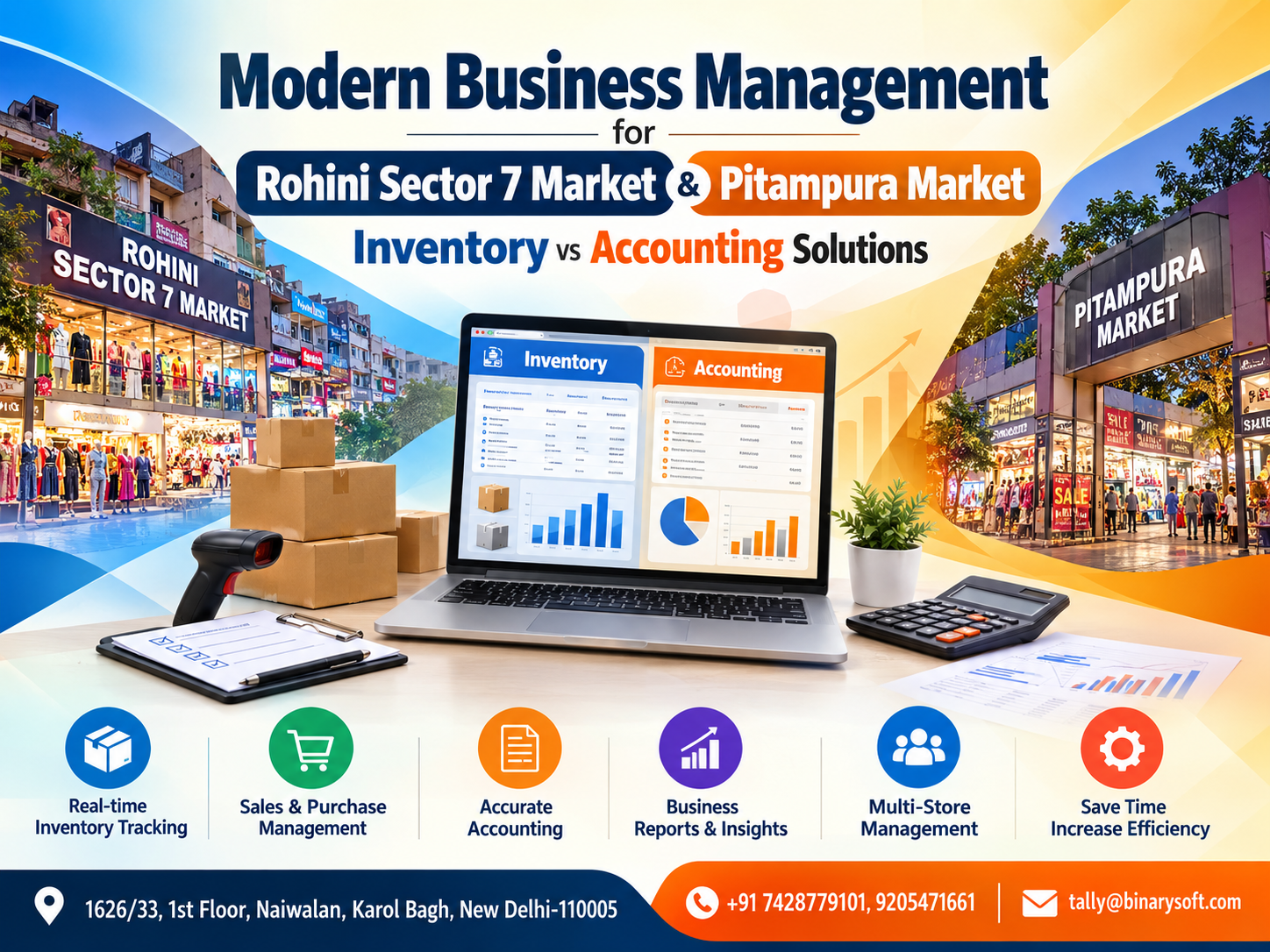
In 2026, growing traders and retailers are discovering that billing alone does not provide enough control over a modern business. For businesses in Rohini Sector 7 Market and Pitampura Market, the pressure now comes from both sides: inventory must be available when customers need it, while accounts, GST, receivables, payables and profitability must remain accurate. A business may show healthy sales but still have money trapped in slow-moving stock, overdue customer balances or unnecessary purchases. Similarly, excellent stock records cannot explain whether the company is actually profitable or financially stable. This is why the choice between inventory software and accounting software should no longer be treated as an either-or decision. A connected inventory and accounting solution can give owners visibility from purchase and stock movement to sale, GST, outstanding balances and financial reports—helping them make faster decisions with fewer disconnected spreadsheets and manual reconciliations.
Inventory vs Accounting: The Question Every Growing Business Eventually Faces
A small business often starts with a simple requirement:
“Give me software for billing.”
At the beginning, that may appear sufficient.
The owner purchases goods, creates invoices, receives payments and checks the bank account.
As the business grows, however, the questions become more complicated.
How much stock is actually available?
Which items are selling quickly?
Which products have not moved for months?
How much money do customers owe?
How much needs to be paid to suppliers?
What is the GST liability?
What is the gross profit?
What is the actual net profit?
Which items should be reordered?
How much capital is blocked in inventory?
At this stage, billing alone is no longer enough.
The business needs both operational visibility and financial visibility.
That is where the difference between inventory management and accounting becomes important.
A Rohini Sector 7 Trader Who Thought High Stock Meant a Strong Business
Consider the story of a family-run trading business operating around Rohini Sector 7.
The business had been growing steadily.
The owner was proud of one thing in particular: the shelves were always full.
Whenever a supplier offered a good rate, he purchased additional quantities.
“Stock will sell eventually,” he would tell his son.
Sales were healthy. Customers came regularly. New product varieties were constantly added.
From the outside, the business looked successful.
Then one month, the owner faced an unexpected problem.
Several supplier payments were due at the same time.
GST obligations were approaching.
Staff salaries had to be paid.
Yet the bank balance was uncomfortable.
The owner was confused.
“How can we have so much business and still be short of cash?”
His son started examining the records.
The answer was sitting all around them.
On the shelves.
A significant amount of money was locked in slow-moving inventory.
Some products had been purchased in quantities far greater than actual demand. Other products had barely moved for months. Meanwhile, a few fast-selling items were repeatedly running out of stock.
The business had inventory.
What it did not have was inventory intelligence.
Then they examined customer balances.
Another part of their money was stuck in receivables.
The problem was not a lack of sales.
The problem was that inventory, accounting and cash flow were being viewed separately.
Once the business started using a more connected approach—tracking stock movement alongside purchases, sales, outstanding balances and financial reports—the owner's decisions changed.
He stopped asking:
“How much stock do we have?”
He started asking:
“Which stock is making us money?”
That single change in thinking transformed the way the business was managed.
What Is Inventory Management?
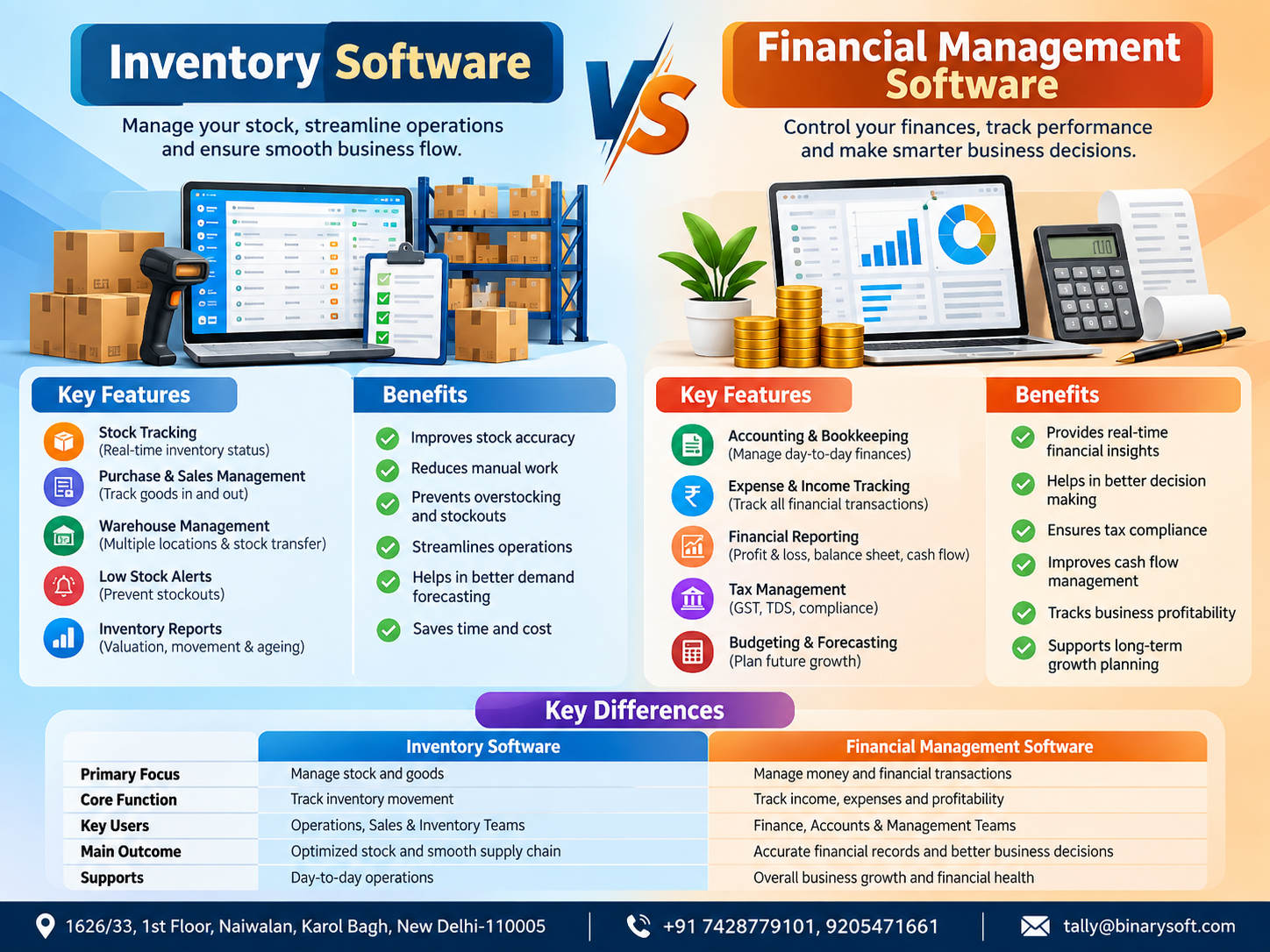
Inventory management focuses on the physical movement and availability of goods.
It helps a business answer operational questions such as:
What products are available?
How many units are in stock?
Which items were purchased?
Which items were sold?
Which products need replenishment?
Which items are moving slowly?
Which products are generating frequent sales?
Where is the stock located?
What is the value of available inventory?
For traders, retailers, wholesalers and distributors, these questions directly affect day-to-day operations.
Inventory management is therefore concerned with controlling goods from purchase to sale.
What Is Accounting Management?
Accounting focuses on the financial impact of business transactions.
It helps answer questions such as:
How much revenue has the business earned?
What are the expenses?
How much money is receivable?
How much is payable?
What is available in the bank?
What are the liabilities?
What is the GST position?
What is the gross profit?
What is the net profit?
What is the financial position of the business?
Accounting converts business activity into financial information.
Inventory vs Accounting: The Fundamental Difference
The easiest way to understand the distinction is through one purchase.
Suppose a Pitampura trader purchases 100 units of a product.
Inventory management asks:
What product was purchased?
How many units arrived?
At what rate?
Where are they stored?
How many remain?
How quickly are they selling?
Accounting asks:
What is the purchase value?
Which supplier is payable?
What taxes are involved?
When is payment due?
How does the purchase affect financial statements and profitability?
Both systems are looking at the same transaction from different perspectives.
Inventory sees goods.
Accounting sees financial value.
A modern business needs both views.
Why Rohini Sector 7 Market Businesses Need Inventory Control
Businesses operating in busy retail and trading markets can carry dozens, hundreds or thousands of individual products.
As product variety increases, manual stock control becomes difficult.
An owner may believe an item is available because it appears on a handwritten stock list.
But perhaps the last units were sold yesterday.
Or the system may show stock while the physical quantity is different.
These differences can cause lost sales.
Imagine a customer asking for 25 units of a particular product.
The employee checks a spreadsheet and says the stock is available.
The customer places the order.
Only then does the warehouse discover that just eight units are physically present.
That is not merely an inventory problem.
It is a customer experience problem.
Why Pitampura Market Businesses Need Strong Accounting
A busy shop can generate significant daily billing while still having weak financial control.
Sales alone do not tell the owner whether the business is financially healthy.
A Pitampura trader might generate substantial monthly revenue but simultaneously have:
Large customer receivables
Heavy supplier obligations
High operating expenses
Slow-moving inventory
Loan repayments
GST liabilities
Low cash reserves
Without accounting visibility, turnover can create a false sense of success.
Revenue is important.
But revenue is not the same as profit.
And profit is not the same as cash.
Inventory Tells You What You Have
One of the primary purposes of inventory management is stock visibility.
A well-maintained inventory system can help identify:
Opening stock
Purchases
Sales
Sales returns
Purchase returns
Stock transfers
Adjustments
Closing stock
This gives the owner an operational picture of available goods.
Accounting Tells You What You Owe and What You Own
Accounting adds the financial dimension.
It tracks areas such as:
Cash
Bank accounts
Receivables
Payables
Sales
Purchases
Expenses
Taxes
Assets
Liabilities
Capital
Profit and loss
This allows management to understand the financial consequences of everyday business decisions.
The Problem with Using Separate Systems
Some businesses maintain stock in one application and accounts in another.
This can work, but it often creates duplicate work when the systems are not integrated.
A sale may first be entered into billing software.
Then the same sale must be entered into accounting software.
A purchase may be entered into stock records.
Then the supplier invoice must be posted separately into accounts.
Every repeated entry creates another opportunity for error.
The result may be:
Billing Sales: ₹25,00,000
Accounting Sales: ₹24,75,000
Now someone must determine why ₹25,000 is missing.
Integrated processes can reduce this type of reconciliation burden.
Why TallyPrime Can Help Connect Inventory and Accounting
TallyPrime is commonly used by Indian businesses for accounting and business management.
Depending on configuration and business requirements, accounting and inventory information can be maintained in a connected environment.
A sales transaction can therefore have multiple effects.
It can record revenue.
It can affect the customer's account.
It can record applicable taxes.
It can reduce stock.
It can contribute to profitability reports.
This connection is valuable because the owner does not have to view inventory and finance as completely separate subjects.
Stock Groups and Stock Categories
As a business grows, maintaining a meaningful product structure becomes important.
Suppose a retailer sells:
Mobile Accessories
Computer Accessories
Electrical Products
Office Supplies
Home Appliances
Creating a logical inventory hierarchy can make reporting more useful.
Instead of seeing hundreds of unrelated product names, management can analyze stock by meaningful business categories.
This makes inventory reporting easier to understand.
Units of Measurement
Different businesses sell products using different units.
Examples include:
Pieces
Boxes
Kilograms
Metres
Litres
Sets
Packets
Correct unit configuration helps maintain meaningful quantity records.
For wholesalers and distributors, this can become particularly important where purchasing and selling quantities vary.
Godown and Location-Wise Inventory
Some growing businesses maintain goods in multiple locations.
For example:
Main Shop
Warehouse
Secondary Store
Dispatch Area
Location-wise inventory tracking can help management understand where stock is physically available.
This becomes increasingly useful as the business expands beyond a single shop.
Batch-Wise Inventory
Certain businesses need to distinguish products by batches.
Batch information can be useful where goods have different manufacturing lots, expiry considerations or other batch-specific characteristics.
The exact configuration depends on the nature of the products being handled.
Reorder-Level Thinking
One of the most valuable inventory questions is:
“When should we buy again?”
Businesses often make purchases based on instinct.
A supplier calls.
A salesperson offers a discount.
The owner remembers that an item was popular.
An order is placed.
A better approach uses actual movement information.
Reorder planning can consider factors such as:
Current stock
Average sales
Expected demand
Supplier lead time
Minimum stock requirements
The purpose is to reduce both stockouts and unnecessary overstocking.
Fast-Moving Inventory
Fast-moving products generate frequent sales.
These products require attention because running out can directly result in lost revenue.
A business should understand:
Which items move quickly?
How frequently are they replenished?
How long does the supplier take to deliver?
What minimum quantity should be maintained?
Inventory information can make purchasing decisions more evidence-based.
Slow-Moving Inventory
Slow-moving stock creates a different problem.
It occupies space and blocks working capital.
A product may appear valuable because it has a high stock value.
But if customers are not buying it, that value may not easily convert into cash.
Businesses should periodically identify slow-moving items and decide whether to:
Reduce future purchasing
Offer promotions
Bundle products
Negotiate supplier returns where possible
Reallocate stock
Discontinue certain lines
Inventory reports become useful when they lead to action.
Dead Stock: The Silent Working-Capital Problem
Dead stock is particularly dangerous because it can remain unnoticed for long periods.
The business may technically own the inventory, but the goods are not contributing to sales.
Imagine ₹8 lakh of inventory sitting in storage for a year without meaningful movement.
That money could potentially have supported:
Fast-moving stock
Supplier payments
Marketing
Staff costs
Technology investment
Working capital
This is why inventory management is ultimately connected to finance.
Receivables: Sales Without Cash
Accounting reveals another common business problem.
A sale can increase revenue without immediately increasing cash.
Suppose a wholesaler sells ₹2 lakh of goods on credit.
Sales increase by ₹2 lakh.
But the bank balance does not.
The business now has a receivable.
If customers take too long to pay, the company can experience cash pressure even while reporting strong sales.
This is why receivable management matters.
Payables: Purchasing Creates Obligations
Purchasing stock on credit creates another side of the equation.
The business receives goods today but may need to pay the supplier after 15, 30, 45 or more days.
Accounting helps track these obligations.
Without proper payable visibility, businesses may unexpectedly face several supplier payments at once.
GST and Business Management
GST adds another reason why accounting and inventory records should be organized.
Businesses may need accurate information relating to:
Sales
Purchases
Taxable values
GST rates
CGST
SGST
IGST
GSTIN details
HSN/SAC information where applicable
Credit and debit adjustments
Accurate transaction records make GST-related review and reconciliation easier.
Inventory Valuation Matters
Closing stock is not merely a quantity.
It also carries financial value.
The way inventory is recorded and valued can affect financial reporting and profitability.
This is another reason inventory and accounting cannot be treated as unrelated systems.
A quantity difference can become a financial difference.
Physical Stock vs System Stock
Every business managing physical products should understand the difference between:
Book Stock
and
Physical Stock.
If software shows 500 units but only 480 units physically exist, the difference needs investigation.
Possible reasons include:
Incorrect entries
Unrecorded damage
Unrecorded returns
Counting errors
Dispatch errors
Theft or loss
Incorrect opening stock
Wrong item selection during billing
Periodic physical verification helps identify such discrepancies.
Inventory Reports That Can Help Management
Useful inventory reports can provide insight into:
Stock Summary
Item-wise Stock
Group-wise Stock
Location-wise Stock
Movement Analysis
Stock Valuation
Purchase Trends
Sales Trends
Reorder Requirements
The exact reports used should match the business model.
A retailer and a distributor may require different levels of analysis.
Accounting Reports That Business Owners Should Review
Accounting information becomes valuable when owners actually review it.
Important reports may include:
Profit and Loss Account
Balance Sheet
Receivables
Payables
Cash and Bank Position
Sales Analysis
Purchase Analysis
Expense Analysis
Tax-related reports
Ledger Statements
Owners do not necessarily need to study every report every day.
They should know which reports answer their most important business questions.
Inventory Profit vs Actual Business Profit
A product may appear highly profitable when only purchase and selling price are considered.
Suppose:
Purchase Price: ₹800
Selling Price: ₹1,000
At first glance, the margin appears to be ₹200.
But the overall business also incurs costs such as:
Rent
Salaries
Electricity
Transportation
Marketing
Software
Professional fees
Interest
Other operating expenses
Inventory margin is therefore not the same as final business profit.
Accounting provides the broader picture.
Why More Sales Can Sometimes Create More Cash Pressure
This seems contradictory, but growing businesses often experience it.
Suppose sales increase rapidly.
The company may need to purchase more inventory.
More money goes to suppliers.
Some customers buy on credit.
Taxes and operating costs continue.
As a result, turnover increases while cash remains tight.
This is why growth needs working-capital management.
Integrated inventory and accounting information helps management understand where money is going.
The Purchase Decision Should Begin with Data
Before placing a major purchase order, an owner should ideally review:
Current stock
Recent sales movement
Outstanding purchase orders
Supplier terms
Available cash
Expected customer collections
Upcoming liabilities
This combines inventory intelligence with accounting intelligence.
Without the first, the owner may buy the wrong products.
Without the second, the owner may buy more than the business can comfortably finance.
Inventory and Accounting for Retailers
Retail businesses typically need fast billing and accurate stock information.
They may benefit from tracking:
Item availability
Daily sales
Returns
Stock movement
Tax details
Cash collections
Digital payments
Gross margin
As transaction volumes grow, integrated records become increasingly useful.
Inventory and Accounting for Wholesalers
Wholesalers may deal with larger quantities and significant credit transactions.
They often need stronger visibility into:
Customer outstanding balances
Supplier balances
Item-wise movement
Bulk pricing
Receivable ageing
Stock availability
Purchase planning
For them, inventory and accounting are deeply connected to working capital.
Inventory and Accounting for Distributors
Distributors often manage large product ranges, supplier relationships and retailer credit.
They may need to monitor:
Fast-moving SKUs
Slow-moving SKUs
Territory sales
Receivables
Supplier dues
Stock replenishment
Returns
Margins
A connected system can reduce the fragmentation between sales operations and finance.
The Pitampura Business Owner's Dashboard
Imagine a Pitampura business owner starting the morning with five questions:
What sold yesterday?
What is running low?
How much do customers owe us?
What do we need to pay suppliers?
How much cash and bank balance is available?
These questions combine inventory and accounting.
That is why modern business management should not force owners to choose between the two.
The objective should be a connected view.
From Billing Software to Business Management
Software should evolve with the business.
Stage 1 may be simple invoicing.
Stage 2 may require inventory.
Stage 3 may require accounting and GST.
Stage 4 may require receivable and payable management.
Stage 5 may require deeper reporting, multi-location stock visibility and management analysis.
The right system should support this progression without forcing the business to rebuild its records every time it grows.
Common Inventory Management Mistakes
Businesses should watch for recurring problems such as:
Creating duplicate stock items.
Using inconsistent product names.
Ignoring negative stock.
Failing to record returns.
Not reconciling physical and system stock.
Purchasing without reviewing movement.
Keeping obsolete products indefinitely.
Using incorrect units.
Mixing similar items.
Not reviewing inventory reports.
These mistakes can gradually reduce the reliability of stock data.
Common Accounting Mistakes
Accounting records can face a different set of issues.
These include:
Incorrect ledger selection.
Unreconciled bank entries.
Old customer balances remaining unresolved.
Supplier payments not properly adjusted.
Incorrect opening balances.
Unrecorded expenses.
Improper tax ledger usage.
Duplicate vouchers.
Missing transactions.
Delayed reconciliation.
A business-management system is only as reliable as the data entered into it.
When Should a Business Choose Inventory Software?
A dedicated inventory-focused solution may be important when the primary operational complexity involves stock.
For example, the business may have:
Large SKU volumes
Multiple warehouses
Complex batch requirements
High-frequency stock movement
Advanced warehouse operations
However, the financial impact of those operations still needs accounting.
When Should a Business Choose Accounting Software?
Accounting capability is essential when the priority is maintaining books, financial transactions, receivables, payables, taxation and financial statements.
But a product-based business cannot ignore inventory merely because its accounts are accurate.
That is why the question should often be reframed.
Not:
“Inventory software or accounting software?”
But:
“How do we manage inventory and accounting together?”
Why Integration Is the Better Long-Term Approach
The strongest business-management process connects operations with finance.
A purchase should affect both stock and supplier obligations.
A sale should affect both inventory and revenue.
A credit sale should affect stock, revenue and receivables.
A payment should reduce customer outstanding balances.
A supplier payment should reduce liabilities.
When these activities are connected, the business has a more coherent view of its operations.
A Simple Daily Management Routine
Businesses do not need to review hundreds of reports every morning.
A short management routine can be more effective.
Review daily sales.
Check critical stock levels.
Review major receivables.
Check upcoming supplier payments.
Monitor cash and bank balances.
Investigate unusual stock or accounting movements.
Then take action.
The purpose of software is not simply to store information.
It is to help management make decisions.
Weekly Review for Growing Traders
Once a week, management can review broader trends.
Which products sold fastest?
Which items did not move?
Which customers crossed their normal credit period?
Which suppliers need payment?
What major expenses occurred?
Is the bank position comfortable?
Are there inventory discrepancies?
These questions help identify problems before month-end.
Monthly Business Review
At month-end, the owner can move from transaction-level thinking to business-level analysis.
Review:
Monthly sales
Gross margin
Major expenses
Net profitability
Receivables
Payables
Inventory value
Slow-moving stock
Cash flow position
GST-related records
This gives a much clearer picture than turnover alone.
Better Data Creates Better Negotiation
Accurate inventory and accounting information can also improve supplier negotiations.
Suppose the owner knows that a product sells 500 units every month.
That information can support a stronger purchasing conversation.
Likewise, knowing actual payment cycles and available working capital helps prevent commitments that the business cannot comfortably meet.
Data gives owners negotiating confidence.
Better Inventory Can Improve Customer Experience
Customers care about availability.
If a product is repeatedly unavailable, they may switch suppliers.
Accurate stock visibility allows staff to answer customer questions more confidently.
Instead of saying:
“I think we have it.”
they can provide a more reliable response.
Operational accuracy becomes part of customer service.
Better Accounting Can Improve Owner Confidence
Many business owners experience unnecessary financial stress because they do not have clear numbers.
They know sales are happening.
They see stock moving.
They see money entering and leaving the bank.
But they cannot immediately answer whether the business is actually improving.
Reliable accounting turns activity into measurable financial performance.
That clarity can improve decision-making.
Modern Business Management Is About Connection
The most important lesson is that inventory and accounting should not operate as isolated functions.
Inventory tells the owner what is happening with products.
Accounting explains what those activities mean financially.
Together, they answer the questions that actually matter:
What are we selling?
What should we purchase?
What is not moving?
Who owes us money?
Whom do we need to pay?
How much cash do we have?
Are we profitable?
Where is our working capital?
What should we do next?
That is modern business management.
Conclusion
For businesses in Rohini Sector 7 Market and Pitampura Market, the debate between inventory software and accounting software should not end with choosing one and ignoring the other.
Inventory management provides control over products, quantities, stock movement, availability and replenishment.
Accounting provides control over revenue, expenses, receivables, payables, GST, cash, bank balances and profitability.
Both perspectives are essential.
A business with accurate inventory but weak accounting may know what is on the shelf without knowing whether it is financially healthy.
A business with accurate accounting but poor inventory management may know its financial position while still losing sales because of stockouts, overstocking or slow-moving goods.
The better long-term approach is to connect inventory and accounting so that every purchase, sale, return, receipt and payment contributes to one coherent view of the business.
For growing traders, retailers, wholesalers and distributors, the real benefit is not simply automation.
It is visibility.
When owners can see stock, money, obligations and profitability together, they can make better decisions before small operational problems become expensive business problems.
Powered by Binarysoft Technologies
Authorized Tally Partner
Location : 1626/33, 1st Floor, Naiwalan, Karol Bagh, New Delhi – 110005, INDIA
Contact us : +91 7428779101, 9205471661
Email us : tally@binarysoft.com
Working Hours : 10:00 AM – 6:00 PM, Mon–Fri
Frequently Asked Questions
What is the main difference between inventory software and accounting software?
Inventory software primarily focuses on products, quantities, stock movement and availability. Accounting software focuses on the financial impact of transactions, including sales, purchases, expenses, receivables, payables, cash, bank balances, taxation and profitability.
Does a retail business need both inventory and accounting?
For most growing product-based businesses, both functions are valuable. Inventory provides product visibility while accounting provides financial visibility.
CA. Ronav Maheshwari works with small and mid-sized businesses on accounting processes, GST compliance, and financial reporting. His focus is on simplifying routine accounting workflows and helping business owners maintain accurate and audit-ready records.