Call CA Tally HelpDesk
+91 9205471661,
7428779101

When Managing a Business Becomes More Difficult Than Growing It
Every entrepreneur starts a business with a dream. Some want financial independence, others want to build something meaningful for their families, and many hope to create employment opportunities while serving customers.
However, as a business grows, managing daily operations becomes increasingly complicated.
Invoices must be generated, customer payments collected, inventory monitored, suppliers paid, GST transactions recorded, and financial reports reviewed. When these activities are handled through separate spreadsheets, handwritten registers, or disconnected applications, mistakes become more likely.
A small billing error can affect customer satisfaction. An overlooked payment can create cash flow problems. An inaccurate inventory record can delay an important delivery.
This is where Tally Prime becomes a valuable business management solution.
Tally Prime combines accounting, invoicing, inventory management, taxation, banking, and financial reporting within an integrated business environment. Instead of managing information across multiple systems, businesses can maintain organized records and make informed decisions using reliable financial data.
Whether you operate a retail store, wholesale distribution business, manufacturing company, consultancy firm, or growing enterprise, Tally Prime can help simplify daily activities and improve operational efficiency.
More importantly, it allows business owners to spend less time resolving accounting problems and more time focusing on customers, profitability, and long-term growth.
1. Seamless Invoicing for Faster and More Accurate Business Transactions
Invoicing is one of the most important activities in any business. Every sale must be recorded correctly because invoices directly influence revenue, customer relationships, taxation, and payment collection.
Manual invoicing often creates unnecessary complications, including calculation errors, duplicate entries, incorrect tax amounts, and missing customer information.
Tally Prime simplifies invoicing by allowing businesses to generate professional sales invoices while automatically recording the related accounting entries.
Key invoicing capabilities
GST-compliant invoicing: Businesses can configure applicable GST rates, tax ledgers, and customer registration details to generate invoices with relevant tax information.
Multiple invoice formats: Businesses can customize invoice layouts to display company information, product details, tax calculations, payment terms, and other relevant fields.
Automatic accounting integration: When a sales invoice is recorded, the corresponding accounting entries are updated without requiring separate manual posting.
Credit and cash sales: Businesses can record different transaction types while maintaining accurate customer balances.
Discount management: Item-level and invoice-level discounts can be recorded according to business requirements.
Sales returns and credit notes: Businesses can maintain proper records when customers return goods or adjustments become necessary.
How Tally Prime helps
Consider a wholesale electronics distributor processing dozens of invoices every day.
Without integrated software, employees may calculate taxes separately, update inventory manually, and enter customer balances into spreadsheets.
With Tally Prime, a correctly configured sales transaction can update accounting records, inventory quantities, and customer outstanding balances together.
This reduces repetitive work and makes transaction information easier to verify.
2. Accurate Financial Tracking for Better Business Decisions
A business may generate substantial sales but still experience financial difficulties.
The reason is simple: revenue alone does not determine financial health.
Business owners must understand expenses, outstanding payments, liabilities, available cash, inventory investment, and profitability.
Tally Prime provides financial reporting capabilities that help businesses monitor these areas.
Important financial reports
Balance Sheet: Displays assets, liabilities, and capital, helping owners understand their financial position.
Profit and Loss Account: Shows income and expenses to determine whether the business is generating profits or experiencing losses.
Cash Flow Statement: Helps businesses understand cash inflows and outflows during a selected period.
Trial Balance: Provides a summary of ledger balances for accounting review and reconciliation.
Day Book: Displays recorded transactions and helps users examine daily business activity.
Ledger Reports: Allow businesses to review transactions related to individual customers, suppliers, expenses, and accounts.
Why financial visibility matters
Imagine a business owner who believes the company is profitable because monthly sales have increased.
However, the financial statements reveal that transportation costs, purchase expenses, and customer outstanding balances have also increased.
With this information, the owner can investigate expenses, review customer credit terms, and improve purchasing decisions.
Tally Prime makes this information accessible through organized financial reports rather than requiring business owners to prepare every calculation manually.
3. Inventory Management That Reduces Stock Problems
Inventory is one of the largest investments for many trading, retail, and manufacturing businesses.
Maintaining excessive inventory blocks working capital, while insufficient stock can lead to missed sales opportunities.
Effective inventory management requires accurate stock records, timely replenishment, and clear visibility into product movement.
Tally Prime provides inventory management features that help businesses maintain control over their goods.
Important inventory management features
-
Stock groups and stock categories for organized product classification.
-
Stock items with relevant units of measurement.
-
Godown or location-wise inventory tracking.
-
Batch-wise inventory management where applicable.
-
Stock valuation and stock summary reports.
-
Reorder level information for replenishment planning.
-
Purchase and sales order processing.
-
Stock ageing analysis for identifying slow-moving inventory.
Practical business example
A hardware distributor sells electrical switches, cables, lighting products, and installation accessories.
Previously, employees checked physical stock before confirming customer orders.
After maintaining inventory records in Tally Prime, the business can review available stock quantities, identify fast-moving items, and examine inventory across different locations.
The distributor can use this information to plan purchases and reduce unnecessary stock accumulation.
Accurate inventory records also support better customer service because employees can provide more reliable information about product availability.
4. Efficient Customer Payment Tracking and Credit Management
Sales are important, but collecting payments is equally essential.
Many businesses experience cash shortages because customers delay payments beyond agreed credit periods.
Without proper tracking, overdue invoices may remain unnoticed until the business faces difficulties paying suppliers or meeting operating expenses.
Tally Prime supports bill-wise accounting, allowing businesses to maintain details of outstanding customer invoices.
How payment tracking works
When a credit sale is recorded, the invoice can be maintained against the customer's ledger.
When payment is received, the receipt can be adjusted against the relevant outstanding invoice.
Businesses can then review outstanding reports to understand which invoices remain unpaid.
Benefits of effective credit management
Improved collection planning: Accounting teams can identify overdue invoices and prioritize customer follow-ups.
Better customer communication: Staff can refer to invoice numbers, outstanding amounts, and transaction details when discussing payments.
Reduced accounting confusion: Bill-wise records make it easier to match receipts against outstanding invoices.
Improved cash flow planning: Business owners gain clearer visibility into money expected from customers.
For businesses extending credit to wholesalers, retailers, distributors, or corporate clients, these capabilities can significantly improve financial discipline.
5. Simplified GST Accounting and Tax Compliance
GST compliance is an essential responsibility for registered businesses operating in India.
Incorrect tax calculations, missing transaction details, or inconsistent records can create additional reconciliation work and compliance risks.
Tally Prime provides GST-related accounting capabilities to help businesses maintain organized tax records.
GST management capabilities
Businesses can configure GST registration details, applicable tax classifications, and relevant ledgers.
Sales and purchase transactions can then be recorded with the appropriate tax treatment.
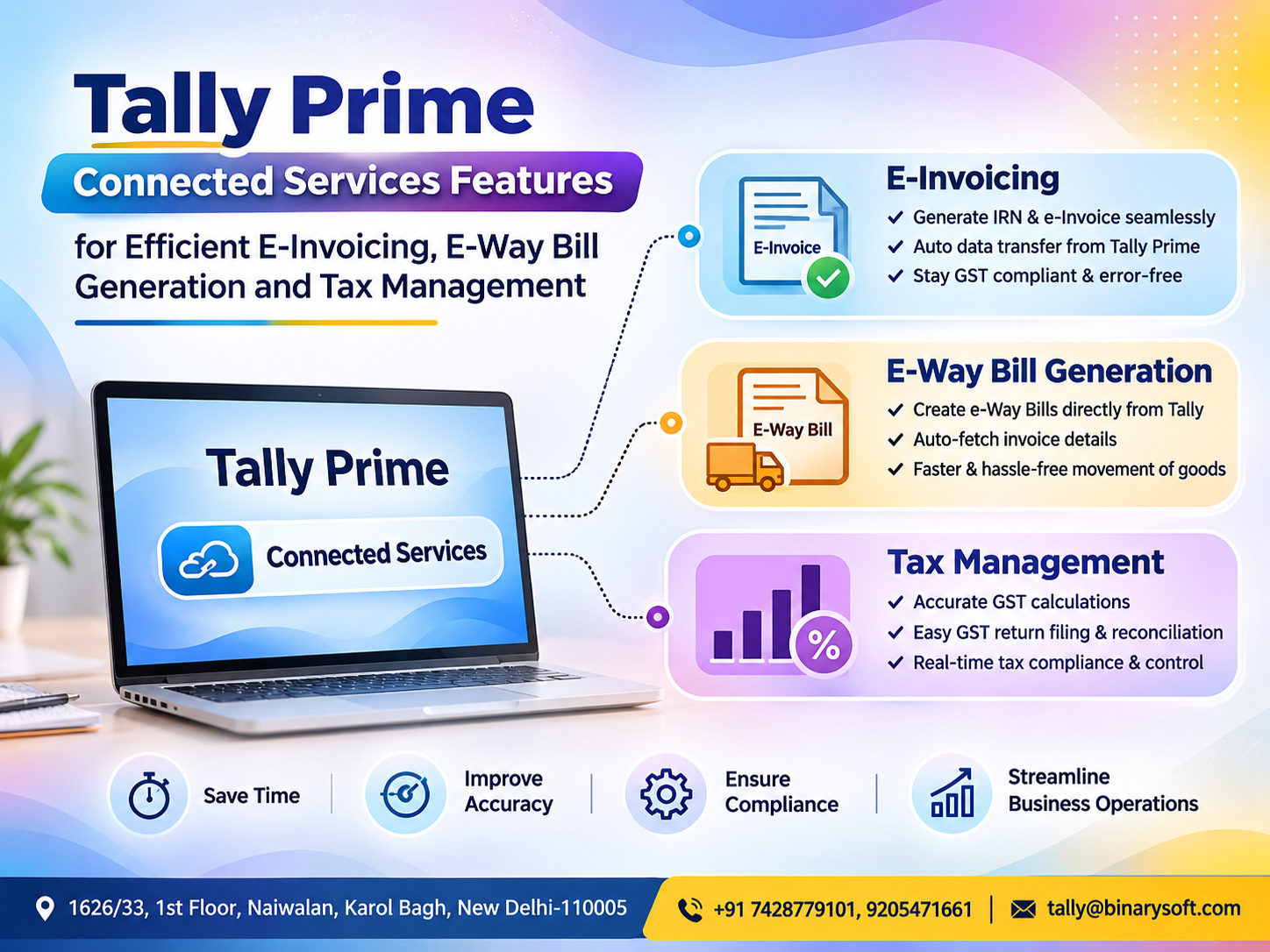
Depending on the installed version, configuration, eligibility, and enabled services, businesses can also use supported GST reporting, reconciliation, e-invoicing, and e-way bill capabilities.
How this improves efficiency
Instead of maintaining separate accounting and tax records, businesses can use transaction data recorded in Tally Prime to support GST reporting.
This helps accounting teams identify inconsistencies and review tax-related information more efficiently.
However, GST compliance still requires correct transaction classification, timely reconciliation, verification of portal information, and review of applicable legal requirements.
Tally Prime supports the compliance process, but businesses remain responsible for the accuracy and timely submission of statutory information.
6. Banking and Bank Reconciliation for Better Cash Control
Banking transactions influence almost every business activity.
Customer receipts, supplier payments, employee salaries, operating expenses, and statutory payments often pass through bank accounts.
When accounting records and bank statements do not match, identifying discrepancies can consume considerable time.
Tally Prime provides banking and reconciliation capabilities to help businesses review these transactions.
Important banking functions
Bank reconciliation: Match transactions recorded in the books with corresponding bank statement entries.
Bank transaction recording: Maintain receipts, payments, transfers, and other relevant entries.
Bank statement import: Supported bank statement formats can be imported, subject to the available features and bank compatibility.
Payment tracking: Review recorded payments and outstanding supplier obligations.
Bank ledger reporting: Examine transactions and balances for individual bank accounts.
Business benefits
A company processing hundreds of banking transactions each month can reduce manual comparison work by using supported reconciliation features.
Accounting staff can identify unmatched entries, investigate missing transactions, and maintain more reliable bank records.
Regular reconciliation also helps businesses detect duplicate postings, unrecorded charges, and timing differences.
7. Purchase Management and Supplier Relationship Improvement
Purchasing is another critical business operation.
Poor purchasing decisions can result in excessive inventory, delayed deliveries, higher costs, and strained supplier relationships.
Tally Prime helps businesses organize purchase transactions and supplier accounts.
Businesses can record purchase orders, purchase invoices, supplier payments, debit notes, and outstanding liabilities.
Purchase reports provide useful information about supplier transactions and purchasing patterns.
How businesses can use purchase reports
A retailer can review purchasing activity to identify frequently ordered products.
A manufacturer can examine material procurement expenses.
A distributor can monitor supplier outstanding balances before scheduling payments.
By reviewing these records, businesses can improve purchasing discipline, maintain supplier relationships, and make more informed working capital decisions.
8. Cost Centres and Profitability Analysis
Not every department, project, or branch contributes equally to profitability.
Some activities generate strong revenue but involve high operating costs. Others may have lower sales but better margins.
Tally Prime provides cost centre capabilities that help businesses allocate relevant income and expenses to specific business units, departments, or activities.
For example, a service company may create separate cost centres for consulting, technical support, and implementation projects.
Management can then review allocated costs and income to better understand performance.
This information helps business owners identify areas requiring attention and allocate resources more effectively.
Cost centre reporting is particularly useful for organizations managing multiple departments, service categories, or projects.
9. Multi-User Access and Better Team Coordination
As businesses grow, accounting responsibilities are distributed among different employees.
Sales teams prepare invoices, purchase departments manage suppliers, accountants maintain financial records, and management reviews performance.
Tally Prime supports multi-user working environments with appropriate licensing and configuration.
Businesses can establish user permissions to control access to sensitive accounting information.
For example, billing employees may receive access to sales-related functions, while accountants and authorized management personnel can work with broader financial information.
This structured approach helps improve coordination while reducing unnecessary exposure of confidential business records.
10. Business Data Security, Backup and Remote Accessibility
Business accounting data contains valuable information about customers, suppliers, transactions, and financial performance.
Losing this information because of hardware failure, accidental deletion, or inadequate backup procedures can disrupt operations.
Tally Prime provides company data management, backup, restoration, and access-control capabilities.
Businesses should maintain regular backups and test restoration procedures to ensure that important information can be recovered when required.
Remote access and supported connected services can also help authorized users review business information outside their primary office.
For businesses using Tally Prime on Cloud, a properly configured hosting environment may provide additional flexibility for accessing the application from different locations.
However, cloud hosting security, backup frequency, simultaneous access, and disaster recovery depend on the selected infrastructure and service arrangement.
11. Real-Time Business Reporting and Operational Efficiency
Successful business management requires timely information.
Waiting until the end of the month to discover falling profits or increasing expenses can delay corrective action.
Tally Prime provides reporting tools that help businesses analyze financial and operational performance using recorded transactions.
Business owners can review sales trends, purchase activity, stock positions, customer outstanding balances, and profitability.
Reports can be filtered by date, ledger, or other available criteria.
For example, a distributor can compare monthly sales performance, identify slow-moving products, and examine overdue customer payments.
Management can use these insights to improve pricing, purchasing, credit control, and operational planning.
Although Tally Prime cannot replace managerial judgment, it provides organized information that supports more confident decisions.
12. An Emotional Story: How Better Financial Control Saved a Family Business
Illustrative business story
For nearly fifteen years, Rajesh operated a small electrical supplies business in Delhi.
His father had started the shop with limited savings and a determination to provide a better future for the family.
Rajesh inherited not only the business but also the responsibility of preserving his father's hard work.
As customer demand increased, the shop expanded into wholesale distribution.
However, the accounting system did not grow with the business.
Invoices were prepared manually, customer payments were recorded in notebooks, and stock information depended heavily on employees' memory.
One evening, Rajesh discovered that several important customer payments were overdue.
At the same time, suppliers were demanding settlement, and the business had purchased excessive quantities of products that were not selling.
Despite strong sales, there was insufficient cash available to meet immediate obligations.
Rajesh felt overwhelmed.
He had worked long hours, sacrificed family time, and invested years of effort into growing the business. Yet he could not clearly explain where the money was going.
His daughter noticed his anxiety and asked a simple question:
"Papa, if the shop is doing so well, why are you always worried?"
That question stayed with him.
Rajesh decided to reorganize his accounting operations using Tally Prime.
He began maintaining customer invoices, supplier balances, inventory records, and financial transactions in one integrated system.
Over time, he developed a habit of reviewing outstanding payments, stock reports, and cash flow information every week.
The business did not transform overnight.
But gradually, Rajesh gained better visibility into its financial position.
He could identify overdue customers, avoid unnecessary purchases, and plan supplier payments more carefully.
Most importantly, he regained confidence in his decisions.
The biggest change was not simply improved accounting.
It was the peace of mind that came from understanding his business.
For entrepreneurs like Rajesh, effective business management is about more than software. It is about protecting years of hard work, supporting employees, and building a secure future for their families.
13. Case Study One: Improving Inventory and Invoicing in a Wholesale Distribution Business
Illustrative case study — figures are examples, not verified customer results
Business: Delhi-based electrical products distributor
Industry: Wholesale trading
Business challenge: Manual invoicing, inaccurate stock records, and delayed payment tracking.
Before implementing Tally Prime
The distributor handled approximately 80 to 100 sales invoices daily.
Billing employees prepared invoices while warehouse staff maintained separate inventory records.
Customer outstanding balances were updated periodically, creating delays in payment follow-ups.
Management also struggled to identify which products required replenishment.
Tally Prime implementation
The company introduced an integrated accounting workflow using:
-
GST-compliant sales and purchase invoicing.
-
Inventory management with stock groups and godowns.
-
Bill-wise customer outstanding tracking.
-
Supplier payment monitoring.
-
Sales and profitability reporting.
Employees received training on maintaining accurate transaction records.
Illustrative operational improvement
|
Business activity
|
Earlier process
|
Improved process
|
|---|
|
Sales invoicing
|
Separate billing and accounting
|
Integrated invoice recording
|
|
Stock monitoring
|
Manual warehouse registers
|
Updated stock reports
|
|
Customer payments
|
Periodic spreadsheet review
|
Bill-wise outstanding reports
|
|
Purchasing
|
Based on approximate stock
|
Based on inventory information
|
|
Financial reporting
|
Manual monthly preparation
|
Reports from recorded transactions
|
Business outcome
The distributor established a more organized process for invoicing, stock management, and collections.
Employees spent less time comparing disconnected records, while management gained clearer information for purchasing and credit decisions.
The key lesson is that integrated accounting can improve operational control when employees maintain accurate records and follow consistent procedures.
14. Case Study Two: Financial Visibility for a Growing Service Company
Illustrative case study
Business: Bengaluru-based IT consulting company
Industry: Professional services
Business challenge: Project expense tracking, delayed customer payments, and limited profitability visibility.
Business background
A growing consulting company managed multiple client projects simultaneously.
Employees worked on software implementation, technical support, and business consulting assignments.
Although the company generated consistent revenue, management struggled to determine which projects were profitable.
Project-related expenses were recorded under general accounting heads without sufficient allocation.
Tally Prime implementation
The company configured separate cost centres for major projects and departments.
Customer invoices were recorded with bill-wise references, while relevant expenses were allocated to the appropriate cost centres.
Management began reviewing financial statements and outstanding customer balances regularly.
Results and benefits
The company gained clearer visibility into project-related income and allocated expenses.
Accounts staff could identify unpaid invoices more efficiently.
Management could compare project performance and examine areas where costs required better control.
The company also developed a more disciplined approach to reviewing financial reports.
Key takeaway
For service businesses, Tally Prime can support much more than basic bookkeeping.
When configured appropriately, it can help track project costs, monitor receivables, and improve financial planning.
15. How to Implement Tally Prime for Better Business Management
Businesses can achieve better results from Tally Prime by following a structured implementation process.
Step 1: Create the company
Enter the company name, financial year, accounting details, and other relevant business information.
Step 2: Configure accounting and taxation
Enable the required accounting, inventory, GST, and other applicable features through the company settings.
Step 3: Create accounting ledgers
Set up customer, supplier, bank, expense, income, purchase, sales, and tax ledgers.
Step 4: Configure inventory
Create stock groups, stock items, units of measurement, and godowns where required.
Step 5: Record opening balances
Enter verified opening ledger balances and stock quantities to establish accurate starting records.
Step 6: Start recording daily transactions
Maintain sales, purchases, receipts, payments, and other business transactions consistently.
Step 7: Enable bill-wise tracking
Use bill references to monitor outstanding customer and supplier invoices.
Step 8: Review reports regularly
Examine cash flow, profitability, inventory, receivables, and payables.
Step 9: Establish data protection procedures
Configure appropriate user permissions, maintain backups, and periodically verify data integrity.
Step 10: Train employees
Ensure employees understand correct voucher entry, inventory procedures, GST classification, and reconciliation.
A successful implementation depends on both software configuration and disciplined business processes.
16. Why Tally Prime Is Suitable for Growing Indian Businesses
Indian businesses operate in a competitive environment where financial accuracy, customer service, and operational efficiency directly influence success.
Tally Prime offers an integrated approach to managing essential business activities.
For small businesses, it provides organized accounting and invoicing.
For trading companies, it supports stock management, purchases, sales, and payment tracking.
For service organizations, it provides financial reporting and cost allocation capabilities.
For growing enterprises, it offers configurable workflows, user access controls, and reporting tools.
The ability to maintain accounting and operational information together helps reduce dependence on disconnected systems.
Businesses can also expand their use of Tally Prime features as their operational requirements become more complex.
17. The Future of Business Management Is Integrated and Data-Driven
Modern businesses cannot rely entirely on intuition when making financial decisions.
They need timely information about revenue, expenses, customer payments, inventory, and profitability.
Integrated business management software helps create a stronger foundation for these decisions.
Tally Prime supports this approach by connecting important accounting and operational activities within a structured system.
As businesses adopt digital invoicing, connected banking, electronic compliance processes, and improved reporting, the importance of accurate underlying accounting data continues to increase.
The most successful organizations will be those that combine reliable software with trained employees, consistent financial controls, and informed management.
Conclusion: Build a More Efficient and Financially Strong Business with Tally Prime
Managing a successful business requires much more than generating sales.
Entrepreneurs must maintain accurate financial records, control expenses, monitor inventory, collect customer payments, manage suppliers, and meet taxation responsibilities.
Tally Prime brings these important activities together through integrated accounting and business management capabilities.
Its invoicing, inventory, financial reporting, banking, GST, and credit management features can help businesses reduce repetitive work and improve operational visibility.
From small retailers to growing distribution companies and professional service organizations, Tally Prime provides tools that support organized financial management.
However, software delivers the greatest value when supported by accurate data entry, regular reconciliation, proper employee training, and disciplined financial review.
For businesses seeking to improve accounting accuracy, strengthen operational control, and prepare for sustainable growth, Tally Prime can be an important part of their digital transformation journey.
Powered by Binarysoft Technologies
Authorized Tally Partner
Location: 1626/33, 1st Floor, Naiwalan, Karol Bagh, New Delhi – 110005, INDIA
Contact us: +91 7428779101, 9205471661
Email us: tally@binarysoft.com
Business Hours: 10:00 AM – 6:00 PM, Monday to Friday
Frequently Asked Questions
What are the main business management features of Tally Prime?
Tally Prime provides accounting, GST invoicing, inventory management, customer payment tracking, purchase management, banking, financial reporting, and cost centre accounting. These features help businesses manage important financial and operational activities within one system.
How does Tally Prime improve invoicing efficiency?
Tally Prime allows businesses to generate invoices while recording related accounting transactions. When inventory integration is enabled and configured correctly, relevant stock records are also updated, reducing duplicate data entry.
Can Tally Prime help businesses track customer outstanding payments?
Yes. Tally Prime supports bill-wise accounting and outstanding reports that help businesses identify unpaid invoices, monitor overdue amounts, and plan customer payment follow-ups.
Is Tally Prime suitable for small businesses?
Yes. Tally Prime can be used by small retailers, traders, service providers, and other businesses requiring structured accounting, invoicing, and financial reporting.
CA. Harshit Gaurwaadi is a practicing Chartered Accountant with hands-on experience in accounting systems, GST compliance, and MSME advisory. He regularly works with small and mid-sized businesses to streamline inventory, billing, and statutory processes using modern accounting software. His articles focus on practical, ground-level challenges faced by Indian traders and professionals.