Call CA Tally HelpDesk
+91 9205471661,
7428779101
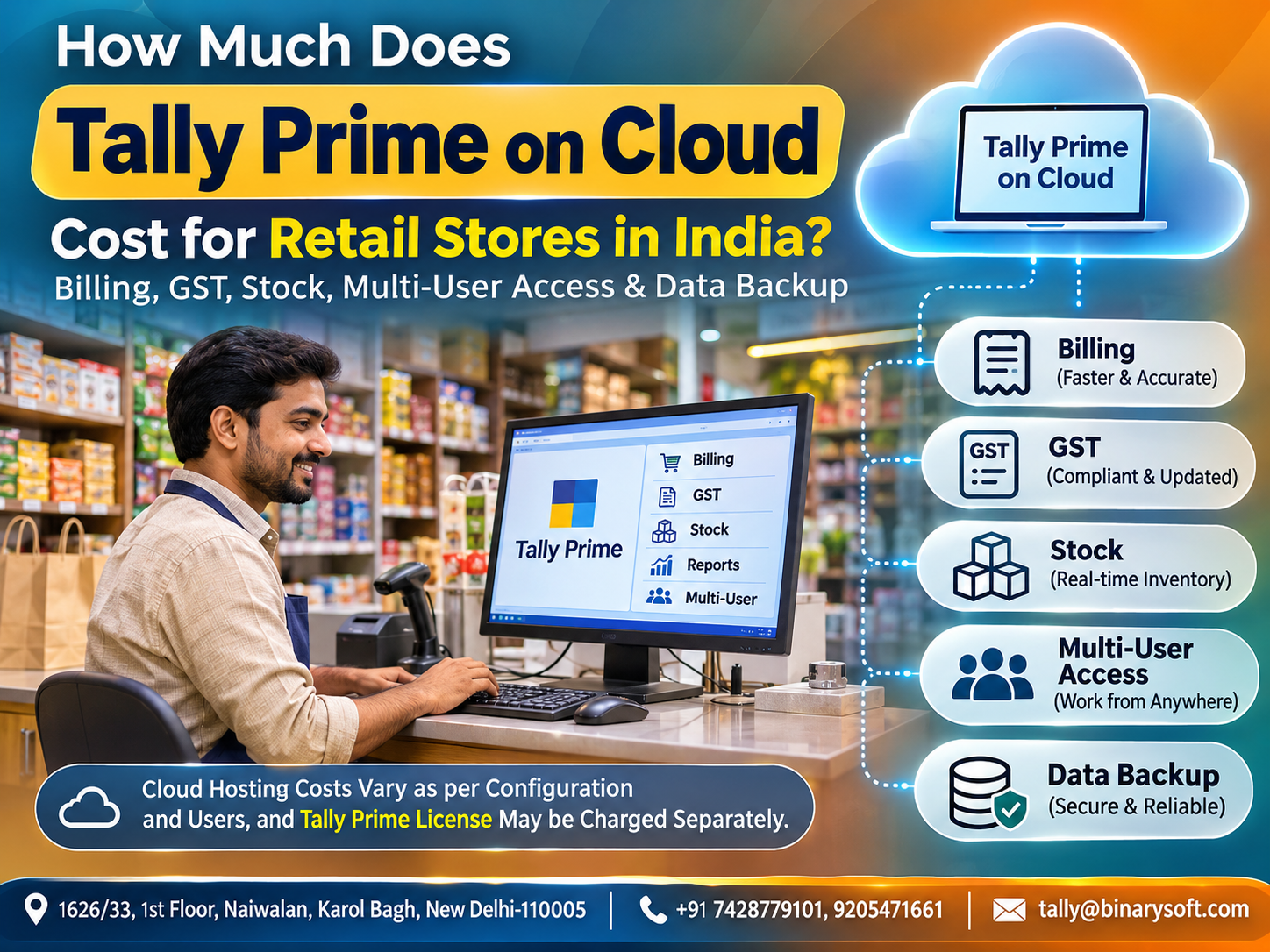
Introduction: Why Indian Retail Stores Are Moving to Tally Prime on Cloud
Running a retail store in India is no longer just about purchasing products and selling them to customers. Modern retailers must manage daily billing, GST compliance, inventory movement, supplier payments, customer balances, employee responsibilities and financial reporting.
Whether you operate a grocery shop in Delhi, a garment showroom in Mumbai, an electronics store in Bengaluru or a chain of retail outlets across India, maintaining accurate financial records is essential for long-term business success.
Traditional accounting systems often create challenges when business owners need to access their financial information outside their shops. A retailer may have to visit the store personally to check sales reports, verify outstanding payments or review inventory availability.
Tally Prime on Cloud helps overcome these limitations by allowing retailers to access their accounting and inventory software through a remotely hosted environment.
Instead of depending entirely on one office computer, retailers can work with their accounting data from authorized devices with an internet connection.
But one important question arises:
How much does Tally Prime on Cloud cost for retail stores in India?
The answer depends on the existing Tally Prime license, cloud hosting resources, number of users, storage requirements, backup arrangements and technical support services.
This guide explains the pricing structure, practical business benefits, GST billing capabilities, inventory management features, multi-user access and data protection considerations.
1. What Is Tally Prime on Cloud for Retail Businesses?
Tally Prime on Cloud is a hosting arrangement in which Tally Prime runs on a remote cloud server instead of relying exclusively on a computer installed inside the retail store.
Authorized users connect to the hosted environment to perform accounting and business management activities.
For example, a clothing retailer with three stores can use a suitable cloud setup to access centralized accounting information without physically visiting each location.
Retailers can use Tally Prime for:
-
GST-compliant sales and purchase invoicing.
-
Daily cash and bank transaction recording.
-
Stock item and inventory management.
-
Supplier and customer ledger management.
-
Outstanding payment monitoring.
-
Sales, purchase and profitability reports.
-
Financial statements and business analysis.
-
Multi-location accounting and authorized user access.
The actual capabilities depend on the Tally Prime edition, configuration, license permissions and hosting environment.
Cloud hosting does not automatically add features unavailable in the underlying software license.
2. How Much Does Tally Prime on Cloud Cost in India?
The cost of Tally Prime on Cloud generally consists of two separate components: the software license and the cloud hosting service.
Retailers who already own a compatible Tally Prime license may only need to arrange cloud hosting and any required configuration or support.
Businesses purchasing Tally Prime for the first time must consider both expenses.
Tally Prime Software License Prices
The following are published India license prices for reference as of November 2026.
|
License Type
|
Price Before GST
|
Suitable For
|
|---|
|
Tally Prime Silver – Lifetime
|
₹22,500
|
Single-user retail operations
|
|
Tally Prime Gold – Lifetime
|
₹67,500
|
Multiple simultaneous users
|
|
Tally Prime Silver – Monthly Rental
|
₹750/month
|
Small retail businesses
|
|
Tally Prime Gold – Monthly Rental
|
₹2,250/month
|
Growing retail teams
|
An additional 18% GST applies to these listed prices. Rental prices and promotional offers may change.
Cloud Hosting Charges
Cloud hosting is an additional expense unless the selected package explicitly includes it.
Published Tally Prime Cloud Access plans start at approximately ₹600 per month before GST for a personal-use configuration. Larger user packs cost more, and subscriptions are generally available for three, six or twelve months.
Third-party hosting providers may use different pricing structures, such as per-user charges, dedicated-server packages or customized enterprise plans.
For a realistic budget, retailers should consider:
-
Software license or rental charges.
-
Cloud server subscription.
-
Number of concurrent users.
-
Storage and backup requirements.
-
Data migration and initial setup.
-
Technical support and maintenance.
-
Optional integrations and customizations.
Important: The final price offered by Binarysoft Technologies should be confirmed through a written quotation. Published software prices do not represent a guaranteed Binarysoft cloud-hosting package.
3. Understanding the Total Cost Through Practical Retail Examples
Consider a small grocery shop that requires one accounting user and remote access.
A possible subscription-based arrangement could include:
|
Expense
|
Monthly Cost
|
|---|
|
Tally Prime Silver rental
|
₹750
|
|
Entry-level cloud access
|
₹600
|
|
Total before GST
|
₹1,350
|
|
Total including 18% GST
|
₹1,593
|
This is an illustrative calculation using published entry-level prices, not a personalized quotation. The actual purchase period, compatible package and additional service requirements must be verified.
For a larger clothing showroom with multiple accounting users, a Gold license and appropriately sized cloud hosting package may be more suitable.
Although multi-user arrangements generally involve higher expenses, they can reduce operational delays and provide better coordination between billing, accounting and management.
Retailers should compare the complete cost of ownership rather than selecting a package solely because it has the lowest advertised monthly price.
4. How Tally Prime on Cloud Helps Retail Stores with Faster Billing
Billing is one of the most important daily activities in a retail business.
During busy shopping hours, customers expect quick invoices, accurate prices and smooth checkout experiences.
Manual billing or poorly organized accounting systems can result in incorrect calculations, missed entries and delayed customer service.
Tally Prime helps retailers generate invoices while maintaining connected accounting and inventory records.
GST-Compliant Retail Invoicing
Retailers can configure relevant GST details, tax classifications and sales transactions according to their business requirements.
The software supports recording taxable sales, applicable GST rates, discounts and customer details.
For example, an electronics store selling mobile accessories can prepare invoices showing product descriptions, quantities, taxable values and applicable GST.
This helps maintain consistency between sales documentation and accounting records.
Cash and Credit Sales Management
Many retail stores accept payments through cash, UPI, bank transfers and credit arrangements.
Tally Prime helps record these transactions under appropriate ledgers.
A retailer can monitor cash sales separately from credit sales and identify amounts outstanding from customers.
Faster Invoice Preparation
Retailers can maintain stock item masters, predefined rates and relevant tax information to reduce repetitive data entry.
Barcode-supported workflows may also be configured using compatible hardware and suitable software arrangements.
However, specialized POS functionality, barcode printing, loyalty programs or payment-device integrations may require additional configuration or third-party solutions.
Cloud hosting makes the accounting environment remotely accessible, but actual billing speed depends on server performance, network quality and workflow design.
5. Retail Inventory Management with Tally Prime on Cloud
Inventory represents a significant investment for most retail businesses.
Excess stock blocks working capital, while insufficient stock can result in lost sales and disappointed customers.
Tally Prime provides inventory management features that help retailers understand stock movement and maintain better control over product availability.
Stock Item Management
Retailers can create individual stock items for different products.
A garment store, for example, may maintain separate items for shirts, trousers, jackets and accessories.
Depending on its configuration, the business can organize products using stock groups, categories, units and relevant inventory attributes.
Stock Availability Reports
Retailers can review stock summaries to understand available quantities and inventory values.
This information supports decisions about replenishment and purchasing.
Multiple Godowns and Locations
Businesses operating warehouses or multiple storage locations can maintain godown-wise inventory records.
For example, a retailer may hold inventory at a central warehouse and distribute products to two showrooms.
With properly recorded stock transfers, management can review inventory by location.
Cloud hosting helps authorized staff access these records remotely, subject to user permissions and the chosen data-sharing setup.
Purchase and Sales Tracking
Purchase entries increase recorded inventory, while appropriately configured sales transactions reduce stock quantities.
This helps maintain a more consistent view of stock movement.
Slow-Moving Inventory Analysis
Stock ageing and movement analysis can help retailers identify products that remain unsold for extended periods.
A footwear retailer may discover that certain designs are moving slowly and introduce discounts before the next season.
Better inventory visibility can help retailers reduce unnecessary purchases, improve cash flow and avoid preventable stock shortages.
6. An Emotional Story: A Retailer's Journey from Daily Stress to Business Confidence
Every evening, Rajesh Sharma closed his small clothing shop in Karol Bagh, Delhi, with the same worry.
Had all the sales been entered correctly? Were the supplier payments updated? How much stock remained in the warehouse?
His father had started the shop decades earlier with a small collection of garments and a determination to build a secure future for the family.
Rajesh wanted to protect that legacy.
But the business had grown, and the old system of handwritten notes, scattered spreadsheets and one office computer was becoming difficult to manage.
During the festive season, a popular clothing item sold out unexpectedly. Customers were disappointed, and Rajesh discovered that additional stock had been sitting in another storage location.
The mistake affected sales and left him frustrated.
One evening, his daughter asked why he always returned home so late.
That question stayed with him.
Rajesh decided to improve the way his business operated.
He adopted Tally Prime with a suitable cloud hosting arrangement, organized stock records, introduced consistent billing procedures and assigned responsibilities to his employees.
Now he could review authorized business reports without waiting to return to the shop.
His staff maintained transactions during the day, while he checked sales and outstanding payments from home.
The biggest change was not simply technological.
It was personal.
He could spend more evenings with his family while staying informed about the business his father had built.
This is an illustrative story showing how improved accounting processes and remote access can support retail business owners.
7. GST Management for Indian Retail Businesses
GST compliance is an essential responsibility for registered retailers.
Incorrect tax calculations, incomplete purchase records and mismatched transactions can create difficulties during return preparation.
Tally Prime supports GST-related accounting activities through structured transaction recording and reporting.
Sales and Purchase GST Records
Retailers can record applicable GST details for sales and purchases.
These entries help organize information required for GST reconciliation and return preparation.
GST Reports
Tally Prime provides GST-related reports that assist businesses in reviewing taxable transactions, input tax credit information and potential inconsistencies.
E-Invoicing and E-Way Bills
Eligible businesses may use supported e-invoicing and e-way bill functionality, subject to applicable rules, active services and configuration.
Not every retail invoice requires an e-invoice or e-way bill. Applicability depends on the transaction and prevailing statutory requirements.
GST Reconciliation
Retailers can compare relevant purchase records with available GST information using supported reconciliation workflows.
This helps identify differences that may require investigation.
Cloud access allows authorized accountants to work with business records from different locations, although permissions and simultaneous access must be configured correctly.
Retailers should continue reviewing GST reports with their accountants before statutory filing.
8. Multi-User Access for Retail Stores and Branches
As retail businesses expand, several employees may need access to accounting information.
A small store might have one accountant, while a growing retail chain could require multiple authorized users.
Tally Prime Gold supports simultaneous multi-user operation in suitable environments.
For example, a business may assign responsibilities as follows:
-
Billing operator: records sales invoices.
-
Purchase manager: enters supplier purchases.
-
Accountant: maintains ledgers and reconciliations.
-
Store manager: reviews inventory reports.
-
Business owner: monitors financial performance.
Access rights should be configured according to each employee's responsibilities.
Not every user needs permission to modify accounting masters, delete transactions or view sensitive financial information.
Centralized Access Across Branches
A properly configured cloud environment can help teams work with centrally hosted data.
However, maintaining one company dataset, separate branch accounts or synchronized company data requires planning.
Businesses should determine their branch structure before implementation.
A Gold license alone does not guarantee unlimited remote users; cloud capacity, remote-access licensing and applicable virtual-user entitlements must also be considered.
9. Secure Data Backup and Protection for Retail Businesses
Accounting data contains important business information, including sales records, customer balances, supplier transactions and financial statements.
Losing this information can disrupt operations and create serious reporting difficulties.
A cloud hosting arrangement can provide managed backup facilities, but retailers must confirm exactly what their chosen provider includes.
Automated Backup Scheduling
Depending on the service package, backups may be scheduled daily or at other agreed intervals.
This reduces reliance on employees remembering to copy files manually.
Backup Retention
Retailers should ask how many historical backup copies are retained.
For example, retaining multiple recovery points may be useful when an error is discovered several days after it occurs.
Data Encryption and Access Security
Cloud providers may offer encrypted connections, access controls and other security measures.
Retailers should request details about security arrangements rather than assuming every cloud service provides identical protection.
Disaster Recovery
A suitable disaster recovery plan helps businesses restore accounting data after server failure, accidental deletion or other disruptions.
It is important to distinguish between routine backups and complete disaster recovery services.
Regular Restoration Testing
Backups are most useful when they can actually be restored.
Retail businesses should periodically verify recovery procedures and maintain appropriate copies according to their operational needs.
Cloud hosting can improve resilience, but it does not eliminate every cybersecurity or data-loss risk.
10. Case Study 1: How a Delhi Garment Retailer Improved Stock Control and Billing
Illustrative case study based on a typical retail business scenario.
Business Background
A garment retailer operating two showrooms in Delhi managed approximately 3,500 stock items, including shirts, trousers, ethnic wear and seasonal collections.
The business depended on spreadsheets and separate accounting records maintained at each location.
Challenges
The retailer experienced difficulties identifying available stock, reconciling daily sales and monitoring supplier payments.
During festive periods, employees sometimes ordered products that were already available in the warehouse.
Tally Prime on Cloud Implementation
The business introduced a centralized accounting setup using Tally Prime Gold and an appropriately configured cloud server.
The implementation included GST billing, stock groups, godown-wise inventory, purchase recording and authorized multi-user access.
Illustrative Results
After three months, the business estimated the following improvements:
|
Business Metric
|
Before
|
After
|
|---|
|
Daily accounting reconciliation
|
90 minutes
|
35 minutes
|
|
Monthly stock discrepancies
|
25
|
8
|
|
Monthly duplicate purchase incidents
|
12
|
3
|
|
Inventory report preparation
|
2 hours
|
20 minutes
|
These figures are illustrative, not independently verified customer results.
Key Learning
Centralized accounting and disciplined stock recording can help retailers make better purchasing decisions and reduce administrative work.
11. Case Study 2: Electronics Retail Chain Improves Financial Visibility
Illustrative case study showing a possible multi-branch implementation.
Business Background
An electronics retailer operated three outlets selling mobile accessories, computer peripherals and small electronic appliances.
The owner frequently travelled between branches to review sales and verify supplier payments.
Challenges
The business faced delayed financial reporting, inconsistent transaction records and difficulty reviewing outstanding customer balances.
Cloud-Based Solution
The retailer implemented Tally Prime Gold on a cloud environment with appropriate user permissions.
Employees recorded daily sales, purchase transactions, payment receipts and stock movements.
The owner accessed authorized financial reports remotely.
Illustrative Results
Within four months, the business estimated a reduction in monthly reporting preparation time from 12 hours to 4 hours.
The accounting team also improved its ability to identify overdue balances and reconcile branch transactions.
Key Learning
Remote access is most valuable when combined with accurate data entry, clearly defined responsibilities and regular financial reviews.
12. How to Choose the Right Tally Prime on Cloud Package
Before selecting a cloud hosting package, retail businesses should evaluate their operational requirements.
A single-store retailer may need only one accounting user, while a multi-branch organization may require several simultaneous users.
Consider the following factors:
Number of users: Determine how many employees need to access Tally Prime at the same time.
Cloud performance: Review server processor, RAM and storage specifications based on data volume and workload.
Internet connectivity: Ensure that stores have reliable internet connections, particularly where cloud access is used for billing.
Backup policy: Confirm backup frequency, retention, restoration support and data export options.
Technical support: Check the provider's support availability, response commitments and migration assistance.
Security: Ask about user authentication, access restrictions, server isolation and encryption.
Scalability: Select a package that can accommodate future business growth.
Retailers should also request a written quotation explaining all recurring charges, taxes and optional services.
13. Why Retail Businesses Should Consider Binarysoft Technologies
Binarysoft Technologies, an Authorized Tally Partner, assists businesses with Tally Prime licensing, cloud hosting requirements, implementation and related support services.
Retailers can discuss their accounting requirements and evaluate an appropriate solution based on business size, user count and operational needs.
Services can include assistance with:
-
Tally Prime Silver and Gold licensing.
-
Cloud hosting package selection.
-
GST billing and inventory configuration.
-
Multi-user access planning.
-
Existing accounting data migration.
-
Backup and security requirements.
-
Technical support and implementation guidance.
The objective is to help retail businesses select a practical accounting environment without paying unnecessarily for resources they do not require.
14. Is Tally Prime on Cloud Worth the Cost for Retail Stores?
For many retailers, the decision depends on whether remote accessibility and centralized accounting provide enough operational value to justify recurring hosting expenses.
A single shop with one computer and no remote-access requirement may find a conventional local installation sufficient.
However, a retailer managing multiple outlets, remote accountants or frequently changing inventory may benefit significantly from a properly configured cloud environment.
The value is not limited to saving time.
Improved access to financial information can help business owners identify stock shortages, monitor overdue payments, review expenses and make informed purchasing decisions.
Before investing, retailers should compare the expected benefits with the complete software, hosting, support and maintenance costs.
Conclusion: Make Retail Accounting Smarter with Tally Prime on Cloud
Retail businesses in India face increasing pressure to maintain accurate billing, manage GST compliance, control inventory and provide reliable customer service.
Tally Prime on Cloud can help retailers manage these responsibilities through remotely accessible accounting and inventory systems.
The overall cost depends on the software license, number of users, cloud hosting resources, backup requirements and technical support arrangements.
Small retailers can begin with a suitable single-user configuration, while expanding businesses may require Gold licensing and larger cloud environments.
The right investment is not necessarily the cheapest cloud package. It is the solution that provides dependable access, suitable performance, appropriate security and room for business growth.
For retail businesses planning to adopt Tally Prime on Cloud, Binarysoft Technologies can assist with evaluating licensing, implementation and hosting requirements.
Powered by Binarysoft Technologies
Authorized Tally Partner
Location: 1626/33, 1st Floor, Naiwalan, Karol Bagh, New Delhi – 110005, INDIA
Contact Us: +91 7428779101, 9205471661
Email: tally@binarysoft.com
Business Hours: 10:00 AM – 6:00 PM, Monday to Friday
Frequently Asked Questions
How much does Tally Prime on Cloud cost per month in India?
Published entry-level cloud access pricing starts at approximately ₹600 per month before GST, excluding the underlying Tally Prime license. Larger packages and third-party hosting arrangements may cost more.
Is Tally Prime on Cloud suitable for small retail shops?
Yes. Small retailers can use a suitable cloud configuration for accounting, GST billing, inventory management and remote access.
CA. Sagar Singh advises MSMEs on accounting accuracy, GST compliance, and internal controls. With exposure to high-volume transaction environments, he writes practical guidance on inventory management, billing discipline, and compliance-ready accounting systems.