Call CA Tally HelpDesk
+91 9205471661,
7428779101
Introduction: The Future of GST Compliance Is Connected
For Indian businesses, managing GST compliance has become an essential part of everyday financial operations. From generating invoices and preparing e-way bills to reconciling tax records and maintaining accurate accounting information, businesses must handle multiple responsibilities while ensuring that transactions comply with applicable regulations.
For many business owners, these responsibilities can become stressful.
Imagine completing a large customer order, preparing goods for dispatch and arranging transportation, only to discover that the required e-invoice or e-way bill has not been generated.
The delivery vehicle is waiting. The customer expects the goods. The accounts department is trying to resolve the problem.
A small delay in documentation can disrupt an otherwise successful transaction.
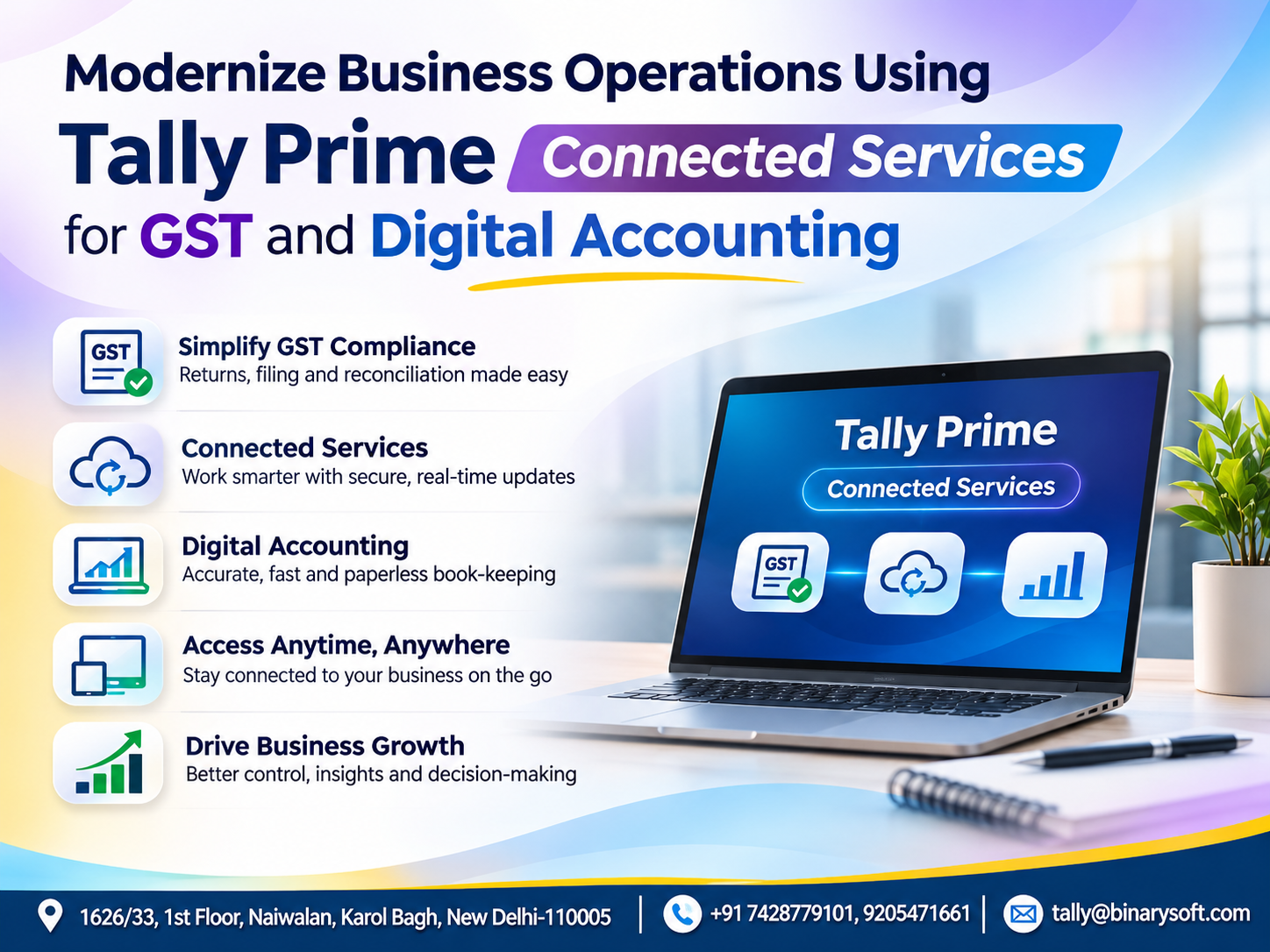
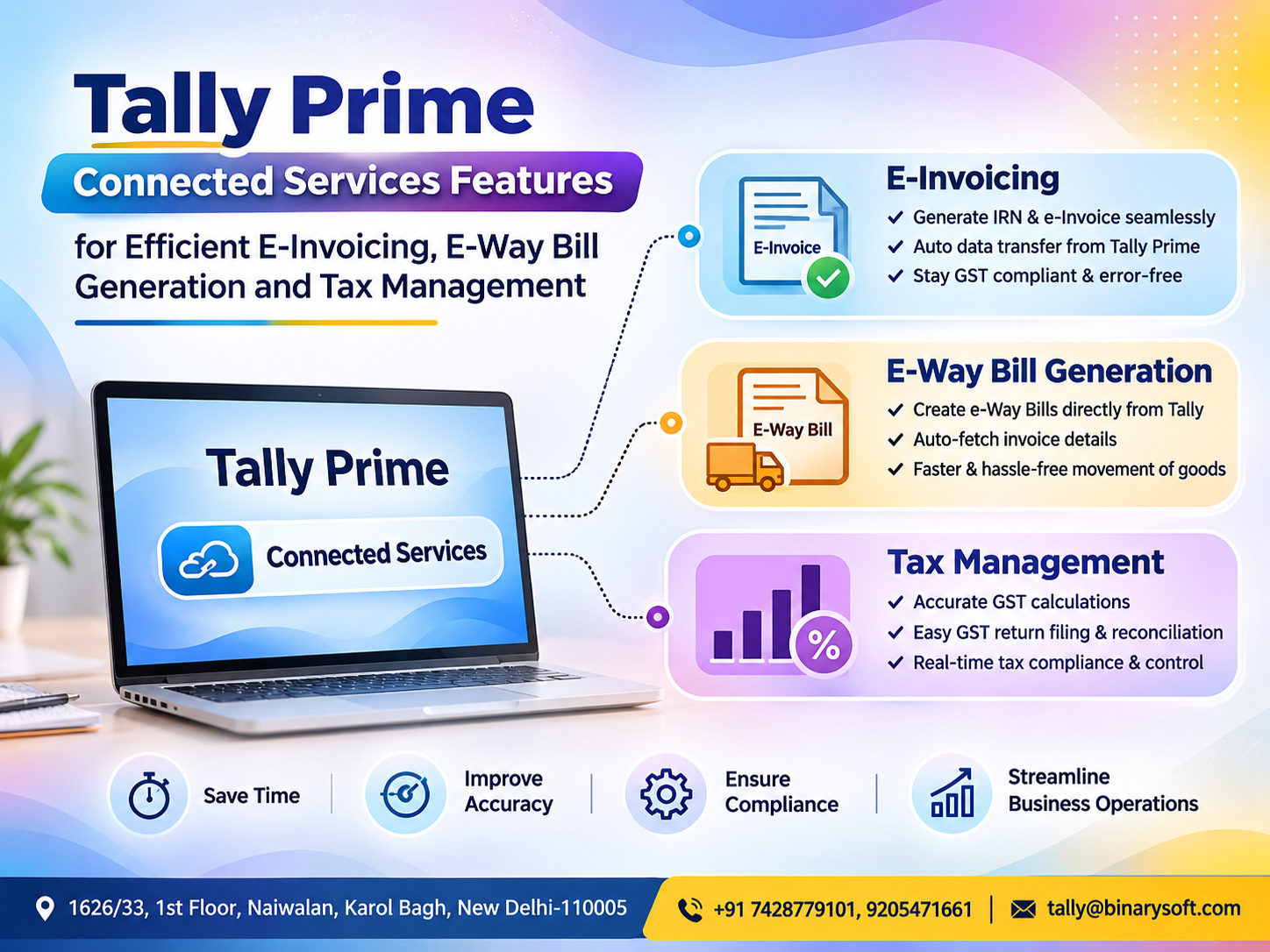
Tally Prime Connected Services help businesses reduce these challenges by connecting accounting workflows with supported digital GST compliance services.
With properly configured e-invoicing, e-way bill generation, GST reporting and reconciliation capabilities, businesses can manage important compliance activities more efficiently.
Instead of repeatedly transferring information between accounting software and government portals, eligible businesses can use integrated workflows to prepare, validate and exchange relevant transaction information.
This article explains how Tally Prime Connected Services work, their practical advantages, and how businesses can use them to improve GST compliance, accounting accuracy and operational efficiency.
1. What Are Tally Prime Connected Services?
Tally Prime Connected Services are integrated capabilities that help businesses connect selected accounting activities with external digital services and supported compliance systems.
These features reduce repetitive data entry and make it easier to manage transactions requiring electronic reporting or verification.
For GST-registered businesses, connected capabilities can support activities such as:
-
E-invoice generation and management.
-
E-way bill generation for applicable goods movements.
-
GST-related data exchange and reconciliation.
-
Retrieval of supported GST information.
-
Digital banking and transaction reconciliation.
-
Sharing selected business reports and documents.
Availability depends on the installed Tally Prime version, active services, configuration, authorization and applicable eligibility requirements.
Why Connected Accounting Matters
Traditional compliance workflows often require users to prepare an invoice in accounting software, copy the details into another system, generate statutory documents and manually update internal records.
Every additional step increases the possibility of mistakes.
Connected workflows help minimize these repeated activities.
When accounting and compliance information is managed through a consistent process, businesses can improve document accuracy, reduce administrative effort and respond more quickly to customer requirements.
2. Simplify GST E-Invoicing with Tally Prime
E-invoicing is an important component of India's GST compliance framework.
Under the applicable system, specified GST-registered taxpayers must report eligible invoices and related documents to an Invoice Registration Portal (IRP).
The portal validates the reported information and generates an Invoice Reference Number (IRN), along with other prescribed details.
E-invoicing does not mean that every invoice must be created directly on a government website.
Businesses can prepare invoices in their accounting software and report eligible documents through supported integration.
How E-Invoicing Works in Tally Prime
A typical connected e-invoicing workflow involves the following activities.
Step 1: Configure GST and E-Invoicing
The business enables the relevant GST and e-invoicing settings and verifies registration information.
Step 2: Create a Sales Invoice
The user records the transaction with correct customer details, item information, taxable values and applicable taxes.
Step 3: Validate Invoice Information
The accounting team checks mandatory information, including GSTIN, document details, tax classification and other required fields.
Step 4: Submit the Invoice for Registration
For eligible transactions, Tally Prime can communicate the required invoice data through its supported connected workflow.
Step 5: Receive the IRN and QR Code
After successful registration, the IRP returns the relevant acknowledgment information, IRN and digitally signed QR code.
Step 6: Print or Share the Invoice
The business can prepare the final invoice containing the required e-invoice details.
Benefits of Integrated E-Invoicing
Connected e-invoicing helps businesses reduce manual portal entry, minimize transcription errors and maintain more consistent invoice records.
It can also improve the speed at which accounting teams complete invoice-related compliance activities.
However, successful submission depends on correct transaction data, system availability and applicable government validation rules.
3. E-Invoicing Applicability and Important Compliance Requirements
Businesses must understand whether e-invoicing applies to their operations.
Under the GST framework, e-invoicing generally applies to specified registered taxpayers based on aggregate turnover and prescribed transaction categories.
The ₹5 crore aggregate turnover threshold became effective from 1 August 2023 for the notified class of taxpayers.
Applicability is determined using the relevant turnover rules, including the prescribed financial-year criteria, and is subject to notified exemptions.
Important Points for Businesses
E-invoicing requirements generally concern eligible B2B supplies, exports and other notified documents.
Ordinary B2C invoices are not subject to the same IRP registration requirement under the general e-invoicing framework.
Certain taxpayers or transaction categories may be excluded under applicable notifications.
Businesses should also distinguish between generating a regular GST invoice and obtaining a valid IRN when e-invoicing is mandatory.
A normal invoice generated in accounting software does not automatically become a registered e-invoice.
The prescribed reporting time limits, cancellation rules and other compliance conditions must also be followed.
Tally Prime helps manage the accounting workflow, but businesses remain responsible for determining applicability and ensuring that submitted information is correct.
4. Efficient E-Way Bill Generation with Tally Prime
An e-way bill is an electronic document required for the movement of goods in specified circumstances under GST.
Generally, an e-way bill is required when the consignment value exceeds ₹50,000, subject to applicable exemptions, special rules and state-specific requirements.
The requirement may apply to goods transported for supply, stock transfer, job work or other relevant purposes.
How Tally Prime Simplifies E-Way Bills
Tally Prime supports connected e-way bill generation using eligible transaction information.
Businesses can enter transport-related details and generate e-way bills through the supported workflow.
Important information may include the supplier and recipient details, document number, goods description, HSN, consignment value, transporter information and vehicle details.
Generate E-Invoices and E-Way Bills Together
For transactions requiring both documents, Tally Prime can support combined generation.
This is particularly helpful for manufacturers, wholesalers and distributors dispatching goods regularly.
Once the transaction is recorded, the relevant information can be submitted through the connected process, reducing duplicate data entry.
Bulk E-Way Bill Generation
Businesses handling multiple dispatches can use bulk generation capabilities where supported.
Instead of preparing every e-way bill individually, accounting teams can process selected eligible transactions together.
Update and Manage E-Way Bills
Tally Prime also supports relevant e-way bill management activities, including cancellation, transporter or vehicle information updates, and validity extensions, subject to portal rules.
Businesses should verify successful generation and the applicable validity period before dispatching goods.
5. A Business Owner's Story: The Delivery That Almost Missed Its Deadline
It was a busy Monday morning in Faridabad.
Amit, the owner of a small industrial equipment supply company, had received an urgent order from a manufacturing customer.
The customer needed replacement machine components before the evening shift.
For Amit, the order was especially important. The customer had recently started working with his company, and a successful delivery could lead to a long-term business relationship.
His warehouse team packed the goods, prepared the delivery vehicle and informed the customer that dispatch was scheduled.
But there was a problem.
The accounting employee responsible for documentation was struggling to complete the e-invoice and e-way bill.
Some details had been entered incorrectly, and information needed to be checked across multiple records.
The driver was waiting outside.
The customer called repeatedly.
Amit felt helpless because the goods were ready, but the documentation was not.
That evening, he realized that business growth required more than inventory and customer relationships. It also required reliable digital processes.
Over the following weeks, Amit introduced a more structured accounting workflow using Tally Prime Connected Services.
Customer GST details were reviewed, inventory records were organized and employees were trained to verify invoice information before dispatch.
The company also introduced a checklist for e-invoice and e-way bill generation.
During a later urgent order, the team completed the required documentation through its connected workflow without repeating the earlier confusion.
Amit could finally focus on the customer instead of chasing missing paperwork.
The experience taught him an important lesson:
Efficient compliance is not only about avoiding penalties. It is also about protecting customer trust, employee confidence and business relationships.
This fictional illustration reflects challenges that many growing businesses experience when financial operations become more complex.
6. Connected GST Services for Better Tax Management
GST management involves much more than generating invoices.
Businesses must maintain accurate purchase and sales records, reconcile tax information, review input tax credit eligibility and prepare returns.
Tally Prime provides GST-related reporting and connected capabilities to support these activities.
GST Return Preparation
Businesses can use GST reports to review relevant outward supplies, purchases, tax liabilities and other accounting information.
Depending on the installed version and supported connected functionality, eligible users can upload return data or perform supported filing activities through integrated workflows.
GSTR-1 Management
GSTR-1 contains details of outward supplies.
Tally Prime helps businesses prepare and review relevant sales transaction information for reporting.
Connected functionality can reduce repeated manual entry while helping users identify transactions requiring correction.
GSTR-2B Reconciliation
GSTR-2B provides supplier-reported information relevant to input tax credit review.
Businesses can compare purchase records with available GST information and investigate differences.
Common issues include missing supplier invoices, incorrect GSTIN details, mismatched taxable values and differences in tax amounts.
Input Tax Credit Management
Accurate purchase accounting and reconciliation help businesses assess potential input tax credit.
However, credit eligibility depends on statutory conditions, including relevant documentation, supplier reporting and other applicable requirements.
Tally Prime supports recordkeeping and reconciliation, but does not replace the legal checks necessary for claiming input tax credit.
7. Case Study 1: Manufacturing Company Improves Dispatch Documentation
This is an illustrative case study using hypothetical figures.
Business Background
A manufacturing company in Gurugram supplied industrial components to customers across North India.
The business generated approximately 900 sales invoices monthly, with many shipments requiring e-invoices and e-way bills.
Challenges
The accounting team spent considerable time transferring invoice information into separate compliance workflows.
Occasional data-entry errors caused rejected submissions and delayed dispatches.
Implementation
The company configured Tally Prime for GST invoicing and connected e-invoice and e-way bill activities.
It also standardized customer master records, HSN classifications and dispatch information.
Employees were trained to review mandatory details before submitting transactions.
Illustrative Results
|
Performance Indicator
|
Before
|
After
|
|---|
|
Average documentation time per dispatch
|
12 minutes
|
5 minutes
|
|
Monthly documentation corrections
|
45
|
12
|
|
Monthly manual compliance effort
|
90 hours
|
42 hours
|
|
Invoice and dispatch records
|
Separate workflows
|
Integrated workflow
|
The example represents a potential reduction of approximately 58% in average documentation time per dispatch.
Key Learning
Connected services can reduce repetitive work and help standardize documentation.
However, the results depend on accurate data, employee training, transaction complexity and system availability.
8. Case Study 2: Wholesale Distributor Strengthens GST Reconciliation
This case study is illustrative rather than a verified customer testimonial.
Business Background
A wholesale electronics distributor in Delhi purchased products from numerous suppliers and sold them to retailers across several states.
The business handled high transaction volumes and frequently encountered differences between purchase records and supplier-reported GST information.
Challenges
The accounts team relied heavily on spreadsheets for GST reconciliation.
Some purchase invoices contained incorrect GSTIN details, while others had not appeared in the expected supplier reporting records.
Management needed better visibility before finalizing tax information.
How Tally Prime Helped
The company adopted structured GST accounting and reconciliation procedures using Tally Prime.
Purchase records were reviewed against available GST information, and exceptions were investigated before relevant return-related decisions.
The accounts team also began conducting regular reconciliation reviews instead of waiting until the end of the reporting period.
Illustrative Results
Monthly reconciliation effort decreased from approximately 30 hours to 12 hours.
The team identified missing supplier records earlier and improved communication with vendors about discrepancies.
Key Learning
Connected reconciliation features can improve the speed of identifying mismatches.
They do not automatically establish input tax credit eligibility or guarantee error-free returns. Proper verification and professional review remain essential.
9. Additional Features That Improve Compliance Efficiency
Tally Prime includes several supporting capabilities that can improve GST-related workflows.
GSTIN and HSN Validation
Online validation features help users check relevant registration and classification information.
This can reduce preventable errors arising from incorrect master data.
Exception Reporting
GST-related reports help identify transactions with missing or inconsistent information.
Accounting teams can investigate exceptions before proceeding with relevant reporting activities.
Multiple GST Registrations
Businesses operating across different states may need to manage multiple GST registrations.
Supported Tally Prime configurations allow users to maintain and process information for multiple registrations.
Accounting and Inventory Integration
When a transaction is recorded, related accounting and inventory information can be updated according to the company's configuration.
This reduces the need to maintain separate transaction records for compliance and internal accounting.
Digital Recordkeeping
Electronic invoices, transaction references and accounting reports make it easier to locate records during routine reviews and audits.
Businesses should still maintain appropriate backups, access controls and document retention procedures.
10. How to Enable Connected Services in Tally Prime
Businesses should follow a structured setup process.
Step 1: Review Software Requirements
Use a supported Tally Prime version and verify that the necessary connected services are available.
Step 2: Configure Company GST Details
Enter the correct GSTIN, state, registration information and applicable GST settings.
Step 3: Enable E-Invoicing
Activate the relevant e-invoicing options if the business falls within the applicable requirements.
Step 4: Complete Portal Registration
Register or configure the necessary IRP and API access using the prescribed process.
Step 5: Configure E-Way Bill Settings
Enable the appropriate e-way bill options and complete the required portal or API authorization.
Step 6: Verify Customer and Inventory Masters
Check GSTIN, addresses, HSN or SAC classifications, units of measurement and tax details.
Step 7: Record an Eligible Transaction
Create an invoice containing the required information and submit it using the supported connected workflow.
Step 8: Verify the Response
Confirm the IRN, QR code, e-way bill number and transaction status, as applicable.
Step 9: Review GST Reports
Examine return-related reports and reconcile relevant transactions regularly.
Step 10: Establish Internal Controls
Train employees, restrict access appropriately and maintain procedures for correcting errors and reviewing statutory deadlines.
11. Important GST Compliance Practices for 2026
Businesses should periodically review government notifications and portal advisories because compliance rules and technical validations can change.
One important requirement is the 30-day e-invoice reporting restriction applicable from 1 April 2025 to taxpayers with aggregate annual turnover of ₹10 crore or more.
For the affected taxpayers, specified documents cannot be reported to the IRP after the prescribed 30-day window.
Businesses must also ensure that their e-invoice records contain accurate mandatory information.
For example, updated validation requirements can affect transactions where billing and shipping parties differ.
Accounting teams should review relevant GSTIN information, transaction dates, document types and portal responses.
Similarly, e-way bill requirements must be assessed before moving goods.
The general ₹50,000 consignment-value threshold should not be treated as a universal exemption for every transaction below that amount.
Special requirements and exceptions may apply.
Connected software can simplify compliance activities, but it cannot eliminate the need to understand and follow applicable GST rules.
12. Why Tally Prime Connected Services Are Valuable for Growing Businesses
As businesses expand, their accounting and compliance requirements become more demanding.
A small trading company may initially manage a limited number of invoices. As it grows, it may need to handle hundreds of transactions, multiple GST registrations, frequent dispatches and complex purchase reconciliation.
Tally Prime Connected Services help businesses develop a more organized approach to these activities.
Manufacturers can improve dispatch documentation, wholesalers can manage large invoice volumes, and service providers can simplify applicable e-invoicing requirements.
Businesses also benefit from having accounting and compliance information available through integrated workflows.
The greatest advantage is not simply faster document generation. It is the ability to maintain more consistent financial records while reducing repetitive administrative work.
13. How Binarysoft Technologies Can Help
Successful adoption of connected accounting services requires correct configuration, reliable master data and employee training.
Binarysoft Technologies, an Authorized Tally Partner, helps businesses implement and use Tally Prime according to their operational requirements.
Businesses can seek assistance with Tally Prime installation, GST configuration, e-invoicing setup, e-way bill workflows, accounting integration, inventory management and reporting.
Professional implementation support can help organizations reduce configuration problems and establish more consistent compliance procedures.
Conclusion
GST e-invoicing, e-way bill generation and tax reconciliation are essential activities for many Indian businesses.
Managing these activities through disconnected systems can increase administrative work, create opportunities for errors and delay business operations.
Tally Prime Connected Services provide an integrated approach to invoice registration, e-way bill management, GST reporting and accounting.
By reducing duplicate data entry, improving transaction visibility and supporting structured reconciliation, these capabilities can help businesses operate more efficiently.
For manufacturers, distributors, wholesalers and service organizations, connected accounting is an important step toward better financial control and digital compliance.
With correct implementation, regular reviews and appropriate professional guidance, Tally Prime can help businesses strengthen their accounting processes while focusing more attention on customers and growth.
Powered by Binarysoft Technologies
Authorized Tally Partner
Location: 1626/33, 1st Floor, Naiwalan, Karol Bagh, New Delhi – 110005, INDIA
Contact us: +91 7428779101, 9205471661
Email us: tally@binarysoft.com
Business Hours: 10:00 AM – 6:00 PM, Monday to Friday
Frequently Asked Questions
What are Tally Prime Connected Services?
Tally Prime Connected Services are integrated features that help businesses manage supported digital activities, including e-invoicing, e-way bill generation, GST-related reconciliation and selected banking workflows.
Can Tally Prime generate GST e-invoices automatically?
Yes. After appropriate configuration and authorization, eligible invoices can be submitted through Tally Prime's connected e-invoicing workflow. Successful registration generates the relevant IRN and QR code.
Can Tally Prime generate e-way bills with e-invoices?
Yes. Tally Prime supports generating e-way bills alongside eligible e-invoices when the required transport information is available and the transaction meets applicable requirements.
What is the GST e-invoicing turnover limit in India?
The general e-invoicing threshold is ₹5 crore in aggregate turnover, subject to the prescribed financial-year rules, taxpayer categories and exemptions. Businesses should verify current applicability before implementation.
CA. Rishaan Lodha focuses on accounting controls, taxation, and financial reporting for trading and service organizations. He helps businesses improve transaction recording, reconciliations, and documentation for efficient financial management.