Call CA Tally HelpDesk
+91 9205471661,
7428779101

An Complete Guide to Modern Business Accounting, Real-Time Inventory Control, Financial Reporting, GST Management and Business Growth
Introduction: Why Smarter Business Management Matters More Than Ever in 2026
In 2026, running a successful business requires more than recording sales, maintaining purchase bills and preparing financial statements. Rising operating expenses, changing customer expectations, competitive pricing, GST compliance requirements and increasing pressure on working capital have made business management significantly more demanding. A profitable company can still experience financial difficulties when customer payments are delayed, inventory remains unsold or management decisions depend on outdated information.
For many Indian businesses, the biggest challenge is not a lack of transactions but a lack of visibility into what those transactions mean.
Tally Prime helps businesses bring accounting, inventory, taxation, banking and financial reporting into a more organized environment. Instead of depending on disconnected spreadsheets and manual calculations, business owners can access updated financial information, monitor stock movement, identify outstanding payments and make better-informed decisions.
The result is improved operational control, reduced administrative effort and greater confidence in managing everyday business challenges.
1. Understanding Next-Level Business Management
Modern business management involves coordinating financial resources, inventory, employees, customers, suppliers and operational activities to achieve sustainable growth.
Traditional accounting systems often focus primarily on recording transactions. However, business owners increasingly need answers to practical questions:
-
Which products generate the highest revenue?
-
How much money is outstanding from customers?
-
Which inventory items are moving slowly?
-
Are operating expenses increasing faster than sales?
-
Is sufficient cash available for upcoming supplier payments?
-
Which business activities require immediate attention?
When this information is maintained across separate systems, obtaining accurate answers becomes difficult.
Tally Prime provides an integrated business management environment where financial and inventory transactions can contribute to management reports.
This helps businesses move from reactive problem-solving toward proactive planning.
2. The Emotional Reality of Running a Business: A Story of Financial Uncertainty
Consider the fictional story of Rajesh, a second-generation wholesale electrical goods distributor operating in Delhi.
His father had established the business through years of hard work, customer relationships and careful financial management.
When Rajesh took responsibility for daily operations, the business was generating reasonable sales. However, increasing transaction volumes created new challenges.
Purchase invoices were maintained in one spreadsheet, customer outstanding balances in another, and inventory records were updated manually.
Every evening, Rajesh stayed at the office trying to reconcile sales, payments and available stock.
One afternoon, an important customer placed a large order for electrical fittings. The inventory register showed sufficient stock, but warehouse employees discovered that several items were unavailable.
The order was delayed.
A few days later, a supplier demanded payment for overdue invoices. Rajesh believed enough money was available, but several major customers had not cleared their outstanding balances.
The situation became stressful.
His father noticed the exhaustion and asked a simple question:
"We built this business to give our family stability. Why are you spending every night worrying about numbers?"
Rajesh realized that increasing sales alone would not solve the problem. He needed better control over business information.
After implementing structured accounting and inventory processes in Tally Prime, his team began recording transactions consistently, tracking customer bills and reviewing inventory reports.
Over time, Rajesh gained clearer visibility into receivables, available stock and financial performance.
He could make purchasing decisions with more confidence and spend less time searching for information.
The important transformation was not simply the adoption of accounting software.
It was the ability to understand his business before problems became emergencies.
This is an illustrative story created to explain common business management challenges.
3. Smarter Financial Decisions with Tally Prime
Financial decisions influence almost every business activity, including purchasing, pricing, credit management, expansion and investment.
Without reliable financial information, even experienced entrepreneurs may make decisions based on assumptions.
Tally Prime helps businesses maintain structured financial records and generate reports that support management decisions.
Profit and Loss Analysis
A Profit and Loss Account shows business income, expenses and profitability over a selected period.
Business owners can use it to understand whether revenue growth is translating into better earnings.
For example, a wholesale trader may experience a 20% increase in sales while profitability remains unchanged because transportation, discounts and administrative expenses have increased.
Regular financial reviews can help identify these trends.
Balance Sheet Visibility
The Balance Sheet presents assets, liabilities and capital at a particular date.
It helps management assess the overall financial position of the business.
Business owners can examine cash and bank balances, receivables, payables, inventory and outstanding obligations.
Cash Flow Monitoring
Cash flow management is essential for maintaining business continuity.
A profitable company may still face liquidity problems when customers delay payments or excessive funds remain invested in stock.
Tally Prime's cash flow reports help businesses understand cash inflows and outflows and support financial planning.
Budgeting and Cost Control
Businesses can use budgets, cost centres and relevant financial reports to compare planned expenses with actual spending.
This helps identify departments or activities requiring attention.
4. Better Inventory Visibility for Accurate Stock Management
Inventory represents a significant investment for retailers, wholesalers, manufacturers and distributors.
Poor inventory visibility can lead to stock shortages, unnecessary purchases, overstocking and working capital pressure.
Tally Prime provides inventory management features that help businesses monitor stock quantities, movement and valuation.
Stock Item Management
Businesses can create individual stock items with appropriate units of measurement, groups and classifications.
For example, an electrical distributor may maintain separate records for cables, switches, circuit breakers and lighting products.
Proper item classification improves reporting and reduces confusion.
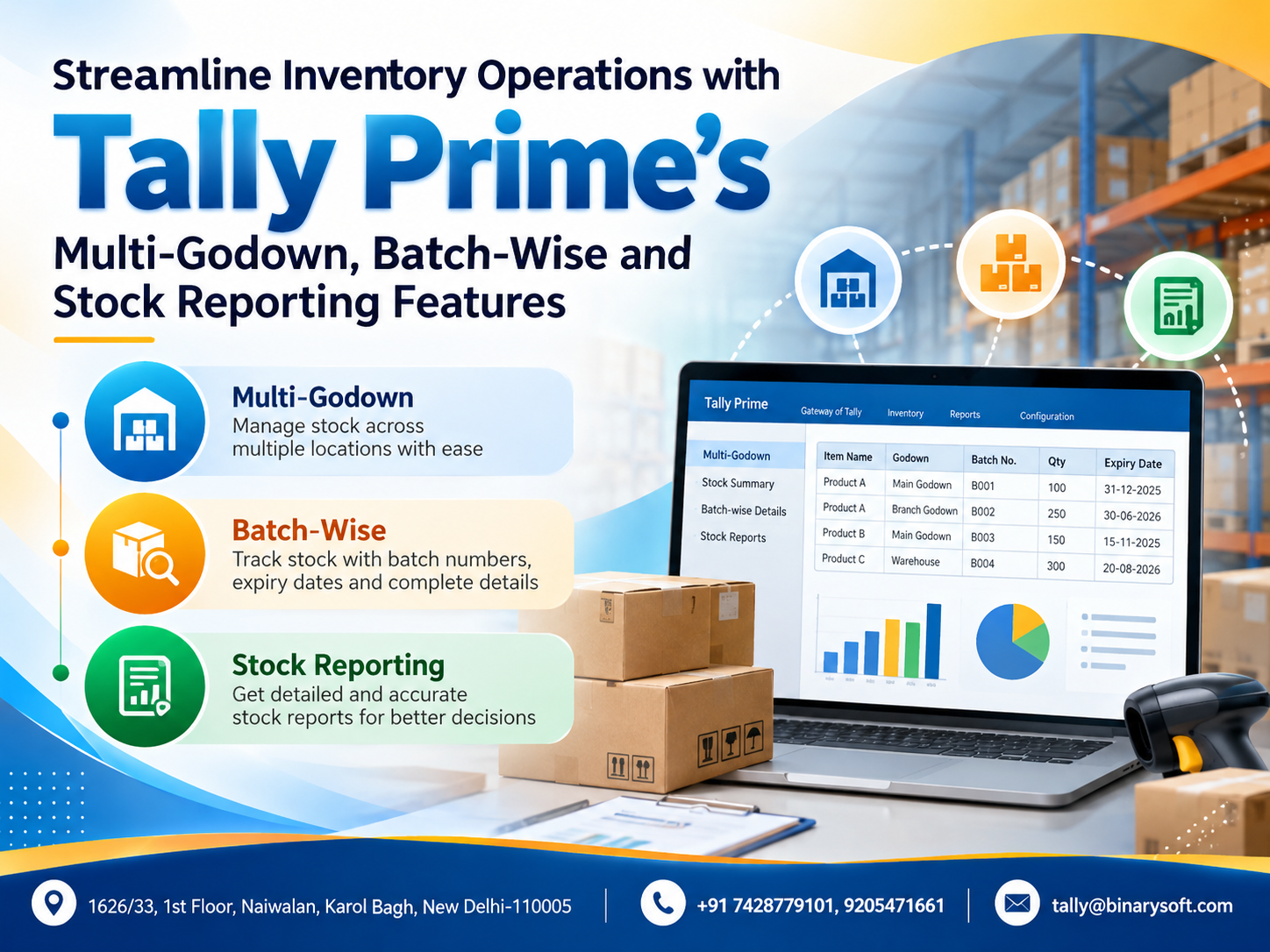
Multi-Godown Inventory Management
Businesses operating multiple warehouses or storage locations can use godown management to maintain location-wise inventory records.
This helps answer questions such as:
-
How much stock is available in the main warehouse?
-
Which branch has additional inventory?
-
Is a stock transfer required?
-
Which storage location contains slow-moving goods?
Stock transfers can be recorded through appropriate inventory vouchers.
Batch-Wise Inventory Tracking
Batch-wise management is particularly useful for pharmaceutical distributors, food businesses and other industries handling identifiable product batches.
Where applicable, businesses can record batch details and expiry dates.
This supports better stock identification and expiry monitoring.
Stock Valuation
Inventory valuation affects both profitability and financial reporting.
Tally Prime supports inventory valuation methods and stock reports that help management understand the financial value of available goods.
Consistent valuation practices are important for reliable financial statements.
5. Improving Workflow Efficiency Through Integrated Accounting
One of the biggest operational challenges for growing businesses is repetitive data entry.
When sales, inventory, customer accounts and tax calculations are maintained separately, employees spend additional time reconciling information.
Tally Prime helps reduce duplication by linking relevant business transactions.
For example, when a properly configured sales invoice is recorded, the transaction can update customer accounts, sales figures, applicable tax ledgers and inventory records.
This reduces the need to update multiple registers independently.
Faster Invoice Processing
Businesses can prepare invoices using configured customer ledgers, stock items, tax classifications and pricing information.
Standardized invoice formats improve consistency and help employees complete billing activities more efficiently.
Organized Purchase Management
Purchase transactions can be recorded with supplier details, inventory quantities, taxes and applicable references.
This improves supplier account maintenance and supports purchasing analysis.
Reduced Reconciliation Work
Maintaining connected financial and inventory records reduces the differences that can arise between separate manual systems.
However, regular verification and accurate voucher entry remain essential.
Improved Employee Productivity
When routine accounting information is easier to access, employees can focus on customer service, purchasing coordination, stock verification and financial analysis.
This can improve productivity without necessarily increasing administrative headcount.
6. Effective Credit Management and Customer Outstanding Tracking
Customer credit is necessary in many industries, but uncontrolled credit can create financial instability.
A business may report strong sales while struggling to pay suppliers because substantial amounts remain outstanding.
Tally Prime supports bill-wise receivables and payables tracking, helping businesses monitor amounts due and payment deadlines.
Customer Credit Limits
Businesses can configure customer credit limits and credit periods to support disciplined sales practices.
Before extending additional credit, the accounts team can review outstanding balances and customer payment history.
Bill-Wise Outstanding Reports
Each credit invoice can be tracked against subsequent receipts.
This helps identify fully paid, partially paid and unpaid invoices.
Receivables Ageing Analysis
Outstanding amounts can be reviewed according to how long they have remained unpaid.
For example:
|
Outstanding period
|
Amount
|
|---|
|
0–30 days
|
₹4,50,000
|
|
31–60 days
|
₹2,80,000
|
|
61–90 days
|
₹1,25,000
|
|
Above 90 days
|
₹95,000
|
|
Total
|
₹9,50,000
|
Illustrative figures.
The business can prioritize collection efforts based on overdue amounts rather than contacting every customer without a clear strategy.
This improves collection planning and helps protect working capital.
7. GST Compliance and Tax Management with Tally Prime
GST compliance is an important responsibility for registered Indian businesses.
Incorrect tax classification, incomplete invoices and reconciliation differences can create additional administrative work.
Tally Prime provides GST-related capabilities that support invoice preparation, tax calculation, return reporting and reconciliation.
GST-Compliant Invoicing
Businesses can configure GST registration details, tax classifications, HSN/SAC information and applicable tax rates.
Correct configuration helps produce invoices containing relevant statutory information.
GST Return Preparation
Tally Prime supports GST reports used for preparing returns such as GSTR-1 and GSTR-3B.
Eligible connected features can also assist with uploading, downloading and filing activities, subject to applicable configuration and authorization.
Input Tax Credit Reconciliation
Businesses can compare purchase records with relevant GST portal information, including GSTR-2A and GSTR-2B.
This helps identify differences requiring supplier follow-up or accounting corrections.
E-Invoicing and E-Way Bills
Where legally applicable, businesses can use supported connected functionality for e-invoice and e-way bill processes.
These features help reduce repetitive portal activities and support transaction tracking.
Businesses should still verify current statutory requirements, eligibility and return information before submission.
8. Banking and Payment Management for Better Financial Control
Banking transactions form a major part of everyday accounting.
Businesses receive customer payments, transfer money to suppliers, pay expenses and maintain multiple bank accounts.
When bank records and accounting records are reconciled manually, discrepancies may remain unnoticed.
Tally Prime offers bank reconciliation capabilities to help compare recorded transactions with bank statement information.
Supported functionality includes bank statement imports, transaction matching and identification of unreconciled entries.
Depending on the product release, bank and connectivity support, additional connected banking and payment functionality may be available.
For example, a business processing hundreds of bank transactions monthly can use reconciliation reports to identify missing entries, bank charges or timing differences more efficiently.
Regular reconciliation improves the reliability of cash and bank balances.
9. Case Study One: Wholesale Distributor Improves Inventory and Credit Visibility
Illustrative case study — Delhi electrical goods distribution business
Business Background
A medium-sized electrical goods distributor supplied switches, wires, lighting accessories and electrical equipment to retailers across Delhi NCR.
The company operated two warehouses and regularly supplied goods on credit.
Challenges
The business experienced recurring differences between physical stock and spreadsheet records.
Its management team also struggled to identify overdue customer invoices and products requiring replenishment.
Purchasing decisions were often based on employees' estimates rather than current stock reports.
Tally Prime Implementation
The company introduced a structured workflow involving:
-
Stock item classification and godown-wise inventory records.
-
Sales and purchase invoice accounting.
-
Bill-wise customer outstanding tracking.
-
Stock ageing and movement analysis.
-
Regular financial and bank reconciliation reviews.
Illustrative Results
|
Operational indicator
|
Before
|
After
|
|---|
|
Monthly stock reconciliation
|
3 days
|
1 day
|
|
Customer outstanding review
|
5 hours
|
1 hour
|
|
Inventory reporting
|
Manual spreadsheets
|
Integrated reports
|
|
Purchasing decisions
|
Estimated requirements
|
Stock-based planning
|
These figures illustrate a possible improvement scenario, not independently verified customer results.
Business Impact
With better visibility, management could identify stock shortages earlier, monitor slow-moving products and focus collection efforts on overdue customers.
The key improvement was greater consistency between financial records and warehouse information.
10. Case Study Two: Pharmaceutical Distributor Strengthens Batch and Expiry Management
Illustrative case study — pharmaceutical distribution business
Business Background
A pharmaceutical distributor supplied medicines and healthcare products to clinics, pharmacies and medical retailers.
The business handled numerous products with different batches, purchase prices and expiry dates.
Challenges
Warehouse employees maintained batch information manually.
As transaction volumes increased, locating specific batches became time-consuming.
Management also faced difficulties reviewing ageing inventory and preparing accurate financial information.
Tally Prime Implementation
The distributor adopted Tally Prime with appropriate inventory settings.
The implementation included batch-wise stock tracking, expiry-date recording, location-wise inventory management, purchase and sales accounting, and GST-related reporting.
Employees received training on maintaining accurate stock masters and recording transactions consistently.
Illustrative Results
After establishing disciplined processes, the company could review available batches more efficiently and identify stock approaching expiry for appropriate action.
Purchase planning became more closely connected to recorded inventory levels.
The accounts department also gained easier access to supplier balances and inventory valuation reports.
Business Impact
The company improved coordination between its warehouse and accounting teams.
However, software-based expiry reporting remained a supporting control rather than a substitute for physical checks, applicable pharmaceutical regulations or product-handling procedures.
This case demonstrates how integrated accounting and inventory management can support industries where stock traceability is particularly important.
11. Advanced Business Reporting for Strategic Planning
Business growth depends on understanding performance rather than simply increasing transaction volumes.
Tally Prime provides financial, inventory and management reports that can support regular decision-making.
Sales Analysis
Management can examine sales activity across selected periods, customers and products.
This helps identify revenue trends and products contributing significantly to business turnover.
Purchase Analysis
Purchase reports help businesses understand procurement patterns and supplier-related expenditure.
These insights can support purchasing negotiations and inventory planning.
Stock Ageing Reports
Stock ageing analysis helps identify inventory that has remained in the business for extended periods.
Management can then evaluate pricing, promotions, redistribution or future purchasing requirements.
Cost Centre Reporting
Businesses can allocate relevant income and expenses to departments, branches or projects.
This supports comparison between operational activities.
Dashboard-Based Monitoring
Supported dashboard views allow management to review selected business indicators and explore underlying reports.
A regular dashboard review can reduce the time required to understand the overall financial position.
12. How to Implement Tally Prime for Effective Business Management
Successful implementation requires more than installing accounting software.
Businesses should establish a structured process that reflects their actual operations.
Step 1: Evaluate business requirements. Identify whether the company needs accounting, inventory, GST, credit management, multiple locations, cost centres or other features.
Step 2: Create and configure the company. Enter accurate company information, financial-year details and relevant statutory settings.
Step 3: Establish accounting masters. Create appropriate customer, supplier, bank, income, expense and tax ledgers.
Step 4: Configure inventory. Create stock groups, stock items, units, godowns and batch settings where applicable.
Step 5: Record opening balances. Verify opening financial and inventory balances before routine operations begin.
Step 6: Train employees. Provide role-specific training on vouchers, invoicing, stock transfers, reconciliation and reports.
Step 7: Review reports regularly. Establish daily, weekly and monthly review procedures.
Step 8: Protect business data. Implement appropriate user permissions, reliable backups, recovery testing and access controls.
Many accounting and inventory preferences can be configured through the F11 Company Features screen, depending on the business's requirements.
13. Tally Prime on Cloud for Flexible Business Operations
Businesses operating from multiple locations may benefit from a properly configured Tally Prime on Cloud environment.
Cloud hosting can allow authorized users to access their accounting environment through a secure remote connection, subject to the hosting service, licensing and connectivity arrangements.
This may be useful for business owners who travel frequently, accountants supporting multiple offices and management teams requiring access outside the main workplace.
Potential advantages include centralized access, reduced dependence on one office computer, managed infrastructure and configurable backup arrangements.
However, businesses should evaluate server performance, user concurrency, access security, data ownership, backup frequency and recovery procedures before selecting a hosting solution.
Cloud hosting does not automatically guarantee uninterrupted service or eliminate the need for internal controls.
14. Industries That Can Benefit from Tally Prime
Tally Prime can support a wide range of Indian businesses.
Retailers can use billing, stock reports and customer account management to maintain day-to-day control.
Wholesalers can benefit from inventory movement analysis, supplier accounting and credit management.
Manufacturers can use relevant inventory, bill-of-material and job-costing features to support production accounting.
Professional service providers can maintain expense records, customer invoices and financial reports.
Pharmaceutical distributors can use batch and expiry tracking alongside their required operational controls.
The ideal configuration depends on the company's transaction volume, industry requirements and reporting needs.
15. Building a More Profitable and Efficient Business
Technology becomes valuable when it supports better decisions.
A business owner who understands inventory movement can avoid unnecessary purchases.
A finance manager who regularly reviews receivables can prioritize overdue collections.
A purchasing manager with accurate stock information can plan replenishment more effectively.
Similarly, management teams using financial reports can identify rising expenses before they materially affect profitability.
Tally Prime provides tools to support these activities, but consistent data entry, staff training and management review remain essential.
The greatest benefit comes when software capabilities are combined with disciplined business processes.
Conclusion: Transform Business Information into Better Decisions
Next-level business management requires accurate financial information, reliable inventory records and efficient operational workflows.
Tally Prime helps bring accounting, invoicing, inventory, GST, banking and business reporting into an integrated environment.
For growing businesses, this can reduce fragmented recordkeeping, improve visibility into outstanding payments and support more informed purchasing and financial decisions.
Whether an organization operates a retail store, wholesale distribution network, manufacturing unit or professional service business, the objective remains the same: better control over financial resources and daily operations.
By implementing Tally Prime with appropriate configurations, regular reporting and employee training, businesses can establish a stronger foundation for operational efficiency and sustainable growth.
Powered by Binarysoft Technologies
Authorized Tally Partner
Location: 1626/33, 1st Floor, Naiwalan, Karol Bagh, New Delhi – 110005, INDIA
Contact us: +91 7428779101, 9205471661
Email us: tally@binarysoft.com
Business Hours: 10:00 AM – 6:00 PM, Monday to Friday
Website: tallyatcloud.com
For assistance with Tally Prime implementation, inventory configuration, accounting workflows, training and cloud-hosting requirements, contact Binarysoft Technologies.
Frequently Asked Questions
What is Tally Prime business management software?
Tally Prime is an integrated accounting and business management application that supports financial records, invoicing, inventory, taxation, banking and management reporting.
How does Tally Prime help businesses make smarter financial decisions?
It provides reports such as Profit and Loss Account, Balance Sheet, cash flow, receivables and payables, helping management review financial performance and identify areas requiring attention.
CA. Raghav Mundhra focuses on business accounting, GST reporting, and financial reconciliations. He works with organizations to strengthen accounting processes and maintain reliable financial information for compliance and decision-making.