Call CA Tally HelpDesk
+91 9205471661,
7428779101
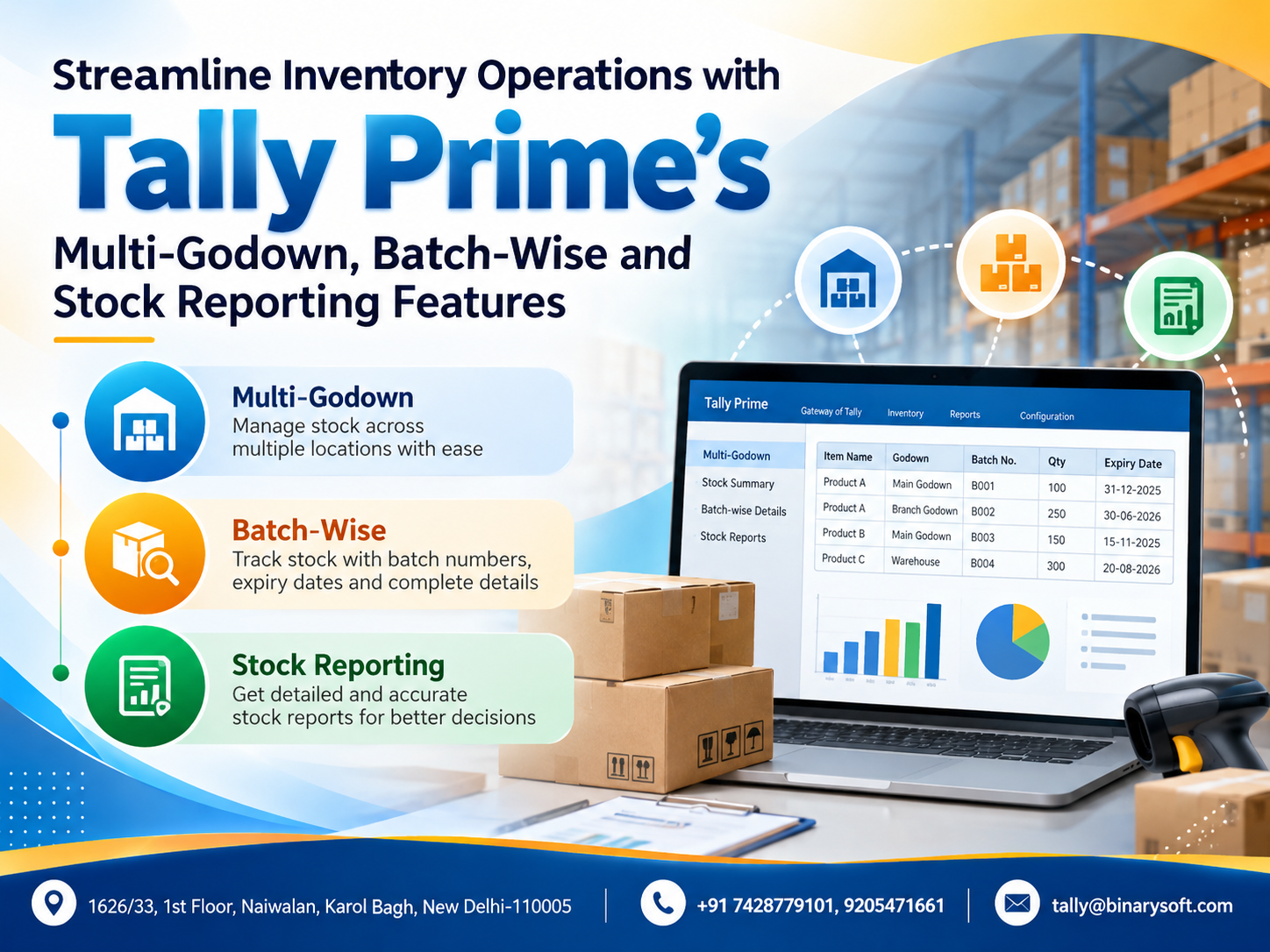
Complete Guide to Smarter Inventory Management, Warehouse Control, Batch Tracking, Stock Valuation and Business Efficiency in 2026
Introduction: Why Smarter Inventory Management Has Become Essential in 2026
In 2026, businesses are facing increasing pressure to manage inventory accurately across multiple warehouses, retail outlets, distribution centres and storage locations. Rising operational costs, unpredictable customer demand, delayed stock updates and growing expectations for faster deliveries have made traditional inventory management methods increasingly difficult to maintain. Even a small mismatch between physical stock and accounting records can result in lost sales, unnecessary purchases, blocked working capital and dissatisfied customers.
Tally Prime offers an integrated approach to inventory management through multi-godown tracking, batch-wise stock monitoring, inventory vouchers and detailed stock reporting. Instead of depending on disconnected spreadsheets and manual registers, businesses can maintain more organised inventory records alongside their financial accounts.
For wholesalers, retailers, manufacturers and distributors, these capabilities can improve stock visibility, reduce avoidable errors, strengthen purchasing decisions and support better business control without introducing unnecessary operational complexity.
1. Understanding Inventory Management in Modern Businesses
Inventory management involves monitoring the purchase, storage, movement, valuation and sale of goods throughout the business cycle.
For businesses handling hundreds or thousands of products, inventory control is not simply about knowing how many items are available. It also involves understanding where products are stored, which batches are moving, which items are approaching expiry and how much capital is invested in unsold goods.
Consider a wholesale distributor operating three warehouses and supplying products to several retail customers.
Without a centralised inventory system, the distributor may experience:
-
Different stock quantities recorded at different warehouses.
-
Delays in identifying available products.
-
Incorrect purchase orders due to outdated stock information.
-
Difficulty tracing specific product batches.
-
Excessive investment in slow-moving products.
-
Errors in inventory valuation and financial reporting.
-
Challenges coordinating warehouse and accounting teams.
Tally Prime helps businesses address these operational problems through integrated accounting and inventory features.
Its inventory capabilities allow businesses to organise stock items, maintain godown-wise quantities, record stock transfers, track batches and generate inventory reports.
2. A Business Story: How Better Inventory Visibility Helped a Distributor Regain Control
Imagine a pharmaceutical and consumer goods distributor named Rajesh, who operates warehouses in Delhi and supplies products to retailers across neighbouring markets.
His business had grown steadily over several years. However, the growth introduced challenges that his existing spreadsheet-based inventory process could no longer handle.
One afternoon, an important customer requested an urgent delivery of products worth ₹2.5 lakh.
Rajesh's sales team confirmed the order because their records indicated sufficient stock.
But when warehouse employees began preparing the shipment, they discovered that the required quantity was not available at the main location.
Additional stock was sitting in another warehouse, while some available units belonged to batches approaching expiry.
The delivery was delayed, the customer became frustrated and Rajesh worried about losing a long-standing business relationship.
That evening, he realised that his biggest problem was not a shortage of products. It was the absence of reliable inventory visibility.
He decided to reorganise his inventory process using Tally Prime.
With properly configured godowns, batch tracking, stock transfers and inventory reports, his team could begin maintaining location-wise quantities and identifying available stock before confirming orders.
Over time, the business established a clearer workflow for warehouse movements, purchase planning and stock verification.
The most important improvement was confidence.
Rajesh no longer needed to depend entirely on telephone calls and scattered spreadsheets to understand where his inventory was located.
This is an illustrative business scenario, but it reflects a common challenge faced by growing distributors.
The lesson is straightforward: inventory visibility is not only an accounting requirement. It directly affects customer relationships, working capital and business reputation.
3. What Is Multi-Godown Inventory Management in Tally Prime?
Multi-godown inventory management allows businesses to maintain stock records across multiple storage locations within their inventory system.
A godown may represent a warehouse, retail shop, distribution centre, storage room, branch inventory location or another defined stock-holding area.
Businesses operating from multiple locations need accurate information about product availability at each location.
Tally Prime supports location-wise inventory tracking through its godown management functionality.
Major benefits of multi-godown management
Location-wise stock visibility
Businesses can examine stock quantities maintained at individual godowns instead of relying only on total company-wide stock.
Better warehouse coordination
Warehouse teams can identify where products are stored and plan internal transfers more effectively.
Reduced stock confusion
Maintaining godown-wise records helps prevent the assumption that stock available at one location is automatically available at another.
Improved purchasing decisions
Businesses can review existing inventory across locations before purchasing additional quantities.
Greater operational accountability
Separate godown records make it easier to investigate discrepancies and conduct location-wise stock verification.
4. How to Enable and Configure Multiple Godowns in Tally Prime
Businesses can configure godown tracking in Tally Prime according to their operational requirements.
The exact navigation may vary depending on the software release and enabled company features.
Step 1: Enable inventory location tracking
Open the relevant company in Tally Prime.
Access the company features through F11 and enable the option for maintaining multiple godowns or locations, where applicable.
Step 2: Create godown masters
Create individual godown masters for each physical or logical storage location.
For example:
|
Godown name
|
Purpose
|
|---|
|
Main Warehouse
|
Central stock storage
|
|
Retail Outlet
|
Customer-facing inventory
|
|
Distribution Centre
|
Order dispatch
|
|
Secondary Warehouse
|
Additional stock
|
|
Returns Godown
|
Returned goods awaiting inspection
|
Step 3: Allocate inventory to godowns
When recording applicable inventory transactions, allocate quantities to the appropriate godown.
This allows the system to maintain location-wise stock balances.
Step 4: Record inventory transfers
Use the appropriate stock journal workflow to record transfers between godowns.
Step 5: Review godown reports
Examine location-wise inventory reports and verify that stock movements are reflected correctly.
Important: Multi-godown tracking depends on accurate voucher entry and timely recording of physical stock movements. Software configuration alone cannot prevent stock discrepancies.
5. Managing Stock Transfers Between Multiple Warehouses
Stock transfers are a routine part of business operations.
A wholesaler may transfer products from its central warehouse to a retail branch. A manufacturer may move finished goods from production storage to a dispatch location.
Tally Prime allows such movements to be recorded through inventory vouchers.
Practical stock transfer example
A distributor maintains 1,000 units of Product A at its main warehouse and transfers 250 units to a retail godown.
|
Particulars
|
Before transfer
|
After transfer
|
|---|
|
Main Warehouse
|
1,000 units
|
750 units
|
|
Retail Godown
|
100 units
|
350 units
|
|
Total Stock
|
1,100 units
|
1,100 units
|
The total stock remains unchanged because the transaction represents an internal transfer rather than a purchase or sale.
When recorded correctly, the transfer improves the accuracy of location-wise inventory information.
Businesses should also establish procedures for transfer approvals, dispatch documentation, receipt confirmation and physical verification.
For movements between distinct GST registrations or legal entities, the applicable tax treatment and documentation must be assessed separately.
6. Batch-Wise Inventory Management: Better Control Over Product Identification
Batch-wise inventory management is particularly valuable for businesses dealing with products that have manufacturing dates, expiry dates, production lots or identifiable batches.
Industries that commonly benefit include pharmaceutical distribution, food processing, cosmetics, chemicals, FMCG and manufacturing.
Tally Prime supports batch-wise stock tracking, subject to the relevant inventory configuration.
Instead of recording only the total quantity of a product, businesses can maintain information about individual batches.
Example of batch-wise inventory
|
Product
|
Batch number
|
Quantity
|
Expiry date
|
|---|
|
Product A
|
BT-101
|
500
|
31 March 2027
|
|
Product A
|
BT-102
|
750
|
30 June 2027
|
|
Product A
|
BT-103
|
400
|
30 September 2027
|
This provides greater visibility than a single combined balance of 1,650 units.
Benefits of batch-wise stock tracking
Improved product traceability
Businesses can identify the batches associated with recorded stock transactions.
Expiry monitoring
Batch expiry information can help staff identify products requiring attention before they become unsaleable.
Better stock rotation
Warehouse teams can use batch information to support first-expiry-first-out (FEFO) procedures.
Simplified investigations
Batch-wise records make it easier to examine stock movements when quality issues or customer complaints arise.
Reduced avoidable losses
Early identification of ageing or expiring stock can support timely operational decisions.
Batch tracking is especially useful when the business maintains consistent batch numbers and records receipts, transfers and dispatches accurately.
7. How to Enable Batch-Wise Inventory Tracking in Tally Prime
Businesses can configure batch tracking to maintain more detailed information about individual product lots.
Step 1: Enable batch management
Open the company features using F11 and enable batch tracking for inventory.
Step 2: Configure stock items
Create or alter the relevant stock item and enable batch-wise details.
Step 3: Maintain manufacturing and expiry dates
For products requiring shelf-life monitoring, enable expiry-date tracking and enter the appropriate dates.
Step 4: Record batch-wise purchases
During purchase entry, select or create the appropriate batch and allocate the received quantity.
Step 5: Record batch-wise sales
When selling products, select the batch from which goods are being dispatched.
Step 6: Review batch reports
Use Batch Summary to review inward and outward quantities, closing balances and recorded batch transactions.
Tally's official documentation confirms that Batch Summary can also help identify expired batches and review manufacturing details.
8. Stock Summary Reports for Better Inventory Decisions
Stock Summary is one of the most useful inventory reports in Tally Prime.
It provides information about stock quantities, stock values and inventory movements based on recorded transactions.
Businesses can use this report to answer important operational questions:
-
How much stock is currently available?
-
Which products require replenishment?
-
What is the value of inventory held by the business?
-
Which products have experienced significant stock movements?
-
How much stock is available in a particular godown?
-
Are outstanding sales orders affecting available stock?
In Tally Prime, the Stock Summary updates as inventory transactions are recorded, allowing users to review current recorded balances without manually preparing a separate spreadsheet.
Example of a stock summary report
|
Stock item
|
Opening stock
|
Inward
|
Outward
|
Closing stock
|
|---|
|
Product A
|
500
|
300
|
450
|
350
|
|
Product B
|
800
|
200
|
600
|
400
|
|
Product C
|
300
|
500
|
350
|
450
|
|
Product D
|
650
|
150
|
400
|
400
|
This report helps managers compare incoming and outgoing quantities and identify products requiring attention.
For example, if Product A has a high sales volume but relatively low closing stock, the purchasing team may need to evaluate replenishment requirements.
However, reorder decisions should also consider supplier lead times, expected demand and outstanding purchase orders.
9. Godown Summary Reports for Warehouse-Level Stock Visibility
Godown Summary provides a detailed view of inventory maintained at different storage locations.
Businesses can review opening balances, inward movements, outward movements and closing stock for individual godowns.
The report can also support hierarchical locations, allowing a business to examine stock at warehouse, section or other configured location levels.
Example: Warehouse inventory comparison
|
Warehouse
|
Stock value
|
|---|
|
Delhi Main Warehouse
|
₹18,50,000
|
|
Noida Distribution Centre
|
₹9,75,000
|
|
Gurugram Warehouse
|
₹7,25,000
|
|
Retail Storage
|
₹4,50,000
|
|
Total
|
₹40,00,000
|
This example shows how a business can compare inventory investment across multiple locations.
Management may discover that one warehouse holds a disproportionately large share of inventory while another experiences frequent shortages.
Such information can support stock redistribution, purchasing decisions and warehouse planning.
How to open Godown Summary
In supported Tally Prime versions:
-
Press Alt+G (Go To).
-
Search for Godown Summary.
-
Select the report.
-
Review the available godowns.
-
Drill down to examine stock items and related transactions.
10. Stock Ageing Analysis: Identify Slow-Moving and Expiring Inventory
One of the biggest challenges for distributors and retailers is maintaining stock that remains unsold for extended periods.
Slow-moving inventory occupies warehouse space and ties up working capital.
For businesses dealing with products having expiry dates, the consequences can be even more serious.
Tally Prime's Stock Ageing Analysis helps businesses review the age of inventory and identify stock requiring management attention.
The report supports batch-related analysis, including stock nearing expiry, where the necessary batch details have been maintained.
Example: Inventory ageing report
|
Stock age
|
Inventory value
|
Recommended action
|
|---|
|
0–30 days
|
₹8,50,000
|
Normal monitoring
|
|
31–60 days
|
₹5,25,000
|
Review sales movement
|
|
61–90 days
|
₹3,75,000
|
Evaluate stock rotation
|
|
91–180 days
|
₹2,40,000
|
Investigate slow-moving stock
|
|
Above 180 days
|
₹1,10,000
|
Review obsolescence and recovery options
|
These figures are illustrative.
For products with expiry dates, the warehouse team should separately examine remaining shelf life, product condition and applicable regulatory restrictions.
Expired or otherwise unsaleable goods should not be dispatched simply to reduce inventory balances.
11. Movement Analysis for Understanding Product Demand
Inventory movement analysis helps businesses understand how products move through purchasing and sales transactions.
A product may generate high sales revenue but deliver a relatively low profit margin.
Another product may sell less frequently but contribute more profit per unit.
Movement Analysis can help managers review transaction patterns, purchase and sales rates, and stock movement characteristics.
Business benefits
Identify fast-moving products
Products with consistent demand can be prioritised during procurement planning.
Understand slow-moving inventory
Management can identify items that may be contributing to unnecessary stock accumulation.
Review purchasing patterns
Businesses can examine supplier-related transaction information and evaluate purchasing decisions.
Improve stock allocation
Products can be distributed between warehouses based on historical movement and anticipated demand.
Support working capital management
Reduced excess inventory may release funds for other operational requirements.
Tally's inventory reporting documentation explains that Movement Analysis focuses on inventory transactions integrated with accounts, such as purchases and sales; purely quantitative inventory vouchers are not included in that analysis.
12. Inventory Reorder Planning and Stock Availability
Maintaining sufficient stock without overstocking is a continuous challenge.
Businesses must balance customer demand, procurement costs, supplier lead times and available warehouse space.
Tally Prime supports inventory reporting and reorder-related analysis that can assist businesses in identifying replenishment requirements.
Example: Reorder planning
Suppose a distributor sells an average of 20 units of a product every day.
The supplier requires seven days to deliver additional stock.
The distributor also wants to maintain 60 units as safety stock.
The suggested reorder point would be:
Reorder Point = Average Daily Demand × Supplier Lead Time + Safety Stock
= 20 × 7 + 60
= 200 units
When the relevant inventory position approaches this level, the purchasing team can review whether additional stock should be ordered.
Actual reorder policies should also consider demand fluctuations, open purchase orders, seasonality and supplier reliability.
13. Inventory Management and GST Accounting in Tally Prime
For Indian businesses, inventory records are closely connected with purchasing, sales, invoicing and GST compliance.
When inventory and accounting are maintained within an integrated system, businesses can reduce duplicate data entry and improve consistency between operational and financial records.
Tally Prime supports GST-related accounting and inventory transactions, subject to correct configuration and applicable statutory requirements.
Important business advantages
GST invoicing
Businesses can prepare invoices using relevant stock item and tax information.
Purchase accounting
Purchase entries can capture inventory quantities and accounting values.
Sales accounting
Sales transactions can update the relevant inventory records while accounting for revenue and taxes.
Inventory valuation
Stock valuation information can support financial reporting and management review.
Purchase and sales analysis
Businesses can examine transaction records for reconciliation and operational planning.
Improved record consistency
Integrated workflows can reduce the need to maintain separate stock and accounting registers.
However, GST compliance still requires appropriate tax classification, correct invoice details, reconciliation and periodic verification. Inventory integration does not automatically guarantee compliant GST returns.
14. Reduce Inventory Errors Through Physical Stock Verification
Even businesses using accounting software may experience differences between physical stock and recorded inventory.
Common reasons include damaged goods, incorrect quantities, missed entries, unauthorised movements and recording mistakes.
Regular physical stock verification helps businesses identify these differences.
Recommended stock verification process
-
Generate stock reports for the selected warehouse.
-
Conduct physical counting of inventory.
-
Compare actual quantities with recorded balances.
-
Investigate significant differences.
-
Identify missing transactions or recording errors.
-
Obtain approval for necessary adjustments.
-
Record appropriate inventory correction vouchers.
-
Review the updated stock position.
Businesses should preserve supporting documentation for adjustments.
A properly managed verification process can improve confidence in both inventory records and financial reporting.
15. Managing Damaged, Returned and Expired Stock
Inventory control also involves managing products that cannot immediately be sold.
Businesses may receive customer returns, damaged goods, defective products or expired inventory.
Maintaining separate godowns or designated storage locations for these products can help prevent accidental dispatch.
For example, a distributor may configure:
|
Godown
|
Inventory purpose
|
|---|
|
Saleable Stock
|
Products available for dispatch
|
|
Customer Returns
|
Returned items awaiting inspection
|
|
Damaged Stock
|
Damaged or defective products
|
|
Expired Stock
|
Products that have passed expiry
|
|
Quality Hold
|
Products awaiting approval
|
This structure can improve internal visibility and support stock verification.
However, physical segregation and approval procedures remain essential.
For regulated products such as medicines, businesses must also follow applicable storage, recall, disposal and distribution requirements.
16. How Tally Prime Supports Manufacturing Inventory Operations
Manufacturing businesses need visibility into raw materials, work-in-progress and finished goods.
Tally Prime provides inventory functionality that can support manufacturing and material movement workflows.
Businesses can maintain stock records for:
-
Raw materials used in production.
-
Semi-finished products.
-
Finished goods.
-
Production-related material consumption.
-
Manufacturing wastage and scrap.
-
Transfers between production and storage locations.
Where relevant, Bill of Materials and manufacturing-related inventory vouchers can help maintain records of material usage.
This can improve the visibility of stock consumed during production and the quantities of finished goods received.
The effectiveness of manufacturing inventory reporting depends on correct item masters, quantities, valuation methods and production entries.
17. Better Inventory Valuation and Financial Accuracy
Inventory valuation affects financial reporting, profitability and working capital analysis.
Incorrect stock quantities or inappropriate valuation methods can distort the financial position of a business.
Tally Prime supports inventory valuation methods that businesses can configure according to their accounting requirements.
Common inventory valuation approaches include FIFO and weighted average cost, where appropriate and supported by the relevant configuration.
Why accurate inventory valuation matters
Financial reporting
Closing stock values influence cost of goods sold and reported profitability.
Working capital management
Inventory represents funds invested in goods that have not yet been sold or consumed.
Business planning
Management needs reliable stock values to evaluate purchasing and storage decisions.
Audit preparation
Well-maintained inventory records can simplify reconciliation and supporting documentation.
Profitability analysis
Accurate costs help businesses understand margins and evaluate pricing decisions.
Businesses should select valuation policies consistently and in accordance with applicable accounting standards.
18. Multi-Godown and Batch-Wise Inventory Management: Key Differences
Although both features support inventory control, they serve different purposes.
|
Feature
|
Multi-Godown Management
|
Batch-Wise Management
|
|---|
|
Primary purpose
|
Track stock by location
|
Track stock by batch
|
|
Main focus
|
Warehouse availability
|
Batch identification
|
|
Useful for
|
Multi-location businesses
|
Batch-sensitive products
|
|
Stock transfers
|
Location-wise movement
|
Batch allocation during movement
|
|
Expiry tracking
|
Not the primary purpose
|
Supported when configured
|
|
Reporting
|
Godown Summary
|
Batch Summary
|
|
Operational benefit
|
Better location control
|
Better traceability
|
Businesses handling batch-controlled products across multiple warehouses can use both capabilities together.
For example, a pharmaceutical distributor may need to identify not only how many units of a medicine are available, but also which warehouse holds a particular batch and when that batch expires.
19. Benefits of Integrated Inventory and Accounting Management
Maintaining inventory and accounting within Tally Prime can provide several practical advantages.
Reduced manual data entry
Integrated transactions reduce the need to enter the same purchase or sale information into separate accounting and stock systems.
Improved stock visibility
Managers can review recorded stock quantities and values without waiting for manual spreadsheet consolidation.
Better warehouse coordination
Location-wise inventory information supports more informed stock transfer and dispatch decisions.
Stronger batch traceability
Batch records can help identify products associated with specific manufacturing or expiry details.
Better purchasing control
Inventory reports help businesses evaluate existing stock before placing new purchase orders.
Improved financial reporting
Stock values and related accounting transactions can be reviewed within the same business system.
More informed decision-making
Managers can use stock reports to investigate shortages, excess inventory and slow-moving products.
These benefits depend on disciplined data entry, proper configuration and regular reconciliation.
20. Common Inventory Management Mistakes Businesses Should Avoid
Even with suitable software, businesses can encounter inventory problems if their internal processes are weak.
Some common mistakes include:
Incorrect opening balances: Inaccurate starting quantities can affect subsequent stock reports.
Inconsistent stock item names: Duplicate or poorly organised item masters can create reporting confusion.
Missing godown allocations: Incorrect location selection can lead to misleading warehouse balances.
Incomplete batch information: Missing batch numbers or expiry dates reduce traceability.
Delayed stock transfer entries: Physical movements that are not recorded promptly create discrepancies.
Ignoring stock ageing: Old inventory may continue occupying warehouse space without management attention.
Insufficient physical verification: Differences between actual and recorded stock can remain undetected.
Uncontrolled inventory adjustments: Adjustments without approvals or documentation can weaken accountability.
Businesses should establish standard operating procedures for inventory transactions and reporting.
21. A Practical Inventory Management Checklist for Growing Businesses
The following checklist can help businesses strengthen inventory control using Tally Prime.
22. Which Businesses Can Benefit from Tally Prime Inventory Features?
Pharmaceutical distributors
Batch tracking, expiry information and godown-wise stock visibility can support medicine distribution operations.
FMCG wholesalers
Location-wise stock monitoring can help businesses handling large volumes of fast-moving consumer goods.
Retail businesses
Retailers can monitor product quantities, purchases, sales and stock availability.
Manufacturing companies
Manufacturers can track materials across storage and production stages.
Electronics distributors
Businesses can organise inventory by product category, warehouse and stock movement.
Food and beverage businesses
Batch and expiry information can help support shelf-life management.
Automobile spare parts dealers
Detailed stock masters and godown-wise reporting can improve visibility into large inventories of spare parts.
Textile and garment businesses
Businesses can organise inventory across product categories, storage locations and distribution points.
23. How Binarysoft Technologies Can Help Businesses Improve Inventory Management
Implementing inventory software requires more than installing an application.
Businesses must configure stock masters, godowns, batch information, transaction workflows and reporting practices according to their operational requirements.
Binarysoft Technologies, an Authorized Tally Partner, can assist businesses with Tally Prime implementation and inventory-related configuration.
Areas of assistance may include:
-
Tally Prime licensing and implementation guidance.
-
Multi-godown inventory configuration.
-
Batch-wise stock management setup.
-
Inventory master creation and organisation.
-
Stock voucher workflow guidance.
-
Inventory reporting and user training.
-
GST and accounting integration support.
-
Tally Prime data backup and operational guidance.
Businesses considering a transition from manual registers or spreadsheet-based inventory systems can evaluate their existing processes before implementation.
A structured setup helps ensure that inventory records reflect actual business operations.
Conclusion: Build a More Efficient Inventory Management System with Tally Prime
Effective inventory management is essential for businesses that want to reduce stock discrepancies, improve warehouse coordination and maintain financial accuracy.
As operations expand across multiple warehouses, products and distribution channels, traditional manual inventory methods can become difficult to manage.
Tally Prime's multi-godown, batch-wise and stock reporting features provide businesses with tools to maintain organised inventory records and review stock movements more efficiently.
Multi-godown management helps businesses understand where inventory is stored. Batch-wise tracking improves product identification and traceability. Stock Summary, Godown Summary, Movement Analysis and Stock Ageing reports support purchasing, warehouse management and financial decisions.
When combined with accurate transaction recording, physical verification and effective internal controls, these features can help reduce avoidable inventory problems.
For wholesalers, distributors, retailers and manufacturers, better inventory management means more than knowing stock quantities. It means protecting working capital, improving customer service and building a more reliable foundation for business growth.
Powered by Binarysoft Technologies
Authorized Tally Partner
Location: 1626/33, 1st Floor, Naiwalan, Karol Bagh, New Delhi – 110005, INDIA
Contact us: +91 7428779101, 9205471661
Email us: tally@binarysoft.com
Business Hours: 10:00 AM – 6:00 PM, Monday to Friday
Frequently Asked Questions
What is multi-godown inventory management in Tally Prime?
Multi-godown inventory management allows businesses to track stock quantities and values across different warehouses, shops, storage areas or other configured locations.
Can Tally Prime manage inventory across multiple warehouses?
Yes. Tally Prime supports multiple godowns and location-wise stock records. Businesses can record stock movements and review inventory availability for individual locations.
Does Tally Prime support batch-wise stock management?
Yes. Tally Prime supports batch-wise inventory tracking, allowing businesses to maintain batch details and monitor associated stock transactions.
Can Tally Prime track manufacturing and expiry dates?
Yes. Businesses can maintain manufacturing and expiry information for relevant batch-controlled stock items when the necessary features are enabled.
CA. Sagar Singh advises MSMEs on accounting accuracy, GST compliance, and internal controls. With exposure to high-volume transaction environments, he writes practical guidance on inventory management, billing discipline, and compliance-ready accounting systems.