Call CA Tally HelpDesk
+91 9205471661,
7428779101
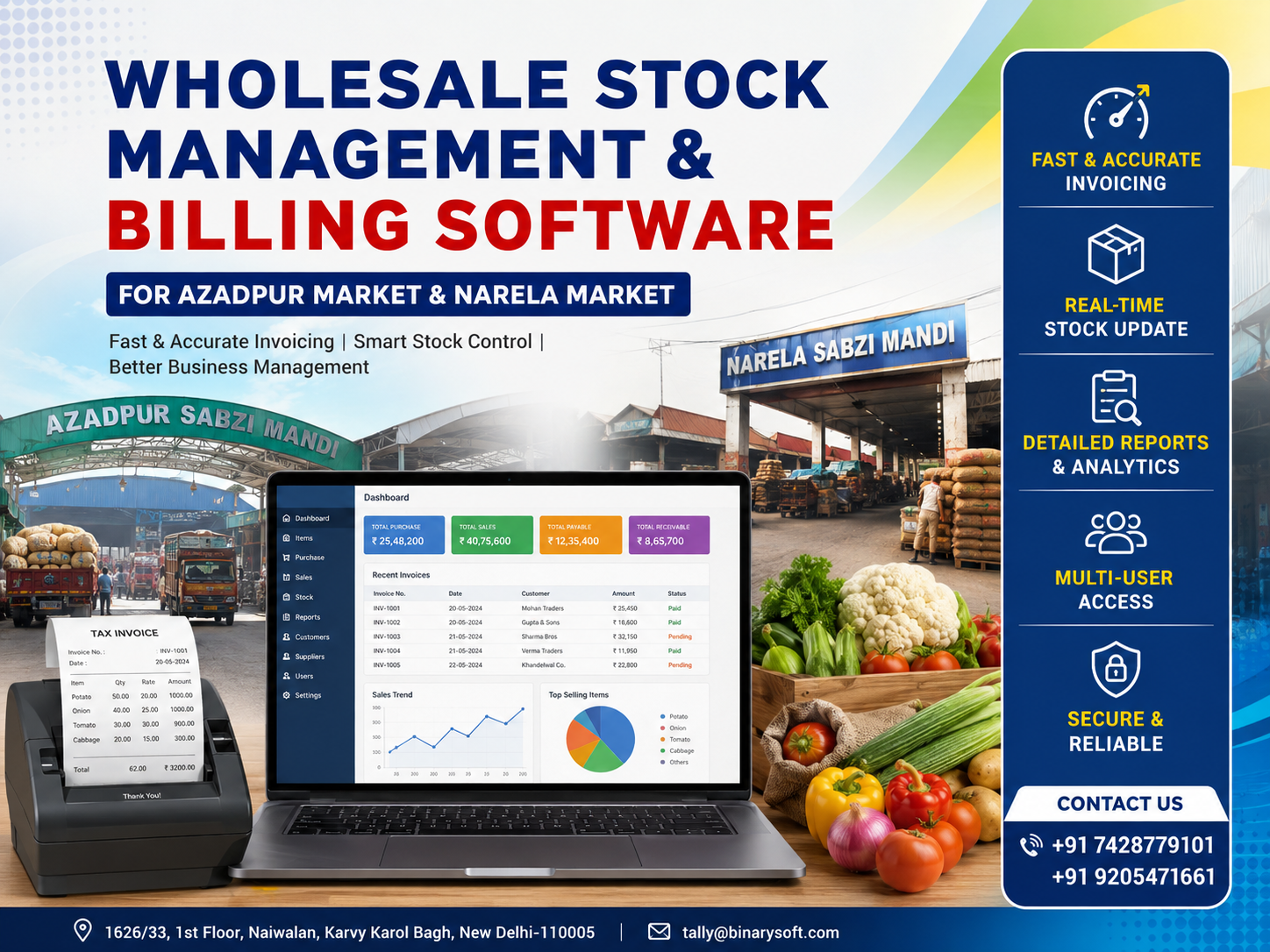
Wholesale Businesses in 2026 Need Faster Stock Control and Billing
In 2026, wholesale businesses operating in busy commercial areas such as Azadpur Market and Narela Market are facing a different kind of pressure. Faster order cycles, large product volumes, GST compliance, tighter margins, customer credit, multiple payment modes and the need for accurate stock visibility have made manual billing and disconnected spreadsheets increasingly difficult to manage. A small quantity error can affect the next purchase, while a delayed invoice can hold up dispatch and payment collection. This is why wholesalers are moving towards integrated stock management and billing software that connects inventory, invoicing, accounting, GST and outstanding balances in one system. With the right solution, businesses can generate invoices quickly, understand available stock before confirming an order, track receivables and make better purchasing decisions—giving owners greater control even during the busiest trading hours.
Why Azadpur Market and Narela Market Businesses Need Better Business Management
Delhi's wholesale ecosystem operates on speed, volume and relationships. Markets such as Azadpur and Narela can involve businesses handling hundreds of products, multiple suppliers, repeat customers, daily purchases, credit transactions and frequent stock movements.
For a wholesaler, the business day does not end when an invoice is printed. Every sale changes stock quantities, customer balances, GST records, profitability and future purchasing requirements.
When these activities are maintained separately, the owner may have to check one system for billing, another sheet for inventory and another record for outstanding payments.
Integrated wholesale stock management and billing software for Azadpur Market and Narela Market can bring these activities together and help businesses maintain a more reliable operational workflow.
The Real Cost of a Stock Mistake
Imagine a wholesaler receiving a large customer order during a particularly busy morning. The sales team checks an old stock sheet and confirms that 250 units are available.
The invoice is prepared. The customer arranges transport. Staff members enter the warehouse to prepare the goods.
But only 190 units are actually available.
The remaining quantity was dispatched the previous evening but had not been updated in the manual stock register.
Suddenly, what appeared to be a routine order becomes a problem.
The customer is waiting. The sales team is uncomfortable. Warehouse employees are searching for stock that does not exist, and the owner must either arrange an urgent purchase or explain the shortage.
For a long-standing customer, one such incident may be manageable. Repeated mistakes, however, can damage trust.
Now imagine the same situation with an integrated stock management system. The sales team checks the current inventory balance before committing the quantity. The invoice updates stock automatically, and management can identify products approaching minimum levels.
That difference is not simply about software. It is about protecting customer relationships and giving business owners confidence in their own numbers.
Fast and Accurate Invoicing for Wholesale Businesses
Speed matters in wholesale trading, particularly when customers or transporters are waiting for goods.
A suitable billing system can help businesses prepare professional invoices using stored customer and item information rather than repeatedly entering the same details.
Depending on configuration and business requirements, companies can maintain product descriptions, rates, GST information, units of measurement, customer ledgers and transaction history.
This makes repeat billing considerably easier.
More importantly, integrated invoicing means that a sales transaction can simultaneously affect the relevant accounting and inventory records, reducing unnecessary duplicate data entry.
Stock Management That Goes Beyond Quantity
Knowing that a product exists in the warehouse is only the beginning.
A wholesale business needs to know:
- How much stock is currently available?
- Which products are selling quickly?
- Which items have remained unsold for longer periods?
- What was the purchase rate?
- What is the current selling rate?
- Which supplier supplied the goods?
- Which customer purchased them?
- Is additional stock required?
- Where is the stock stored?
- What is the value of available inventory?
A structured inventory management solution can make this information easier to access.
For businesses dealing with large product ranges, this visibility can significantly improve purchasing decisions and working-capital management.
TallyPrime for Wholesale Accounting and Inventory Management
For businesses that want accounting, inventory and GST-related workflows within a connected environment, TallyPrime can be configured according to the organisation's operational requirements.
Wholesale businesses may use TallyPrime for functions such as sales and purchase recording, inventory maintenance, receivables and payables, GST-related accounting, banking workflows and business reporting.
The exact features and configuration required will depend on the nature of the business, number of users, inventory structure and reporting requirements.
As an Authorized Tally Partner, Binarysoft Technologies can assist businesses in evaluating, implementing and supporting Tally solutions according to their requirements.
Manage Sales and Purchases Together
Wholesale businesses constantly move between purchasing and selling.
A purchase changes supplier outstanding balances and available inventory. A sale changes customer balances, stock quantities and revenue records.
When purchase and sales records are connected through one business system, owners gain a clearer picture of operations.
They can examine what has been purchased, what has been sold and what remains available without depending entirely on separate registers.
This becomes particularly valuable for businesses processing large transaction volumes.
Better GST Management for Wholesale Transactions
GST compliance is another major reason businesses need accurate transaction recording.
Incorrect tax classification, customer details or transaction values can create unnecessary reconciliation work later.
A properly configured accounting and billing system can help maintain GST-related transaction information systematically and support the preparation of relevant records and reports.
Businesses should still ensure that their GST configuration and transactions are reviewed according to applicable legal and professional requirements.
The advantage of integrated software is that compliance-related information originates from structured day-to-day accounting records rather than being reconstructed at the end of the reporting period.
Customer Outstanding and Credit Management
Wholesale markets often operate extensively on credit.
A customer may purchase goods today and settle the amount after an agreed period. When dozens or hundreds of customers operate on different payment cycles, outstanding management becomes critical.
A business management system can help maintain customer ledgers and outstanding information so management can identify pending receivables.
This gives owners better visibility into questions such as:
Which customers have pending payments?
How much is receivable?
Which invoices remain unpaid?
What is the overall customer balance?
Better outstanding visibility can improve follow-up and support healthier cash-flow management.
Supplier Payables and Purchase Planning
The same principle applies to suppliers.
Wholesale businesses need to understand upcoming liabilities alongside customer collections.
If a business knows that substantial supplier payments are approaching but customer collections are delayed, management can plan accordingly.
Integrated accounting therefore gives wholesalers a broader view than billing alone.
The objective is not simply to create an invoice—it is to understand the financial effect of every transaction.
Multiple Godowns and Stock Locations
Some wholesalers maintain goods at more than one storage location.
Without structured records, determining which location contains a particular product can become difficult.
Inventory software configured for the business can help maintain location-wise or godown-wise stock records where required.
This can improve coordination between sales, warehouse and management teams.
Instead of repeatedly calling warehouse staff to confirm quantities, authorised users can refer to the available records before committing an order.
Reduce Slow-Moving and Excess Inventory
Unsold inventory blocks working capital.
A business may appear to have substantial stock value while a large portion of that value is tied up in products that are not moving quickly.
Inventory reports can help management identify movement patterns and examine products requiring attention.
This information can support decisions such as reducing future purchases, reviewing pricing, creating promotional strategies or concentrating purchasing capital on faster-moving products.
For wholesalers operating on narrow margins, better stock rotation can have a meaningful impact on profitability.
Improve Reordering Decisions
Purchasing too late can lead to stock-outs.
Purchasing too early can increase unnecessary inventory.
Good stock management helps businesses find a better balance.
When historical sales and current inventory information are available, owners can make more informed decisions about what to reorder and when.
Software does not replace business experience. Instead, it gives experienced traders better information on which to base their decisions.
Faster Order-to-Dispatch Workflow
A wholesale transaction typically involves several stages:
Customer enquiry → availability confirmation → rate confirmation → billing → packing → dispatch → payment tracking.
If every stage depends on separate records, delays become more likely.
Integrated billing and stock management can shorten this cycle by making relevant transaction information available within a connected workflow.
For a busy wholesale counter, saving even a small amount of time on each transaction can make a significant difference across an entire working day.
Reduce Duplicate Data Entry
One of the biggest operational problems in traditional workflows is entering the same information repeatedly.
A sale may first be written on paper, then entered into billing software, then updated in a stock sheet and later recorded for accounting purposes.
Every additional entry creates another opportunity for mistakes.
An integrated system reduces duplication by allowing transaction data to update related business records.
This can improve both speed and accuracy.
Business Reports for Better Decision-Making
Business owners need more than a final sales total.
They may want to understand:
- Sales performance
- Purchase values
- Stock position
- Customer outstanding
- Supplier outstanding
- Cash and bank balances
- Inventory movement
- Profitability
- Product-wise performance
- Ledger balances
Access to structured reports can help management identify problems earlier rather than discovering them after weeks or months.
Why Accurate Data Matters More in 2026
Business software has become increasingly powerful, but the quality of its output still depends heavily on the quality of the information entered.
Incorrect opening balances, duplicate product names, inconsistent units, wrong GST settings or incomplete customer masters can reduce reporting accuracy.
This is why implementation should not focus only on installing software.
Businesses should also consider proper company configuration, ledger creation, stock grouping, units, taxation settings, user access and employee training.
A well-planned implementation can produce substantially better long-term results than simply installing software and expecting employees to work everything out themselves.
Role-Based Access for Growing Businesses
As a wholesale operation grows, different employees may handle different responsibilities.
The billing employee may need sales-related access. The accountant may require financial information. Management may need broader reports and controls.
Appropriate user access can help businesses maintain operational discipline while reducing unnecessary exposure of sensitive information.
The exact security configuration should be planned according to the organisation's workflow.
Moving from Manual Records to Digital Management
Many established wholesalers have used registers and spreadsheets successfully for years.
Moving to software does not mean those methods were wrong. It means the scale and speed of modern business increasingly demand faster information.
A practical transition can be gradual.
Businesses can first structure masters and opening balances, configure invoicing and taxation, train users, verify reports and then expand the system as employees become comfortable.
The goal should be continuity—not disruption.
Benefits for Azadpur Market Wholesalers
Businesses operating around Azadpur may deal with rapid stock movement and time-sensitive transactions.
A structured billing and inventory system can help them maintain faster invoicing, current stock records, customer accounts, supplier accounts and management reports.
During busy periods, the ability to retrieve transaction information quickly becomes particularly valuable.
Instead of searching through multiple registers, employees can access structured business records from the system according to their authorised access.
Benefits for Narela Market Businesses
Narela and its surrounding commercial and industrial ecosystem includes businesses with varied inventory and accounting requirements.
Traders, distributors, wholesalers and other enterprises may need better coordination between procurement, inventory, billing and finance.
A configurable business management solution can help create a more organised workflow while giving management better visibility into operations.
Why Choose Binarysoft Technologies?
Selecting business software is only one part of the process.
Correct implementation, configuration, migration planning, employee understanding and ongoing support can determine how effectively the software is used.
Binarysoft Technologies is an Authorized Tally Partner and assists businesses with Tally-related licensing, implementation, configuration, training and support based on their requirements.
Businesses in Azadpur Market, Narela Market and other areas can discuss their current workflow and determine an appropriate Tally solution.
A Typical Wholesale Digital Transformation
Consider a wholesaler who has operated successfully for more than a decade.
The owner knows many stock quantities from memory. His senior employee knows which customers normally pay late. The accountant knows which suppliers need to be paid first.
The system works because experienced people carry critical business information in their heads.
Then the business grows.
More customers arrive. New employees join. Product varieties increase. The owner cannot personally check every transaction.
One evening, he discovers that a popular item has been out of stock for two days. A large customer payment is overdue, but nobody followed up because the information remained in the accountant's register.
The problem is not lack of hard work.
Everyone is working harder than before.
The problem is that the business has grown beyond the old information system.
After moving towards structured billing, inventory and accounting, the owner no longer has to remember everything himself. He can review records and reports to understand what requires attention.
For many growing wholesalers, that sense of control is one of the most important benefits of digital business management.
Wholesale Software Is About Control, Not Just Billing
Businesses often begin searching for software because they want faster invoices.
But after implementation, the greater benefit may come from everything surrounding the invoice.
Every properly recorded transaction contributes to stock records, customer balances, sales information, accounting data and management reports.
That creates a connected operational picture.
For a wholesale business, this means answering important questions faster and with greater confidence.
Who Can Consider Wholesale Stock Management and Billing Software?
The solution may be useful for businesses such as wholesalers, distributors, stockists, trading companies, FMCG distributors, hardware traders, electrical wholesalers, garment wholesalers, spare-parts businesses, industrial suppliers and other inventory-based enterprises.
The appropriate configuration should always be determined by the specific workflow and scale of the organisation.
Preparing Your Business Before Implementation
Before implementing new software, businesses should review their existing processes.
Important areas include customer and supplier masters, inventory lists, opening quantities, outstanding balances, GST details, godown structures, units of measurement and employee responsibilities.
Cleaning and organising this information before migration can help improve the accuracy of the new system.
Training is equally important.
Employees should understand not only which buttons to press, but why transactions must be recorded consistently.
Local Tally Support for Delhi Businesses
Businesses looking for Tally software in Azadpur Market, Tally software in Narela Market, wholesale billing software in Delhi, or inventory management software for wholesalers can contact Binarysoft Technologies to discuss their requirements.
Powered by Binarysoft Technologies
Authorized Tally Partner
Location:
1626/33, 1st Floor, Naiwalan, Karol Bagh, New Delhi – 110005, INDIA
Contact Us:
+91 7428779101, 9205471661
Email:
tally@binarysoft.com
Business Hours:
10:00 AM – 6:00 PM, Monday to Friday
Conclusion
Wholesale businesses in Azadpur Market and Narela Market operate in an environment where speed, stock accuracy and financial visibility can directly affect customer satisfaction and profitability. As transaction volumes increase, relying on disconnected billing, stock registers and spreadsheets can make everyday management increasingly complicated.
An integrated wholesale stock management and billing software solution can help connect invoicing, inventory, purchases, sales, receivables, payables, GST-related records and management reporting.
For businesses considering TallyPrime, the right configuration should reflect their actual workflow rather than using a one-size-fits-all setup.
With professional implementation and support from Binarysoft Technologies, an Authorized Tally Partner, wholesalers can build a more structured system designed for faster invoicing, better stock visibility and stronger control over day-to-day business operations.
Frequently Asked Questions
Which software is suitable for wholesale billing and stock management?
TallyPrime can be considered by wholesale businesses that require accounting, billing, inventory management and GST-related functionality within an integrated business environment. The appropriate setup depends on the organisation's requirements.
Can TallyPrime manage wholesale inventory?
Yes. TallyPrime supports inventory-related functionality that businesses can configure according to their stock structure and operational requirements.
CA. Atharv Nambiar provides advisory services in accounting, audit, and taxation. He shares practical guidance on financial reporting, business controls, and technology adoption for modern organizations.