Call CA Tally HelpDesk
+91 9205471661,
7428779101
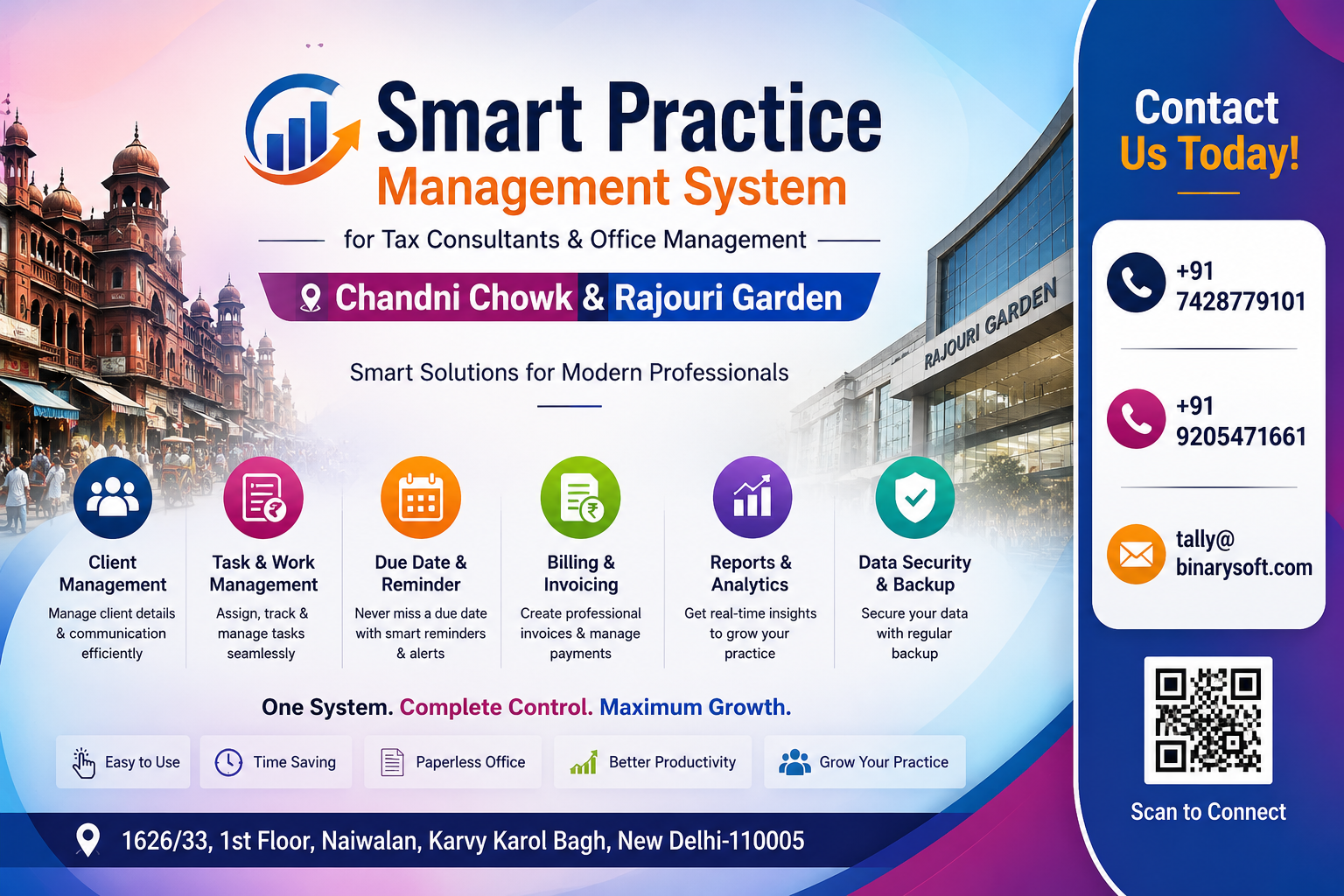
In 2026, tax consultants, CA firms, GST practitioners, and legal offices across Delhi are facing a major operational shift. Compliance timelines have become tighter, client expectations have increased, and manual office management is no longer practical for firms handling multiple clients every day. In recent months, businesses in Chandni Chowk and Rajouri Garden have started moving toward Smart Practice Management Systems that combine client management, task tracking, billing, document storage, GST workflows, employee monitoring, and office reporting into one centralized platform. The pressure is real because missing a compliance deadline, losing client documents, or failing to respond quickly can directly impact professional credibility and revenue. Firms that are adopting automation now are reducing operational delays, improving team coordination, and handling more clients without increasing manpower. In 2026, practice management software is no longer just an optional tool for large firms. It has become a business necessity for tax consultants, accountants, and professional offices that want speed, accuracy, control, and long-term growth.
Why Tax Consultants in Delhi Are Upgrading Their Office Systems
Traditional office operations often depend on spreadsheets, WhatsApp communication, manual registers, desktop folders, and scattered client records. This creates confusion during return filing seasons, audit periods, TDS deadlines, and GST reconciliations.
A Smart Practice Management System helps tax consultants manage:
- Client database
- Task allocation
- GST return schedules
- Income tax filing status
- Document collection
- Employee work monitoring
- Office communication
- Billing and payment follow-up
- Compliance reminders
- Digital approvals
- Client portal access
For firms in commercial areas like Chandni Chowk and Rajouri Garden, where multiple client interactions happen daily, centralized automation significantly improves operational efficiency.
The Growing Pressure on Tax and Compliance Offices in 2026
Government reporting requirements, GST scrutiny, income tax notices, reconciliation processes, and digital compliance systems have increased the workload on tax professionals.
Today’s clients expect:
- Instant updates
- Faster return filing
- Online document sharing
- Real-time communication
- Transparent work status
- Professional reporting
A consultant who still manages files manually often struggles during peak filing seasons.
Modern practice management software solves this challenge by automating reminders, maintaining centralized records, and giving firms better control over pending work.
Story: How a Small Tax Office in Rajouri Garden Transformed Operations
A mid-sized tax consultancy office in Rajouri Garden was handling more than 450 GST and income tax clients using Excel sheets, physical files, and manual follow-ups. During filing periods, employees worked late nights searching for missing documents, checking pending payments, and tracking client communications.
One missed GST filing created a penalty issue for a long-term client. The client became frustrated because nobody in the office could immediately identify the pending status.
The firm decided to implement a Smart Practice Management System.
Within three months:
- Client documents became searchable instantly
- GST and TDS reminders were automated
- Employees received assigned tasks through dashboards
- Billing and pending payments became trackable
- Client communication improved
- Management could monitor office productivity daily
The owner later admitted that the software did not just improve operations—it reduced stress inside the office and helped the team regain client trust.
This is the reality many professional firms in Delhi are now experiencing.
Key Features of a Smart Practice Management System
Centralized Client Management
All client details remain available in one dashboard:
- PAN details
- GST numbers
- Contact details
- Return filing history
- Billing records
- Document storage
- Communication history
This reduces dependency on individual employees and improves office continuity.
Task & Workflow Automation
Tax firms handle hundreds of repetitive tasks every month.
Automation helps manage:
- GST returns
- TDS filing
- ROC compliance
- Income tax filing
- Audit tracking
- Client follow-up
- Notice responses
Managers can assign work, track deadlines, and monitor completion status in real time.
Document Management System
Professional offices generate large volumes of documents every day.
A smart document system allows:
- Secure cloud storage
- Digital file access
- Client-wise folders
- Search functionality
- Upload/download control
- Backup security
This prevents document loss and improves operational speed.
Employee Productivity Tracking
Practice management software also acts as an office monitoring solution.
It helps track:
- Employee work status
- Pending assignments
- Daily productivity
- Team performance
- Workload balancing
- Deadline completion
This becomes extremely important during tax season when offices handle large compliance volumes.
Billing and Payment Tracking
Many tax consultants lose revenue because invoices and payment follow-ups are not properly managed.
A smart system can automate:
- Invoice generation
- Payment reminders
- Outstanding tracking
- Service billing
- AMC management
- Client ledger reports
This improves cash flow and professional transparency.
Why Chandni Chowk Businesses Need Smart Office Management
Chandni Chowk is one of Delhi’s busiest commercial markets. Tax consultants there often handle traders, wholesalers, import-export businesses, jewelry businesses, textile traders, and manufacturing units.
These businesses generate:
- High invoice volumes
- GST complexities
- Frequent reconciliations
- Inventory-related accounting
- Multi-location reporting
Manual office handling creates bottlenecks.
A Practice Management System helps consultants manage multiple clients efficiently while improving response time and compliance control.
Why Rajouri Garden Firms Are Rapidly Adopting Automation
Rajouri Garden has become a growing hub for service professionals, consultants, and business advisory firms.
Modern clients in this region prefer:
- Online coordination
- Faster documentation
- Cloud-based communication
- Digital approvals
- Quick report access
Firms using smart automation appear more professional, responsive, and organized compared to traditional offices.
This directly improves client retention and referrals.
Benefits of Smart Practice Management Software
Better Client Experience
Clients receive faster responses, organized communication, and timely reminders.
Reduced Manual Errors
Automation reduces filing mistakes, duplicate entries, and missed deadlines.
Improved Office Coordination
Employees and managers can collaborate through a single centralized system.
Faster Compliance Processing
Returns, notices, reconciliations, and reporting become faster and more accurate.
Data Security
Cloud-based storage and controlled access improve data protection.
Business Scalability
Firms can manage more clients without proportionally increasing staff size.
Important Modules That Modern Firms Need
A professional practice management platform should ideally include:
- Client Relationship Management (CRM)
- GST Management
- Income Tax Management
- Task Scheduler
- Notice Tracking
- Billing Module
- Employee Monitoring
- Document Storage
- Workflow Automation
- SMS & Email Alerts
- Dashboard Reporting
- Mobile Access
- Backup & Security Features
Cloud-Based Practice Management Is the Future
In 2026, cloud technology is becoming standard for professional offices.
Cloud systems allow:
- Remote office access
- Work-from-home flexibility
- Multi-branch coordination
- Real-time updates
- Better backup security
- Faster collaboration
For consultants who frequently travel between clients or branches, cloud accessibility provides major operational advantages.
SEO Advantage for Modern Consulting Firms
Digitally managed firms often respond faster to online leads, maintain organized communication, and improve customer satisfaction.
This indirectly supports:
- Better online reviews
- Higher client retention
- Increased referrals
- Stronger professional reputation
Technology now plays a direct role in business growth for professional service firms.
How to Choose the Right Practice Management Software
Before selecting software, firms should evaluate:
- Ease of use
- Cloud support
- Security features
- Scalability
- GST compatibility
- Customization options
- Multi-user access
- Support services
- Data backup systems
- Reporting capabilities
The right software should simplify operations instead of making them complicated.
Conclusion
The professional services industry is changing rapidly in 2026. Tax consultants, accountants, and compliance firms in Chandni Chowk and Rajouri Garden can no longer depend entirely on manual systems if they want sustainable growth and operational control.
A Smart Practice Management System helps firms automate workflows, improve client servicing, reduce errors, strengthen office coordination, and handle growing compliance pressure with confidence.
The firms adopting automation today are building faster, smarter, and more scalable operations for the future. In the coming years, office management technology will not only improve efficiency—it will define which firms remain competitive in an increasingly digital professional environment.
Frequently Asked Questions
What is a Smart Practice Management System?
It is software designed for tax consultants, accountants, CA firms, and professional offices to manage clients, tasks, compliance work, documents, billing, and office operations from a centralized platform.
Is Practice Management Software useful for small tax consultants?
Yes. Even small firms benefit from automation because it reduces manual work, improves organization, and helps manage deadlines effectively.
CA. Ankit Vardiya works closely with traders, wholesalers, and service businesses on accounting automation, GST reporting, and audit readiness. His professional exposure to day-to-day business operations allows him to translate complex accounting concepts into practical guidance for Indian business owners.