Call CA Tally HelpDesk
+91 9205471661,
7428779101
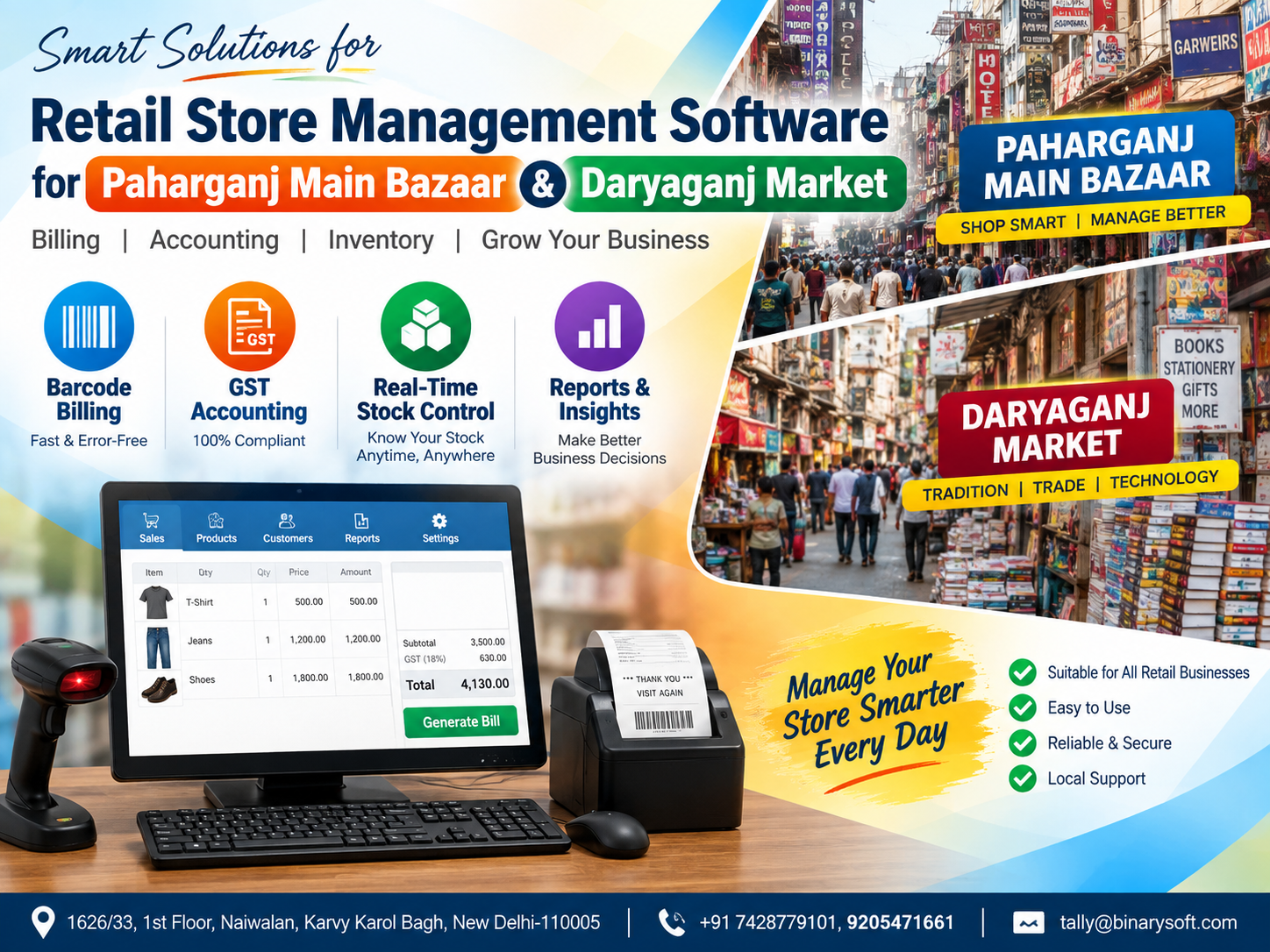
What Changed in 2026 for Retail Businesses in Paharganj and Daryaganj?
In 2026, running a retail business in busy markets such as Paharganj Main Bazaar and Daryaganj Market is becoming increasingly dependent on speed, accurate stock information and digitally managed accounts. Customers expect faster checkout, proper GST invoices and instant information about product availability, while shop owners must simultaneously control inventory, purchases, payments, margins and compliance. Traditional handwritten registers and disconnected billing systems can create costly problems when hundreds of products move through a store every day. A modern Retail Store Management Software solution brings barcode billing, GST accounting, inventory tracking and business reports together on one platform. The immediate benefit is visibility: retailers can know what is selling, what is running low, how much stock is available and where money is being generated. For businesses operating in competitive Delhi markets, better control can mean faster billing, fewer errors and smarter decisions.
Retail Business Is Changing in Paharganj Main Bazaar and Daryaganj Market
Paharganj Main Bazaar and Daryaganj Market represent two of Delhi's well-known commercial areas, where businesses often handle large numbers of products, customers, suppliers and daily transactions.
Retailers today cannot depend only on experience and manual records. As the number of products and transactions increases, questions become more difficult to answer quickly:
How much stock is actually available?
Which products are selling fastest?
Which items have not moved for months?
What was today's total sale?
How much GST has been collected?
Which supplier payments are outstanding?
What is the actual profit on a particular product?
Is the physical stock matching the system stock?
Which products need to be reordered tomorrow?
Retail Store Management Software helps bring these answers into one connected business system.
What Is Retail Store Management Software?
Retail Store Management Software is a business solution designed to manage the day-to-day activities of a retail store digitally.
Instead of maintaining separate registers or software for billing, inventory and accounts, retailers can manage important operations through an integrated system.
Depending on the software and configuration, a retail management solution can support:
Barcode billing
GST invoicing
Inventory management
Purchase management
Sales management
Accounting
Customer records
Supplier records
Payment tracking
Outstanding management
Stock reports
Reorder management
Sales analysis
Profitability reports
Multi-user operations
Business dashboards
The objective is simple: reduce repetitive manual work while giving the business owner greater control over store operations.
A Paharganj Retailer's Story: When the Store Was Busy but Stock Was Missing
Imagine a retailer running a busy store near Paharganj Main Bazaar.
For years, the owner had managed the business using a billing computer, notebooks and the experience of trusted employees. The shop was busy, customers kept coming and sales appeared healthy.
But there was one recurring problem.
Whenever a customer requested a particular item, employees sometimes believed it was available because the register showed stock. After searching the shelves and storage area, however, they discovered that the item was unavailable.
On other occasions, boxes of slow-moving products remained in storage while popular products unexpectedly ran out.
The owner was working longer hours but still did not have a clear picture of inventory.
After introducing barcode-based billing and real-time inventory management, every sale automatically reduced the relevant stock quantity. Purchase entries increased stock, and reports highlighted fast-moving and low-stock items.
One evening, instead of manually checking shelves after closing the shop, the owner opened the stock report.
For the first time, the numbers told the same story as the shelves.
That feeling of control mattered more than simply replacing a handwritten register. The business owner could finally spend more time planning the business instead of repeatedly counting it.
Barcode Billing: Faster Checkout for Busy Retail Counters
During busy shopping hours, every extra minute at the billing counter matters.
Manual product selection can become inefficient when a store handles hundreds or thousands of different items.
Barcode billing simplifies this process.
The cashier scans the barcode, and the system can automatically identify the relevant product, quantity and configured price. The item is added to the invoice without repeatedly searching through product lists.
This can significantly improve checkout efficiency.
Why Barcode Billing Matters
Barcode-based retail billing can help businesses:
Reduce manual product-entry errors
Speed up invoice preparation
Identify products accurately
Maintain consistent item information
Update inventory after billing
Handle busy checkout counters efficiently
Improve customer experience
For retailers operating in high-footfall markets such as Paharganj, faster checkout can be particularly valuable during peak business hours.
GST Billing and Accounting in One System
GST compliance is another important part of modern retail operations.
A well-configured accounting and billing solution can help businesses create GST invoices while maintaining transaction records required for accounting and reporting.
Depending on the nature of the business and applicable GST requirements, retailers may need to manage information such as:
GSTIN
HSN/SAC details
Taxable value
CGST
SGST
IGST
Tax rates
Discounts
Invoice values
Customer and supplier information
When billing and accounting are connected, businesses can reduce duplicate data entry.
Instead of creating a bill in one system and entering the transaction again into accounting records, integrated software can maintain the transaction as part of the accounting workflow.
Real-Time Stock Control: Know What You Actually Have
Inventory is money sitting on shelves.
Too little stock can lead to lost sales. Too much stock can block working capital.
This is why real-time stock visibility is one of the most valuable capabilities for a growing retailer.
Every purchase can increase available inventory, while every recorded sale can reduce it.
The business owner can then use reports to understand the current stock position.
For example, if a retailer receives 100 units of a product and sells 67 units, the system can reflect the remaining quantity based on properly recorded transactions.
This is much more efficient than waiting until the end of the week or month to manually count every item.
Low-Stock and Reorder Management
Imagine discovering that your best-selling item is out of stock only when a customer asks for it.
That is not simply an inventory problem. It can become a lost-revenue problem.
A retail inventory system can help businesses identify products approaching predefined reorder levels.
For example:
Available Stock: 12 units
Minimum Stock Level: 10 units
Reorder Level: 15 units
The retailer can review the report and arrange replenishment before stock reaches a critical level.
This makes purchasing more proactive rather than reactive.
Manage Fast-Moving and Slow-Moving Products
Not every product deserves the same amount of shelf space or working capital.
Retail software reports can help identify fast-moving and slow-moving inventory.
Fast-moving products may require frequent replenishment, while slow-moving products may need discounts, bundling, reduced future purchasing or other sales strategies.
For retailers in Daryaganj Market and Paharganj Main Bazaar, where product variety can be extensive, this information can help improve inventory planning.
Purchase Management and Supplier Tracking
Retail management is not only about selling.
Every sale begins with purchasing.
A comprehensive business system can help maintain purchase transactions along with supplier information.
Retailers can monitor:
Purchase invoices
Supplier-wise purchases
Pending payments
Purchase returns
Product costs
Outstanding balances
Stock received
Better supplier records can also help when negotiating prices or reviewing purchasing patterns.
Customer Outstanding Management
Retail businesses that provide credit to selected customers need reliable outstanding tracking.
Depending on the accounting solution used, retailers can review customer balances, bill-wise outstanding amounts and ageing information.
Instead of searching through old registers, the business can quickly determine which invoices remain unpaid.
This can improve collection follow-ups and cash-flow management.
Retail Accounting Beyond Billing
Billing records sales, but accounting tells the financial story behind those sales.
Retail accounting software can help maintain important financial records such as:
Sales
Purchases
Receipts
Payments
Expenses
Cash transactions
Bank transactions
Customer balances
Supplier balances
Reports can then provide a broader picture of business performance.
For businesses using TallyPrime, accounting, inventory and GST-related workflows can be configured according to applicable business requirements.
Daily Sales Visibility
A retailer should not have to wait until the end of the month to understand sales performance.
Digital retail management enables owners to review daily sales information much more quickly.
Useful analysis may include:
Today's sales
Yesterday's sales
Weekly sales
Monthly sales
Product-wise sales
Category-wise sales
Customer-wise sales
Salesperson-wise performance, where configured
This allows business decisions to be based on recorded data rather than assumptions.
Better Control Over Profit Margins
High sales do not automatically mean high profits.
A store might sell large quantities of a product while earning a very small margin on each unit.
Retailers therefore need visibility into both revenue and cost.
Appropriate reports can help management analyse product performance and profitability based on correctly maintained purchase, sales and accounting data.
This can support better pricing, purchasing and promotion decisions.
Why Retailers in Paharganj Main Bazaar Need Better Technology
Paharganj is associated with a dense commercial environment, including retail, hospitality and businesses serving both local customers and visitors.
In such environments, retailers can experience sudden periods of high customer traffic.
A slow billing process creates queues.
Poor stock records create confusion.
Incorrect product selection can create billing errors.
Missing purchase records affect inventory.
Disconnected accounting makes reconciliation more difficult.
An integrated retail solution addresses these operational problems by connecting billing, stock and accounts.
Why Daryaganj Market Businesses Can Benefit
Daryaganj has a long-established commercial identity in Delhi.
Businesses dealing with multiple product categories, suppliers and customers can accumulate substantial transaction data over time.
As operations expand, manual management becomes increasingly difficult.
A digital retail system creates structured records that can be searched, analysed and reviewed.
Instead of relying entirely on memory, the business begins relying on information.
Barcode Labels for Products Without Manufacturer Barcodes
Not every retail product arrives with a usable barcode.
Retail businesses may therefore need to generate and print their own barcode labels.
Depending on the selected software, printer and configuration, barcode workflows can be established for internally managed products.
The process may include creating an item code, assigning a barcode, printing a label, attaching it to the product and scanning it during billing.
This is especially useful for stores managing large numbers of individual SKUs.
Reduce Human Errors
Human errors cannot be eliminated completely, but software can reduce repetitive manual work that often causes them.
Common retail errors include:
Selecting the wrong product
Entering an incorrect price
Forgetting to update inventory
Duplicating entries
Incorrectly recording quantities
Missing purchase transactions
Incorrect customer balances
A properly configured workflow, combined with staff training, creates better control.
Multi-User Retail Operations
As a business grows, one computer or one person may no longer be enough.
Different employees may be responsible for billing, purchases, accounting, inventory or management.
A suitable multi-user setup can allow authorized users to work according to assigned responsibilities.
For example, a cashier may focus on billing while an accountant manages accounts and the owner reviews reports.
Access and configuration should always be planned according to the software being used and the business's security requirements.
Inventory by Category, Brand, Size or Other Attributes
Retailers frequently manage products with multiple variations.
A clothing business may need size and colour.
An electronics retailer may track brand and model.
A general merchandise store may need categories and subcategories.
Well-structured inventory masters make reporting more useful.
Instead of seeing only the total number of products, management can analyse inventory based on meaningful business classifications.
Sales Returns and Purchase Returns
Returns are part of retail business.
A customer may return a product, or a retailer may return defective goods to a supplier.
If returns are not recorded correctly, stock and accounting balances can become inaccurate.
A structured system helps maintain sales returns and purchase returns while ensuring the corresponding business records are updated appropriately.
GST Accounting for Delhi Retail Businesses
Retailers should ensure that their accounting processes are configured according to current GST requirements applicable to their business.
Software can assist with transaction recording, tax calculation and reporting, but compliance still depends on correct master data, accurate entries, appropriate configuration and applicable legal requirements.
Businesses should periodically review GST settings, tax classifications and transaction data with their accountant or tax professional.
Cash and Bank Management
Retail businesses can receive money through multiple payment methods.
These may include cash, bank transfers, cards, UPI and other digital payment channels.
Accounting software helps maintain the corresponding financial records so businesses can reconcile transactions and understand their cash and bank positions.
Proper reconciliation becomes increasingly important as digital transaction volumes grow.
Manage Multiple Stores or Locations
A retailer operating more than one location needs greater inventory visibility.
Depending on the selected solution and configuration, businesses may be able to maintain location-wise inventory or consolidate information for management reporting.
This helps answer questions such as:
Which location has a particular product?
Which store is selling more?
Where is excess stock available?
Which location requires replenishment?
Could inventory be transferred instead of purchasing more?
For expanding retailers, this type of visibility can become extremely valuable.
Retail Reports That Help Owners Make Better Decisions
Software becomes valuable when transaction data turns into useful business information.
Retailers should regularly review relevant reports for sales, purchases, stock, outstanding balances, expenses and profitability.
The objective should not be to generate more reports.
The objective should be to find information that leads to better decisions.
For example, a stock ageing report may reveal money blocked in products that have not sold for months. A sales analysis may reveal that a small group of products generates a large portion of revenue.
These insights can influence purchasing and pricing decisions.
TallyPrime for Retail Business Management
TallyPrime can support accounting, inventory, invoicing and GST-related business workflows.
For retail businesses, its usefulness depends on appropriate configuration according to the company's requirements.
A retail implementation may involve:
Company configuration
Ledger creation
Stock groups
Stock items
Units of measurement
GST configuration
Purchase workflow
Sales workflow
Inventory reports
User access
Backup procedures
Data security practices
Additional retail-specific workflows, integrations or custom requirements should be evaluated separately according to the business environment.
Why Proper Implementation Matters
Buying software is only the first step.
Poorly configured software can create different problems instead of solving existing ones.
Before implementation, retailers should identify:
Number of products
Product categories
Billing counters
Number of users
GST requirements
Barcode requirements
Inventory locations
Purchase workflow
Sales workflow
Accounting requirements
Required reports
Backup requirements
User permissions
This creates a clearer implementation roadmap.
Employee Training Is Equally Important
Even excellent software delivers limited value if employees do not know how to use it properly.
Staff should understand the processes relevant to their responsibilities.
Billing employees should know how to scan, invoice and process permitted corrections.
Inventory employees should understand stock entries and transfers.
Accounting staff should understand vouchers, ledgers and reconciliation.
Management should know which reports to review.
Training turns software from an installed application into a working business system.
Data Backup and Business Continuity
Retail data represents years of transactions, customer information, supplier records and accounting history.
It should be protected accordingly.
Businesses should maintain appropriate backup procedures and periodically verify that backups can actually be restored.
The exact strategy will depend on the software, deployment model and business requirements.
Data protection should never be treated as an afterthought.
Retail Management Software for Growing Businesses
A small retailer may initially need only billing and basic inventory.
As the business expands, requirements can change.
The business may later need:
More users
More billing counters
Additional inventory locations
Advanced reports
Remote access
Integrations
Stronger security controls
More structured accounting
Choosing a scalable approach reduces the need to rebuild processes repeatedly as the business grows.
How Binarysoft Technologies Can Help
Binarysoft Technologies works with businesses seeking TallyPrime and related business-management solutions.
Retailers can discuss their operational requirements before deciding how billing, accounting, GST and inventory workflows should be configured.
A requirement discussion may cover barcode billing, stock management, GST accounting, multi-user requirements, reports, implementation, training and support.
For businesses in Paharganj Main Bazaar, Daryaganj Market and other parts of Delhi NCR, the objective should be to implement a system suited to actual day-to-day operations rather than simply installing software.
Moving from Manual Retail Management to Digital Control
Digital transformation does not necessarily mean replacing every process overnight.
A retailer can begin with the areas creating the greatest operational pressure.
For many stores, that means:
Billing
Inventory
Purchases
Accounting
GST records
Outstanding management
Business reporting
Once these core processes are structured, additional automation can be introduced based on business requirements.
The biggest change is not the computer screen.
It is the ability to answer important business questions using reliable data.
Conclusion
Retail competition in Paharganj Main Bazaar and Daryaganj Market is no longer only about product selection and pricing. Operational speed, inventory accuracy, GST-ready accounting and access to timely business information are becoming increasingly important.
Retail Store Management Software can connect barcode billing, inventory, purchases, sales and accounting into a more structured workflow. Barcode-based checkout can reduce repetitive manual entry, while properly maintained inventory records give retailers better visibility into available, fast-moving and low-stock products.
For growing retail businesses, the goal should be more than simply generating invoices. The goal should be creating a connected system where each recorded transaction contributes to better stock control, cleaner accounts and stronger business decisions.
With appropriate software, implementation and training, retailers can spend less time searching through registers and more time serving customers and growing their businesses.
Frequently Asked Questions
What is Retail Store Management Software?
Retail Store Management Software helps retailers manage activities such as billing, inventory, purchases, accounting, customer records and business reporting through a structured digital system.
Is barcode billing useful for small retail stores?
Yes. Barcode billing can be useful even for smaller stores when they manage many products or want faster product identification and checkout.
CA. T.R Venkat is a Chartered Accountant with extensive experience in accounting systems, GST compliance, and MSME advisory. He has worked closely with Indian traders and businesses on inventory control and accounting process improvement. His writing draws from real operational challenges faced by growing enterprises.