Call CA Tally HelpDesk
+91 9205471661,
7428779101
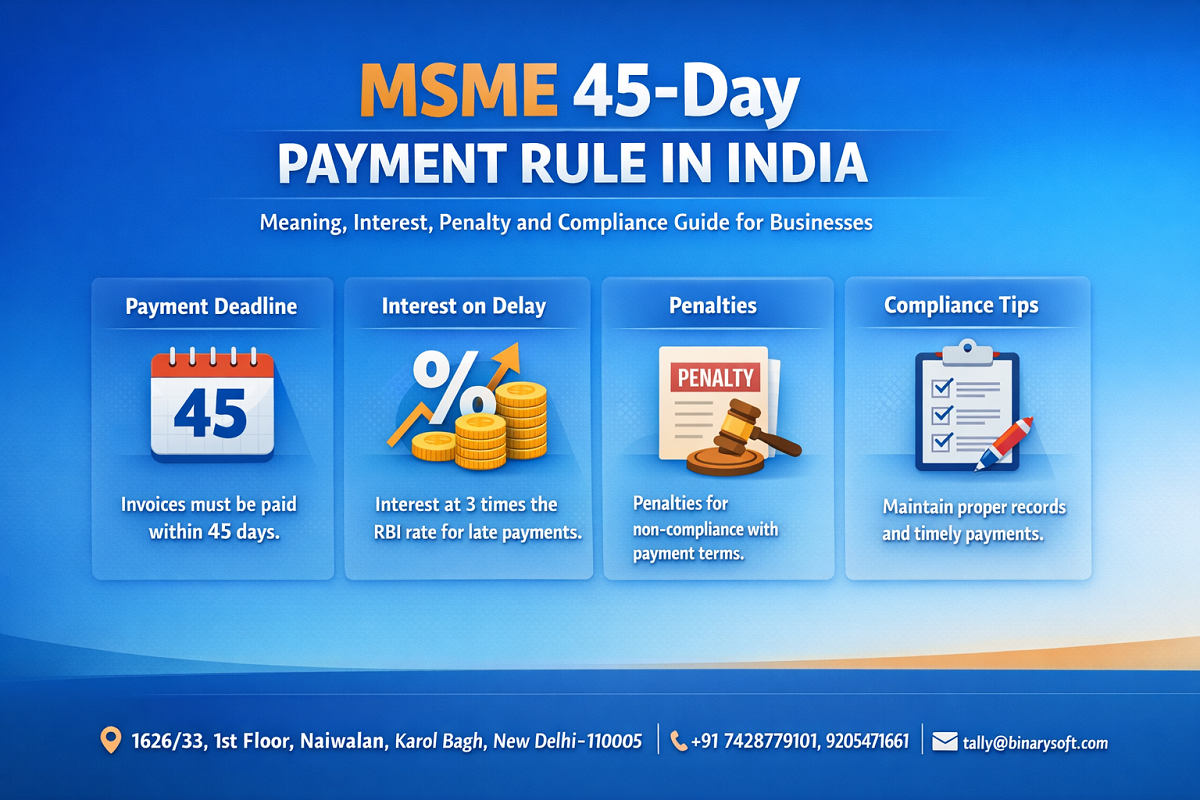
In recent months, the MSME 45-Day Payment Rulehas become one of the most important compliance topics for Indian businesses. The government has strengthened enforcement under the MSME Development Actand recent Income Tax provisions, putting serious pressure on companies that delay payments to Micro and Small Enterprises. From FY 2024-25 onward, payments made to MSME suppliers beyond the permitted period are not allowed as tax deductions, which means delayed payments can increase a company’s taxable income.
For many businesses, this rule has changed how they manage vendor payments, accounting entries, and working capital. Buyers who previously delayed payments for months are now forced to clear invoices within the legally allowed time frame. The benefit is clear: MSME suppliers receive faster payments, while compliant businesses avoid heavy interest penalties, legal disputes, and tax disallowances. Understanding this rule is now essential for finance teams, accountants, and business owners who want to stay compliant and maintain strong supplier relationships.
Understanding the MSME 45-Day Payment Rule
The MSME 45-Day Payment Rulecomes under the Micro, Small and Medium Enterprises Development (MSMED) Act, 2006. The objective of this law is to protect micro and small enterprises from delayed payments by larger buyers.
Under this rule:
-
If a buyer purchases goods or services from a registered MSME, payment must be made within 45 daysfrom the date of acceptance of goods or services.
-
If there is no written agreement, the payment must be made within 15 days.
This rule applies to all buyers including companies, traders, corporates, and government organizationswho purchase from MSMEs.
The regulation ensures that small businesses do not face cash flow problems because of delayed payments by larger customers.
Why the MSME Payment Rule Became Critical Recently
In earlier years, delayed payments to MSMEs were common in many industries. Suppliers often waited 60, 90 or even 120 daysfor payment. While the MSMED Act already existed, enforcement was relatively weak.
However, recent regulatory changes have made this rule much stricter.
The Income Tax Act amendment under Section 43B(h)states that if payment to an MSME supplier is not made within the permitted time period, the expense cannot be claimed as a deductionfor that financial year.
This creates a direct financial impact for businesses.
For example:
-
If a company purchases goods worth ₹10,00,000 from an MSME supplier
-
But delays payment beyond the permitted period
That ₹10,00,000 expense will be disallowed in the tax calculation, increasing the company’s taxable profit.
This change has forced businesses across India to review their vendor payment systems, accounting software, and compliance procedures.
The Meaning of “45 Days” Under MSME Law
The 45-day limit does not apply blindly in all situations. It depends on whether there is a written agreement between buyer and supplier.
Scenario 1 – Written Agreement Exists
If the buyer and MSME supplier have a written contract specifying the payment terms, the payment period can be up to 45 days, but not beyond.
Scenario 2 – No Written Agreement
If there is no written agreement, payment must be made within 15 daysfrom the date of acceptance of goods or services.
The law ensures that businesses cannot extend payment periods indefinitely.
How Interest is Calculated on Delayed MSME Payments
One of the strongest aspects of the MSMED Act is the interest penaltyfor delayed payments.
If payment is not made within the allowed time, the buyer must pay compound interestat a rate three times the RBI bank rate.
This interest is calculated from the due date until the payment is made.
Example
Suppose:
Invoice Amount: ₹5,00,000
Due Date: 45 days from invoice
Payment Delay: 60 days beyond due date
If the RBI bank rate is 6.5%, the interest rate becomes:
3 × 6.5% = 19.5% per year
This interest accumulates rapidly and becomes a major financial burden for buyers who delay payments.
Legal Penalties and Dispute Resolution
If a buyer refuses to pay within the allowed time, MSME suppliers can file a complaint with the Micro and Small Enterprises Facilitation Council (MSEFC).
The process generally includes:
-
Filing a delayed payment complaint
-
Mediation between buyer and supplier
-
Arbitration if mediation fails
The council can issue orders requiring the buyer to pay:
-
The original invoice amount
-
Interest on delayed payment
-
Legal costs in some cases
Courts generally support MSMEs strongly under this law.
Real Story: How a Small Manufacturer Nearly Shut Down
In a small industrial area near Delhi, a family-run manufacturing unit supplied metal components to several large distributors. The business employed nearly twenty workers and had built relationships with buyers over many years.
However, payments were frequently delayed. Some invoices were paid after three or four months. The company struggled to pay salaries and purchase raw materials. The owner even considered shutting down the business.
Then the MSME payment rules became stricter. The manufacturer registered under the MSME portal and started reminding buyers about the 45-day rule and legal interest liability.
Slowly, things began to change. Buyers who previously delayed payments started clearing invoices within a month. Cash flow improved, employee salaries became regular, and the business regained stability.
This story reflects why the MSME payment law exists—to protect small businesses that form the backbone of India’s economy.
Who Must Follow the MSME 45-Day Payment Rule
The rule applies to all buyers who purchase goods or services from Micro or Small Enterprisesregistered on the Udyam Registration Portal.
This includes:
However, the rule applies specifically when the supplier is classified as Micro or Small Enterprise, not Medium enterprises.
Accounting and Compliance Requirements
Businesses must maintain proper records of MSME transactions.
Important compliance practices include:
Maintain MSME Vendor Identification
Companies must identify vendors who are registered MSMEs and track their payment deadlines separately.
Track Invoice Due Dates
Finance teams must calculate the payment due date based on:
Maintain Documentation
Proper documentation such as purchase orders, delivery confirmations, and agreements should be maintained.
Financial Statement Disclosure
Companies must disclose delayed MSME payments in their financial statements.
Role of Accounting Software in MSME Compliance
Managing MSME payment compliance manually can be difficult, especially for companies handling hundreds of supplier invoices.
Modern accounting software helps businesses by:
-
Tracking MSME vendor categories
-
Monitoring invoice payment deadlines
-
Calculating interest on delayed payments
-
Generating compliance reports
-
Integrating with GST and financial reporting
Many businesses now rely on advanced accounting solutions to ensure they do not accidentally violate MSME payment regulations.
Contact Details
Powered by Binarysoft Technologies – Authorized Tally Partner
1626/33, 1st Floor, Naiwalan, Karol Bagh,
New Delhi – 110005, INDIA
Contact Us:
+91 7428779101
+91 9205471661
Email:
tally@binarysoft.com
Working Hours:
10:00 AM – 6:00 PM (Mon–Fri)
Conclusion
The MSME 45-Day Payment Ruleis not just a legal requirement—it is a critical step toward building a fair and sustainable business ecosystem in India. Small businesses depend on timely payments to maintain operations, pay employees, and invest in growth.
With stricter tax provisions and stronger enforcement in recent years, companies can no longer ignore delayed payments to MSME suppliers. Businesses must update their accounting systems, monitor vendor payment cycles carefully, and maintain proper compliance records.
Organizations that adapt early will not only avoid penalties but also build stronger relationships with MSME suppliers. In a fast-growing economy like India, timely payments and responsible business practices are becoming essential for long-term success.
Frequently Asked Questions
What is the MSME 45-Day Payment Rule?
It is a legal provision under the MSMED Act that requires buyers to pay MSME suppliers within 45 days of accepting goods or services.
What happens if payment is delayed beyond 45 days?
The buyer must pay compound interest at three times the RBI bank rate on the outstanding amount.
CA. Pankaj Bhadoria brings practical experience in GST, accounting, and business process consulting. He works closely with MSMEs to resolve compliance challenges and improve operational transparency. His articles aim to simplify complex regulations for everyday business use.