Call CA Tally HelpDesk
+91 9205471661,
7428779101
In 2026, the MSME 45-Day Payment Rulehas become a major compliance priority for businesses across India. Recent regulatory enforcement and the impact of Income Tax provisions under Section 43B(h)have changed how companies manage payments to Micro and Small Enterprises. Businesses that delay payments beyond the permitted time limit now face serious consequences, including tax deduction disallowances, interest liabilities, and legal disputes.
Earlier, many companies followed long payment cycles of 60 to 120 days when dealing with small suppliers. But now, delayed payments can increase taxable income and trigger financial penalties. The rule has forced finance teams, accountants, and business owners to review vendor payment policies and strengthen accounting systems. For MSMEs, the benefit is clear: faster payments, improved cash flow, and greater financial stability. Understanding the MSME payment rule in 2026 is essential for every business that deals with registered small suppliers in India.
Understanding the MSME 45-Day Payment Rule
The MSME 45-Day Payment Ruleoriginates from the Micro, Small and Medium Enterprises Development (MSMED) Act, 2006. The law was introduced to protect micro and small enterprises from delayed payments by larger buyers.
Small businesses often face severe financial pressure when payments are delayed. Many MSMEs operate on tight working capital and rely on regular cash flow to pay employees, purchase raw materials, and maintain production. When payments are delayed for months, the entire business cycle can be disrupted.
To address this problem, the MSMED Act clearly states that buyers must pay MSME suppliers within a specified time frame.
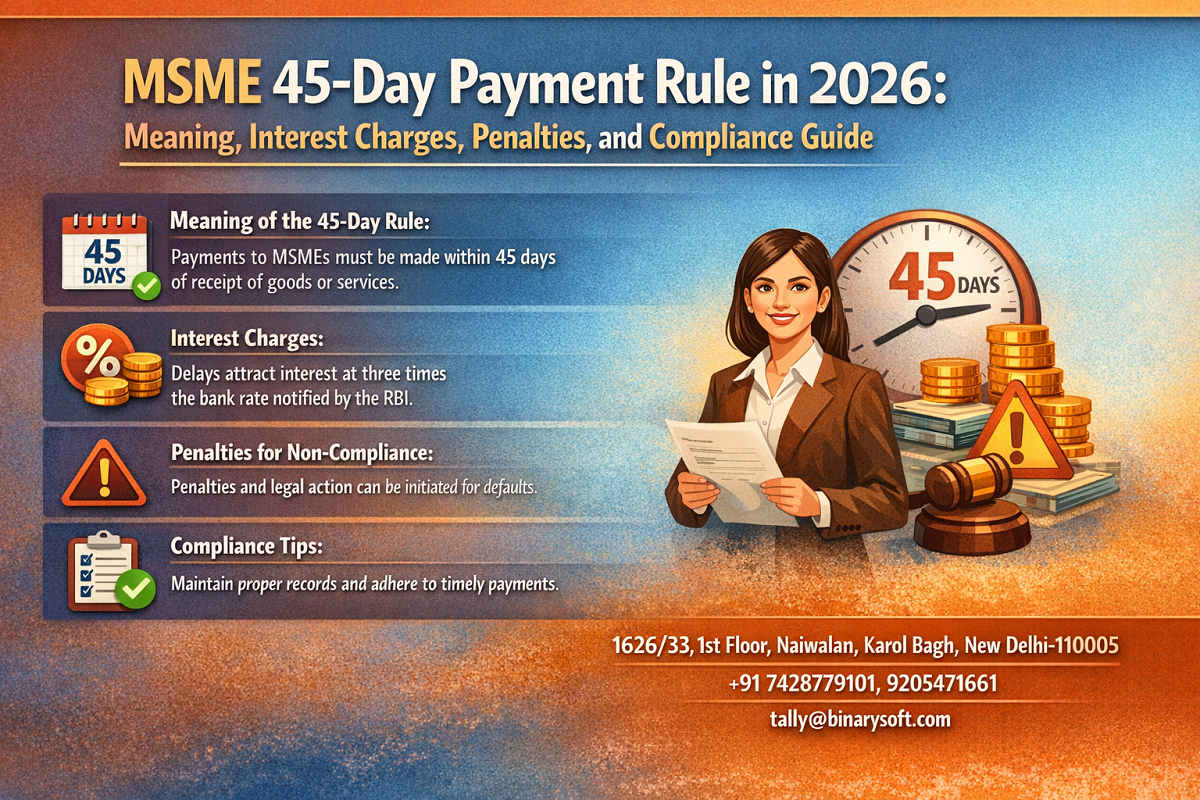
If goods or services are supplied by a registered MSME, payment must be made within 45 daysfrom the date of acceptance.
If there is no written agreement between buyer and supplier, the payment must be made within 15 days.
This rule ensures that small businesses are protected from unfair payment delays.
Why the Rule Has Become More Important Recently
In recent years, the government has strengthened enforcement of MSME payment regulations. The introduction of Section 43B(h) in the Income Tax Acthas significantly increased compliance pressure.
Under this provision, if a business purchases goods or services from a registered MSME but fails to pay within the permitted time limit, the expense cannot be claimed as a deductionwhile calculating taxable income.
This means the unpaid amount becomes part of taxable profit.
For example, if a company purchases materials worth ₹15,00,000 from an MSME supplierand delays payment beyond the allowed period, that ₹15,00,000 expense may be disallowed for tax purposes.
This rule has forced companies to review vendor payment cycles and ensure that MSME invoices are cleared on time.
Meaning of “Date of Acceptance”
The payment timeline begins from the date of acceptance of goods or services.
This is generally defined as the date when the buyer accepts the goods delivered by the MSME supplier or confirms the completion of services.
If there is a written objection raised regarding the quality of goods or services, the timeline may begin after the issue is resolved.
Understanding this date is crucial because it determines when the 15-day or 45-day payment period begins.
Interest Charges on Delayed Payments
One of the strongest features of the MSME law is the interest penalty for delayed payments.
If the buyer fails to make payment within the allowed period, the MSME supplier has the right to charge compound interest.
The interest rate is three times the RBI bank rate.
This interest is calculated from the due date until the payment is made.
For instance, if the RBI bank rate is 6.5 percent, the applicable interest becomes 19.5 percent per year.
Since the interest is compounded, delayed payments can quickly become expensive for buyers.
This provision acts as a strong deterrent against payment delays.
Penalties and Legal Consequences
If the buyer refuses to pay even after reminders, MSMEs can initiate legal action through the Micro and Small Enterprises Facilitation Council (MSEFC).
The process generally involves:
Filing a delayed payment complaint
Mediation between buyer and supplier
Arbitration if mediation fails
The council has the authority to order the buyer to pay the outstanding amount along with interest.
In many cases, courts support MSME claims because the MSMED Act specifically protects small enterprises.
Ignoring the MSME payment rule can therefore lead to legal disputes and financial liabilities.
Emotional Story: A Small Supplier’s Struggle
A small packaging supplier in a Delhi industrial market spent years building relationships with larger companies. The owner had started the business with just a few machines and gradually expanded with the help of loyal employees.
But there was a constant problem. Payments were always delayed.
Invoices worth several lakhs remained unpaid for months. Salaries had to be delayed, raw materials could not be purchased on time, and the owner often had to borrow money just to keep the business running.
The stress affected not only the business but also the family behind it.
After registering as an MSME and understanding the payment protection laws, the owner began reminding buyers about the 45-day payment rule and interest provisions.
Gradually, the payment cycle improved. Buyers became more cautious, invoices were cleared faster, and the company regained financial stability.
This is exactly why the MSME payment rule exists—to ensure that small entrepreneurs are not crushed under the weight of delayed payments.
Who Must Follow the MSME Payment Rule
The rule applies to any buyer who purchases goods or services from Micro or Small Enterprises registered under the Udyam Registration system.
This includes:
Manufacturing companies
Retail businesses
Wholesale traders
Corporate buyers
Startups purchasing services
Government departments
Private companies
However, the rule mainly applies when the supplier is categorized as Micro or Small Enterprise. Medium enterprises are generally not covered under this specific provision.
Compliance Requirements for Businesses
To ensure compliance with the MSME payment rule, businesses must maintain proper financial records and monitoring systems.
Companies should first identify whether their suppliers are registered MSMEs.
Once identified, payment timelines must be carefully tracked for each invoice.
Accounting teams must ensure that invoices from MSME vendors are prioritized for payment before the deadline expires.
Businesses should also maintain proper documentation such as purchase orders, delivery notes, and acceptance records.
Many companies also disclose outstanding MSME dues in financial statements as part of statutory compliance.
Role of Accounting and ERP Software
Managing MSME compliance manually can be difficult for businesses with hundreds of vendors and invoices.
Modern accounting software helps businesses track payment deadlines and maintain compliance.
Such systems can automatically identify MSME vendors, monitor invoice dates, and alert finance teams before payment deadlines.
They also generate reports showing outstanding MSME liabilities, which is useful during audits and financial reporting.
With increasing regulatory pressure, many organizations are adopting digital accounting solutions to ensure smooth compliance with MSME rules.
Contact Details
Powered by Binarysoft Technologies – Authorized Tally Partner
1626/33, 1st Floor, Naiwalan, Karol Bagh,
New Delhi – 110005, INDIA
Contact Us:
+91 7428779101
+91 9205471661
Email:
tally@binarysoft.com
Working Hours:
10:00 AM – 6:00 PM (Mon–Fri)
Conclusion
The MSME 45-Day Payment Ruleplays a vital role in protecting small businesses in India. By ensuring timely payments, the law helps MSMEs maintain healthy cash flow and continue contributing to economic growth.
With stricter enforcement and tax implications in recent years, businesses can no longer afford to ignore this regulation. Delayed payments can lead to interest penalties, tax disallowances, and legal action.
Organizations must therefore strengthen their accounting processes, identify MSME vendors clearly, and ensure that payments are made within the permitted period.
Complying with the MSME payment rule not only avoids penalties but also builds trust with small suppliers who form the backbone of India’s industrial ecosystem.
Frequently Asked Questions
How can businesses stay compliant with MSME payment regulations?
Businesses should identify MSME suppliers, track payment deadlines carefully, maintain proper documentation, and use accounting systems that help monitor vendor payments.
Can MSMEs take legal action against delayed payments?
Yes. MSMEs can file a complaint with the Micro and Small Enterprises Facilitation Council (MSEFC) to recover the outstanding amount along with interest.
CA. T.R Venkat is a Chartered Accountant with extensive experience in accounting systems, GST compliance, and MSME advisory. He has worked closely with Indian traders and businesses on inventory control and accounting process improvement. His writing draws from real operational challenges faced by growing enterprises.