Call CA Tally HelpDesk
+91 9205471661,
7428779101
What Changed in 2026: Why Businesses Should Check GSTR-9 Applicability Before Year-End
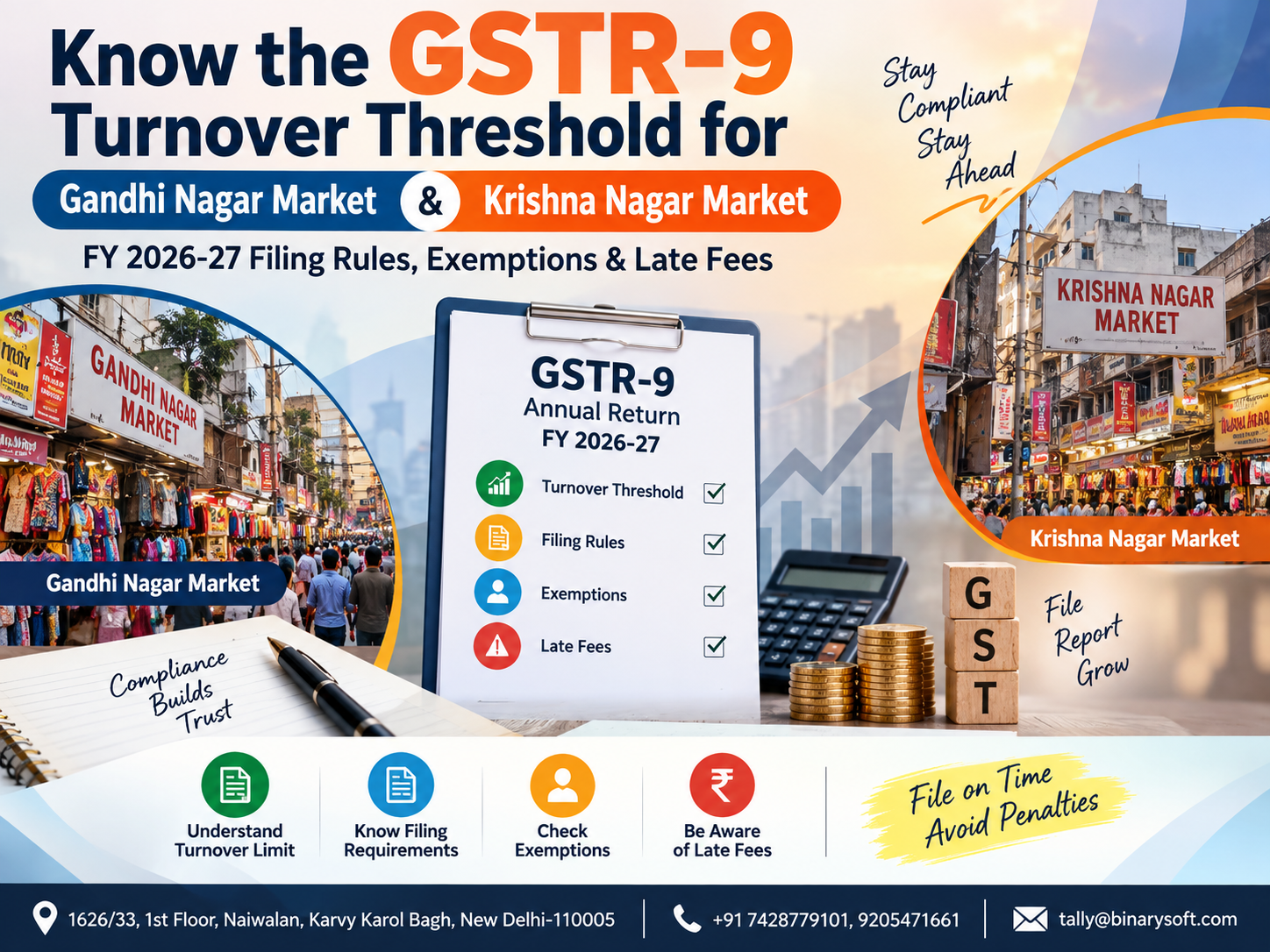
In 2026, GST annual-return compliance is becoming more data-driven, leaving businesses with less room to postpone reconciliation until the final weeks before filing. Traders in Gandhi Nagar Market and Krishna Nagar Market may generate thousands of invoices, purchase entries, credit notes, GST returns and input-tax-credit transactions during a financial year. The real pressure begins when figures reported in GSTR-1, GSTR-3B and accounting books do not match at year-end. For FY 2026-27, businesses should therefore monitor aggregate turnover throughout the year rather than waiting until March 2027 to determine whether GSTR-9 or GSTR-9C may apply. Under the present framework, GSTR-9 is the annual return for eligible regular taxpayers, while GSTR-9C applies where aggregate turnover exceeds ₹5 crore. Businesses should also watch for the Government's year-specific notification concerning exemption from GSTR-9 for smaller taxpayers. Early reconciliation can reduce filing pressure, detect GST differences and help prevent avoidable late fees.
GSTR-9 for FY 2026-27: Why Gandhi Nagar and Krishna Nagar Traders Should Prepare Early
Gandhi Nagar Market and Krishna Nagar Market are important trading areas in Delhi where wholesalers, garment businesses, distributors, retailers, manufacturers and service businesses may process a substantial volume of transactions every year.
For such businesses, GST compliance is not limited to monthly or quarterly returns.
At the end of the financial year, eligible taxpayers may also need to consider the GST annual return in Form GSTR-9.
GSTR-9 provides a consolidated annual summary of relevant GST information for a financial year.
The GST Portal describes GSTR-9 as an annual return for regular registered taxpayers, including eligible SEZ units and developers, containing information relating to purchases, sales, input tax credit, refunds, demands and other relevant GST details.
For FY 2026-27, the financial year runs from:
1 April 2026 to 31 March 2027.
The annual-return filing exercise therefore comes after the end of March 2027.
Businesses should not wait until then to begin reconciliation.
What Is GSTR-9?
Form GSTR-9 is an annual GST return intended to provide a consolidated picture of transactions reported during the financial year.
It generally draws upon information reported through periodic GST returns and other GST records.
Businesses may need to reconcile figures relating to:
Outward taxable supplies
B2B sales
B2C sales
Exempt supplies
Zero-rated supplies
GST paid
Input tax credit
Reversed ITC
Purchase information
Credit notes
Debit notes
Tax liabilities
Refunds
Demands
Other annual GST information
Once Form GSTR-9 is filed, the GST Portal states that changes cannot subsequently be made in the filed annual return. This makes proper review before submission especially important.
Is GSTR-9 Mandatory for FY 2026-27?
Section 44 of the CGST Act provides the underlying requirement for an annual return.
Under the statutory framework, every registered person is generally required to furnish the annual return except specifically excluded categories such as:
Input Service Distributors
Persons deducting tax under Section 51
Persons collecting tax under Section 52
Casual taxable persons
Non-resident taxable persons
The annual return is ordinarily due by 31 December following the end of the relevant financial year, unless the Government extends the deadline.
However, the Government has historically issued notifications exempting certain smaller taxpayers from filing GSTR-9 for specified financial years.
For example, CBIC expressly exempted taxpayers having aggregate annual turnover up to ₹2 crore from the annual-return requirement for FY 2020-21.
Therefore, businesses should distinguish between:
The statutory annual-return requirement, and
Any financial-year-specific exemption subsequently notified by the Government.
Important FY 2026-27 Position
As of September 2026, FY 2026-27 has not yet ended.
Accordingly, businesses should not assume that a ₹2 crore exemption for FY 2026-27 has already been finally notified unless an applicable notification is issued.
The practical approach is to monitor turnover and prepare records so that the business can comply if GSTR-9 becomes applicable.
The ₹2 Crore GSTR-9 Threshold Explained
The figure most businesses associate with GSTR-9 is ₹2 crore.
This requires some clarification.
The ₹2 crore level has been used in Government notifications to exempt eligible taxpayers from annual-return filing for particular years.
It should therefore not be confused with the basic GST registration threshold.
These are completely different concepts.
A business may already be GST registered even though its turnover is far below ₹2 crore.
The ₹2 crore figure relates to annual-return exemption when specifically notified, not whether the business needs GST registration in the first place.
What Is Aggregate Turnover for GSTR-9?
Understanding "aggregate turnover" is essential.
Under the GST law, aggregate turnover is broadly computed on an all-India basis for persons having the same PAN.
It includes the value of:
Taxable supplies
Exempt supplies
Exports
Inter-State supplies
It excludes GST taxes and compensation cess and generally excludes inward supplies on which tax is payable under reverse charge.
CBIC's GST guidance confirms that aggregate turnover is calculated on an all-India PAN basis.
This point becomes important for businesses with multiple GST registrations.
Example
Suppose a business owner has:
Delhi GSTIN turnover: ₹1.40 crore
Haryana GSTIN turnover: ₹90 lakh
Total PAN-based aggregate turnover: ₹2.30 crore
The business should not simply look at the Delhi GSTIN figure of ₹1.40 crore when determining aggregate turnover.
The combined PAN-level turnover may be relevant for threshold applicability.
A Gandhi Nagar Garment Trader's Story: The ₹2 Crore Surprise
Imagine a garment wholesaler operating from Gandhi Nagar Market.
For most of the year, the owner believed his turnover was approximately ₹1.82 crore.
His accountant therefore assumed annual-return compliance would probably not create additional work.
But in March, the books were reviewed carefully.
Several transactions had not been included in the owner's informal turnover calculation:
Exempt supplies
Inter-State sales
A small branch's turnover
Credit adjustments
Online sales recorded separately
After proper consolidation, aggregate turnover was higher than expected.
Suddenly, the business had to review its annual-return applicability much more carefully.
The bigger problem was not the turnover itself.
It was that the business had waited until year-end.
Purchase records did not fully reconcile with accounting data.
Several invoices had been amended.
GSTR-1 showed values different from the books.
Some input tax credit entries required investigation.
The team spent days going through spreadsheets and old invoices while the owner became increasingly worried.
His question was simple:
"Why did nobody tell me this earlier?"
That situation illustrates an important lesson for businesses in Gandhi Nagar and Krishna Nagar Market.
Annual GST compliance should start with monthly reconciliation, not December panic.
GSTR-9 vs GSTR-9C: Do Not Confuse the Two Thresholds
One of the most common GST compliance mistakes is treating GSTR-9 and GSTR-9C as the same form.
They are not.
GSTR-9 is the annual return.
GSTR-9C is a reconciliation statement that becomes relevant for higher-turnover taxpayers.
Under the current Rule 80 framework, taxpayers whose aggregate turnover during a financial year exceeds ₹5 crore are required to furnish a self-certified reconciliation statement in Form GSTR-9C along with the annual return.
Therefore, businesses should remember two separate numbers:
₹2 crore: commonly associated with the notified GSTR-9 exemption for smaller taxpayers for specified financial years.
₹5 crore: current statutory threshold for GSTR-9C applicability.
Simple GSTR-9 Applicability Examples
Example 1: Turnover ₹1.50 Crore
Suppose a Krishna Nagar retailer has aggregate turnover of ₹1.50 crore during FY 2026-27.
If the Government issues an exemption for taxpayers up to ₹2 crore for FY 2026-27, the business may not be required to file GSTR-9.
However, the year-specific notification should be checked before relying on the exemption.
Example 2: Turnover ₹2.75 Crore
Suppose a Gandhi Nagar wholesaler records aggregate turnover of ₹2.75 crore.
If the applicable exemption remains limited to ₹2 crore, GSTR-9 would ordinarily need to be filed.
GSTR-9C would not ordinarily apply merely because turnover exceeded ₹2 crore.
Example 3: Turnover ₹5.75 Crore
If a business records aggregate turnover of ₹5.75 crore, the current framework generally requires consideration of both:
GSTR-9, and
Self-certified GSTR-9C.
The ₹5 crore GSTR-9C threshold is confirmed under the current Rule 80 framework.
Who Is Generally Excluded From GSTR-9?
Section 44 itself excludes specified categories of registered persons from the annual-return requirement.
These include:
Input Service Distributor
Person paying tax under Section 51
Person collecting tax under Section 52
Casual taxable person
Non-resident taxable person
The exact applicability should always be reviewed according to the taxpayer's registration type and current GST provisions.
What About Composition Dealers?
Businesses should not assume that Form GSTR-9 applies identically to every GST registration category.
Composition taxpayers follow separate return mechanisms under GST.
A business that changed between composition and regular taxation during a financial year may require more careful analysis.
This is another situation in which simply checking one turnover number may not be sufficient.
FY 2026-27 GSTR-9 Due Date
Section 44 presently provides for filing the annual return by 31 December following the end of the relevant financial year.
FY 2026-27 ends on:
31 March 2027.
Therefore, based on the existing statutory timeline, the normal due date would be:
31 December 2027.
However, the Government may extend the due date through notification.
Businesses should therefore verify the final deadline applicable at that time.
Why Waiting Until December 2027 Is Risky
A trader may think:
"If GSTR-9 is due in December, why start preparing now?"
Because GSTR-9 is essentially an annual reconciliation exercise.
By December, correcting certain earlier compliance issues may be more complicated.
Businesses should therefore regularly compare:
Books vs GSTR-1
Books vs GSTR-3B
Sales register vs GST returns
Purchase register vs ITC records
Credit notes vs returns
Debit notes vs returns
Tax payable vs tax actually paid
ITC claimed vs eligible ITC
A systematic monthly process can make the year-end return significantly easier.
Major Areas to Review Before Filing GSTR-9
Turnover Reconciliation
The first important area is total turnover.
Compare:
Accounting software turnover
GSTR-1 turnover
GSTR-3B outward-supply values
Financial statements
Credit notes
Debit notes
Exports
Exempt supplies
Inter-State supplies
A mismatch should be investigated rather than blindly copied into the annual return.
GSTR-1 vs Books of Accounts
GSTR-1 contains outward-supply information.
A trader should verify whether all relevant sales invoices and adjustments recorded in accounting software have been properly reflected in GST filings.
Common differences may arise because of:
Invoice omissions
Incorrect invoice dates
Wrong GSTIN
Amendments
Credit notes
Debit notes
Cancelled invoices
Incorrect tax rates
B2B/B2C classification errors
GSTR-3B vs Books
GSTR-3B captures tax liability and input tax credit information.
Differences between books and GSTR-3B require careful review.
A business should understand whether tax was underpaid, overpaid or reported under an incorrect tax head.
Input Tax Credit Reconciliation
ITC is one of the most important annual GST reconciliation areas.
Businesses should review:
ITC booked in accounts
ITC claimed in periodic returns
Eligible ITC
Ineligible ITC
Reversed ITC
Supplier-related differences
Credit notes
Debit notes
Imports, where applicable
Other adjustment entries
Errors left unresolved throughout the year can become difficult to investigate at annual-return stage.
HSN-Wise Information
The GST Portal's current GSTR-9 process includes HSN-wise reporting requirements, and its manual indicates that relevant HSN information must be completed before liability computation where applicable.
Businesses maintaining thousands of inventory items should therefore keep HSN masters properly configured throughout the year.
This is particularly important for garment wholesalers and multi-product retailers in Gandhi Nagar Market.
Why Good Accounting Software Matters
If sales, purchases, inventory and GST records are maintained across multiple disconnected Excel files, annual reconciliation can become difficult.
Accounting software can make the process more structured by maintaining centralized records of:
Sales
Purchases
GST ledgers
Stock items
HSN details
Customers
Suppliers
Credit notes
Debit notes
Receipts
Payments
Tax liability
Input tax credit records
Business reports
Proper accounting records do not automatically guarantee correct GST filing, but they provide a much stronger foundation.
TallyPrime and GST Reconciliation
TallyPrime is commonly used by Indian businesses for accounting, GST invoicing, inventory management and financial reporting.
A properly configured accounting system can help businesses review differences between transaction records and GST-related data.
The effectiveness of the system depends on accurate entry, correct GST configuration and regular reconciliation.
For a busy wholesale operation, this can reduce dependence on last-minute spreadsheet preparation.
Late Fees for Delayed GSTR-9 Filing
Late filing can result in late fees under Section 47.
For FY 2022-23 onwards, Notification No. 07/2023-Central Tax rationalized the GSTR-9 late-fee structure according to turnover slabs.
The current combined CGST + SGST late-fee structure is broadly as follows:
| Aggregate Turnover | Combined Late Fee Per Day | Maximum Combined Late Fee |
|---|
| Up to ₹5 crore |
₹50 per day |
0.04% of turnover in the State/UT |
| Above ₹5 crore and up to ₹20 crore |
₹100 per day |
0.04% of turnover in the State/UT |
| Above ₹20 crore |
₹200 per day |
0.50% of turnover in the State/UT |
For the first slab, the amount is ₹25 per day under CGST plus ₹25 under SGST/UTGST.
For the second slab, it is ₹50 plus ₹50.
For turnover above ₹20 crore, the original ₹100 plus ₹100 per-day structure continues, subject to the statutory cap.
The ₹50 and ₹100 rationalized slabs for turnover up to ₹20 crore are supported by Notification No. 07/2023 and subsequent technical guidance.
Example of GSTR-9 Late Fee
Suppose a business with turnover of ₹3 crore is required to file GSTR-9 but files it 20 days late.
At the current combined rate of ₹50 per day:
20 days × ₹50 = ₹1,000.
The applicable turnover-based maximum cap would also need to be checked.
The GST Portal automatically computes late-fee liability during the filing process.
GSTR-9C Delay Can Also Matter
Businesses above the GSTR-9C threshold should pay particular attention to completing the entire annual-return process.
CBIC clarified in Circular No. 246/03/2025-GST that where GSTR-9C is applicable, the annual return under Section 44 includes both GSTR-9 and GSTR-9C for the purpose of late-fee implications.
In other words, filing GSTR-9 alone does not necessarily complete annual-return compliance where GSTR-9C is required.
Can Additional Tax Liability Be Paid Through GSTR-9?
The GST Portal explains that additional liability disclosed while preparing GSTR-9 may need to be paid through Form GST DRC-03.
GSTR-9 itself is not simply a replacement for regular tax-payment mechanisms.
Businesses identifying short-paid tax during annual reconciliation should therefore review the appropriate payment method carefully.
Can GSTR-9 Be Revised After Filing?
The GST Portal states that once GSTR-9 is filed, changes cannot be made in the filed return.
This makes review extremely important.
Before filing, businesses should carefully check:
Turnover
Tax liability
ITC
HSN data
Credit notes
Debit notes
Exempt supplies
Zero-rated supplies
Other adjustments
Common GSTR-9 Mistakes Gandhi Nagar Traders Should Avoid
Assuming Sales Turnover Equals Aggregate Turnover
Aggregate turnover under GST can include more than taxable domestic sales.
Exempt supplies, exports and Inter-State supplies can also affect the calculation.
Looking at Only One GSTIN
Aggregate turnover is generally PAN-based on an all-India basis.
A business with registrations in Delhi, Haryana, Uttar Pradesh or another State should not determine aggregate turnover by checking only one branch.
Ignoring Credit Notes
Credit notes can affect turnover and tax reconciliation.
They should be matched properly against accounting and GST records.
Mixing GSTR-9 and GSTR-9C Thresholds
The commonly used ₹2 crore annual-return exemption and ₹5 crore GSTR-9C threshold serve different purposes.
Do not treat them as the same limit.
Waiting Until the Last Month
A year's worth of mismatches can be difficult to resolve in a few days.
Monthly reconciliation is significantly more manageable.
Common GSTR-9 Issues for Krishna Nagar Businesses
Businesses in Krishna Nagar may include retailers, distributors, service businesses and mixed trading operations.
Common annual-return issues can include:
Incorrect GSTIN on sales invoices
Wrong tax classification
B2B invoice omissions
Unrecorded purchase credit notes
Incorrect ITC claims
Mismatch between accounting and GST returns
Improper HSN mapping
Unreconciled cash or credit sales
Missing sales-return entries
Incorrect interstate/intrastate classification
Each problem may appear small individually.
Across thousands of transactions, however, the differences can become significant.
How to Prepare for GSTR-9 During FY 2026-27
A good preparation process can be divided into monthly, quarterly and annual reviews.
Monthly
Reconcile sales with GSTR-1.
Review GSTR-3B liability.
Review input tax credit.
Check credit and debit notes.
Verify GST ledgers.
Quarterly
Review cumulative turnover.
Check HSN classification.
Review unusual GST balances.
Check branch and godown transactions.
Review interstate supplies.
At Year-End
Freeze and review annual books.
Calculate aggregate turnover.
Determine GSTR-9 applicability.
Determine GSTR-9C applicability.
Reconcile GSTR-1 with books.
Reconcile GSTR-3B with books.
Review ITC.
Review liabilities.
Prepare annual-return working papers.
Maintain a Monthly GSTR-9 Working File
A business does not have to wait for the GST Portal to open the annual return.
Maintain an internal annual-return reconciliation file throughout FY 2026-27.
It may include:
Month
Book turnover
GSTR-1 turnover
Difference
GSTR-3B tax liability
ITC booked
ITC claimed
Credit notes
Debit notes
Reason for difference
Action taken
By March 2027, most discrepancies will already have explanations.
Why Turnover Monitoring Matters Before March
Suppose your turnover reaches:
₹1.70 crore in January.
Then February and March sales add another ₹45 lakh.
Annual turnover becomes ₹2.15 crore.
A business that assumed it would stay below ₹2 crore could unexpectedly cross the level often associated with the annual-return exemption.
Real-time turnover reporting can prevent this surprise.
High-Volume Markets Need Better Compliance Systems
Gandhi Nagar is known for wholesale and garment trading activity.
High transaction volume creates specific challenges:
Large invoice counts
Frequent price changes
Supplier credit notes
Sales returns
Transport-related documentation
Multiple customers
Inter-State sales
Stock transfers
Seasonal spikes
Discount adjustments
These factors make GST reconciliation more important.
Festival Sales Can Push Turnover Above Expected Levels
A trader may prepare projections at the beginning of the financial year.
But festival seasons can dramatically increase sales.
Suppose projected turnover was ₹1.75 crore.
A strong festive quarter generates ₹40 lakh more than expected.
Now turnover reaches ₹2.15 crore.
Businesses should therefore review actual turnover regularly rather than relying on an old projection.
Multi-State Businesses Need Special Attention
Suppose the same PAN has:
Delhi business: ₹1.60 crore
Uttar Pradesh branch: ₹70 lakh
Total: ₹2.30 crore
The aggregate turnover concept looks at the overall PAN-based amount, even though each GSTIN maintains separate GST records.
This is a common area of misunderstanding.
Exempt Sales Still Matter for Aggregate Turnover
Another common error is assuming exempt sales do not count because GST was not charged.
For aggregate-turnover purposes, exempt supplies are included under the statutory definition.
Therefore, businesses selling a mixture of taxable and exempt goods should calculate turnover carefully.
GST Turnover and Accounting Turnover May Need Reconciliation
The turnover shown in financial statements may not always directly correspond to values reported across GST returns.
Differences may arise because of:
Accounting treatment
Timing
Advances
Credit notes
Branch transactions
Exports
Exempt supplies
Tax adjustments
Incorrect postings
A proper reconciliation should explain why differences exist.
GSTR-9 Is More Than a Compliance Form
Businesses should view the annual return as an opportunity to conduct a GST health check.
The exercise can reveal:
Revenue mismatches
GST classification mistakes
Incorrect ITC
Supplier issues
Unpaid liabilities
Accounting errors
Incorrect tax rates
Missing documentation
Weak reconciliation practices
Identifying these issues before filing is usually more useful than discovering them during scrutiny later.
Practical Checklist for FY 2026-27
Before finalizing GSTR-9 applicability, verify:
PAN-wise aggregate turnover.
All GST registrations under the PAN.
Taxable supplies.
Exempt supplies.
Exports.
Inter-State supplies.
GSTR-1 totals.
GSTR-3B totals.
Input tax credit.
Credit notes.
Debit notes.
HSN data.
Additional tax liability.
Applicability of GSTR-9C.
Government notification for FY 2026-27 GSTR-9 exemption.
Final due date and any extension.
Why Professional Review Can Be Valuable
GST annual returns involve tax law as well as accounting reconciliation.
Businesses with complex transactions, multiple registrations, significant ITC or high turnover should consider reviewing their annual-return position with their CA, tax professional or GST advisor.
Technology can organize data.
Professional judgment is still important for tax treatment.
Binarysoft Technologies and Tally-Based GST Management
Binarysoft Technologies supports businesses using Tally solutions for accounting, GST, billing, inventory and business reporting.
Businesses in Gandhi Nagar Market, Krishna Nagar Market and other parts of Delhi can use properly configured accounting systems to keep records more organized throughout the financial year.
A structured accounting setup can help businesses maintain:
GST sales records
Purchase records
Customer ledgers
Supplier ledgers
HSN information
GST tax ledgers
Credit notes
Debit notes
Inventory transactions
Receivables
Payables
Financial statements
Reconciliation reports
The objective should not be to begin annual-return preparation only when the filing deadline approaches.
The better approach is to keep accounting and GST data ready throughout the year.
Powered by Binarysoft Technologies
Powered by Binarysoft Technologies
Authorized Tally Partner
Location: 1626/33, 1st Floor, Naiwalan, Karol Bagh, New Delhi – 110005, INDIA
Contact us: +91 7428779101, 9205471661
Email us: tally@binarysoft.com
Business Hours: 10:00 AM – 6:00 PM, Mon–Fri
Conclusion
For businesses in Gandhi Nagar Market and Krishna Nagar Market, GSTR-9 compliance for FY 2026-27 should begin with one fundamental question: what is the correct aggregate turnover of the business?
The answer should be based on proper GST turnover calculations and should consider all relevant registrations under the same PAN, not simply the sales figure of one shop.
The ₹2 crore level is commonly associated with Government-granted exemption from GSTR-9 for smaller taxpayers in specified financial years. However, because FY 2026-27 is still ongoing in September 2026, businesses should verify the final Government notification applicable to FY 2026-27 before treating that exemption as confirmed.
The current GSTR-9C threshold is clearer: businesses with aggregate turnover exceeding ₹5 crore should consider the self-certified reconciliation-statement requirement under the existing Rule 80 framework.
The safest business strategy is therefore not to wait for the filing deadline.
Monitor turnover throughout the year. Reconcile GSTR-1, GSTR-3B and accounting books regularly. Review ITC and tax liabilities. Maintain proper HSN information. Check GSTR-9 and GSTR-9C applicability after the financial year closes.
When annual GST records are maintained continuously, filing becomes a compliance exercise rather than an emergency.
Frequently Asked Questions
What is GSTR-9?
GSTR-9 is the annual GST return generally furnished by eligible regular registered taxpayers for a financial year. It consolidates information relating to supplies, taxes, ITC and other GST data.
What is the financial year for GSTR-9 FY 2026-27?
FY 2026-27 runs from 1 April 2026 to 31 March 2027.
CA. Rishubh Talrejaa specializes in GST, business accounting, and compliance advisory for growing enterprises. With experience in handling real-time transactional data and audits, he writes practical insights on inventory control, taxation, and digital transformation for Indian businesses operating in competitive markets.