Call CA Tally HelpDesk
+91 9205471661,
7428779101
The way businesses manage operations has changed significantly in 2026. Over the past few months, rising operating costs, increasing GST compliance requirements, supply chain fluctuations, and growing customer expectations have pushed companies to scrutinize every aspect of their operations. One area receiving particular attention is business software. Many organizations still rely on separate systems for inventory management and accounting, while others continue using spreadsheets that create inefficiencies and increase the risk of costly mistakes.
As businesses seek ways to reduce expenses and improve productivity, understanding the difference between Inventory Software and Accounting Software has become more important than ever. Choosing the wrong solution can lead to poor stock visibility, inaccurate financial records, delayed decision-making, and lost revenue opportunities. On the other hand, selecting the right software—or an integrated solution—can streamline operations, improve cash flow, enhance customer service, and provide complete control over inventory and finances. For modern businesses, software decisions are now directly linked to profitability and long-term growth.
Why This Comparison Matters
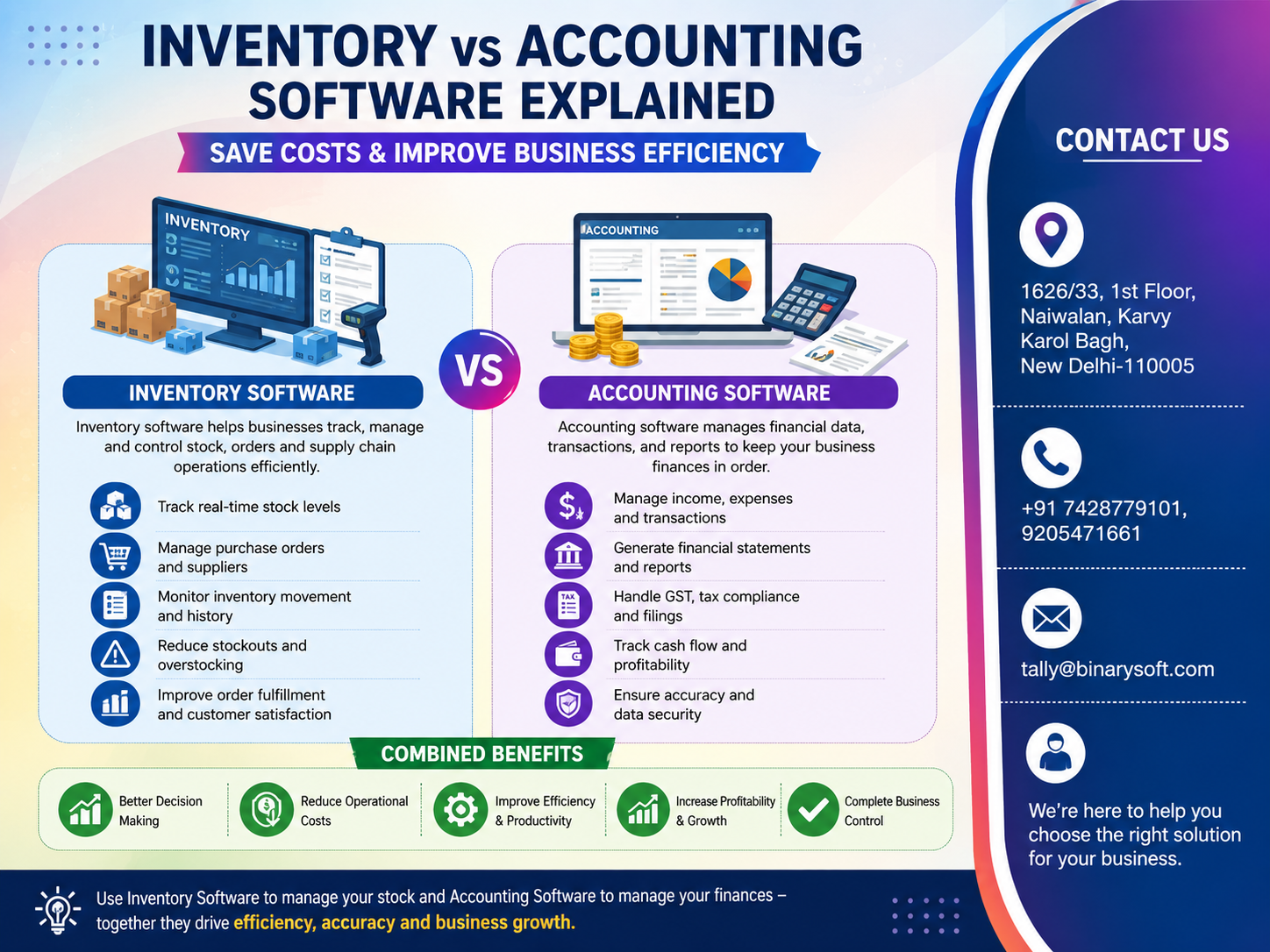
Many business owners assume inventory software and accounting software perform the same functions. While both systems contribute to business management, they serve different purposes.
Understanding their differences helps organizations:
- Reduce operational costs
- Improve efficiency
- Increase profitability
- Strengthen business control
- Make informed technology investments
The right software strategy can significantly impact business performance.
A Story That Many Business Owners Can Relate To
Amit owned a growing electronics distribution business. As sales increased, managing inventory became increasingly difficult. His accounting software accurately recorded sales and expenses, but it could not provide detailed stock movement information.
At the same time, inventory records maintained in spreadsheets frequently differed from actual warehouse stock.
One month, a major customer order could not be fulfilled because inventory records showed products available that were actually out of stock. The company lost a valuable business opportunity.
Frustrated by recurring issues, Amit invested in a solution that integrated inventory management with accounting functions.
The transformation was immediate. Inventory became visible in real time. Financial records remained accurate. Purchasing decisions improved. Customer satisfaction increased.
Most importantly, management finally had a complete view of the business.
Today, Amit's company operates more efficiently because inventory and accounting work together rather than separately.
This challenge is common among businesses trying to scale in today's competitive marketplace.
What Is Inventory Software?
Inventory Software is designed specifically to manage and track stock throughout the supply chain.
Its primary focus is inventory control and product management.
Key functions include:
- Stock tracking
- Inventory valuation
- Warehouse management
- Batch tracking
- Serial number tracking
- Purchase management
- Stock transfers
- Reorder level monitoring
- Product movement analysis
Inventory software helps businesses understand what products they have, where they are located, and when they need replenishment.
What Is Accounting Software?
Accounting Software focuses on managing financial transactions and maintaining accurate financial records.
Its primary objective is financial control and reporting.
Typical functions include:
- Sales recording
- Purchase recording
- Accounts payable
- Accounts receivable
- GST management
- Tax compliance
- Bank reconciliation
- Profit and loss reporting
- Balance sheet preparation
- Cash flow analysis
Accounting software helps businesses monitor financial performance and maintain compliance.
Key Differences Between Inventory Software and Accounting Software
Primary Purpose
Inventory Software
Designed to manage products, stock levels, warehouses, and inventory movement.
Accounting Software
Designed to manage financial transactions, bookkeeping, compliance, and reporting.
Focus Area
Inventory Software Focuses On:
- Stock control
- Warehouse operations
- Product availability
- Inventory optimization
Accounting Software Focuses On:
- Revenue
- Expenses
- Taxation
- Financial reporting
Core Users
Inventory Software Users
- Warehouse managers
- Inventory controllers
- Supply chain teams
- Procurement departments
Accounting Software Users
- Accountants
- Finance managers
- Business owners
- Auditors
Business Objectives
Inventory Software Goals
- Reduce stock shortages
- Minimize excess inventory
- Improve order fulfillment
- Optimize warehouse operations
Accounting Software Goals
- Improve financial accuracy
- Ensure compliance
- Monitor profitability
- Manage cash flow
Why Inventory Management Is Critical in 2026
Inventory is often one of the largest investments a business makes.
Poor inventory management can result in:
- Overstocking
- Stock shortages
- Dead inventory
- Lost sales
- Increased carrying costs
Modern inventory software provides real-time visibility that helps businesses optimize stock levels and improve profitability.
Why Accounting Software Remains Essential
Accurate financial management is the foundation of business success.
Accounting software enables organizations to:
- Track income and expenses
- Generate financial reports
- Monitor profitability
- Maintain tax compliance
- Prepare for audits
Without reliable accounting systems, businesses struggle to make informed financial decisions.
Can Businesses Operate with Only One System?
This depends on the nature and size of the business.
Businesses That May Need Primarily Accounting Software
- Consultants
- Freelancers
- Professional service firms
- Small agencies
These organizations often have limited inventory requirements.
Businesses That Need Strong Inventory Management
- Retail stores
- Manufacturers
- Distributors
- E-commerce companies
- Wholesalers
For these businesses, inventory visibility is critical.
The Benefits of Integrated Inventory and Accounting Software
Many modern business solutions combine inventory and accounting functions into a single platform.
This integration provides significant advantages.
Real-Time Business Visibility
Management can view:
- Inventory levels
- Sales performance
- Profit margins
- Outstanding receivables
- Cash flow
All from one centralized system.
Reduced Data Entry
Integrated systems eliminate duplicate work.
A single transaction updates:
- Inventory records
- Accounting entries
- GST calculations
- Financial reports
This improves efficiency and reduces errors.
Better Decision-Making
Business leaders gain access to accurate, real-time information.
This supports:
- Purchasing decisions
- Pricing strategies
- Expansion planning
- Cash flow management
Improved Customer Service
Accurate stock visibility helps businesses:
- Fulfill orders faster
- Prevent stockouts
- Improve delivery performance
Customer satisfaction improves significantly.
How Integrated Software Helps Save Costs
One of the biggest benefits of combining inventory and accounting functions is cost reduction.
Businesses can save through:
- Reduced manual labor
- Lower error rates
- Better inventory utilization
- Improved purchasing decisions
- Faster reporting processes
These savings contribute directly to profitability.
Industries That Benefit Most from Integration
Manufacturing
Manufacturers need both inventory control and financial visibility to manage production efficiently.
Wholesale Distribution
Distributors benefit from real-time stock management and accurate financial reporting.
Retail
Retail businesses require inventory tracking, billing, GST compliance, and profitability monitoring.
E-Commerce
Online sellers need inventory synchronization, order management, and financial control.
Future Trends in Business Management Software
Business software continues to evolve rapidly.
Emerging innovations include:
- Artificial Intelligence-based forecasting
- Predictive inventory planning
- Automated accounting workflows
- Cloud-based accessibility
- Mobile-first operations
- Real-time business intelligence dashboards
Integrated platforms are becoming the preferred choice for growing businesses.
Choosing the Right Solution for Your Business
Before selecting software, businesses should evaluate:
- Industry requirements
- Inventory complexity
- Compliance obligations
- Number of users
- Growth plans
- Reporting needs
- Budget considerations
The ideal solution should support both current operations and future expansion.
Why Businesses Are Moving Toward Unified Systems
Modern businesses want simplicity.
Managing separate systems often creates:
- Data duplication
- Reporting inconsistencies
- Increased costs
- Operational inefficiencies
Integrated inventory and accounting software eliminates these challenges while improving business control.
Conclusion
Understanding the difference between Inventory Software and Accounting Software is essential for businesses seeking greater efficiency and profitability in 2026. While inventory software focuses on stock management and operational control, accounting software manages financial transactions, compliance, and reporting.
For many growing businesses, the greatest value comes from integrating both functions into a unified platform. This approach improves visibility, reduces costs, enhances decision-making, and supports long-term growth.
Organizations that invest in modern, integrated business software gain the ability to operate more efficiently, serve customers better, and respond quickly to changing market conditions.
Frequently Asked Questions
What is the main difference between Inventory Software and Accounting Software?
Inventory Software manages stock and warehouse operations, while Accounting Software manages financial transactions, reporting, and compliance.
Can inventory software replace accounting software?
No. Inventory software focuses on stock management and typically does not provide comprehensive accounting capabilities.
Can accounting software manage inventory?
Some accounting solutions include inventory features, but advanced inventory management may require dedicated or integrated functionality.
CA. T.R Venkat is a Chartered Accountant with extensive experience in accounting systems, GST compliance, and MSME advisory. He has worked closely with Indian traders and businesses on inventory control and accounting process improvement. His writing draws from real operational challenges faced by growing enterprises.