Call CA Tally HelpDesk
+91 9205471661,
7428779101
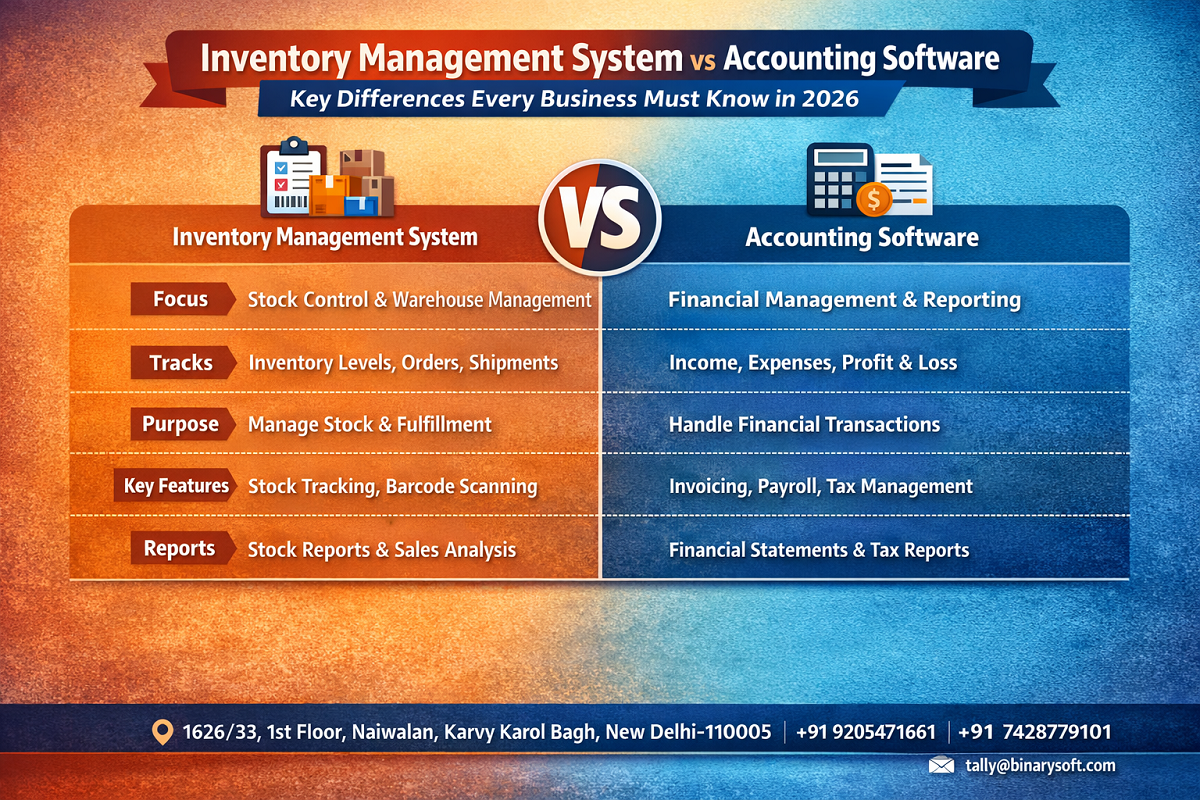
Businesses are under more pressure than ever to stay accurate, fast, and compliant. GST reporting is stricter, inventory cycles are faster, and customer expectations for real-time updates have increased. Many businesses that once managed operations manually or with basic tools are now facing stock mismatches, delayed financial reports, and compliance risks. The biggest confusion? Choosing between an Inventory Management System and Accounting Software—or understanding how they differ. Making the wrong choice can lead to poor decision-making, cash flow issues, and lost revenue. The right choice, however, can streamline operations, improve accuracy, and unlock growth. If you’re still unsure which system your business needs in 2026, this guide will give you absolute clarity—without confusion or fluff.
A Real Business Story: Where It All Went Wrong
Rohit, a wholesale trader in Delhi, was managing his business using only accounting software. His sales and purchase entries were properly recorded, and his GST returns were filed on time. On paper, everything looked perfect.
But reality told a different story.
One day, a major client placed a bulk order. Rohit confidently confirmed availability—but when his team checked the warehouse, half the stock was missing. Some items were already sold but not updated, others were misplaced, and a few were damaged but still counted in records.
That one mistake cost him a long-term client.
The problem wasn’t accounting—it was the lack of a proper inventory management system.
What is an Inventory Management System?
An Inventory Management System is designed to track, manage, and control stock in real time. It ensures that businesses always know what they have, where it is, and when to reorder.
Key Functions:
- Real-time stock tracking
- Batch-wise and location-wise inventory
- Stock valuation and ageing
- Barcode integration
- Reorder level alerts
- Warehouse management
Primary Goal:
To ensure stock accuracy, prevent overstocking or stockouts, and improve operational efficiency.
What is Accounting Software?
Accounting Software focuses on managing financial transactions and ensuring compliance with tax regulations.
Key Functions:
- Recording sales and purchase transactions
- Managing ledgers and trial balance
- GST calculation and return filing
- Profit & Loss and Balance Sheet
- Bank reconciliation
- Financial reporting
Primary Goal:
To maintain accurate financial records and ensure compliance with legal and taxation requirements.
Key Differences Between Inventory Management System and Accounting Software
| Basis | Inventory Management System | Accounting Software |
|---|
| Focus Area |
Stock and inventory control |
Financial transactions |
| Core Function |
Track quantity, movement, location |
Record income, expenses, taxes |
| Real-Time Updates |
Yes (stock movement) |
Limited (based on entries) |
| GST Compliance |
Indirect support |
Direct support |
| Reports |
Stock reports, ageing, valuation |
Financial reports, P&L, Balance Sheet |
| Automation |
Stock alerts, reorder levels |
Tax calculation, reconciliation |
| Use Case |
Warehouses, retail, manufacturing |
All businesses for accounting |
Why Businesses Need Both in 2026
In today’s environment, relying on only one system is risky.
- Inventory without accounting = No financial clarity
- Accounting without inventory = No stock accuracy
Modern businesses require both systems working together to ensure:
- Real-time decision making
- Accurate GST compliance
- Better cash flow management
- Reduced operational errors
- Improved customer satisfaction
Integrated Approach: The Smart Choice
The smartest businesses in 2026 are not choosing between the two—they are integrating both.
Software like TallyPrime combines inventory and accounting into one unified system. This allows:
- Automatic stock updates with every transaction
- Real-time financial impact of inventory movement
- Seamless GST reporting
- Better control over business operations
When Should You Choose Inventory Management System?
You should prioritize inventory management if:
- You deal with physical goods
- You face stock mismatches frequently
- You manage multiple warehouses
- You need barcode or batch tracking
- You experience stockouts or overstocking
When Should You Focus on Accounting Software?
You should prioritize accounting software if:
- You want accurate financial reporting
- GST compliance is your primary concern
- You need audit-ready records
- You want to track profitability and expenses
Final Insight: Don’t Make the 2026 Mistake
The biggest mistake businesses make is treating inventory and accounting as separate decisions. In reality, both are deeply connected.
If your stock is wrong, your financial data will also be wrong.
If your financial data is wrong, your decisions will suffer.
The future belongs to businesses that operate with clarity, speed, and accuracy—and that only comes from the right combination of systems.
Contact Details
Powered by Binarysoft Technologies – Authorized Tally Partner
1626/33, 1st Floor, Naiwalan, Karol Bagh,
New Delhi – 110005, INDIA
Contact Us:
+91 9205471661
+91 7428779101
Email:
tally@binarysoft.com
Working Hours:
10:00 AM – 6:00 PM (Mon–Fri)
Conclusion
Inventory Management Systems and Accounting Software serve different but equally important purposes. One manages your stock, the other manages your finances. In 2026, businesses cannot afford to rely on just one. The right approach is to use an integrated system that ensures both operational and financial accuracy. This not only reduces risk but also improves efficiency, profitability, and long-term growth.
Frequently Asked Questions
Can I use only accounting software without inventory management?
Yes, but it is risky for businesses dealing with physical goods. You may face stock mismatches and operational issues.
Is inventory management included in accounting software?
Some advanced accounting software like TallyPrime includes inventory features, but basic software may not.
Which is more important: inventory or accounting?
Both are equally important. Inventory ensures stock accuracy, while accounting ensures financial accuracy.
What is the best solution for businesses in 2026?
An integrated system that combines inventory and accounting for complete business control and efficiency.
CA. Lakshy Vermaa advises small and mid-sized businesses on accounting discipline, tax compliance, and process improvement. With exposure to retail and trading environments, he writes practical articles aimed at helping business owners gain better financial visibility and control.