Call CA Tally HelpDesk
+91 9205471661,
7428779101
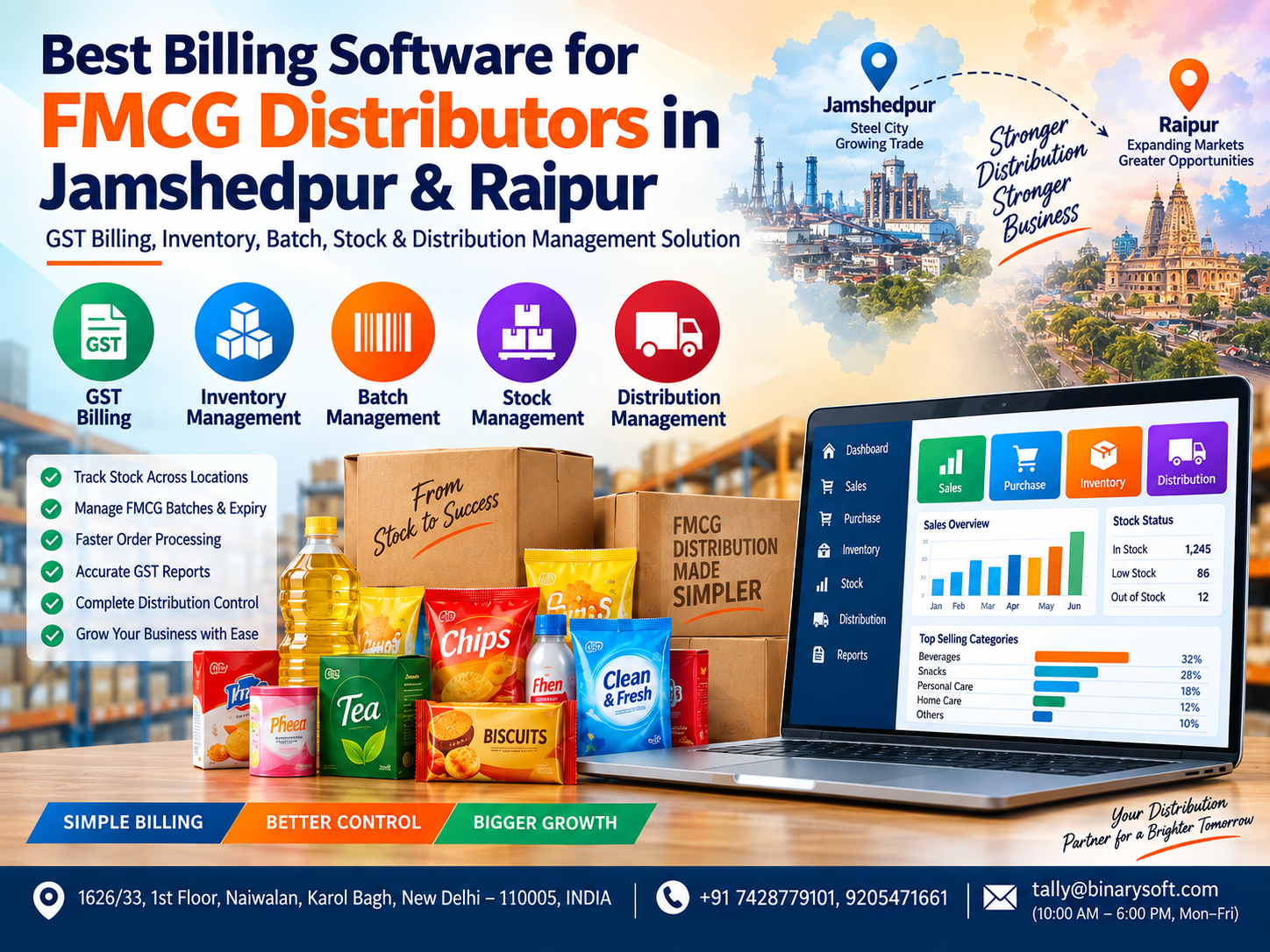
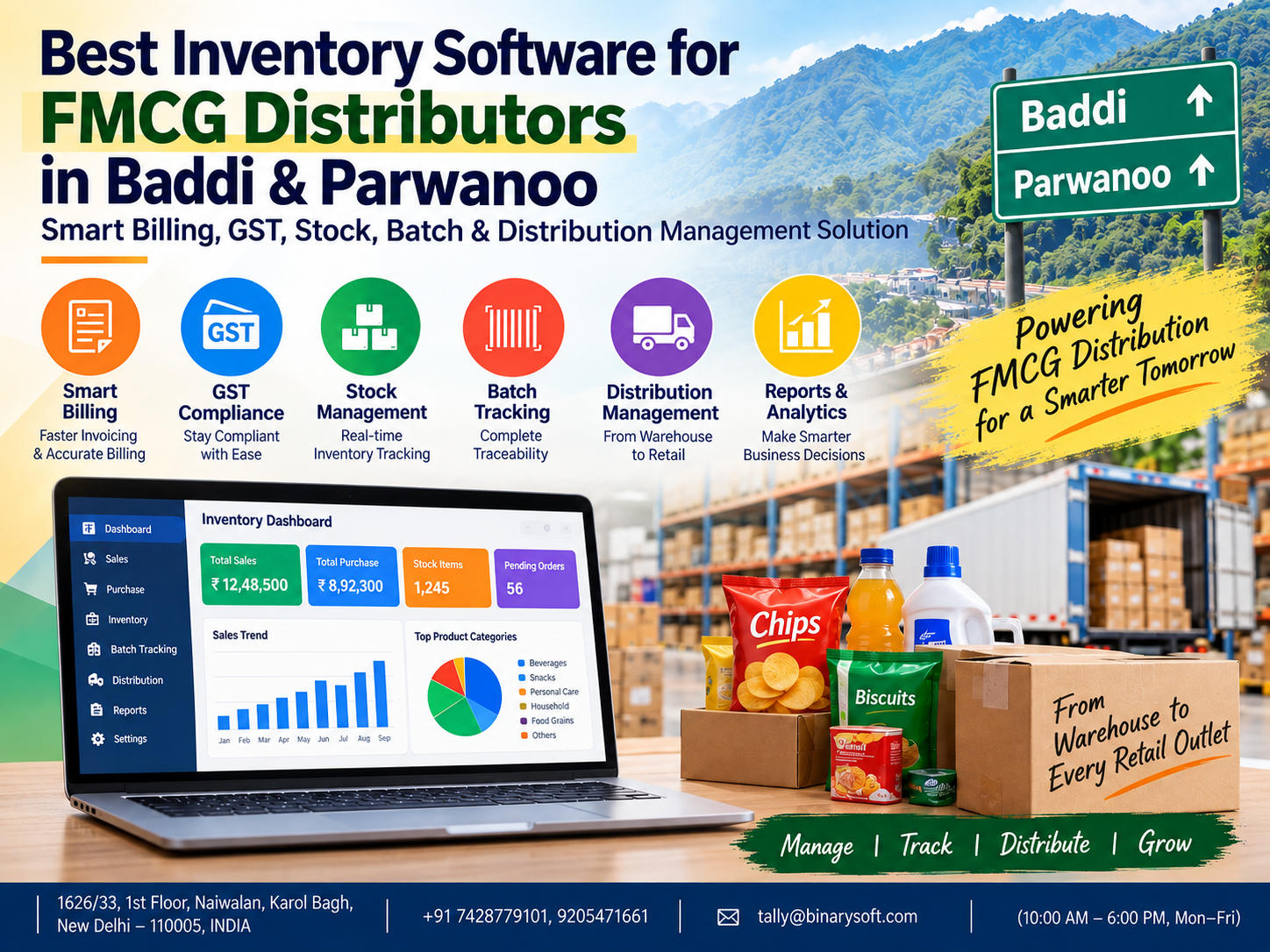
In 2026, FMCG distributors in Jamshedpur and Raipur are handling a more demanding mix of faster order cycles, expanding product catalogs, GST documentation, retailer credit, batch-wise inventory and tighter control over working capital. In recent months, the pressure has become less about simply creating invoices and more about knowing whether the goods being billed are actually available, which batch should move first, how much a retailer owes and which products need replenishment. For distributors serving Jamshedpur Industrial Area, Jamshedpur Industrial Estate, Jamshedpur Main Market Area and Raipur Industrial Area, disconnected billing and stock records can slow dispatches and create costly mismatches. Modern billing software can connect GST invoicing with inventory, purchases, batches, godowns, receivables and business reports. The practical benefit is a faster billing-to-dispatch cycle, clearer stock visibility, better credit control and more reliable information for everyday distribution decisions.
Why FMCG Distribution Needs More Than Basic Billing Software
An FMCG distribution business may generate hundreds of invoices while simultaneously managing thousands of stock items.
The products move quickly, but margins can be tight.
A distributor may deal with packaged foods, beverages, personal-care products, household products, detergents, toiletries, confectionery, grocery items and other fast-moving categories.
Each product may have multiple:
-
Sizes
-
Variants
-
Pack quantities
-
Purchase rates
-
Selling rates
-
GST classifications
-
Batches
-
Expiry dates
-
Schemes
This creates a much more complicated workflow than simply entering a customer's name and printing an invoice.
A good FMCG billing system should connect billing with the actual movement of goods.
The ideal workflow is:
Purchase → Stock Receipt → Batch Entry → Godown → Customer Order → GST Invoice → Dispatch → Stock Update → Outstanding → Payment → Reports
When these activities remain disconnected, business owners may spend more time reconciling information than using it.
FMCG Billing Challenges in Jamshedpur and Raipur
Distributors operating in major commercial and industrial markets frequently serve many types of customers.
These can include:
-
Retail shops
-
Grocery stores
-
Supermarkets
-
Wholesalers
-
Institutional buyers
-
Hotels and restaurants
-
Corporate customers
-
Other distributors
A growing customer base is good for business, but it also creates operational pressure.
Orders need to be processed quickly.
Stock needs to be available.
Invoices need to be accurate.
Dispatch teams need clear information.
Customer outstanding needs to be monitored.
Purchase requirements need to be identified before important products run out.
This is why billing software should become part of a wider business-management process.
A Distributor's Story: The Invoice Was Ready, but the Goods Were Not
Consider an FMCG distributor whose business had grown steadily over several years.
He began with a small warehouse and a limited number of brands.
He personally knew every retailer.
He could almost remember the stock position without checking a report.
Then the business expanded.
Hundreds of SKUs became thousands.
One warehouse employee became a team.
A few regular retailers became a much larger customer network.
Yet the billing process had not evolved at the same pace.
One morning, an important retailer placed a large order.
The billing employee prepared the invoice immediately.
According to the stock sheet, every item was available.
The invoice was printed.
The vehicle was ready.
Then the warehouse team called.
"Sir, we are short on three items."
The distributor checked the records.
The computer showed stock.
The warehouse showed something different.
One product had been dispatched the previous evening but its stock entry had not been updated properly. Another was available under a different batch. A third product had enough total quantity, but some units required attention because they were from an older batch.
The retailer called again.
"How long will dispatch take?"
The distributor did not have a clear answer.
The frustration was not only about one delayed order.
He had spent years earning that customer's trust.
That evening, he stayed late with his staff, checking invoices against physical inventory.
He realized that the business had reached a point where billing could no longer operate separately from inventory.
The next phase was not about buying "another billing program."
It was about creating a connected system.
Once purchases, sales, batches, godowns and billing were recorded through a more disciplined process, the distributor gained something more valuable than a faster invoice.
He gained confidence in the information on his screen.
What Is FMCG Billing Software?
FMCG billing software is a system designed to help distributors generate sales invoices while connecting those transactions with stock, taxes, customers and accounting.
Depending on the selected software and implementation, it may help manage:
The important difference is integration.
When an invoice is recorded correctly, the transaction should contribute to the business's inventory and accounting information rather than remaining an isolated bill.
Smart GST Billing for FMCG Distributors
GST billing is an essential part of distribution operations.
An FMCG distributor may handle a large number of products with different HSN classifications and applicable GST rates.
Maintaining these details manually for every invoice increases the possibility of mistakes.
A properly configured product master can maintain information such as:
Product Name
Item Code
HSN Code
GST Rate
Unit of Measurement
Purchase Rate
Selling Rate
MRP
Product Category
When a transaction is created, the configured information can be used during billing.
Businesses should ensure that GST classifications and tax treatment reflect current requirements and obtain professional tax advice where needed.
Why Billing Speed Matters in FMCG Distribution
A distributor may receive many orders during the same period.
One order might contain five products.
Another could contain fifty.
When billing is slow, the problem spreads to other departments.
The warehouse waits for the invoice.
The dispatch vehicle waits.
The customer waits.
The sales employee follows up.
The accounts team may later need to correct errors.
Faster and more structured billing can therefore improve the entire order-to-dispatch process.
Billing and Inventory Should Work Together
A common mistake is treating billing and inventory as separate systems.
Suppose the business sells 100 units.
The invoice is created, but inventory is not updated.
The billing system says the sale happened.
The inventory sheet still says those 100 units are available.
A few days later, another customer orders the same product.
Management believes stock exists.
The warehouse cannot find it.
This is how disconnected records create operational problems.
A connected process allows sales transactions to update inventory based on recorded movements.
Real-Time Stock Visibility
For an FMCG distributor, stock information should be easy to access.
Management may need answers to questions such as:
How many units are available?
Which godown contains them?
Which batch is available?
Which products are running low?
Which products are overstocked?
Which products have not moved recently?
Which items need replenishment?
Which products require attention because of their expiry timeline?
When these answers depend on physical checking every time, decision-making becomes slow.
Structured inventory software provides management with a clearer operational view.
Batch-Wise Stock Management
Batch tracking can be particularly important for FMCG businesses.
Suppose a distributor has 800 units of a product.
The total quantity alone may not tell the full story.
It could actually be:
Batch A: 150 units
Batch B: 250 units
Batch C: 400 units
The batches may have different manufacturing or expiry information.
This is why batch-wise visibility can be valuable.
It helps management understand not only how much stock exists, but also which stock exists.
Expiry Management for FMCG Products
Expiry-sensitive inventory requires disciplined monitoring.
Products that approach expiry can become increasingly difficult to sell through normal distribution channels.
Discovering them too late may result in financial loss.
A structured batch and expiry process can help management identify inventory that requires attention.
The distributor may then review:
The objective is early visibility.
FIFO and Stock Rotation
FIFO stands for First In, First Out.
For many inventory workflows, older eligible stock should generally move before newer stock.
This becomes especially important where products have limited shelf lives.
However, software alone cannot ensure proper physical rotation.
Warehouse employees also need to follow the intended process.
If the software indicates one batch but another batch is physically dispatched, the records can become inaccurate.
The strongest system therefore combines:
Good Software + Accurate Data + Warehouse Discipline
Billing Software for Jamshedpur Industrial Area
Distributors serving businesses around Jamshedpur Industrial Area may handle a significant mix of retail and commercial demand.
As the number of products and customers grows, manual billing processes can become difficult to scale.
A structured billing and inventory solution can help organize:
-
Customer invoices
-
Product records
-
GST
-
Stock
-
Purchases
-
Outstanding balances
-
Returns
-
Business reports
This creates a stronger foundation for growth.
Billing Software for Jamshedpur Industrial Estate
An FMCG distributor operating around Jamshedpur Industrial Estate may serve customers across multiple surrounding markets.
The business may therefore require better visibility into inventory availability and customer credit.
Instead of depending on multiple spreadsheets, management can maintain structured records through an integrated system.
This can reduce the time spent reconciling billing, inventory and accounts.
FMCG Billing Software for Jamshedpur Main Market Area
Main-market distribution is often highly competitive.
Retailers want fast service.
If one distributor cannot provide a fast-moving product, another may be able to.
Accurate stock information therefore supports customer service.
When sales employees know what is actually available, they can confirm orders with greater confidence.
Billing Software for Raipur Industrial Area
FMCG distributors operating around Raipur Industrial Area may handle high-volume transactions across a wide customer network.
As the business expands, owners need visibility beyond daily sales.
They need to know:
-
Current inventory
-
Daily billing
-
Customer outstanding
-
Supplier payable
-
Stock movement
-
Product performance
-
Purchase requirements
A connected billing and accounting system can provide a clearer picture of these areas.
Multiple Godown Management
Many distributors maintain more than one storage location.
For example:
Main Warehouse
Secondary Godown
Dispatch Location
Simply knowing that 2,000 units exist is not enough.
Management needs to know where those units are physically available.
A location-wise inventory system can help maintain this information.
This becomes particularly useful when fulfilling urgent customer orders.
Stock Transfers Between Locations
Suppose one godown has excess inventory while another is running low.
Purchasing additional goods may not always be necessary.
An internal stock transfer may solve the problem.
The transfer should be properly recorded so the system reflects:
Stock Out from Location A
and
Stock In at Location B
Otherwise, total stock may appear correct while godown-wise stock becomes unreliable.
Fast-Moving Product Analysis
Some FMCG products may sell every day.
These require close replenishment monitoring.
If a high-demand product repeatedly goes out of stock, the distributor may lose sales and customer confidence.
Reports can help management identify these fast-moving items.
The business can then review reorder levels and purchasing frequency.
Slow-Moving and Non-Moving Stock
High stock quantity is not always a sign of business strength.
Sometimes it represents blocked working capital.
Suppose a distributor has ₹8 lakh invested in products that barely move.
That money could potentially have been used to purchase higher-demand inventory.
Slow-moving reports help identify such situations.
Management can then review future purchases and applicable commercial strategies.
Reorder Management
Waiting until inventory reaches zero is risky.
A better approach is to establish reorder levels.
Suppose:
Average daily sales = 40 units
Supplier lead time = 5 days
Desired safety stock = 100 units
The distributor can establish a threshold that provides enough time to review and replenish stock.
Actual reorder policies should consider sales patterns, supplier reliability, seasonality and available working capital.
Purchase Management
Purchasing is one of the most important functions in FMCG distribution.
A distributor should be able to understand:
Structured purchase records make this analysis easier.
Supplier-Wise Analysis
Different suppliers may provide different products, rates and commercial arrangements.
Maintaining supplier-wise purchase information helps management evaluate procurement activity.
Historical purchase data can also help identify rate changes.
When margins are tight, even small purchase-rate increases matter.
Customer-Wise Billing
FMCG distributors often have customers with different buying patterns.
One retailer may order daily.
Another may order weekly.
One may purchase beverages.
Another may focus on household products.
Customer-wise billing history helps sales teams understand these patterns.
It also supports customer relationship management by giving employees better information during follow-ups.
Customer Credit and Outstanding Management
Credit sales are common in distribution.
However, sales revenue and cash collection are not the same thing.
For example:
Total monthly billing: ₹60 lakh
Collections: ₹45 lakh
Outstanding: ₹15 lakh
The business still needs money to purchase the next inventory cycle.
If receivables continue increasing, cash flow can become difficult even when sales look strong.
Billing software integrated with accounting can help monitor outstanding balances.
Invoice-Wise Outstanding Tracking
A customer may have several unpaid invoices.
Simply knowing the total outstanding amount may not be sufficient.
Invoice-wise tracking can help management understand which bills remain unpaid and how long they have been outstanding.
This information can support more organized payment follow-up.
Credit Control
Every business should establish credit policies according to its commercial requirements.
Before accepting additional credit orders, management may review:
Software provides information.
Management uses that information to make the final business decision.
Sales Returns
FMCG distribution often involves sales returns according to commercial terms.
Goods may be returned because of reasons such as:
These returns must be recorded correctly.
Otherwise, stock and customer balances may become inaccurate.
Purchase Returns
The same principle applies to goods returned to suppliers.
A purchase return can affect:
-
Inventory
-
Supplier balance
-
Accounting
-
Tax information
-
Batch quantities
Correct recording keeps inventory and accounts aligned.
Discount and Scheme Management
FMCG distribution may involve promotional schemes and quantity-based discounts.
Examples could include commercially agreed offers based on purchase volume or promotional campaigns.
When employees calculate complex schemes manually, inconsistencies can occur.
Where supported by the chosen software, structured discount and pricing configuration can make billing more consistent.
Rate Management and Profit Margins
Distributors often operate on relatively small margins across high volumes.
Consider:
Purchase rate: ₹200
Selling rate: ₹210
Gross difference: ₹10
If the purchase price increases to ₹206 while the selling price remains unchanged, the difference drops sharply.
If thousands of units are involved, the impact becomes significant.
This is why distributors need visibility into purchase costs and selling rates.
Working Capital and Inventory
Inventory represents money.
A warehouse containing ₹50 lakh of products means ₹50 lakh is invested in stock based on the applicable valuation method.
The distributor therefore needs to balance two risks:
Understocking
Too little stock can lead to missed sales.
Overstocking
Too much stock can block working capital and increase expiry or obsolescence risk.
Good inventory information helps management find a more appropriate balance.
Barcode Support for FMCG Distribution
Barcode-based product identification can reduce manual searching and typing.
Depending on the selected solution and warehouse workflow, barcode scanning may be useful during billing or inventory operations.
For businesses handling similar product variants, accurate identification can reduce selection errors.
Multi-User Billing
As a distribution business grows, several employees may need to use the system.
For example:
Billing staff may create invoices.
Warehouse employees may work with stock processes.
Accounts staff may handle receipts and payments.
Management may review reports.
A suitable multi-user setup can allow responsibilities to be distributed while maintaining structured access.
User-Level Controls
Not every employee needs access to every function.
A billing operator may not need permission to change sensitive accounting information.
Management can therefore benefit from appropriate user-level controls where supported.
This helps maintain better operational discipline.
TallyPrime for FMCG Billing and Inventory
For distributors considering an integrated accounting and inventory system, TallyPrime can support many common business requirements.
Depending on configuration and business needs, TallyPrime can support areas such as:
The correct configuration should be based on the distributor's actual workflow rather than using the same setup for every business.
Why Proper TallyPrime Configuration Matters
Installing software is only the beginning.
A successful implementation requires accurate setup.
This can include:
-
Company configuration
-
GST details
-
Ledger masters
-
Customer masters
-
Supplier masters
-
Stock groups
-
Stock items
-
Units
-
HSN and tax details
-
Godowns
-
Batch-related settings
-
Opening stock
-
Opening balances
-
User access
Incorrect masters can create problems later.
A structured implementation can reduce unnecessary duplication and make reporting easier.
Reports FMCG Distributors Should Review
Software becomes most useful when reports are regularly reviewed.
Important reports may include:
Stock Summary
Provides visibility into current inventory based on recorded transactions.
Sales Register
Shows sales transactions for the selected period.
Purchase Register
Shows purchase activity.
Customer Outstanding
Helps track receivables.
Supplier Outstanding
Provides visibility into payables.
Godown-Wise Stock
Shows where inventory is located.
Batch-Wise Stock
Helps review stock according to batches where configured.
Item-Wise Sales
Helps identify product performance.
Slow-Moving Inventory
Helps management identify products with low movement.
Profitability Information
Can support margin and business-performance analysis.
Daily Dashboard for a Distribution Business
A distributor does not necessarily need to study every report every morning.
A focused daily review could include:
Today's Sales
Current Cash/Bank Position
Important Outstanding Receivables
Low-Stock Products
Major Orders Pending Dispatch
Products Requiring Purchase
Inventory Requiring Attention
The objective is to turn business data into action.
Billing Software and Business Growth
When a business is small, the owner can personally supervise almost everything.
As the company grows, that becomes impossible.
The owner needs systems.
Good billing software helps create a digital trail of business activity.
Management can review what happened even when the owner was not physically present during every transaction.
That is an important step in moving from an owner-dependent business to a process-driven business.
How to Select Billing Software for an FMCG Distributor
Before selecting software, evaluate actual business requirements.
Consider:
Billing Volume: How many invoices are generated daily?
Number of Products: How many active SKUs are maintained?
GST Requirements: What tax and reporting requirements apply?
Batch Requirements: Does the business need batch-wise stock?
Expiry Requirements: Are products expiry-sensitive?
Godowns: How many inventory locations exist?
Users: How many employees require simultaneous access?
Accounting: Should billing connect with the books of accounts?
Outstanding Management: Does the business sell on credit?
Reporting: What information does management need daily, weekly and monthly?
Support: Who will help configure and maintain the system?
Choosing based only on price can result in a system that does not match actual business needs.
Implementation Checklist for FMCG Distributors
Before going live, businesses should verify product masters, customer and supplier information, tax configuration, godowns, opening balances and physical inventory.
Employees should understand how to record:
Management should also define responsibilities clearly.
A good implementation is not just a software installation.
It is a business-process improvement project.
Data Accuracy Is the Foundation
Even excellent software produces poor reports when incorrect data is entered.
If a purchase is not recorded, stock becomes wrong.
If a sales return is ignored, inventory becomes wrong.
If the same product is created twice, reports become confusing.
If employees enter transactions days late, real-time information loses its value.
This is why data discipline matters.
Physical Stock Verification Still Matters
Digital inventory management does not eliminate physical verification.
Periodic stock checks remain useful for identifying:
-
Missing entries
-
Damaged products
-
Incorrect quantities
-
Misplaced goods
-
Process errors
-
Other discrepancies
When a difference is found, businesses should investigate its cause.
Repeatedly adjusting stock without identifying the reason only hides the underlying process problem.
From Billing Software to Business Intelligence
The real value of a connected system becomes visible over time.
Every invoice contributes information.
After several months, management can identify trends.
Which products generate the most sales?
Which customers purchase regularly?
Which products frequently go out of stock?
Which inventory remains unsold?
Which customers have growing outstanding balances?
Which suppliers account for significant purchases?
Which categories contribute strongly to business volume?
These questions turn transaction data into business intelligence.
Why 2026 Is the Right Time to Improve FMCG Billing Operations
In 2026, distributors are operating in an environment where speed and visibility increasingly matter.
Retail customers expect quicker order confirmation.
Management needs tighter working-capital control.
GST and accounting records need to remain organized.
Warehouse teams need accurate stock information.
Owners need reports that help them make decisions rather than simply record past transactions.
For FMCG distributors in Jamshedpur and Raipur, the goal should therefore not be "computerized billing" alone.
The goal should be a connected distribution-management workflow.
Smart Billing, Inventory and Distribution in One Workflow
A well-structured FMCG operation can connect the complete transaction cycle:
Supplier → Purchase → Goods Receipt → Batch/Godown Stock → Customer Order → GST Billing → Picking → Dispatch → Stock Update → Customer Outstanding → Payment → Accounting → Reports
Each stage produces information for the next.
This reduces dependence on separate notebooks and disconnected spreadsheets.
More importantly, it gives management a clearer picture of what is actually happening in the business.
Conclusion
For FMCG distributors operating across Jamshedpur Industrial Area, Jamshedpur Industrial Estate, Jamshedpur Main Market Area and Raipur Industrial Area, billing is no longer an isolated back-office activity.
It is connected to inventory, warehouse operations, GST, dispatch, customer credit, purchasing and working capital.
As the number of customers, invoices and SKUs increases, manual and disconnected processes become harder to control.
A properly implemented billing and inventory system can help businesses manage GST billing, stock, batches, godowns, purchases, sales, returns, receivables, payables and business reports through a more structured workflow.
The biggest benefit is visibility.
When management knows what has been sold, what remains in stock, where the inventory is located, which products need replenishment and which customer payments are pending, everyday decisions become more informed.
For businesses considering TallyPrime, the value comes not simply from installing the software but from configuring it according to actual business requirements and maintaining disciplined transaction entry.
Better billing is the starting point.
Better control over the entire distribution cycle is the larger goal.
Powered by Binarysoft Technologies
Authorized Tally Partner
Location: 1626/33, 1st Floor, Naiwalan, Karol Bagh, New Delhi – 110005, INDIA
Contact us: +91 7428779101, 9205471661
Email us: tally@binarysoft.com
Business Hours: 10:00 AM – 6:00 PM, Mon–Fri
Frequently Asked Questions
What is the best billing software for FMCG distributors in Jamshedpur and Raipur?
The appropriate solution depends on billing volume, number of SKUs, GST requirements, batch tracking, godowns, users and accounting needs. FMCG distributors requiring integrated accounting and inventory management can evaluate TallyPrime based on their business requirements.
Can FMCG billing software manage GST invoices?
Yes. Properly configured billing and accounting software can maintain GST-related product and transaction information and calculate applicable taxes according to the configured treatment.
CA. Aarav Bhandari specializes in GST compliance, accounting systems, and business advisory services. He regularly writes about tax updates, accounting automation, and financial best practices to help businesses improve efficiency and maintain statutory compliance.